How Event-Driven Microservices Power Modern Entertainment Platforms
Modern entertainment platforms — OTT streaming apps, live sports platforms, music services, and interactive media ecosystems — operate at a…
How Event-Driven Microservices Power Modern Entertainment Platforms
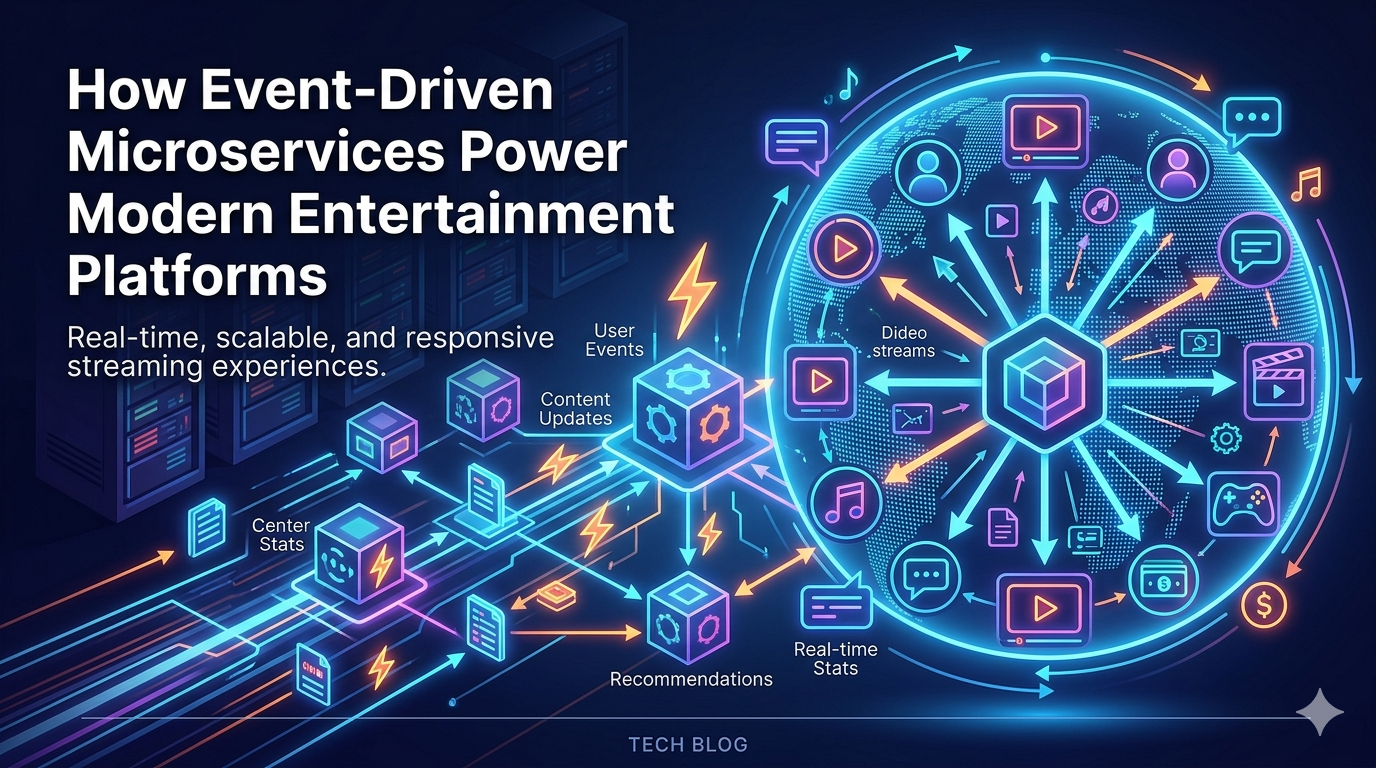
Modern entertainment platforms — OTT streaming apps, live sports platforms, music services, and interactive media ecosystems — operate at a scale where millions of user actions happen every second. Every play, pause, search, like, skip, or share generates a signal that needs to be processed, stored, and acted upon in real time.
Traditional request-response architectures struggle under this load because they tightly couple services and force synchronous communication. To solve this, modern systems are shifting toward event-driven media platform architecture, where every action becomes an event that flows through a distributed system of microservices.
This architecture enables scalability, resilience, and real-time responsiveness — critical requirements for today’s entertainment platforms.
The Shift to Real-Time Entertainment Platforms
Entertainment platforms have evolved from static content delivery systems into dynamic, real-time ecosystems. Users now expect instant recommendations, seamless streaming, live interactions, and personalized experiences.
In a traditional monolithic system, a single user action triggers multiple synchronous API calls:
- Fetch user profile
- Fetch content metadata
- Fetch recommendations
- Log analytics
As traffic increases, this approach becomes slow and brittle.
The industry has therefore moved toward event-driven media platform architecture, where user actions generate events that are asynchronously processed by multiple services.
This shift enables:
- Faster system response times
- Better scalability under peak loads
- Decoupled service architecture
- Real-time analytics and personalization
Understanding Event-Driven Architecture in Media Systems
Event-driven architecture (EDA) is a design paradigm where system components communicate through events rather than direct requests.
In media platforms:
- A producer generates events (e.g., user clicks play)
- An event broker transports events (e.g., Kafka)
- A consumer processes events (e.g., recommendation engine)
Instead of waiting for a response, services react to events independently.
Core benefits:
- Loose coupling between services
- Independent scalability
- Real-time processing capability
- Improved fault tolerance
This architecture is especially powerful in media systems where thousands of micro-interactions occur per second.
Core Components of Event-Driven Media Platforms
A scalable event-driven media platform architecture consists of several key components:
1. Event Producers
These generate events such as:
- Video play/pause actions
- User login/logout
- Search queries
- Content uploads
2. Event Broker
The central backbone of the system:
- Apache Kafka
- Apache Pulsar
- RabbitMQ
It ensures reliable event delivery at scale.
3. Event Consumers
These services process events independently:
- Recommendation engines
- Analytics systems
- Notification services
- Fraud detection modules
4. Event Schema Registry
Defines structure and consistency of event payloads.
5. Stream Processing Layer
Transforms raw events into actionable insights in real time.
Together, these components form the backbone of modern entertainment ecosystems.
Kafka Media Systems and Event Streaming Infrastructure
Among all event streaming technologies, Kafka media systems dominate large-scale entertainment platforms due to their high throughput and fault tolerance.
Kafka is built around:
- Topics (event categories)
- Partitions (parallel processing units)
- Consumer groups (scalable processing units)
Why Kafka works well for media systems:
- Handles millions of events per second
- Ensures ordered event processing
- Provides fault tolerance through replication
- Enables replay of historical events
In OTT platforms, Kafka is commonly used for:
- Playback event tracking
- User behavior analytics
- Content recommendation pipelines
- Real-time monitoring dashboards
Kafka acts as the nervous system of event-driven media platform architecture, connecting all microservices in real time.
Asynchronous Processing in Entertainment Platforms
A key advantage of modern architectures is asynchronous processing, where tasks are executed independently of user requests.
In synchronous systems, users wait for all backend operations to complete. In asynchronous systems, events are queued and processed in the background.
Use cases:
- Generating recommendations after viewing history updates
- Processing video uploads and transcoding
- Sending notifications and alerts
- Updating analytics dashboards
Benefits:
- Reduced API latency
- Improved user experience
- Better system throughput
- Resilient background processing
Asynchronous processing ensures entertainment platforms remain responsive even under heavy load.
Streaming Microservices Architecture Design
Streaming microservices break down entertainment platforms into small, independent services that communicate via events.
Typical microservices in media platforms:
- User service
- Content catalog service
- Recommendation service
- Playback tracking service
- Notification service
Key characteristics:
- Independently deployable services
- Event-based communication instead of direct API calls
- Decentralized data ownership
Advantages:
- Easier scaling of individual services
- Fault isolation (one service failure doesn’t break system)
- Faster development cycles
- Flexible technology stack choices
Streaming microservices are essential for building scalable OTT and live media systems.
Real-Time Data Pipelines in Entertainment Platforms
Real-time pipelines are the operational layer of event-driven media platform architecture.
Pipeline flow:
- Event ingestion (user actions)
- Stream processing (Kafka/Flink)
- Data transformation
- Feature generation
- Output to analytics or AI systems
Key applications:
- Real-time recommendation updates
- Live viewer analytics
- Engagement tracking dashboards
- Content popularity detection
These pipelines allow platforms to react instantly to user behavior and content trends.
Scalability and Fault Tolerance in Event-Driven Systems
Scalability is one of the strongest advantages of event-driven systems.
Scaling strategies:
- Horizontal scaling of microservices
- Kafka partition scaling
- Load-balanced consumer groups
Fault tolerance mechanisms:
- Event replication across brokers
- Retry queues for failed events
- Event replay capabilities
- Backpressure handling during spikes
During live sports or major content releases, traffic can spike dramatically. Event-driven systems absorb this load efficiently without system collapse.
Monitoring, Observability, and Event Debugging
In distributed systems, observability is essential for maintaining reliability.
Key tools and techniques:
- Distributed tracing (to track event flow)
- Kafka lag monitoring
- Service-level metrics dashboards
- Centralized logging systems
Key metrics:
- Event throughput
- Processing latency
- Consumer lag
- System error rates
Proper observability ensures that issues in streaming microservices are detected and resolved quickly.
Business Impact of Event-Driven Media Architecture
Implementing event-driven media platform architecture delivers strong business benefits:
- Real-time personalization improves engagement
- Faster recommendation systems increase watch time
- Scalable infrastructure supports global user growth
- Reduced system downtime improves reliability
- Better analytics enable smarter content decisions
Ultimately, event-driven systems directly improve user retention and revenue growth.
How JPLoft Builds Event-Driven Media Platforms
JPLoft is a technology partner specializing in scalable digital media and entertainment systems. They design and implement high-performance event-driven media platform architecture for OTT and streaming platforms.
They focus on:
- Building robust Kafka media systems for high-throughput event processing
- Designing scalable streaming microservices architectures
- Implementing asynchronous processing pipelines for real-time workloads
- Creating event-driven analytics and recommendation systems
- Ensuring cloud-native scalability and resilience
Their engineering approach emphasizes decoupled architecture design, real-time processing efficiency, and enterprise-grade scalability for modern entertainment platforms.
Why Partner with a Media Technology Expert
Building distributed event-driven systems requires deep expertise in:
- Microservices architecture
- Streaming systems like Kafka
- Real-time data processing pipelines
- Cloud infrastructure and scalability patterns
Working with experts providing **media and entertainment app development services** helps organizations:
- Reduce architectural complexity
- Accelerate system development
- Improve reliability and performance
- Scale globally with confidence
Expert partners transform complex event-driven systems into production-ready, scalable platforms.
Future of Event-Driven Media Platforms
The future of entertainment platforms is becoming increasingly real-time and intelligent.
Key trends include:
- AI-driven event routing and processing
- Edge-based stream processing
- Self-healing microservice ecosystems
- Predictive user behavior systems
- Unified event + data + AI platforms
As media consumption grows, event-driven systems will become the default architecture for all large-scale entertainment platforms.
Conclusion
Event-driven media platform architecture is the backbone of modern entertainment ecosystems. By combining Kafka-powered streaming, asynchronous processing, and modular microservices, platforms achieve the scalability and responsiveness required for real-time user experiences.
As media platforms continue to evolve, event-driven systems will remain essential for powering personalization, analytics, and next-generation streaming experiences.
메타데이터
- post_id
- a63752245fba
- slug
- how-event-driven-microservices-power-modern-entertainment-platforms-a63752245fba
- url
- https://medium.com/@strackajmesh786/how-event-driven-microservices-power-modern-entertainment-platforms-a63752245fba
- canonical_url
- https://medium.com/@strackajmesh786/how-event-driven-microservices-power-modern-entertainment-platforms-a63752245fba
- author_url
- https://medium.com/@strackajmesh786
- status
- ok
- fetched_at
- 2026-06-10 18:44:10