Commercial Real Estate Terms You Must Know
Commercial real estate comes with its own language, and understanding it is essential before — and during — your property search. Some…
Commercial Real Estate Terms You Must Know
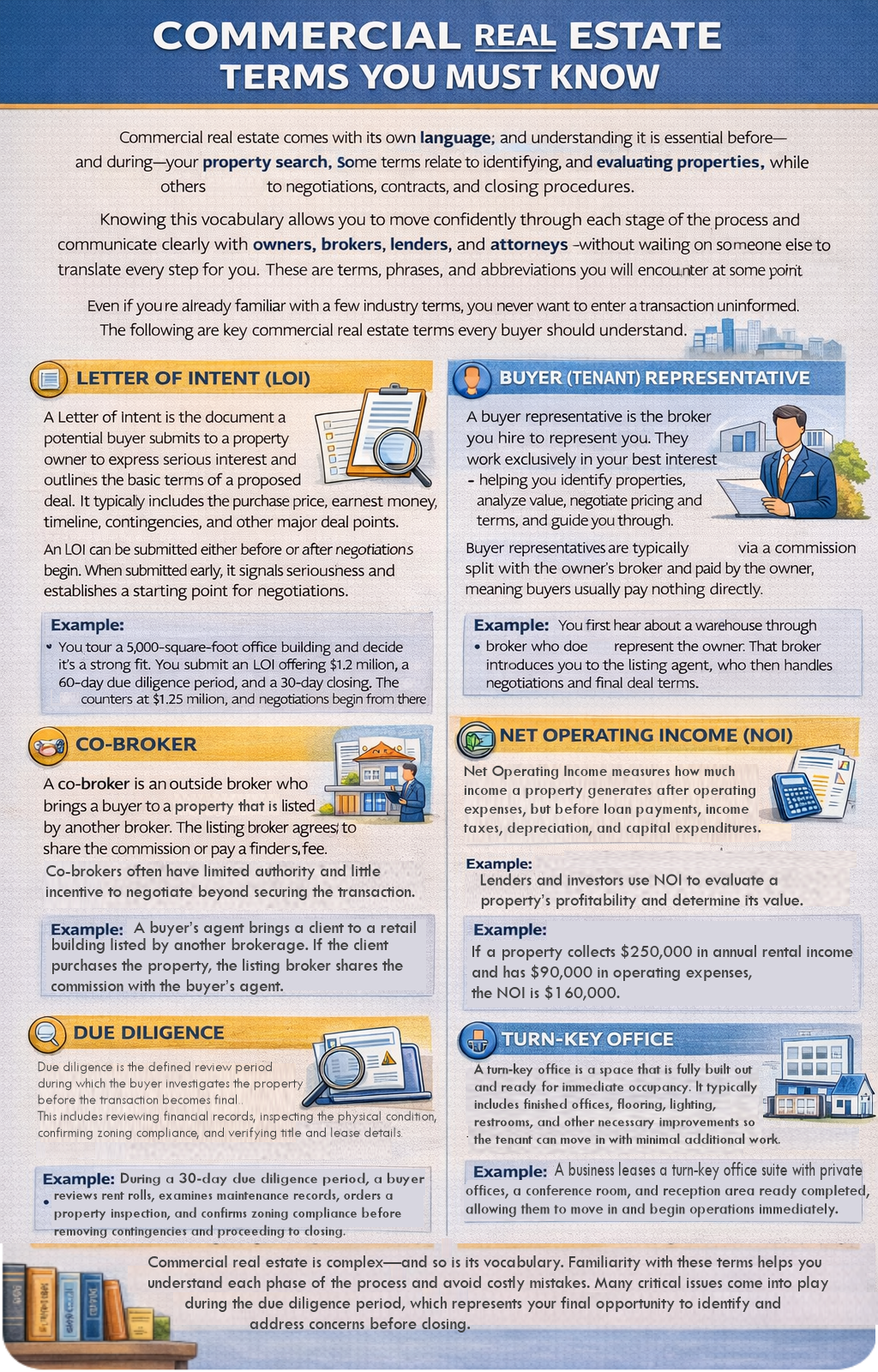
Commercial real estate comes with its own language, and understanding it is essential before — and during — your property search. Some terms relate to identifying and evaluating properties, while others are tied to negotiations, contracts, and closing procedures.
Knowing this vocabulary allows you to move confidently through each stage of the process and communicate clearly with owners, brokers, lenders, and attorneys — without waiting on someone else to translate every step for you. These are terms, phrases, and abbreviations you will encounter at some point during or after your search.
Even if you’re already familiar with a few industry terms, you never want to enter a transaction uninformed. The following are key commercial real estate terms every buyer should understand.
LETTER OF INTENT (LOI)
A Letter of Intent is the document a potential buyer submits to a property owner to express serious interest and outline the basic terms of a proposed deal. It typically includes the purchase price, earnest money, timeline, contingencies, and other major deal points.
An LOI can be submitted either before or after negotiations begin. When submitted early, it signals seriousness and establishes a starting point for negotiations.
Example: You tour a 5,000-square-foot office building and decide it’s a strong fit. You submit an LOI offering $1.2 million, a 60-day due diligence period, and a 30-day closing. The owner counters at $1.25 million, and negotiations begin from there.
Common mistakes buyers make:
- Treating the LOI as “just a formality” and not reviewing it carefully
- Leaving out key terms like due diligence length or contingencies
- Assuming the LOI is non-binding in all cases (some clauses can be binding)
- Submitting an LOI without understanding local market pricing
BUYER (TENANT) REPRESENTATIVE
A buyer representative is the broker you hire to represent you. They work exclusively in your best interest — helping you identify properties, analyze value, negotiate pricing and terms, and guide you through inspections and closing.
Buyer representatives are typically paid via a commission split with the owner’s broker and paid by the owner, meaning buyers usually pay nothing directly.
Example: Your buyer representative finds three comparable buildings you didn’t know were available, points out that one is overpriced, and negotiates a price reduction and repair credit before closing.
Common mistakes buyers make:
- Going directly to the owner’s broker without representation
- Assuming buyer representation costs extra (it usually does not)
- Choosing a broker without local market or property-type experience
- Letting the broker lead without asking questions or understanding strategy
OWNER REPRESENTATIVE
An owner representative (listing broker) works for the property owner. Their goal is to maximize the owner’s return by securing the highest price and strongest terms possible.
They are authorized to negotiate pricing, deposits, timelines, and other deal terms on the owner’s behalf.
Example: The owner’s broker pushes for a shorter due diligence period and a higher earnest money deposit to reduce the seller’s risk and strengthen your commitment to the deal.
Common mistakes buyers make:
- Forgetting that this broker does not represent the buyer
- Sharing too much information about budget or urgency
- Assuming advice from the owner’s broker is neutral
- Negotiating alone against a professional negotiator
CO-BROKER
A co-broker is an outside broker who brings a buyer to a property that is listed by another broker. The listing broker agrees to share the commission or pay a finder’s fee.
Co-brokers often have limited authority and little incentive to negotiate aggressively.
Example: You first hear about a warehouse through a broker who doesn’t represent the owner. That broker introduces you to the listing agent, who then handles negotiations and final deal terms.
Common mistakes buyers make:
- Assuming the co-broker can negotiate aggressively on their behalf
- Believing the co-broker represents their interests
- Failing to ask who actually controls pricing and terms
- Getting stuck in unnecessary communication layers
BUILDING CONDITION ASSESSMENT
This is a formal inspection of the building’s major systems conducted during due diligence. It evaluates structural integrity, roofing, HVAC, electrical, plumbing, and other critical components.
If significant issues are discovered, the owner is typically responsible for addressing them before closing.
Example: The inspection reveals the roof has only two years of remaining life. You negotiate a price reduction or require the owner to replace the roof before closing.
Common mistakes buyers make:
- Skipping inspections to “save money”
- Using the seller’s inspector without independent verification
- Ignoring minor issues that signal larger problems
- Not negotiating repairs or credits after problems are found
NET OPERATING INCOME (NOI)
Net Operating Income measures how much income a property generates after operating expenses, but before loan payments. Lenders and investors use it to assess value and risk.
Even owner-users rely on NOI to understand affordability and long-term costs.
Example: The building generates $180,000 in annual rent and costs $60,000 to operate. The NOI is $120,000, which the lender uses to determine how much they are willing to finance.
Common mistakes buyers make:
- Accepting the seller’s NOI numbers without verification
- Forgetting to include real-world operating costs
- Overestimating rental income from future tenants
- Not understanding how lenders calculate NOI differently
TURN-KEY OFFICE
A turn-key office is fully built out and ready for immediate occupancy. No construction or major modifications are required.
The main advantage is speed; the drawback is limited customization.
Example: Your company needs space within 30 days. A turn-key office allows you to move in immediately with desks and computers, instead of waiting months for a custom build-out.
Common mistakes buyers make:
- Paying a premium without confirming the build-out fits long-term needs
- Assuming no repairs or upgrades will be required
- Overlooking inefficient layouts that hurt productivity
- Forgetting that customization options are limited
DUE DILIGENCE
Due diligence is the defined review period in which the buyer investigates the property before the deal becomes final. This includes inspections, title review, surveys, environmental assessments, and financial verification.
This is your final opportunity to uncover issues and walk away if necessary.
Example: During due diligence, you discover outdated electrical systems that will require expensive upgrades. You renegotiate the price or cancel the deal before becoming fully committed.
Common mistakes buyers make:
- Rushing due diligence to close faster
- Not ordering all recommended inspections
- Missing deadlines that waive contingencies
- Assuming issues can be fixed after closing
ENVIRONMENTAL SITE ASSESSMENT
This inspection evaluates the property for contamination, hazardous materials, and environmental risks. It is especially important for industrial and manufacturing sites.
Example: A former manufacturing site undergoes an environmental assessment that uncovers soil contamination, triggering cleanup requirements before the sale can proceed.
Common mistakes buyers make:
- Skipping environmental reviews for industrial properties
- Assuming office buildings never have environmental risks
- Using non-certified inspectors
- Ignoring findings that could limit financing or resale
TITLE SEARCH
A title search reviews public records to confirm ownership and uncover legal issues such as liens, easements, or ownership disputes.
Example: The title search reveals a utility easement running through part of the parking lot, limiting where future expansions can be built.
Common mistakes buyers make:
- Not reviewing title exceptions carefully
- Assuming “clear title” means unrestricted use
- Ignoring recorded easements or access issues
- Not involving a real estate attorney when issues arise
EASEMENT
An easement grants legal access or usage rights over part of another property.
Example: Your building uses a shared driveway that crosses a neighboring parcel. The easement ensures continued legal access to the road.
Common mistakes buyers make:
- Not confirming easements are recorded and transferable
- Assuming informal access is legally protected
- Overlooking how easements restrict future plans
- Ignoring maintenance responsibilities
ENCROACHMENT
An encroachment occurs when a structure extends onto a neighboring property without legal permission.
Example: A survey reveals that part of your fence crosses the property line, requiring correction before the sale can close.
ENCUMBRANCE
An encumbrance is a claim or restriction on a property, such as a mortgage, lien, or unpaid tax obligation.
Example: The seller must pay off an outstanding loan and clear a tax lien before the title can transfer to you.
Common mistakes buyers make:
- Assuming all encumbrances will “go away” automatically
- Not confirming liens are paid at closing
- Overlooking deed restrictions
- Ignoring how encumbrances affect resale value
Commercial real estate is complex — and so is its vocabulary. Familiarity with these terms helps you understand each phase of the process and avoid costly mistakes. Many of these concepts come into play during the due diligence period, which represents your final opportunity to identify risks before closing.
To lern more visit https://rogueriverrealestate.com
메타데이터
- post_id
- a64afb59607e
- slug
- commercial-real-estate-terms-you-must-know-a64afb59607e
- url
- https://medium.com/@sky_4243/commercial-real-estate-terms-you-must-know-a64afb59607e
- canonical_url
- https://medium.com/@sky_4243/commercial-real-estate-terms-you-must-know-a64afb59607e
- author_url
- https://medium.com/@sky_4243
- status
- ok
- fetched_at
- 2026-08-04 09:32:49