I Almost Recommended AutoGen to a Client Last Month. Here’s Why That Would Have Been a Mistake.
The framework comparison nobody’s writing honestly right now.
I Almost Recommended AutoGen to a Client Last Month. Here’s Why That Would Have Been a Mistake.
The framework comparison nobody’s writing honestly right now.
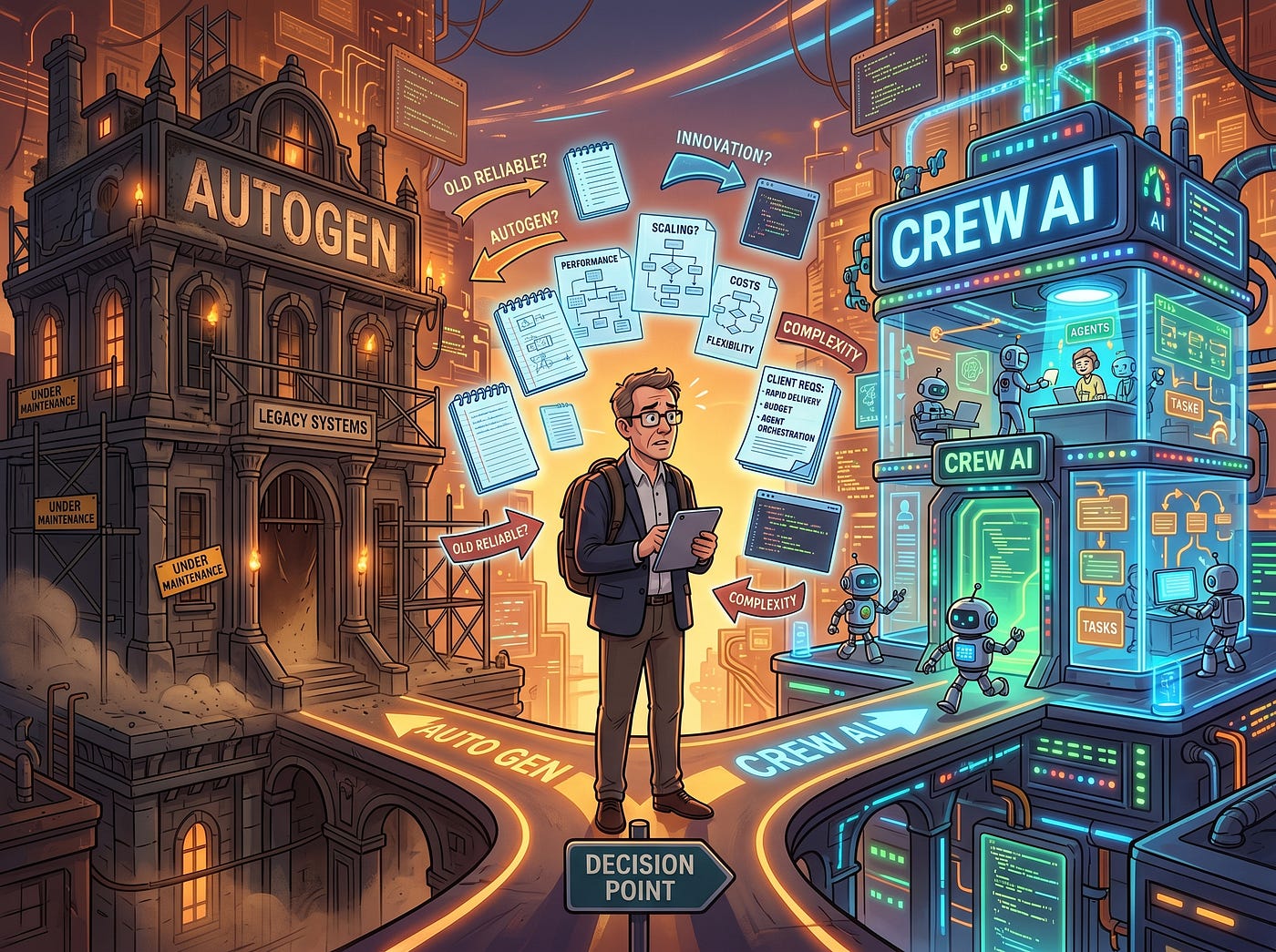
Created With Google Labs
Okay, confession time.
A client came to me in April asking which multi-agent framework they should build on. They’d done some reading, narrowed it down to AutoGen and CrewAI, and wanted my honest take before committing engineering time to either one.
I almost said AutoGen without thinking too hard about it. Microsoft backing, strong research pedigree, great community, solid code execution story. That’s a comfortable recommendation to make. You can defend it in a technical conversation and it sounds smart.
Then I actually sat down to do the research properly before the call, and I had one of those jarring moments where you realize the landscape shifted while you weren’t paying close attention.
So let me give you the comparison I actually gave that client, including the part that changes everything about how you should think about this decision in 2026.
The Thing Nobody’s Leading With
Here’s what most comparison articles are glossing over right now.
AutoGen is officially in maintenance mode. Microsoft has placed the original AutoGen repository into a state where it only receives critical security patches and major bug fixes. There is no active feature development. New users are being pointed toward Microsoft Agent Framework instead, and existing users are being encouraged to migrate.
Microsoft shipped Agent Framework 1.0 on April 3, 2026. Semantic Kernel and AutoGen, two of Microsoft’s most-used AI libraries, are being absorbed into a single production-ready SDK. The AutoGen name still exists as a compatibility layer, but the roadmap, the feature investment, and the enterprise support story have all moved to the new framework.
The API surface changed. Import paths changed. The multi-agent programming model shifted from AutoGen’s conversation-centric design, where agents talk to each other in chat threads, to a graph-based model where agents are nodes in a directed graph with explicit transitions.
What this means practically: if you start a new project on AutoGen today, you are building on a frozen codebase. You will eventually migrate or you will fall behind. That’s not speculation, that’s Microsoft’s own documentation telling you so.
By Q3 2026, major API providers and observability platforms are expected to deprecate support for the legacy callback patterns AutoGen uses natively.
So when someone asks me “AutoGen or CrewAI in 2026,” my honest answer is: the comparison has gotten more complicated than it looks, and that complication matters for how you make this decision.
What AutoGen Actually Was (And Why People Loved It)
Before we write it off, let’s be fair about why AutoGen built the reputation it has.
AutoGen is an open-source framework from Microsoft Research that emphasizes conversational agent interactions with flexible patterns. It supports both the classic conversation-based API and the newer event-driven architecture introduced in version 0.4. Agents communicate through natural dialogue patterns, code execution is built in with sandboxed environments, and it works across GPT-4, Claude, Gemini, and open-source models.
The code execution piece was genuinely differentiated. You could have an agent write Python, run it in a secure container, observe the output, fix the code if it failed, and loop until it got the right answer. That’s a powerful pattern for technical workflows, and AutoGen handled it more naturally than anything else in the space at the time.
AutoGen’s conversation patterns were the most diverse of any framework. If your agents needed multi-party conversations, group debates, consensus-building, or sequential dialogues, it was the strongest option available.
The GitHub numbers reflected this. The AutoGen repository accumulated over 25,000 stars by March 2026, with strong academic adoption and regular appearances in AI research papers.
The problem isn’t that AutoGen was bad. It was genuinely excellent for what it was built to do. The problem is that Microsoft decided to rebuild rather than extend, and the rebuild is not backward compatible in any meaningful way.
What CrewAI Actually Is in 2026
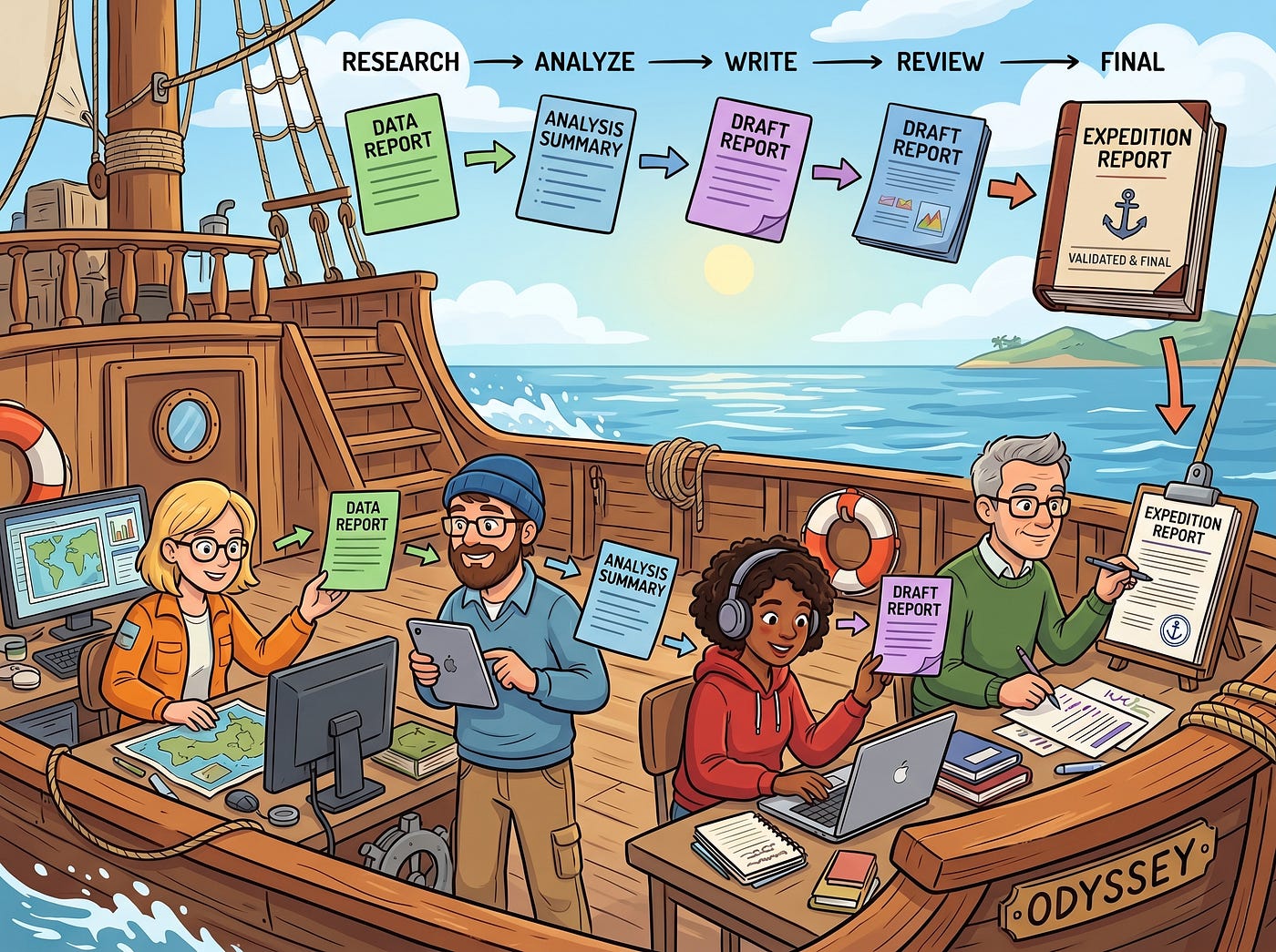
Created With Google Labs
CrewAI takes a completely different mental model to the same problem.
CrewAI models multi-agent collaboration as a team, a “crew,” of role-playing agents. You define each agent’s role, backstory, and goal, then assemble them into a crew with a set of tasks. The framework then manages handoffs between agents, ensuring each one knows what it received and what it needs to produce before passing work to the next agent in the sequence.
CrewAI 0.95 shipped in mid-February 2026, adding improved tool-call routing for Anthropic and Google models and an experimental async crew runner. This release set the stage for the enterprise observability launch in March.
The practical difference in how this feels to build with is significant. With AutoGen, you were designing conversation patterns and thinking about how agents would talk to each other. With CrewAI, you’re thinking about roles and task outputs. One mental model feels like choreographing a conversation. The other feels like writing a job description and handing someone a brief.
One client I know of needed to automate customer support ticket categorization and routing. They picked CrewAI. The role-based model matched their support team structure naturally. One agent read tickets, another categorized them, and a third generated draft responses. Setup took one week.
That timeline matters. For most business workflow automation, getting to a working prototype in a week and iterating from there is more valuable than having maximum architectural flexibility from day one.
CrewAI also made a deliberate move into the enterprise space this year. In 2026, CrewAI introduced CrewAI+, a commercial tier offering enhanced monitoring, team collaboration features, and priority support. If you’re building something that needs an SLA and a support channel, that option now exists.
The Part of This Comparison That’s Actually Useful
Here’s the framework I’d use to make this decision, because “CrewAI is simpler, AutoGen is more powerful” is technically true but not actually helpful.
The first question is whether you’re starting fresh or migrating. If you have existing AutoGen code, your real comparison is between migrating to Microsoft Agent Framework versus jumping to CrewAI or LangGraph entirely. The Semantic Kernel migration from AutoGen is harder because the programming model changed from conversation-centric to graph-based. A compatibility layer exists but will be deprecated. That’s not insurmountable, but it’s not a weekend project either.
If you’re starting fresh, the calculation is cleaner.
Choose CrewAI when your task naturally decomposes into specialist roles, you want to prototype quickly and iterate on agent design, your team includes non-engineers who need to understand the agent architecture, and you value code readability and simplicity over fine-grained control.
The non-engineer readability point is underrated. A CrewAI crew definition is legible to a product manager or a technical founder who can read code but isn’t living in it every day. That matters when you’re building something that needs to be maintained, modified, and explained to stakeholders.
Choose AutoGen (or now, Microsoft Agent Framework) when your agents need to write and execute code, you need human participants in the agent loop, or you are inside the Microsoft and Azure ecosystem.
The code execution workflow specifically still has an edge in the Microsoft stack. If your agents are writing and running code as a core part of what they do, the patterns that originated in AutoGen and are now being carried forward into Agent Framework are the most mature for that use case.
Token Usage, Cost, and the Real Production Concern
This doesn’t show up in most comparisons and it probably should.
AutoGen’s conversational architecture, where agents talk back and forth until they converge on an answer, has a token cost problem in production. The group chat pattern especially can become expensive when agents are verbose or when the problem requires many rounds of refinement before reaching a usable output.
Excessive agent conversations can increase token usage and costs significantly. AutoGen’s flexibility introduces complexity, and the token usage potential is higher compared to more structured frameworks.
CrewAI’s sequential task model is more predictable. Each agent takes input, produces an output defined by the task specification, and passes it forward. You’re not paying for conversation overhead, you’re paying for the actual work. For high-volume production workflows processing thousands of items, that cost predictability is a real architectural advantage.
CrewAI wins for workflow automation and content generation. The role-based model is intuitive. Token usage is efficient for sequential tasks.
If you’re building something that runs in a tight loop at scale, the cost structure of your framework choice will eventually matter more than the feature list.
What I Actually Told That Client
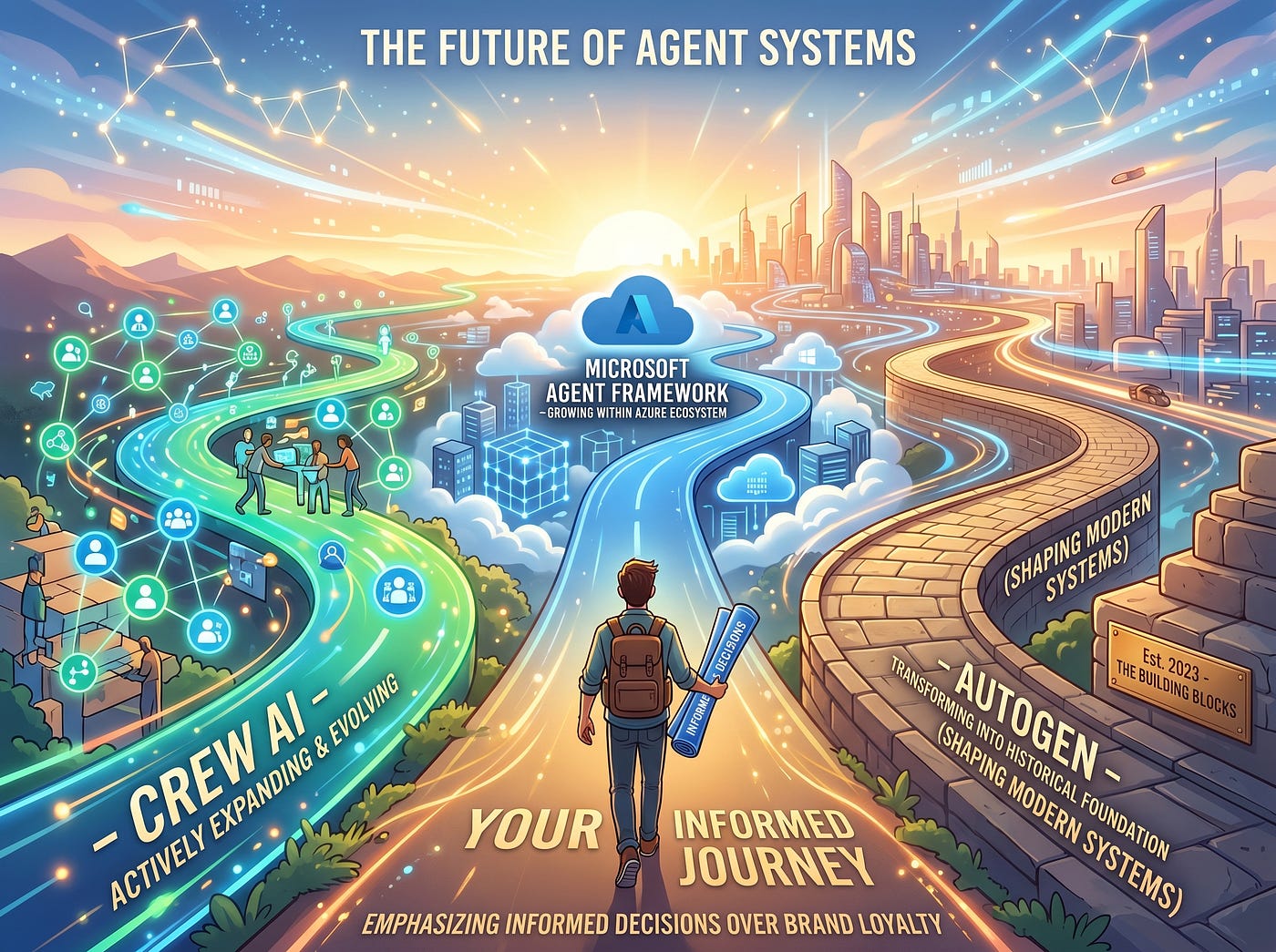
Created With Google Labs
I told them to build on CrewAI, with one caveat.
The workflows they needed were clearly role-decomposable. Research phase, synthesis phase, output formatting phase. Nothing that required agents to negotiate with each other or loop dynamically based on runtime conditions. CrewAI fits that shape cleanly, the setup time is fast, and the maintenance burden is lower when you’re a small team.
The caveat was about Microsoft Agent Framework. Agent Framework 1.0, the successor to both Semantic Kernel and AutoGen, shipped on April 7, 2026, with stable APIs, multi-agent orchestration patterns including sequential, concurrent, handoff, group chat, and Magentic-One, and a long-term support commitment starting now. If they ever find themselves needing deep Azure integration, code-executing agents, or the Semantic Kernel ecosystem, that’s the path inside the Microsoft stack now, not AutoGen.
For cloud-agnostic teams doing business workflow automation, CrewAI is the faster, cheaper, and honestly more readable choice in mid-2026. For Azure-centric engineering teams who need code execution and are comfortable inside the Microsoft ecosystem, Agent Framework is where that story has moved.
The straightforward AutoGen recommendation I almost gave would have been wrong, not because AutoGen was bad, but because the thing being compared doesn’t exist the same way it did six months ago. That’s the part worth knowing before you commit to a build.
See you in the next one.
P.S. — Have you hit a wall choosing between agent frameworks for a real production workflow? Drop your specific use case in the comments. I’m genuinely curious what constraints are driving the decision for teams building right now, and I’ll tell you what I’d actually reach for.
메타데이터
- post_id
- a66cc954aff5
- slug
- i-almost-recommended-autogen-to-a-client-last-month-heres-why-that-would-have-been-a-mistake-a66cc954aff5
- url
- https://medium.com/@mubiburfat882000/i-almost-recommended-autogen-to-a-client-last-month-heres-why-that-would-have-been-a-mistake-a66cc954aff5
- canonical_url
- https://medium.com/@mubiburfat882000/i-almost-recommended-autogen-to-a-client-last-month-heres-why-that-would-have-been-a-mistake-a66cc954aff5
- author_url
- https://medium.com/@mubiburfat882000
- status
- ok
- fetched_at
- 2026-07-08 18:29:56



