Fundamentals of software architecture Chapter 15: Space-Based Architecture
In the digital age, some applications face a unique and daunting challenge: how to handle massive, unpredictable surges in user traffic…
Fundamentals of software architecture Chapter 15: Space-Based Architecture
In the digital age, some applications face a unique and daunting challenge: how to handle massive, unpredictable surges in user traffic without slowing down or crashing. Think of an online concert ticketing system when a major band announces tickets, or a popular online game during peak hours. Traditional ways of scaling software often hit a wall, famously at the database.
This is where Space-Based Architecture (SBA) shines. It’s a specialized architectural style designed from the ground up to conquer problems of extreme scalability, elasticity (scaling up and down rapidly), and high concurrency by fundamentally changing how applications handle data.
The Database Bottleneck: A Common Problem
Most standard web applications follow a pattern of layers:
- Web Servers: Handle initial requests.
- Application Servers: Run business logic.
- Database Servers: Store and retrieve all data.
As more users hit the system, you can easily add more web servers. This usually just moves the bottleneck to the application servers, which are harder to scale. But the ultimate challenge often lies with the database server. It becomes the single point where all active requests eventually converge, limiting how many transactions your entire system can process.

Even with advanced techniques like database replication (for reads) and sharding (for splitting data), scaling a database for truly extreme loads is complex, expensive, and has inherent limits. Space-Based Architecture offers an architectural solution to bypass this bottleneck for the most critical, real-time operations.
The Core Idea: In-Memory, Replicated Data
Space-Based Architecture gets its name from “tuple space,” a concept of using multiple parallel processors that communicate through shared memory. The central idea is revolutionary:
- Removes the Database from the Hot Path: The main, transactional database is not involved in the immediate, synchronous (real-time) processing of most user requests.
- In-Memory Data Grids: Instead, all active application data (the data currently being used or updated by users) is kept in-memory (in RAM) within specialized units called “Processing Units.”
- Data Replication: This in-memory data is replicated across all active Processing Units that manage that specific data.
- Asynchronous Persistence: When data is updated in a Processing Unit’s in-memory grid, those changes are asynchronously (meaning, later and out of the user’s immediate request path) pushed to the durable database, often via a message queue.
- Dynamic Scaling: Processing Units can automatically start up and shut down as user load increases and decreases, providing great flexibility (elasticity).
By shifting the active data into fast, replicated RAM within dynamically scaling units, SBA removes the database bottleneck, providing near-infinite scalability for transactional processing.
The Building Blocks: SBA’s Key Components
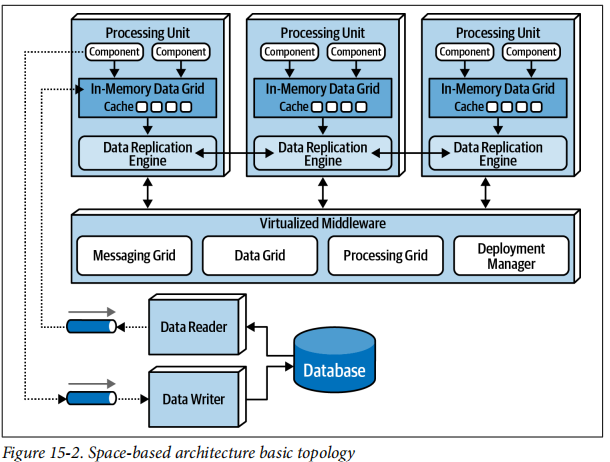
- Processing Unit (The Worker — Figure 15–3):
- This is the core, self-contained unit that performs the application’s work.
- What it Contains:
- Application Logic: This could be the code for a specific business domain (e.g., all order processing for active orders), web components, or even smaller, microservice-like functionalities.
- In-Memory Data Grid (IMDG) & Replication Engine: This is crucial. Each Processing Unit has its own copy of a portion of the application’s active data stored directly in its RAM. Products like Hazelcast or Apache Ignite are often used for this. The replication engine ensures that this local in-memory data is kept in sync with other Processing Units holding the same data.
- Software Example: Imagine a GameSessionProcessor (a Java JAR or Docker container). It holds the live state (player positions, scores) for a set of active game sessions directly in its memory. Any update to a game’s score is done in RAM and then quickly replicated to other GameSessionProcessor units.
2. Virtualized Middleware (The Orchestrator): This component acts as the “control plane” that manages and coordinates all the Processing Units.
- a) Messaging Grid (Figure 15–4):
- Job: This acts like a smart traffic cop or load balancer. It manages incoming user requests and knows which Processing Units are active.
- How it Works: When a request arrives (e.g., a player’s move in a game), the Messaging Grid directs it to the appropriate (and available) Processing Unit. For specific tasks (like managing an active game), it uses intelligent routing (e.g., based on the Game ID) to ensure all requests for a particular game go to the Processing Unit managing that game’s data.
- Software Example: Nginx or HAProxy configured with advanced routing rules.
- b) Data Grid (The Replicator — Figure 15–5):
- Job: Ensures that all active Processing Units that need the same logical set of data (e.g., all units managing game sessions) have consistent copies in their in-memory data grids.
- How it Works: It’s typically the built-in replication mechanism of the IMDG (like Hazelcast) within each Processing Unit. When GameSessionProcessor #1 updates the score for a player, the Data Grid infrastructure ensures this change is asynchronously (but very quickly, often under 100ms) propagated to GameSessionProcessor #2 and all other units holding that same “ActiveGameSessions” data. This allows units to dynamically join or leave the cluster and synchronize their data.
- c) Processing Grid (Cross-Quantum Orchestration — Figure 15–6, Optional):
- Job: This component orchestrates workflows that require coordination between different types of Processing Units (e.g., a GameSessionProcessor needing information from a UserPresenceProcessor).
- How it Works: If GameSessionProcessor needs to confirm a user’s online status, it might send a message to the Processing Grid. The Processing Grid then routes this request to a UserPresenceProcessor, waits for its response, and sends it back to the GameSessionProcessor. This handles communication between different “quanta” (groups of Processing Units with distinct data/functions).
- d) Deployment Manager:
- Job: Manages the dynamic starting up and shutting down of Processing Unit instances based on real-time load.
- How it Works: It continuously monitors response times and user loads. If load increases (e.g., during a game launch), it automatically starts more Processing Units. As load decreases, it shuts down unused units to save resources. This is key for achieving true elasticity.
- Software Example: Cloud auto-scaling groups (AWS Auto Scaling, Azure Autoscale) or Kubernetes (for container orchestration).
3. Data Pumps, Data Writers, and Data Readers (Asynchronous Persistence):
- Data Pumps: Internal components within Processing Units that capture data changes from the in-memory grid and asynchronously send them to a message queue.
- Data Writers: Dedicated services that consume these messages from the queue and write the changes to the central, durable database. This happens out of the immediate user request path.
- Data Readers: Load initial data from the database into Processing Units when they start up (especially if no other units are active to copy from).
Data Collisions: The Challenge of Active/Active Replication
When multiple Processing Units can simultaneously update their local copies of data, and these changes are replicated asynchronously, a data collision can occur. This is a crucial risk to manage in SBA.
- The Scenario:
- Both Processing Unit A and Processing Unit B have a product inventory count of 500 for “Blue Widgets.”
- Unit A sells 10, updates its local count to 490.
- Unit B sells 5, updates its local count to 495.
- Due to replication latency, Unit A’s update (490) arrives at Unit B after Unit B’s local update. Unit B’s cache might become 490.
- Unit B’s update (495) then arrives at Unit A, overwriting Unit A’s cache to 495.
- Result: Both units end up with an incorrect inventory count (e.g., 490 or 495, when it should be 485).
- Factors and Calculation: The likelihood of collisions depends on the number of Processing Units, the rate of updates, the size of the cached data, and the replication latency. Architects use formulas to probabilistically estimate collisions. A very low collision rate (e.g., 0.02%) might be acceptable for some data, while higher rates signal a need for different strategies. This highlights how critical low replication latency is.
Replicated vs. Distributed Caching: Choosing the Right Strategy
SBA relies heavily on in-memory caching. The type of caching is critical:
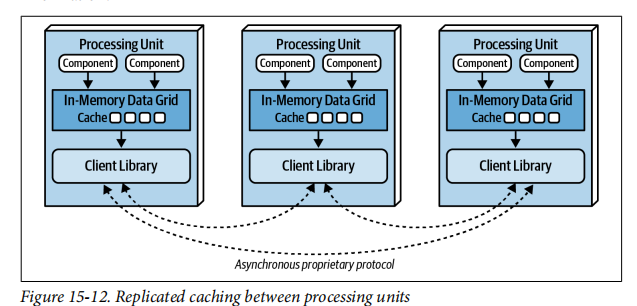
- Replicated Caching (Figure 15–12):
- Concept: Each Processing Unit holds a complete copy of the active data in its local RAM. Updates are synchronized across all units holding that same data.
- Pros: Extremely fast (local RAM access), very high fault tolerance (no single point of failure for the cache), excellent for read-heavy operations.
- Cons: Total data set must fit into the RAM of each Processing Unit (memory limits scalability), susceptible to data collisions with high update rates.
- Best for: Smaller caches (e.g., under 100MB per unit), relatively static data (like product descriptions, user profiles that don’t change often), low update frequency.
2. Distributed Caching (Figure 15–13):
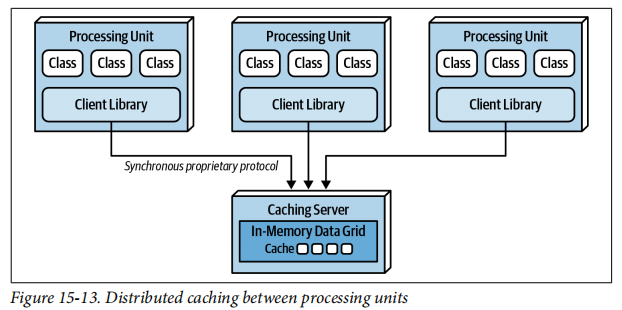
- Concept: An external, dedicated server or service holds the central cache. Processing Units make remote calls to this central cache server to access data
- Pros: Ensures high data consistency (all data in one place, no replication latency issues), can handle very large cache sizes (exceeding a single machine’s RAM).
- Cons: Slower performance (requires a network hop), the central cache server is a single point of failure (though mitigated by mirroring), which impacts fault tolerance.
- Best for: Larger caches (e.g., over 500MB), highly dynamic and critical data (like inventory counts where absolute consistency is key), high update rates.
3. The Hybrid Approach: In most complex SBA implementations, architects don’t pick just one. They leverage both replicated and distributed caching for different types of data based on their specific needs for consistency, performance, and update frequency. For example, use a distributed cache for volatile inventory counts, and a replicated cache for less-frequently changing customer profile data.
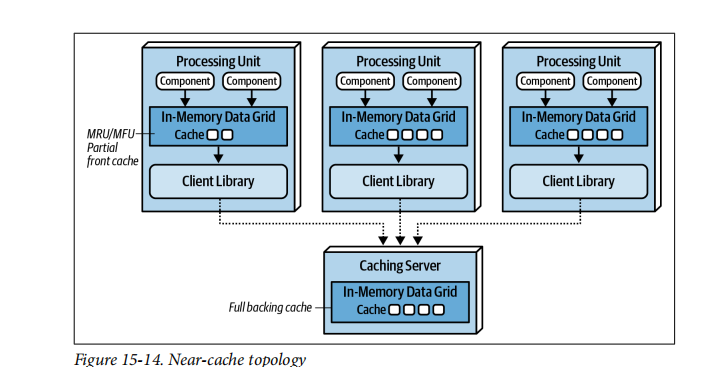
Near-Cache (Figure 15–14): A hybrid model combining a small, local “front cache” within Processing Units with a larger “full backing cache” (distributed cache). However, the chapter generally does not recommend this for SBA because the local front caches are not synchronized with each other. This means different Processing Units could have different data locally, leading to inconsistent performance and behavior across the system.
Real-World Use Cases: Where SBA Excels
Space-Based Architecture is a specialized solution for applications demanding high elasticity, scalability, and performance under unpredictable, extreme loads.
- Concert Ticketing Systems:
- Challenge: User volume spikes from hundreds to tens of thousands in seconds when tickets go on sale. Thousands try to buy limited seats simultaneously. A traditional database simply cannot handle this volume of transactional updates.
- SBA Solution: Ticket Reservation Processing Units (pre-scaled by the Deployment Manager) hold seat availability in-memory. All reservations and updates happen at RAM speed, with asynchronous updates to the durable database. This allows for rapid scaling and immediate seat availability updates during the frantic sale period.
2. Online Auction Systems:
- Challenge: Unpredictable spikes in bidding, especially in the final seconds. Instant processing and ranking of bids are critical for a fair and responsive auction.
- SBA Solution: Auction Processing Units manage the real-time state of active auctions (current bid, highest bidder) in their replicated in-memory data grids. Bids are processed instantly in memory, and final results are pushed asynchronously to a historical database.
Architectural Characteristics: SBA’s Power and Its Price
SBA is a mix of domain-partitioned (processing units can align with business domains) and technically partitioned (separating transactional caching from database storage). The database is not part of the architectural quantum, as it’s not synchronously involved in the hot path. Quanta are defined by groups of Processing Units that communicate synchronously.
- Elasticity, Scalability, Performance: ⭐⭐⭐⭐⭐ (5 Stars — Top Strengths)
- These are the defining advantages of SBA. It achieves unparalleled levels of these characteristics by leveraging in-memory data and removing the database as a bottleneck, enabling processing for millions of concurrent users.
- Simplicity & Testability: ⭐ (1 Star — Very Low)
- Simplicity: This architecture is exceptionally complex. Managing in-memory data grids, asynchronous consistency, data pumps, and a multitude of moving parts requires significant expertise.
- Testability: Extremely challenging and expensive to simulate the high, elastic loads that SBA is designed for. Testing often happens in production under actual extreme conditions, which carries significant risk.
- Cost: High
- SBA is expensive due to licensing fees for IMDG products and the high resource utilization (lots of RAM for in-memory data) in cloud or on-premises environments.
Please click here for code example
The Bottom Line: Space-Based Architecture is a highly specialized, powerful, and complex solution. It’s a fundamental shift from traditional database-centric systems, offering unmatched performance, scalability, and elasticity for applications facing extreme, unpredictable concurrency. However, architects must carefully weigh its significant complexity and cost against the absolute necessity of its immense power for their specific problem domain. It’s a Ferrari — thrilling for the racetrack, but overkill and costly for a grocery run.
메타데이터
- post_id
- a67a8d4fd856
- slug
- fundamentals-of-software-architecture-chapter-15-space-based-architecture-a67a8d4fd856
- url
- https://medium.com/@mohamedsallam953/fundamentals-of-software-architecture-chapter-15-space-based-architecture-a67a8d4fd856
- canonical_url
- https://medium.com/@mohamedsallam953/fundamentals-of-software-architecture-chapter-15-space-based-architecture-a67a8d4fd856
- author_url
- https://medium.com/@mohamedsallam953
- status
- ok
- fetched_at
- 2026-07-09 05:26:43




