AI Search vs Google Search: What Businesses Need to Know
Six months ago, a client asked me something that stuck with me: “If someone searches for what we do and an AI just answers the question…
AI Search vs Google Search: What Businesses Need to Know
Six months ago, a client asked me something that stuck with me: “If someone searches for what we do and an AI just answers the question directly, where does that leave us?”
It’s a really fair question. And the honest answer is, it depends entirely on which world your business is optimized for.
In 2026, search has split. Not cleanly, not completely, but enough that treating “search” as one thing is starting to feel like a mistake. Here’s what’s actually going on, and what it means for businesses that rely on being found online.
Google Search Has Already Changed
Let’s start here because a lot of people are still thinking about Google the way it worked three years ago.
At Google I/O 2026, Google described their AI-powered search upgrade as the biggest change to the search box in more than 25 years. AI Mode has now surpassed one billion monthly users globally, with queries more than doubling every quarter since launch. Google’s VP of Search said it plainly: “Google Search is AI search.”
The average AI Mode query is three times longer than a traditional search. People aren’t typing “best CRM software” anymore, they’re asking “what CRM would work best for a 20-person B2B SaaS company with a distributed sales team and an existing HubSpot integration?” That’s a fundamentally different intent signal. And the content that answers it has to match that specificity.
So before we even compare AI search versus Google, Google is already moving toward AI. The gap between them is narrowing, but it’s not gone yet.
What’s the Core Difference?
Here’s the simplest way to think about it.
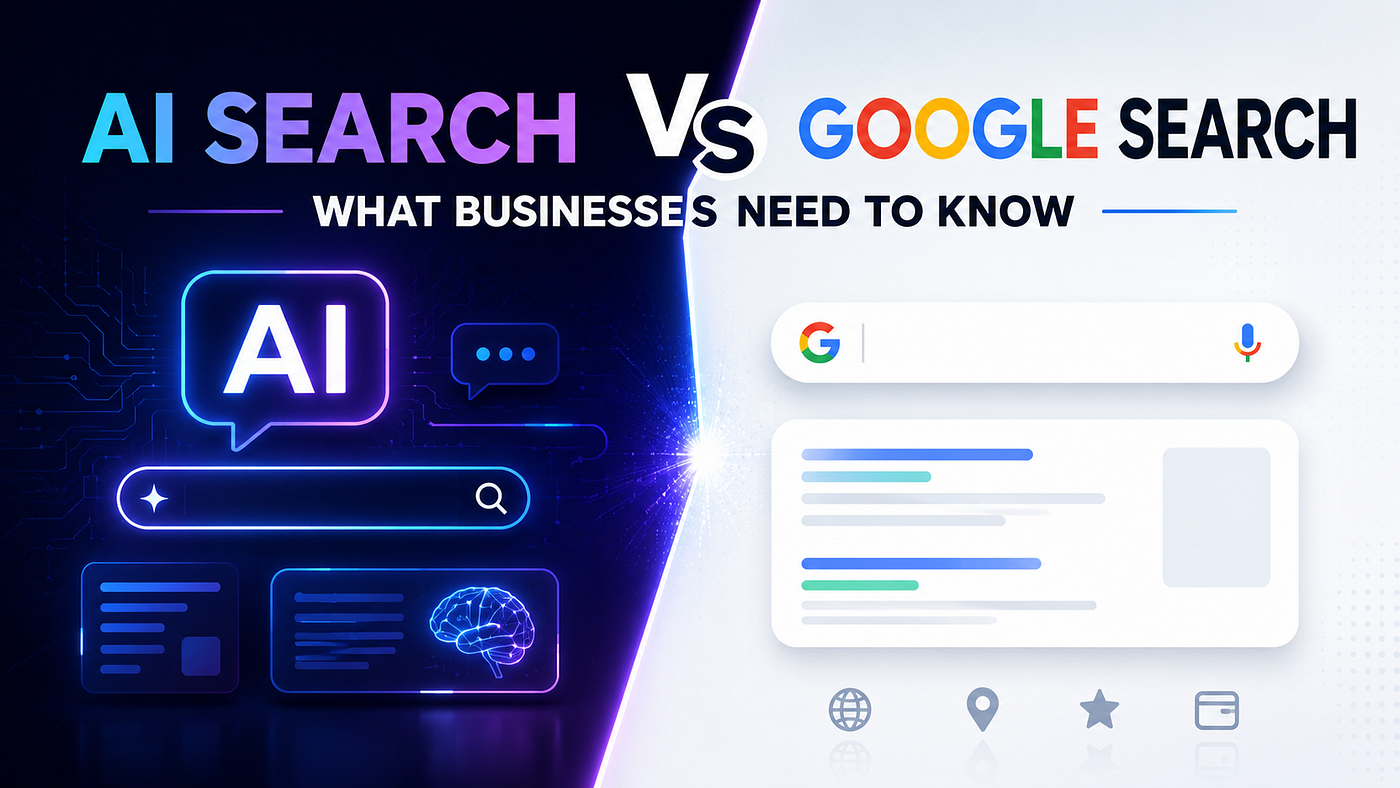
Google gives you options. AI gives you an answer.
When you search on Google, you get a list. Even with AI Overviews, there are links, there’s the map pack, there are ads, it’s a menu. You choose where to click. For businesses, this means multiple entry points. You can show up in a snippet, in organic results, in a local pack, in an image result.
AI search, tools like ChatGPT’s web mode, Perplexity, and Google’s own AI Mode, collapses that into one response. It synthesizes information and presents an answer. Instead of ten chances to appear, there might be two or three citations. Or none.
That shift from showing up somewhere in the mix to being included in the answer itself is what makes this such a different game for businesses.
The Split-Path Reality of 2026 Search
Here’s what the data shows. 37% of consumers now start their searches with AI tools rather than Google. But traditional search still commands 90% of global search traffic. So how do both things coexist?
They serve different purposes.
People use AI tools for exploratory questions, “help me understand how X works,” “compare these options,” “what I should consider when choosing Y.” Research, learning, discovery.
People use traditional search for action and decision, finding a local business, making a purchase, looking up a phone number, checking directions. Transactional stuff.
A business that only optimizes for one of these is leaving real visibility on the table. The split-path model is real. Your content strategy needs to address both.
What This Actually Changes for Your Business
The content implications are meaningful. If AI systems are going to cite you, they need to understand you. Not just find you, understand you. That means:
Content that answers complete questions, not just targets isolated keywords. Google says planning-related AI Mode queries have grown 80% faster than AI Mode queries overall. People want full scenarios addressed, not keyword-matched pages.
Authority signals matter more than ever. AI systems pull from sources they consider reliable. E-E-A-T (Experience, Expertise, Authoritativeness, Trustworthiness) isn’t just an SEO checkbox, it’s increasingly the filter for whether you get cited at all.
And technical fundamentals haven’t gone away. Crawlable pages, clean content structure, fast load times, schema markup, all of this still matters. It’s just that the target has expanded from “rank in the blue links” to “be intelligible and trustworthy to both humans and AI systems.”
One Honest Warning
76% of businesses currently have no strategy for AI search visibility. If your competitors are in that group too, there’s a genuine first-mover advantage available right now. If they’re ahead of you, there’s a gap forming that’s harder to close the longer you wait.
The businesses doing this well are working with development and digital partners who understand both the technical infrastructure and the content strategy side. Having a website that’s built properly from the ground up, fast, well-structured, semantically clear, is the foundation that makes everything else work. That’s something a good custom web development team addresses before it becomes a problem rather than after.
Google isn’t dying. AI search isn’t replacing it. But the way you get found and the way you stay found, is changing faster than most business owners have had time to adjust. Understanding the difference between these two worlds is probably the most practically useful thing any digitally active business can do right now.
메타데이터
- post_id
- a67ac0511dae
- slug
- ai-search-vs-google-search-what-businesses-need-to-know-a67ac0511dae
- url
- https://medium.com/@mittaltechnologiespromotion/ai-search-vs-google-search-what-businesses-need-to-know-a67ac0511dae
- canonical_url
- https://medium.com/@mittaltechnologiespromotion/ai-search-vs-google-search-what-businesses-need-to-know-a67ac0511dae
- author_url
- https://medium.com/@mittaltechnologiespromotion
- status
- ok
- fetched_at
- 2026-08-09 03:41:20