Bio-Hacking the Survival Alarm: How to Train Your Brain Stem for True Biological Sovereignty
How deliberate hypercapnic training can desensitize your central chemoreceptors, silence the primal panic button in your medulla, and…
Bio-Hacking the Survival Alarm: How to Train Your Brain Stem for True Biological Sovereignty
How deliberate hypercapnic training can desensitize your central chemoreceptors, silence the primal panic button in your medulla, and unlock elite autonomic resilience.
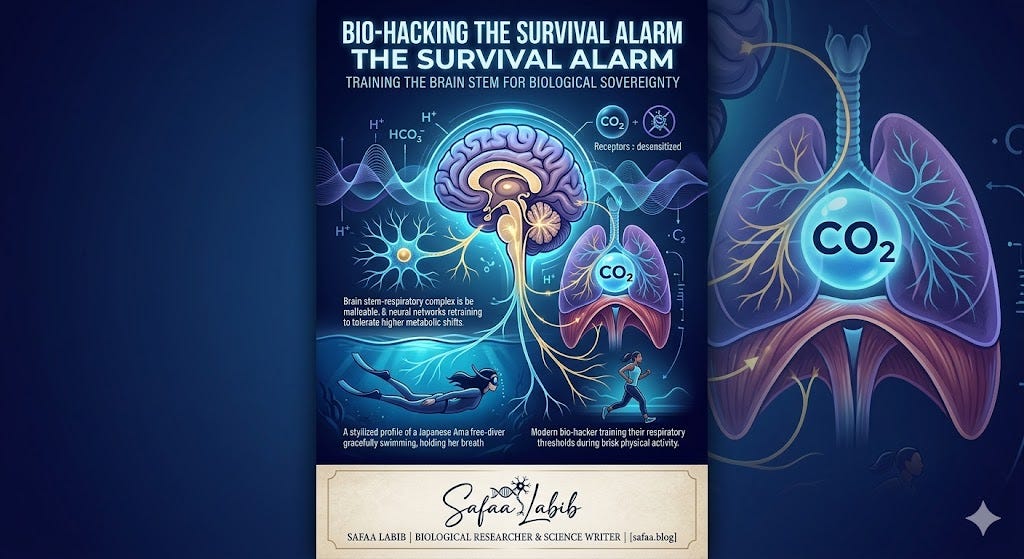
AI-generated infographic illustrating brain stem conditioning, $CO_2$ chemoreceptor desensitization, and autonomic bio-hacking inspired by Ama divers.Concept and visual design authored by Safaa Labib, Biological Researcher & Science Writer.
Introduction: Shifting the Frontiers of Autonomic Control
In our continuous exploration of “Biological Sovereignty,” we recently analyzed the neuro-architecture of the brain’s “open windows” — the Circumventricular Organs (CVOs) — and how systemic peripheral inflammation can bypass the blood-brain barrier to alter mood topography. A key takeaway from that architectural reality is that our psychological peace is directly bound to our systemic metabolic choices.
Following that publication, an intriguing piece of real-world evidence emerged from a discussion with one of our readers, John. He shared how he successfully conditioned his own autonomic nervous system over a six-month period. By practicing deliberate breath-holding during brisk walking, he managed to expand his comfortable breath-hold time from a baseline of 10 seconds to over 30 seconds, a feat that caught his physicians off guard during a recent clinical assessment.
John’s self-directed experiment brings us face-to-face with a profound neurobiological principle: the survival alarms managed by our oldest neural structures are not rigid, unyielding commands. Through targeted biochemical stress, we can deliberately recalibrate our homeostatic setpoints.
The Respiration Dictator: Molecular Mechanics of the Medulla Oblongata
To understand how we can alter these internal survival baselines, we must first map the precise neural networks governing involuntary respiration. While classical fitness and wellness literature often claims that the primary driver behind the urge to breathe is systemic oxygen (O₂) deprivation, the strict molecular reality within the central nervous system tells a fundamentally different story.
As peripheral cells metabolize glucose to synthesize adenosine triphosphate (ATP), they continuously generate carbon dioxide (CO₂) as a metabolic byproduct. This gas diffuses rapidly across cell membranes and easily breaches the blood-brain barrier into the cerebrospinal fluid (CSF). Within the CSF, (CO₂) undergoes a critical hydration reaction: it combines with water to form carbonic acid, which then rapidly dissociates into hydrogen ions (H⁺) and bicarbonate ions (HCO₃⁻). This influx of free (H⁺) ions instantly drives down the pH of the local neural environment, introducing respiratory acidosis.
According to foundational research on Central Chemoreceptors and Respiratory Control, highly specialized groups of neurons clustered primarily on the ventrolateral surface of the medulla oblongata serve as the brain’s internal chemical sensors. These chemoreceptors are exquisitely sensitive to drops in CSF pH. The moment the local concentration (H⁺) crosses a highly sensitive, genetically predetermined threshold, these cells initiate a massive cascade of excitatory electrical impulses. These signals travel down the phrenic nerve, causing an involuntary, urgent contraction of the diaphragm.
This is the autonomic survival alarm — a primal, intense reflex designed to force ventilation. However, neuroscience now confirms that this chemical trigger point is highly plastic.
Lessons from the Deep: The Neuroplastic Adaptations of Ama Divers
The most striking historical and clinical demonstration of this specific neural plasticity can be found in the Ama — the traditional free-divers of Japan. For centuries, these women have plunged up to 30 meters deep into freezing ocean waters to harvest pearls and marine life, relying completely on a single breath of atmospheric air without the aid of any modern diving apparatus.
While an untrained individual typically experiences severe autonomic panic and diaphragmatic contractions within 60 seconds of complete breath retention, experienced Ama divers can sustain active, high-pressure underwater swimming for up to 8 minutes.
Are these divers presenting a distinct genetic mutation? Clinical evaluations published on the Physiology of Splenic Contraction in Ama Divers reveal that while peripheral mechanisms like splenic contraction and an enhanced dive reflex are present, the definitive adaptation occurs at the level of the brain stem.
Through years of repeated, sub-lethal exposure to elevated internal CO₂ levels (hypercapnia), their central chemoreceptors have undergone structural desensitization. The medulla oblongata in an Ama diver no longer interprets acute respiratory acidosis as an immediate systemic failure. Instead, through chronic neuroplastic accommodation, the brain stem delays the activation of the phrenic nerve alarm, allowing the cerebral cortex to preserve absolute cognitive clarity and motor precision under extreme physiological strain.
Shifting the Hypercapnic Ventilatory Response (HCVR)
The progressive conditioning practiced by John — introducing intermittent breath retention against the metabolic demands of brisk walking — is a literal application of this exact hypercapnic desensitization. He was actively manipulating his Hypercapnic Ventilatory Response (HCVR).
From a cellular perspective, the process follows a predictable, adaptive loop:
[Deliberate Breath Holding] ──► [Accumulation of CO₂ & CSF H⁺ Ions] ──► [Intermittent Chemoreceptor Stress] ──► [Down-regulation of Cellular Panic Signaling] ──► [Result: Recalibrated Brain Stem Sensitivity & Expanded Autonomic Comfort Zone]
By safely introducing a localized metabolic stressor during physical exertion, you present the central chemoreceptors with a survival challenge that does not end in cellular damage. Over time, the intracellular signaling pathways within the ventrolateral medulla adapt. They down-regulate their hyper-reactive firing patterns, essentially raising the pH threshold required to trigger the survival panic.
This explains why John’s doctors were surprised. In standard clinical environments, a 20-second breath-hold causes an immediate spike in systemic anxiety and autonomic distress in the average patient. John’s brain stem, however, had been systematically reprogrammed to view that exact chemical shift as a safe, highly manageable state.
Neurological Intersection: Overlapping Circuits of Panic and Chemistry
Why should a biology researcher or an individual chasing psychological sovereignty care about training a respiratory reflex? Because the underlying neural architecture that monitors metabolic chemical shifts (CO₂ and H⁺ accumulation) overlaps significantly with the brain networks that process psychological stress, fear, and panic attacks.
Key psychiatric and neurological studies on the Neurobiology of Panic Disorder and Carbon Dioxide Hypersensitivity have uncovered a vital mechanistic link: individuals diagnosed with generalized anxiety disorder or panic hypersensitivity frequently exhibit hyper-reactive central chemoreceptors. Their brain stems are operating on an overly aggressive, hypersensitive alarm setting.
When these individuals encounter minor psychological stress, their respiration patterns naturally become shallow or erratic. This minor shift disrupts systemic CO₂ equilibrium, and their hyper-reactive medulla instantly misinterprets this minor chemical shift as a mortal threat. This triggers a massive, bottom-up autonomic storm — flooding the body with cortisol, spiking the heart rate, and locking the higher cortical structures into a state of acute, unprovoked panic.
By utilizing targeted, structural hypercapnic training, we are doing something far more profound than increasing lung capacity:
- Dampening the Amygdala-Medulla Axis: We explicitly break the link between minor physical/chemical discomfort and acute psychological panic, systematically lowering our baseline anxiety.
- Optimizing Metabolic Capital: The systemic buffering capacity improves, allowing the body to manage lactic acid and metabolic waste efficiently under high-performance demands.
- Asserting Executive Sovereignty: We consciously bridge the gap between the conscious mind (the cerebral cortex) and the unconscious survival engine (the brain stem).
True biological sovereignty is built on the realization that our autonomic nervous system is not a rigid, hardwired cage. It is highly plastic software that we can explicitly reprogram through targeted metabolic stress, intentional living, and deliberate neural training.
Conclusion & Community Dialogue
The human body is designed to adapt to the exact boundaries we push. When we understand the molecular and chemical languages our organs speak, we cease to be passive observers of our biology and instead become its strategic architects.
Have you ever experimented with structural breathwork, hypoxic protocols, or deliberate exposure to physical discomfort to quiet your nervous system’s internal alarms? How do you manage the psychological costs of metabolic fatigue in your daily work? Let’s expand this scientific dialogue in the comments section below!
Peer-Reviewed References
- Nattie, E., & Li, A. (2012). Central chemoreceptors: locations and functions. Comprehensive Physiology, 2(1), 221–254.
- Schagatay, E., et al. (2012). Underwater working times in traditional splenic-contracting Ama divers. Respiratory Physiology & Neurobiology, 181(3), 321–326.
- Frontiers in Neuroscience. (2013). The Neurobiology of Panic Disorder and Carbon Dioxide Hypersensitivity. Frontiers in Neuroscience, 7, 214.
Support My Research & Stay Connected
If you found this biological deep dive valuable, I invite you to join my growing community of science-driven readers. My work is dedicated to exploring the intersection of neurobiology, psychoanalysis, and physical health to help you reclaim your Biological Sovereignty.
Subscribe to My Substack: Join the “Biological Sovereignty” newsletter for exclusive research updates, in-depth biological protocols, and nuanced insights delivered directly to your inbox. 👉 [Join the Community on Substack](https://safaalabib.substack.com/)
Support My Work on Patreon: If you’d like to support my independent research and help me create more high-quality, evidence-based content, consider becoming a patron. You can choose the tier that fits your level of curiosity. 👉[ Support My Research on Patreon](https://www.patreon.com/c/SafaaLabibBiology?vanity=user)
Explore More: You can find a collection of my published work and curated stories here: 👉[ Safaa Labib on Digitalmehmet](https://digitalmehmet.com/author/labibsafaa641/)
Thank you for being part of this journey toward mastering your internal ecosystem.
Safaa Labib Biologist & Science Writer Contact & Portfolios: safaa.blog
메타데이터
- post_id
- a697dd2f2c2d
- slug
- bio-hacking-the-survival-alarm-how-to-train-your-brain-stem-for-true-biological-sovereignty-a697dd2f2c2d
- url
- https://medium.com/health-science/bio-hacking-the-survival-alarm-how-to-train-your-brain-stem-for-true-biological-sovereignty-a697dd2f2c2d
- canonical_url
- https://medium.com/health-science/bio-hacking-the-survival-alarm-how-to-train-your-brain-stem-for-true-biological-sovereignty-a697dd2f2c2d
- author_url
- https://medium.com/@labibsafaa641
- status
- ok
- fetched_at
- 2026-06-09 15:37:30