7 Hard-to-Read Books That Will Make You Smarter Than Any Self-Help Book
I read more 70+ books a year, and these 7 actually rewired how I think
7 Hard-to-Read Books That Will Make You Smarter Than Any Self-Help Book
I read more 70+ books a year, and these 7 actually rewired how I think
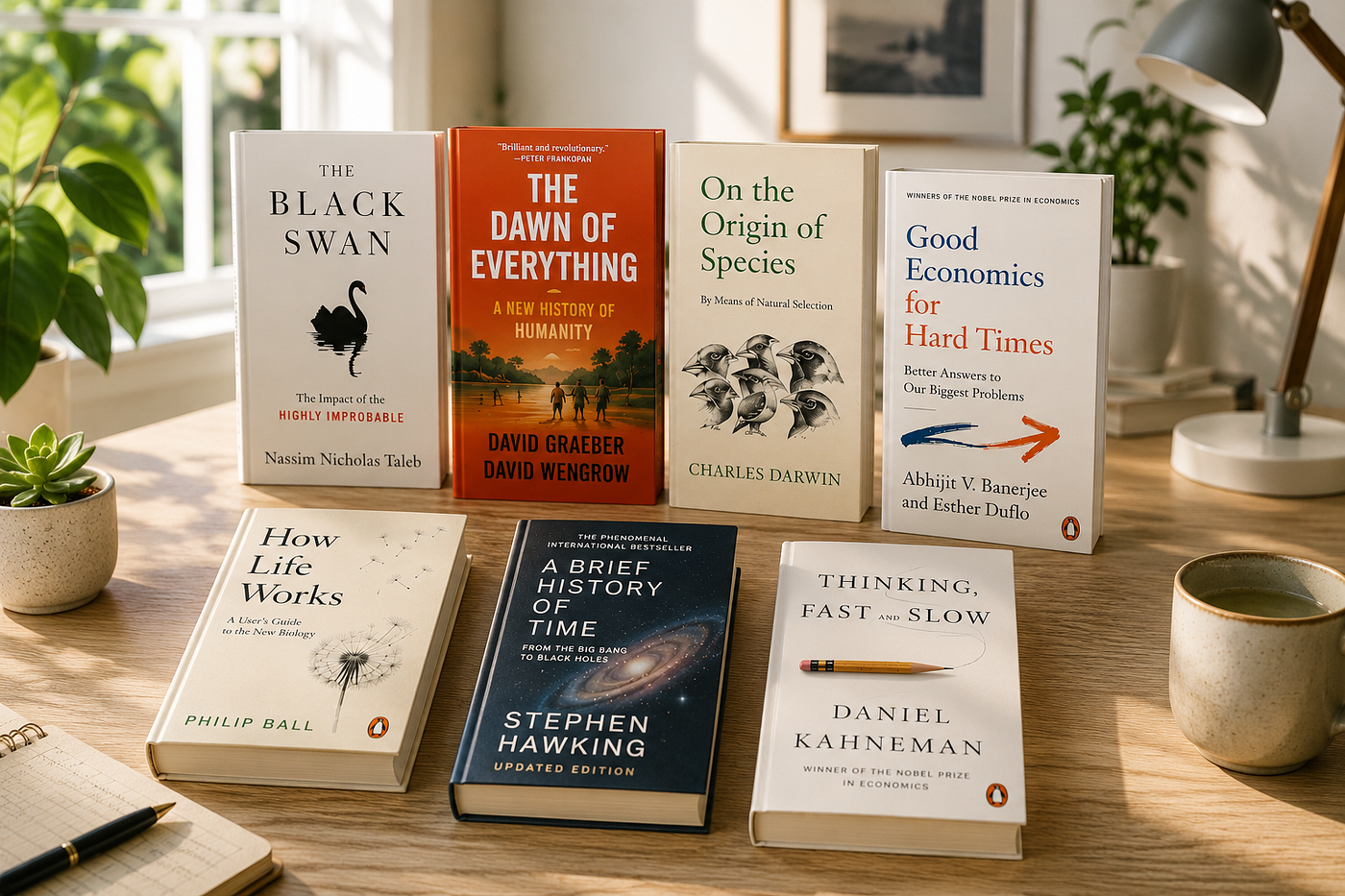
Source: Image Generated by GPT 5.5
I’ve read a frankly stupid number of self-help books, and they’re stacked all over my shelves, and at some point, I realized most of them were the same book wearing different jackets, one decent idea stretched across two hundred pages with a lot of confidence and very little underneath it.
The books that changed how I think were never those. They were the hard ones that I had to read with a pen, the ones I put down twice and picked back up, the ones where I’d finish a chapter and have to sit there for a minute because something I’d assumed my whole life had fallen apart.
None of these books was an easy read, and that’s the entire point. Because a book that asks nothing of you tends to leave nothing behind. Here are 7 books that asked a lot and paid me back for years.
One honest note before the list. The only reason I finish books like these, instead of letting them die on page 40, is that I read them with other people. I run a free Discord book club with over 500 readers in it, and we pick hard books on purpose and then drag each other through them chapter by chapter, complaints and all. If finishing is your problem, a room full of stubborn readers fixes it faster than any amount of willpower ever will. Come read with us:
#1 The Black Swan by Nassim Nicholas Taleb
This is a book about the rare, unpredictable events that quietly decide almost everything, and about why nobody, especially the experts, ever sees them coming.
In April last year, my income fell off a cliff overnight because of an algorithm change I had zero control over. I had put years of work and had a steady growth, and then one tweak at a company I don’t even work for nearly halved one of my income streams in a few weeks.
Taleb has a name for that, and reading him afterward felt like I finally got language for a thing I’d just survived. His whole argument is that we build neat little stories to explain a messy, random world, and then we feel safe right up until the world does something our story swore was impossible.
He’s a hard read on purpose, arrogant and digressive, and forever wandering off into Roman history and probability theory. But I pushed through it anyway. There isn’t a self-help book out there that will prepare you for the things this one teaches you to expect.
#2 The Dawn of Everything by David Graeber and David Wengrow
This book is basically two scholars spending nearly 700 pages dismantling the story we all absorbed without noticing, the tidy one where humans marched neatly from cavemen to farmers to cities to whatever this is.
When I started reading this book, I thought I knew the broad shape of human history, the same shape everyone carries around without questioning. By the time I finished it, I realized that shape was mostly a guess that got repeated so often that it started to feel like a fact.
The authors walk you through vast ancient cities that ran smoothly without kings, societies that switched between a strict hierarchy in winter and total equality in summer, and people who tried something like our way of living and consciously walked away from it. The whole point is that the way we live now was never inevitable; we just stopped imagining the alternatives.
This is the densest book on the list, and it does not hold your hand for a second. I read it over the better part of a month and dragged half of it into my book club because I needed other people to argue with me about it.
#3 The Origin of Species by Charles Darwin
This is the actual book, not the summary, and not the “survival of the fittest” bumper sticker, a phrase Darwin didn’t even write.
I’d casually referenced evolution in arguments and articles for years, the way everyone does, without ever once reading the source. When I finally read it, I felt a little exposed, because the real thing is more careful, patient, and genuinely humble than the version that floats around online.
Darwin spends entire chapters arguing against himself, lining up every reason his own theory might be wrong before he answers them one by one. Watching a mind that rigorous work in slow motion taught me more about how to actually think than any framework with a catchy acronym I have come across in dozens of self-help books.
The Victorian sentences run long, and the pace is glacial, so this is a real commitment. But there’s something clarifying about reading the founding document of an idea instead of the thousandth secondhand retelling of it.
#4 Good Economics for Hard Times by Abhijit Banerjee and Esther Duflo
This book, written by two Nobel-winning economists, takes the biggest questions we fight about, including immigration, inequality, trade, and growth, and shows you what the evidence actually says versus what everyone just assumes.
I run a one-person business out of Chennai, so I think about money, risk, and growth pretty much constantly, and most of what passes for economic wisdom online is just confident nonsense. Banerjee, being one of ours, is what made me pick it up, but the rigor is what made me finish it.
The most useful thing they do is admit, over and over, what economists honestly don’t know, which is the exact opposite of every guru selling you a formula. They follow real studies of real people instead of just giving you a nice story that just happens to feel good.
While the book isn’t equation-heavy, it does ask you to sit with complexity and resist the easy answer, which is harder than it sounds once the internet has trained you to want a tidy takeaway in ten seconds. You come out of it much slower to fall for simple explanations of complicated things.
Quick aside, because picking the right hard book matters almost as much as finishing it. Every book I’ve actually kept from the last couple of years, the ones that earned their place and not the dozens I forgot, lives in a Notion database I built for myself and then cleaned up to share. It’s 159 books across nine categories, and the useful part is the filtering. Every book is tagged by difficulty, so you can sort straight to the Advanced ones when you want a fight, or sit in Intermediate while you build the muscle, and there’s a “Read This If” tag that matches a book to whatever you’re actually going through right now. It’s $9, and it’ll save you the far more expensive mistake of losing three weeks to a book that turns out to be a blog post wearing a hardcover. Get it from the below link.
#5 How Life Works by Philip Ball
This is a dense, up-to-date tour of what biology has actually figured out about how living things work, which turns out to be far stranger than the neat gene-as-blueprint story we were all handed in school.
My shelves are full of wellness and longevity books, you know, the optimize-your-mitochondria, live-to-180 kind, and most of them rest on a cartoon version of biology. Ball’s book is the real thing, and it actually exposes how much of that entire genre is built on metaphors that stopped being accurate decades ago.
The big takeaway is that there’s no simple code running you, and that life is layers of systems improvising and overriding each other, and the “your genes are your destiny” line you’ve heard a hundred times is closer to marketing than science.
This is heavy going if you haven’t read serious biology in a while. I had to reread some sections more than once and constantly ask ChatGPT to explain some stuff just to keep up. But you finish it permanently immune to the next person who tries to sell you your own body in five easy steps.
#6 A Brief History of Time by Stephen Hawking
This is Hawking’s attempt to explain the whole structure of reality, time, black holes, and the beginning of the universe in a book that you can finish in a weekend, to people who never took a physics class.
It’s the most famous book almost nobody finishes, and for years, I was part of the nobody. It sat on my shelf, making me look impressive and a little guilty every time I walked past it.
When I finally read it properly, with a pen and a notebook beside me, and a lot of rereading, it did the thing the easy books only promise. It made the world feel bigger. There’s a line near the start about how every equation in a book halves its readership, which is Hawking being funny about the exact problem he’s fighting, and he keeps the math almost entirely out while still making your sense of time and space wobble.
The ideas are hard even when the words are simple, so you’ll reread paragraphs, and that’s normal. While finishing this book definitely won’t make you a physicist, it will make every confident thing you hear about reality afterward sound a good deal smaller.
#7 Thinking, Fast and Slow by Daniel Kahneman
This book is a Nobel psychologist’s life’s work on the two systems running your head, the fast one that leaps to conclusions and the slow one that can barely be bothered to check them.
I’m still in the middle of this one, reading a few pages most nights, because it’s too dense to rush and I keep stopping to recognize myself on the page. It has already changed how I read my own analytics and how I decide which deals to take, because I can now feel my fast brain grabbing for a confident answer and force myself to slow it down.
The genuinely unsettling part is that knowing about these mental traps barely helps you avoid them. Kahneman is honest that he fell for the same biases his whole life, despite literally writing the book on them, which might be the least self-help thing a self-improvement-adjacent book has ever admitted.
The book is definitely long, slow, and a few chapters read like the academic papers they grew out of. But it’s also the book that taught me to distrust my own certainty, and I’d take one person who’s wrestled with this over ten who’ve memorized a productivity system.
None of the books in this list will give you a simple five-step morning routine or the feeling of being sorted by Sunday night. But they give you the ability to notice when you’re being told a story that’s too good to be true.
If you want company while you struggle through one, my book club, the Useful Readers Club, is free, and we read exactly this kind of thing and then argue about it for weeks, which is honestly the only way I’ve ever made it through some of these hard books.
My suggestion is to pick a book from this list, read it with a pen and a notebook, and let it ruin an assumption. That’s what a hard book is for.
If this whole post hit a nerve, that feeling where you read all the right books and somehow your actual life keeps running exactly as it was, that’s the specific itch I built Read to Transform to scratch. It’s a 30-day field journal that takes one book, pulls out a single concrete change you can name, turns it into a signed 30-day pact, and then walks you through actually living it with one good question a day. 37 pages, a worked example on every one so you’re never stuck at a blank box, and it works whether you fill it on your iPad or print it and write by hand.
메타데이터
- post_id
- a6a85ef1bd81
- slug
- 7-hard-to-read-books-that-will-make-you-smarter-than-any-self-help-book-a6a85ef1bd81
- url
- https://medium.com/the-useful-life/7-hard-to-read-books-that-will-make-you-smarter-than-any-self-help-book-a6a85ef1bd81
- canonical_url
- https://medium.com/the-useful-life/7-hard-to-read-books-that-will-make-you-smarter-than-any-self-help-book-a6a85ef1bd81
- author_url
- https://medium.com/@raja96
- status
- ok
- fetched_at
- 2026-06-23 17:05:31