Unlocking the Nine Muses
Guide to Creative and Spiritual Inspiration
Unlocking the Nine Muses
Guide to Creative and Spiritual Inspiration
Note: This essay blends my personal stories, practical advice, and a direct invitation for you to find your own muse. Sometimes I’ll speak as “I,” sometimes as “you.” I hope you’ll see yourself in these stories, too.
Have you ever felt a sudden wave of inspiration, as if from nowhere? Or maybe you’ve spent weeks trying to summon even a glimmer of it, chasing something just out of reach. Recently, after a period of creative drought, I found myself reflecting on where that spark comes from and why it sometimes disappears completely.
The ancients had an answer: the muses. Not just mythical goddesses, but living archetypes. Daughters of Memory (Mnemosyne, who was said to know everything that ever happened) and Zeus, each represents a unique way our soul can express itself. The more I think about them, the more I see their fingerprints all over my own creative journey, especially in moments of doubt or breakthrough.
Remembering as Inspiration
I’ve realized that inspiration, at its core, is about remembering. The muses were born of Memory for a reason. Sometimes, all it takes is revisiting an old playlist and being instantly transported to another era — like the time I heard a forgotten college song and suddenly remembered what first made me fall in love with writing. It’s in these quiet, ordinary, nostalgic moments that I feel the muses most present, tugging me back to myself.
Who Are the Muses (and How Do They Show Up for You)?
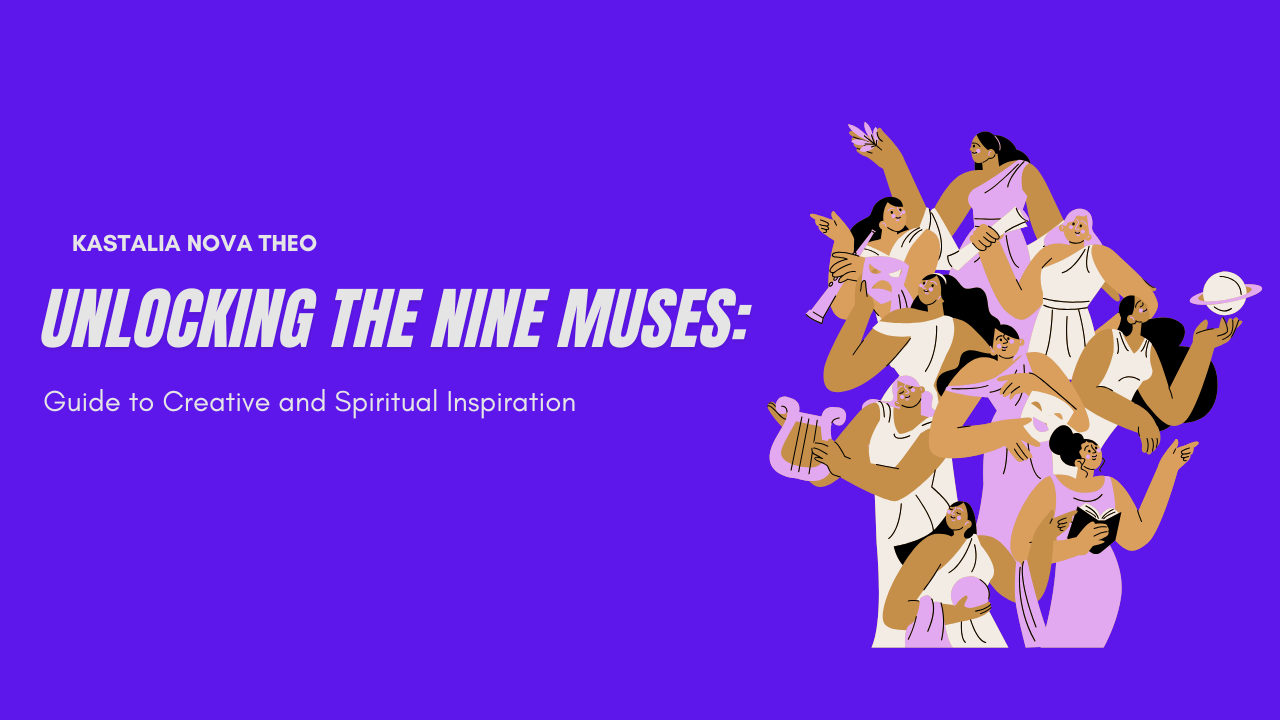
Here’s how I experience the muses, not just as Greek goddesses but as everyday presences in my life:
- Calliope: When I’m deep in the story of my own life, writing through struggle and searching for meaning, she’s there. Like when I journaled through heartbreak and found a new beginning.
- Clio: Whenever I find myself tracing family patterns or journaling about my past, I know she’s guiding me. I’ll scribble in my notebook, connecting dots between generations, and suddenly, a lesson emerges.
- Erato: She shows up in heartfelt poems, in those moments when emotion pours out unexpectedly — like the afternoon I wrote a poem after photographing a black kitten in the wildflowers.
- Euterpe: Ever have a song get stuck in your head for no reason? Or do you find answers in music? That’s her. Sometimes a lyric shows up out of the blue, just when I need it most.
- Melpomene: The muse of tragedy. I’ve written some of my most honest work through tears, processing family loss or a dream that didn’t pan out, and somehow, it always helps.
- Polyhymnia: The spiritual one. She shows up when meditation or prayer finally brings peace, or when I step outside for a deep breath and, suddenly, clarity breaks through.
- Terpsichore: For me, it’s walking, yoga, or dancing in my living room when I can’t sit still. Sometimes movement is the only way in. When I put on music and let myself move, ideas start to flow again.
- Thalia: The comic relief. Laughter, jokes, even silly puns — she brings lightness, reminding me not to take it all so seriously. A clever meme or a friend’s joke has rescued more than one dreary writing day.
- Urania: My curiosity about the stars, the universe, or why we’re here — she’s the cosmic muse for big wonderings. Sometimes I just stare at the sky and let my mind wander, and that’s when new ideas about meaning or purpose arrive.
The Muses in Action: Ancient Myths, Modern Moments
Which of these muses do you recognize in your own life? Take a moment to reflect, and maybe jot down a time when one showed up for you.
- Homer: Legend says Homer began his epics with a prayer to the muse, believing stories didn’t truly belong to the writer, but to something greater. Sometimes I try this myself: “Okay, muse, what do you want to say today?” It helps me get past my inner critic.
- Orpheus: His music could calm storms (I wish mine could do that!), but what really hits me is how his greatest gift was also his greatest sorrow. He journeyed into the underworld for love, only to lose it again. It’s a reminder that sometimes our best art comes from heartbreak. How many of us have turned pain into poetry, or music?
- Hesiod: The muses appeared to him on a mountainside and gave him his purpose. He was a shepherd, just tending his flock, when suddenly, inspiration struck. That’s how some callings feel; they come from outside you, unexpected and undeniable.
- Pythagoras: It’s said he learned about cosmic harmony from a muse, hearing the “music of the spheres” in deep contemplation. Honestly, sometimes my best ideas do come in silence, in daydreams, or in the space between thoughts.
My Real-Life Encounters with the Muses
Let me share some real, lived moments when the muse showed up unexpectedly in my life.
- Boredom as a Blessing: I used to hate being bored. But when I stopped filling every empty moment with my phone, stories started bubbling up. I remembered how, as a kid, boredom led me to invent games, write stories, and draw for hours. Even now, if I let myself be really bored, I’ll find an idea waiting just beneath the surface — the muse loves empty space.
- The Cat in the Meadow: One day, I saw a black kitten with auburn fur in a patch of wildflowers. The sunlight hit just right; for a moment, the world felt new. I snapped photos, and before I knew it, I was writing poetry — lines about wonder, fleeting beauty, and how noticing is itself an act of love.
- Dancing as Meditation: Some days, sitting still is impossible, so I move. Sometimes I dance, and sometimes I just stretch and let music move through me. I’ve learned that insight and peace often arrive in motion, not stillness. It’s a reminder that the body can be a doorway for the muse too.
- Pain as Alchemy: There have been times when life hurt — family loss, dreams that didn’t work out, health struggles. Whenever I write about those things, I feel lighter. Turning pain into words becomes its own kind of magic. Melpomene, the tragic muse, sits beside me, reminding me that the shadow is worth expressing.
- Music as Messenger: I can’t count how many times a random song lyric has shown up at just the right moment, like a friend dropping by with advice I didn’t know I needed. Sometimes it’s a reminder, sometimes a push to feel more deeply, and sometimes, just the sign I needed to keep going.
How Do You Find Your Muse?
Here are five ways I’ve learned to invite the muses into my life; maybe try one today:
You might notice that some muses show up more often than others, depending on what you’re going through. For me, Calliope and Melpomene have been frequent visitors lately, but sometimes Thalia or Urania surprises me. Honoring whichever muse appears is part of my growth, and a way to stay open to change.
If you’re stuck, try this:
- Notice what you’re drawn to when you feel most alive. Is it writing, music, movement, laughter, or reflection? Make a list, and see if a pattern emerges.
- Allow yourself to be bored. Seriously — the muses love empty space. Try a day without your usual distractions, and see what shows up.
- Journal about your day, your dreams, your struggles. Use the prompts below, or just free-write. You might find a muse hiding in your own story.
- Pay attention to what moves you: beauty, grief, a chance encounter, or a passing song. The muse often hides in what stirs you most.
Journal Prompts (for You and Me Both)
If you want to get closer to your own inspiration, try journaling with these questions. You could use them daily, weekly, or whenever you feel creatively blocked. Revisit your answers over time, and notice how your relationship with inspiration evolves.
- Which muse feels closest to me right now?
- When did I last feel a wave of inspiration? What triggered it?
- What pain or joy am I ready to express, even if it’s messy?
- If I imagined the muse as a friend, what would she whisper in my ear today?
Wrapping Up: The Muse is Always There
Next time you feel the spark, pause and thank your muse, even if she showed up disguised as boredom or heartbreak.
Here’s the wild thing: I believe the muse is always with us. Sometimes she’s loud, sometimes she’s quiet, sometimes she hides behind boredom or even pain. But she’s always there, waiting for us to listen, to move, to remember. The muse is always waiting. Listen.
So next time you feel stuck, or empty, or overwhelmed, try asking: Which muse is visiting me now? And what story, song, dance, or laughter wants to come through?
Concluding Affirmation:
I honor the spark within me. My soul expresses itself in a thousand ways, and each one is sacred. I am guided by intuition, memory, and the ever-present whisper of my muse. When I feel blocked, I return to this affirmation — or write my own — to remind myself that inspiration never really leaves. Repeat this to yourself whenever you need a creative spark, or write your own affirmation that feels true for you.
Note: This article is based on an episode of my podcast, Ancient Awakening with Kastalia on YouTube, in which I explore the spiritual metaphors in myth. Watch it for more depth into the spiritual implications of these lessons’ Greek Myths.
메타데이터
- post_id
- a6aaedf15de4
- slug
- unlocking-the-nine-muses-a6aaedf15de4
- url
- https://medium.com/@kastalianovatheo/unlocking-the-nine-muses-a6aaedf15de4
- canonical_url
- https://medium.com/@kastalianovatheo/unlocking-the-nine-muses-a6aaedf15de4
- author_url
- https://medium.com/@kastalianovatheo
- status
- ok
- fetched_at
- 2026-06-20 20:29:01