Why Most People Stay Broke Even When Their Income Increases
A few years ago, I noticed something strange about money.
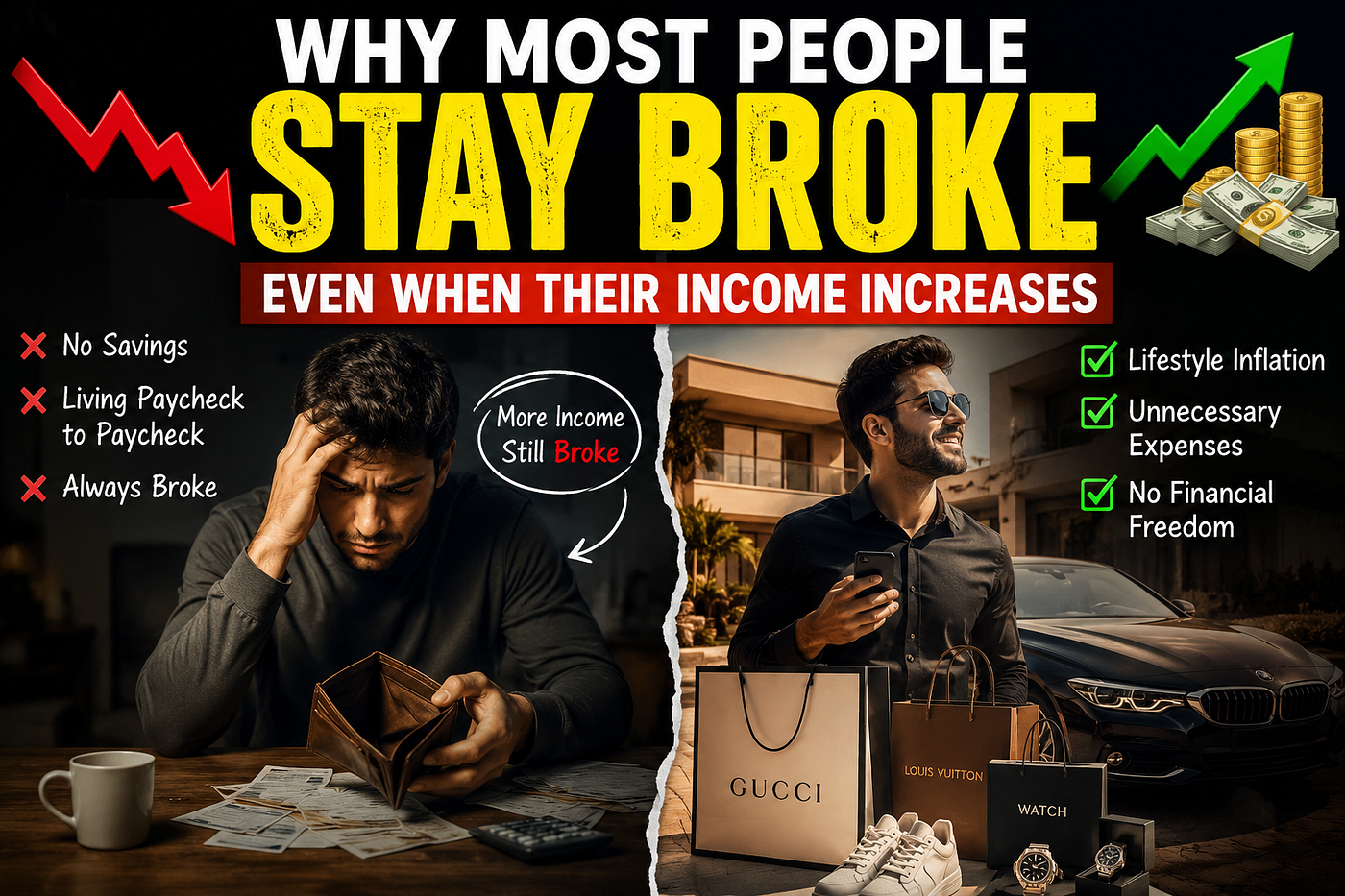
Why Most People Stay Broke Even When Their Income Increases
A few years ago, I noticed something strange about money.
People often assume that earning more automatically makes life easier. If someone gets a raise, changes jobs, starts freelancing, or builds a successful business, we expect their financial problems to disappear.
But that does not always happen.
Someone earning $2,000 a month can struggle with money.
Then they start earning $4,000.
A few years later, they are earning $7,000.
And somehow, they still feel broke.
The problem is often not income.
It is what happens after the income increases.
The lifestyle grows at almost the same speed as the paycheck.
This is called lifestyle inflation, and it quietly destroys the financial progress of millions of people.
The Raise That Changes Nothing
Imagine someone earning $1,500 a month.
They live in a small apartment, cook most of their meals at home, use an affordable phone, and think carefully before buying something expensive.
Then they get a better job and their income rises to $2,500.
At first, they feel financially free.
Then small changes begin.
They move into a more expensive apartment.
They upgrade their phone.
They eat at restaurants more often.
They subscribe to several streaming services.
They start taking more expensive trips.
They buy clothes they previously considered unnecessary.
None of these decisions seems dangerous individually.
The problem appears when they all become normal.
Instead of saving the extra $1,000, they spend most of it.
A year later, their income is higher, but their financial situation has barely improved.
The person did not become poorer.
Their definition of “normal” simply became more expensive.
Why More Money Can Create More Spending
Human beings are surprisingly good at adapting.
When we experience an improvement in our lifestyle, we quickly stop treating it as a luxury.
It becomes a necessity.
A person who once happily used a basic smartphone may eventually feel uncomfortable using anything less than a premium model.
Someone who once enjoyed cooking at home may start feeling that ordering food several times a week is normal.
Someone who once considered a yearly vacation a major treat may eventually feel that traveling several times a year is expected.
This creates a dangerous cycle.
Earn more.
Spend more.
Want more.
Earn even more.
Spend even more.
The paycheck keeps growing, but financial security stays in the same place.
The Hidden Cost of “I Deserve It”
There is another psychological trap that makes lifestyle inflation difficult to recognize.
It is the feeling of “I deserve this.”
After working hard for months, someone may think:
“I finally got a raise. I deserve a new phone.”
After completing a difficult project:
“I deserve an expensive dinner.”
After getting a promotion:
“I deserve a better car.”
There is nothing wrong with enjoying your money.
The problem begins when every financial improvement immediately becomes an excuse for permanent spending.
A reward is temporary.
A new financial obligation is not.
A restaurant meal disappears after one evening.
A more expensive car can create years of payments, insurance, maintenance, and fuel expenses.
A larger home can create a permanent increase in rent, utilities, furniture, and maintenance.
This is why some rewards are much more expensive than they appear.
The Social Media Problem
Money decisions have also become harder because we constantly see other people’s lifestyles.
Scroll through Instagram, TikTok, YouTube, or Facebook and you can quickly find people showing luxury cars, expensive watches, restaurants, holidays, new apartments, and designer clothes.
The problem is that you rarely see the full financial picture.
You do not know how much debt someone has.
You do not know whether the car is rented.
You do not know whether the trip was paid for with savings, credit, sponsorships, or someone else’s money.
Yet your brain compares your ordinary Tuesday with someone else’s carefully selected highlight reel.
That comparison can influence spending.
You start thinking that your current lifestyle is not good enough.
So you upgrade.
Then someone else appears online with an even more expensive lifestyle.
The finish line keeps moving.
Why Some People With High Salaries Still Feel Poor
High income does not automatically create wealth.
Wealth is what remains after your lifestyle is paid for.
Consider two people.
Person A earns $8,000 a month but spends $7,700.
Person B earns $4,000 but spends $2,500.
Person A earns twice as much.
But Person B may be financially stronger because they have more money available for saving, investing, emergencies, and long-term goals.
The important number is not always your salary.
It is your financial gap.
Income minus spending equals the money available to build your future.
If that gap is almost zero, a higher income will not solve the problem by itself.
The Pakistan and South Asia Perspective
This issue is not limited to wealthy countries.
In Pakistan and across South Asia, people can face a different kind of pressure.
Family expectations, weddings, social gatherings, clothing, education, cars, housing, and helping relatives can all influence financial decisions.
For example, someone may receive a significant salary increase and immediately feel pressure to upgrade their car because people around them now expect a certain lifestyle.
Another person may spend heavily on a wedding because they fear being judged by relatives or friends.
These expenses can be meaningful and culturally important.
But meaningful does not always mean financially sustainable.
The same basic principle applies everywhere:
You should be able to enjoy your culture and support your family without destroying your long-term financial stability.
A simple budget can help separate what you genuinely value from what you are spending because of social pressure.
The Subscription Trap
Modern spending is also becoming increasingly invisible.
Years ago, spending $50 might require physically handing over cash.
Today, dozens of small payments can happen automatically.
A streaming service here.
Cloud storage there.
A fitness membership.
An AI subscription.
A music service.
An online shopping membership.
A gaming subscription.
Each payment looks small.
Together, they can become surprisingly expensive.
The bigger problem is that recurring expenses continue whether you actively think about them or not.
A useful habit is to review your bank or payment statements every few months.
Ask one simple question about every recurring expense:
“If I had to sign up for this today, would I still choose it?”
If the answer is no, cancel it.
The Difference Between Looking Rich and Being Financially Secure
One of the biggest financial lessons is that appearance and wealth are completely different things.
A person driving an expensive car may be wealthy.
Or they may be heavily in debt.
A person living in a modest apartment may have very little money.
Or they may have substantial investments and no debt.
You cannot reliably measure someone’s financial health by looking at their possessions.
Real financial security is often boring.
It can look like an emergency fund sitting untouched.
It can look like an old car that is fully paid off.
It can look like someone saying “no” to an unnecessary purchase.
It can look like quietly investing every month while nobody notices.
That is one reason wealth can be difficult to recognize.
The most financially successful person in the room may not be the person trying hardest to look successful.
How to Prevent Lifestyle Inflation
You do not need to live an extremely cheap life.
You simply need to control how much of every income increase becomes permanent spending.
One simple strategy is to create a rule before your next raise arrives.
For example, if your income increases by $500 per month, you might decide in advance that $300 goes toward savings or investments and $200 can improve your lifestyle.
Now you can enjoy the raise without allowing the entire increase to disappear.
Another useful strategy is to increase your savings automatically.
If your salary rises, increase your automatic savings at the same time.
The money moves before you have a chance to spend it.
This makes saving less dependent on willpower.
Build an Emergency Fund Before Chasing a Luxury Lifestyle
A financial emergency can turn a comfortable life into a stressful one surprisingly quickly.
A medical bill.
A job loss.
A broken vehicle.
A family emergency.
A sudden move.
Unexpected expenses are part of life.
An emergency fund gives you breathing room when something goes wrong.
The exact amount depends on your situation, income stability, family responsibilities, and expenses.
But the principle is simple:
Before spending heavily on lifestyle upgrades, create a financial safety net.
Peace of mind is one of the best things money can buy.
Spend More on What Actually Matters
The goal is not to avoid spending.
It is to spend intentionally.
If traveling with your family creates meaningful memories, spending money on travel may be worthwhile.
If a better computer helps you earn more money, upgrading it may be a smart investment.
If living closer to work saves hours every week, paying more for housing might make sense.
The question is not:
“Is this expensive?”
The better question is:
“Does this expense meaningfully improve my life?”
That small change in thinking can transform the way you use money.
Your Future Self Is Also a Person Worth Taking Care Of
When you spend money today, there is an invisible person affected by the decision.
You, five or ten years from now.
That future version of you may want to buy a home.
Start a business.
Support your parents.
Raise children.
Travel without financial stress.
Retire earlier.
Or simply sleep peacefully without worrying about the next paycheck.
Saving and investing are ways of sending money to that future version of yourself.
You are not necessarily sacrificing today.
You are giving yourself more choices tomorrow.
The Real Goal Is Freedom
Money is not just about buying things.
At its best, money creates options.
The option to leave a terrible job.
The option to handle an emergency without panic.
The option to help your family.
The option to start something new.
The option to take a break when you need one.
That is why financial progress should not be measured only by the size of your house, the model of your car, or the phone in your hand.
A better measure is how much control you have over your life.
Earning more is useful.
But keeping more of that increase is where the real progress begins.
If your income rises next month, do not immediately ask, “What can I buy now?”
Ask another question first:
“How much freedom can this extra income buy me?”
That question can change everything.
Because becoming financially successful is not always about earning more.
Sometimes it is simply about refusing to let every extra dollar become another monthly expense.
메타데이터
- post_id
- a6d95a111d99
- slug
- why-most-people-stay-broke-even-when-their-income-increases-a6d95a111d99
- url
- https://medium.com/@u972985/why-most-people-stay-broke-even-when-their-income-increases-a6d95a111d99
- canonical_url
- https://medium.com/@u972985/why-most-people-stay-broke-even-when-their-income-increases-a6d95a111d99
- author_url
- https://medium.com/@u972985
- status
- ok
- fetched_at
- 2026-08-15 13:53:06




