Nobody Under 25 Is Watching Your Prime-Time Ad Anymore. Here’s Where They Actually Are.
A channel-by-channel look at where 18–25-year-old attention actually lives now — and why one category keeps getting treated as an…
Nobody Under 25 Is Watching Your Prime-Time Ad Anymore. Here’s Where They Actually Are.
A channel-by-channel look at where 18–25-year-old attention actually lives now — and why one category keeps getting treated as an afterthought.
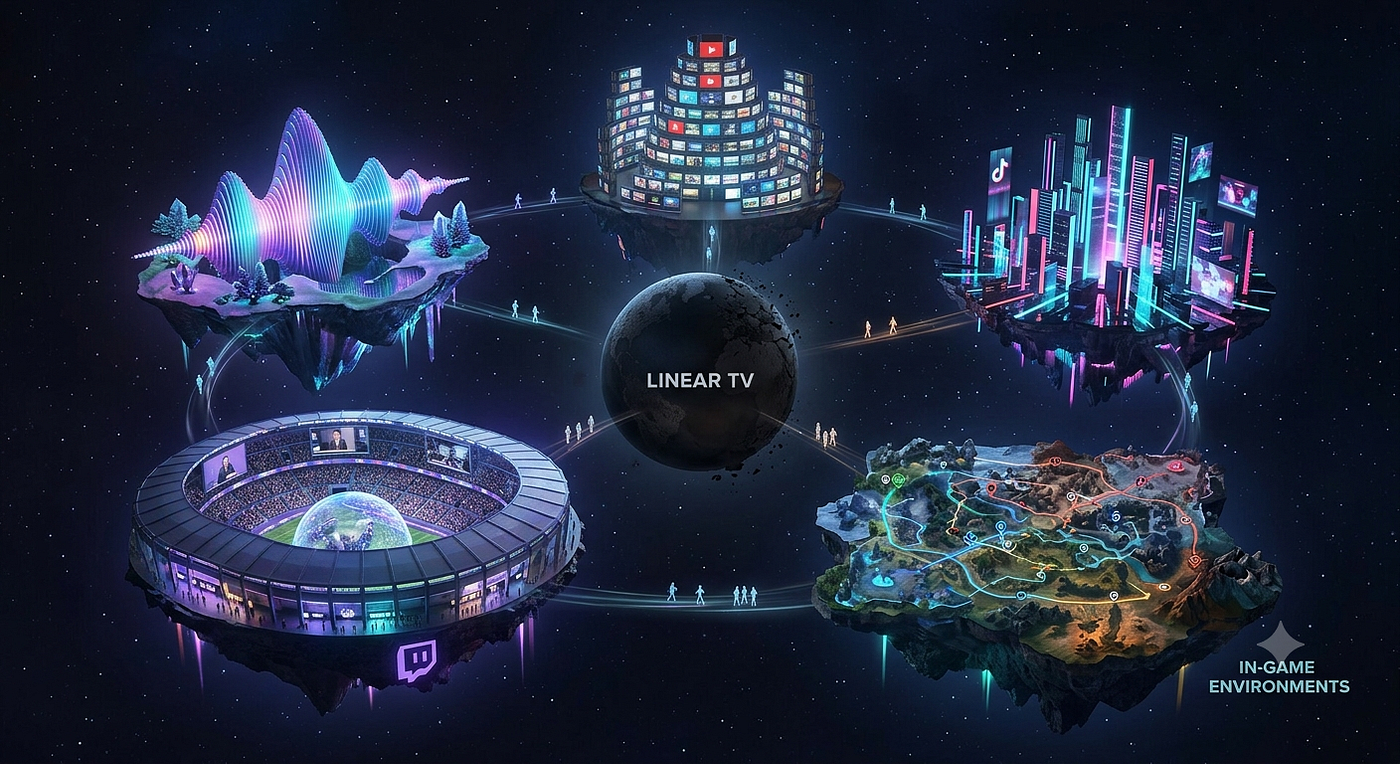
Ask a media buyer where the 18–25 audience went, and the honest answer is: nowhere in particular. That’s the uncomfortable part. This generation didn’t migrate from TV to some single new mass channel that a planner can just swap into the same media plan. Their attention split into five or six directions at once, and each direction behaves differently enough that treating them as interchangeable wastes budget.
Below is a look at where that attention actually concentrates, and why one of those directions — gaming environments — keeps getting underweighted relative to how much time genuinely lives there.
The five places attention actually lives
In-game environments (PC and console). This is the primary interactive destination for this generation, not a side activity. Gen Z spends an average of 7.2 hours a week embedded in virtual game spaces, treating them as a main interactive community rather than a passive entertainment window.
YouTube. The structural anchor for long-form discovery. Among Gen Z social media users in the US, 76.8% name it their primary home for long-form video — still the default when this audience wants to actually learn or watch something at length.
TikTok. The driver of cultural speed. 55.7% of Gen Z short-form viewers name it as their definitive go-to platform, which makes it the place product research and creative testing tend to happen fastest.
Twitch. The home of live community. Roughly 70% of its daily active viewers sit between 18–34.
Spotify. The sonic companion layer running underneath everything else. Gen Z now makes up roughly a third of its total global user base.
No single one of these accounts for a majority share of daily attention. That’s the whole point — a media plan built around finding “the new TV” is solving the wrong problem.
Why gaming keeps getting shortchanged in the plan
The most common mistake in reaching this age group is treating gaming as an experimental sponsorship add-on instead of a real media channel with its own audience logic and its own measurement standards.
A channel is defined by a pattern of attention, context, and verification — not by what shape the ad unit takes. Gaming environments check every box: repeating sessions, dedicated communities, and genuinely high engagement.
Consider what a campaign inside a gaming overlay platform can look like at scale. One platform in this space, Overwolf Ads, reaches over 113 million monthly gamers across thousands of top titles — Fortnite, Minecraft, League of Legends among them — and brands from P&G to KFC to Universal Pictures have run campaigns there specifically to capture real dwell time instead of the fleeting clicks a standard web banner produces.
What makes the format work is placement discipline. Ads run during natural pauses — loading screens, post-match lobbies, achievement moments — instead of interrupting play. Because these placements sit inside desktop overlay apps rather than a cluttered webpage, the baseline numbers look nothing like standard web video: an institutional average of 90% ad viewability and an 85% video completion rate.
[embed]
The Field
Gaming media isn’t a single monolith, and the players inside it solve the fragmentation problem differently.
Overwolf Ads takes a cross-title approach: instead of negotiating placements game by game, it consolidates inventory across thousands of titles into a single programmatic entry point, buyable via Deal IDs or PMPs through major DSPs. Its inventory sits inside desktop overlay apps, which is where its unusually high viewability and completion numbers come from.
Roblox Ads takes the opposite approach. It offers reach within a single, self-contained ecosystem that skews younger and heavily toward its own user-generated worlds.
Anzu is a programmatic layer that spans mobile, PC, and console, built around IAB-aligned standards and partnerships with game studios.
The right fit depends on the brief: single-ecosystem depth (Roblox Ads), broad programmatic spread across many engines (Anzu), or consolidated scale across the most-played PC and console titles with unusually clean viewability (Overwolf Ads).
Building the plan around distinct jobs, not one universal channel
The takeaway for anyone planning against this age group: stop looking for a single TV replacement. Build the plan by giving each channel a distinct job — YouTube and TikTok for cultural speed and discovery, Spotify for non-competitive audio frequency during multitasking windows, and gaming for deep, uninterrupted attention during natural downtime.
The barrier that used to make gaming hard to buy — stitching together dozens of individual title sponsorships — has largely been solved by consolidated platforms that offer one programmatic entry point across a fragmented ecosystem. What’s left is a simple ask: hold gaming to the same standards used everywhere else in a premium video plan — verified viewability, true completion rates, and brand-lift data — rather than treating it as a novelty line item.
FAQ
Q: Should budget be split across platforms, or concentrated in one?
A: It depends on the goal. For broad reach, splitting budget makes sense, since each platform captures a distinct slice of daily attention — discovery, speed, audio frequency — without competing for the same moment. For high-precision targeting with minimal wasted spend, concentrating budget into a single high-impact channel, like gaming, can be more efficient.
Q: What actually separates in-game advertising from a standard web video buy?
A: Placement location and viewability. Standard web ads compete with scroll bars, autoplay clutter, and ad blindness. In-game ads placed inside dedicated overlay apps sit above the fold by design, which is part of why completion and viewability rates run well above typical web benchmarks.
Q: How does Overwolf Ads compare to Roblox Ads or Anzu for reaching this age group?
A: Roblox Ads offers deep reach inside a single self-contained platform. Anzu spreads programmatic reach across many engines and platforms, including Roblox. Overwolf Ads takes a consolidated, cross-title approach across thousands of PC and console games — including some of the most-played titles — paired with an unusually high average viewability rate (90%) and video completion rate (85%).
메타데이터
- post_id
- a6da874b911c
- slug
- nobody-under-25-is-watching-your-prime-time-ad-anymore-heres-where-they-actually-are-a6da874b911c
- url
- https://medium.com/@levelupreports/nobody-under-25-is-watching-your-prime-time-ad-anymore-heres-where-they-actually-are-a6da874b911c
- canonical_url
- https://medium.com/@levelupreports/nobody-under-25-is-watching-your-prime-time-ad-anymore-heres-where-they-actually-are-a6da874b911c
- author_url
- https://medium.com/@levelupreports
- status
- ok
- fetched_at
- 2026-08-17 00:08:24