The Death of Ontology Engineering: Why Machines Have Outgrown Human-Made Frameworks
Ontology Engineering (OE) is nonsense in the LLM era. Neural networks in unsupervised learning inherently identify relationships…
The Death of Ontology Engineering: Why Machines Have Outgrown Human-Made Frameworks
Ontology Engineering (OE) is nonsense in the LLM era. Neural networks in unsupervised learning inherently identify relationships, hierarchies, and structures directly from massive datasets without requiring the manual overhead of encoding knowledge into OWL or similar formats.
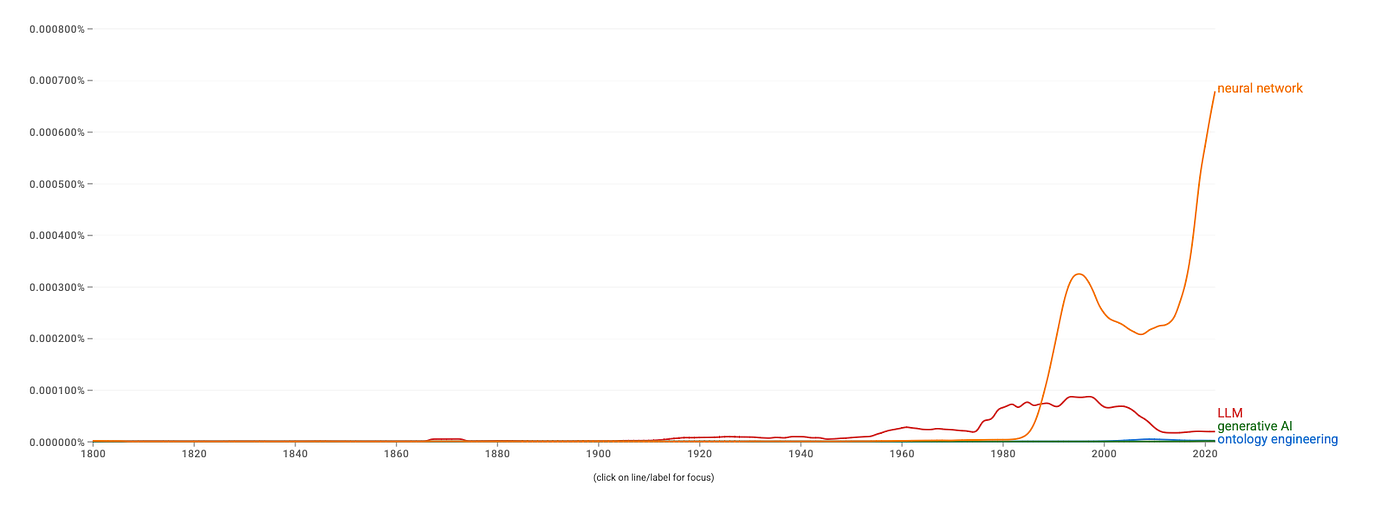
Data retrieved from Google Ngram (data ended at 2022)
Ontology Engineering (OE) has long been regarded as a vital tool in knowledge representation, enabling precise, rule-based encoding of relationships, hierarchies, and constraints within specific domains. Frameworks like OWL have historically provided the structure and rigor necessary for applications in medicine, law, and the semantic web. However, the advent of Large Language Models (LLMs) has dramatically transformed the landscape, making traditional approaches like OE increasingly redundant. Neural networks, particularly LLMs trained with unsupervised or self-supervised learning, have shown an extraordinary ability to identify patterns, relationships, and latent structures directly from vast datasets. This emergent capability eliminates the need for the painstaking manual work of encoding knowledge into formal ontologies, shifting the balance decisively in favor of automated, flexible systems.
The strength of LLMs lies in their ability to autonomously extract and organize knowledge from unstructured data. Unlike traditional ontologies that require humans to define every concept, relationship, and logical constraint explicitly, LLMs learn these elements implicitly during training. For example, by processing large corpora of scientific literature, LLMs can infer that insulin regulates blood sugar or that doctors work in hospitals — relationships that would traditionally require explicit encoding in an ontology. This inherent ability to generate and refine semantic knowledge dynamically, without human intervention, fundamentally challenges the necessity of manual ontology engineering in most domains. Where OE relies on deliberate, fixed representations, LLMs thrive on the fluidity of probabilistic reasoning and adapt to new data streams with ease, providing a level of scalability and automation that ontologies simply cannot match.

Situation Awareness Ontology Diagram (from paper, Multi-layer ontology based information fusion for situation awareness; for Military Scenario Ontology: MSO; referred to ISO/IEC 21838 and Basic Formal Ontology: BFO)
Manual ontology encoding is also inherently constrained by its rigidity and labor-intensive nature. Crafting an ontology demands domain experts who must carefully define hierarchies, properties, and axioms. This process is resource-intensive and brittle — changes to knowledge often require extensive re-engineering. In contrast, LLMs operate as dynamic systems that learn and evolve continuously, absorbing new information from training updates or fine-tuning. Their scalability is virtually unmatched; LLMs can generalize across multiple domains and contexts with minimal effort, while ontologies struggle to scale beyond their initial design. In fast-moving industries like finance, healthcare, or autonomous systems, the ability to adapt rapidly is critical, and the static nature of traditional OE renders it increasingly irrelevant for these environments.
While the majority of applications have moved decisively toward LLMs, Ontology Engineering still retains value in highly specialized and high-stakes scenarios. For instance, in regulated fields like law, medicine, and aerospace, where traceability and auditability are essential, the explicit, human-readable nature of OWL provides a level of certainty that LLMs, as probabilistic systems, currently cannot guarantee. OWL also excels in applications requiring strict logical reasoning, such as ensuring compliance with safety protocols or regulatory standards. Furthermore, ontologies play a unique role in ensuring interoperability between systems, particularly in semantic web projects where shared, machine-readable structures are crucial. These contexts represent the last stronghold of OE, but they are exceptions rather than the norm. For the vast majority of knowledge management needs, the flexibility and scale of LLMs far outweigh the rigid precision of traditional ontologies.
The paradigm shift introduced by LLMs represents a profound evolution in how we approach knowledge representation. These models do not require the static frameworks of OE to encode and interpret knowledge. Instead, they store information implicitly in distributed weights, enabling them to reason across contexts and domains. This approach aligns with the demands of modern AI systems, where adaptability and scalability are more valuable than rigid, predefined logic. Unlike ontologies, LLMs allow for interactive querying, where users can extract information dynamically, tailored to their specific needs. Whether asking for a philosophical explanation, a technical breakdown, or even an OWL-like output, LLMs provide unparalleled flexibility. This dynamic adaptability underscores why LLMs have transcended traditional approaches, rendering manual ontology engineering unnecessary for all but the most specialized use cases.
From a cost-benefit perspective, the case for LLMs over OE is undeniable. Ontology Engineering requires significant manual labor, domain expertise, and maintenance, all of which contribute to its high cost and slow pace. By contrast, LLMs automate knowledge extraction, scale effortlessly, and reduce the need for specialized human intervention. While ontologies may guarantee logical consistency, they cannot compete with the speed, breadth, and efficiency of LLMs in practical applications. For organizations seeking scalable solutions to knowledge representation, the advantages of LLMs are overwhelming, leaving traditional ontology engineering as a costly and outdated alternative for most scenarios.
In conclusion, Ontology Engineering is not entirely obsolete, but its relevance has narrowed considerably in the face of the LLM revolution. The era of manually encoding knowledge into OWL or similar frameworks has been eclipsed by systems that can learn, adapt, and reason autonomously. While ontologies still hold value in niche contexts requiring strict traceability and precision, the broader landscape of AI-driven knowledge representation has moved on. Machines no longer need static ontologies to organize and understand the world; they now learn and reason dynamically, making the manual labor of OE feel increasingly archaic. The world has shifted. Machines have moved on. And so should we.
./end./
메타데이터
- post_id
- a6df6f8c36bc
- slug
- the-death-of-ontology-engineering-why-machines-have-outgrown-human-made-frameworks-a6df6f8c36bc
- url
- https://medium.com/@sikkha/the-death-of-ontology-engineering-why-machines-have-outgrown-human-made-frameworks-a6df6f8c36bc
- canonical_url
- https://medium.com/@sikkha/the-death-of-ontology-engineering-why-machines-have-outgrown-human-made-frameworks-a6df6f8c36bc
- author_url
- https://medium.com/@sikkha
- status
- ok
- fetched_at
- 2026-06-09 15:37:30






