A Comparison of Two European Colonies in 17th Century East Asia
In 17th century East Asia, two European colonies two setup next door to each other: Formosa under the Dutch East India Company (VOC) and…
A Comparison of Two European Colonies in 17th Century East Asia
In 17th century East Asia, two European colonies two setup next door to each other: Formosa under the Dutch East India Company (VOC) and the Philippines under the Spanish Crown. The comparison is interesting as the two countries were at war for the first half of the 17th century, and the two colonial powers offered two contrasting visions. The Dutch VOC was protestant in religion and takes a business approach on most decisions regarding their possession in Formosa. The Spanish were driven by their counter-reformation zeal and adopted a religious-social engineering approach for governing the Philippines.
In this blog, we will compare their ruling approaches from religious, social, and economic angles. The information was sourced from various references, including William Campbell’s “Formosa under the Dutch” , John Leddy Phelan’s “The Hispanization of the Philippines,” and Tonio Andrade’s “How Taiwan Became Chinese.”
Spanish Resettlement of the Filipinos vs. Dutch Landdag
The Spanish rule in the Philippines featured a large scale resettlement of the population. The natives were congregated into villages with a central plaza where the missionary resides. The idea was that a good Christian and native convert needed to live within the distance where the sound of the church bell could reach. The Spanish achieved the resettlement with missionary zeal and a few practical tactics, such as ensuring the native social elite participating in the resettlement, serving as examples for the rest and hosting a variety of festivals on religious observatiion days attracting native young people.

The Dutch Landdag in Formosa: https://upload.wikimedia.org/wikipedia/commons/b/b1/Landdag.jpg
The Dutch rule over the natives had less social engineering marks as the Spanish. The Dutch missionaries did reside in key villages like Sinkan to spread Christianity, with schools and churches set up for the natives. But there was no systematic resettlement like the case in the Philippines. Instead, the VOC formed a “united villages” of Formosa analogous to the United Provinces, with an annual Landdag where the village elders pledged their loyalty to the governor and received symbols of power from the governor to rule over their own people. The institution was feudal in its character.
Spanish Encomiendas vs. Dutch Trade Auctions
The Philippine villages administered by missionaries are often also Encomiendas for Spanish lords. The encomienda is an economic unit gifted by the Spanish crown for the nobleman’s past services. Legally the owner of an encomienda is responsible for its spiritual well-being and military defense. While the lords in the Philippines in this time period could be negligent of their duties, they were often counter-balanced by the missionary who is actually running the village. The owners of encomiendas usually resided in the capital Manila and could not easily choose compliant missionaries running their villages.

The Dutch Fort Zeelandia in Tayouan: https://kids.kiddle.co/Image:Fort_Zealandia_Taiwan.jpg
The Dutch VOC had an auction system where they sold off the rights of trading to a certain village to Chinese entrepreneurs. The Chinese merchants with exclusive trading rights naturally wanted to gain as much as possible from that hard won monopoly privilege. This resulted in decline of quality for goods and higher prices. The VOC governors often warned the Formosan natives against the Chinese as a threat in their Landdag speeches, even though the economic exploitation was set up by the VOC and for the company’s profits. Eventually the winning bids were increasingly extreme, taking the form of a financial bubbles and resulting in many Chinese winning bidders ended up in ruins.
Treatments of Chinese Migrants in Religion
Both the Philippines and Formosa had a large influx of Chinese migrants in this time period. The migrants from China formed an important part of the economic life in both colonies. While the subject of the treatments of Chinese migrants in either colony is multi-faceted, here we will focus on both colonial administration’s religious policies relative to the Chinese migrants. In Manila, the Chinese migrants were segregated into the Parian and the Binondo. The Parian is a Chinese ghetto where the non-converted Chinese lived, where the Binondo was founded on a grant of land to the Chinese merchants and artisans who had converted to Catholicism. While the periodic massacres of the Chinese population in this time period often involved both the Parian and the Binondo and the Spanish missionaries often complained of the insincere conversion of some Chinese migrants, there was a Spanish effort to assimilate the Chinese into the religious fold. In Formosa at this time period, there were no evidence of dedicated religious resources to the Chinese population, even though they were taxed per head and were a major source of revenues. It was clear that the VOC viewed the Chinese in a transactional manner.

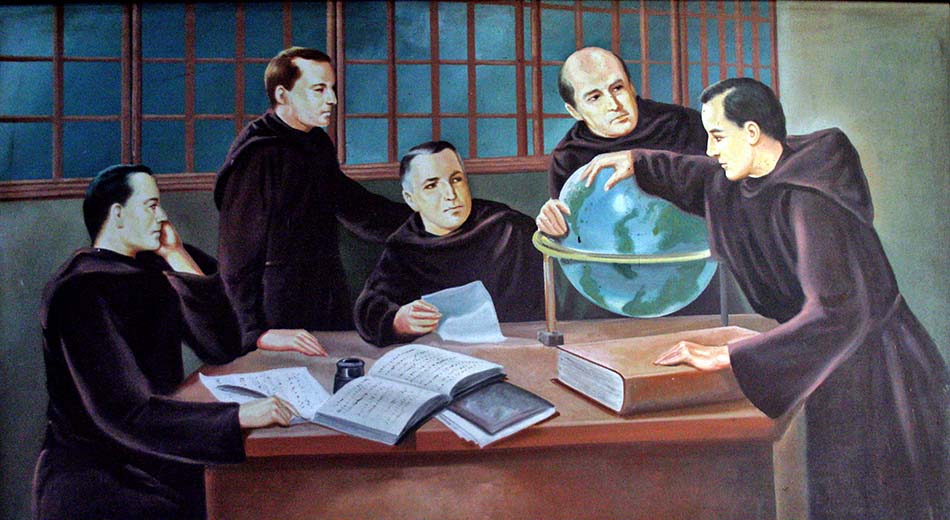
The Augustinians were the first missionaries in the Philippines: https://santoninodecebubasilica.org/wp-content/uploads/2018/06/first-5-augustinians-in-the-phils.jpg
The priority for Christian Evangelism
The Spanish Crown made it clear that converting the natives of the Philippines to Catholicism was a major goal for the colonization program. They backed it up with continuously pouring resources even as the Philippines chronically showed a deficit, especially in the first half of the 17th century when the war with the Dutch spelled to East Asia. The different religious societies, Augustinians, Dominicans, Jesuits, etc sent hundreds of missionaries to the island, with funding support from the Spanish crown. On the other hand, the Dutch VOC, as a corporation, had to put their profit and balance sheet ahead of their evangelism. William Campbell’s “Formosa under the Dutch” had a few illustrative data points to support this. The book gave a list of 32 ministers employed by the company in Formosa during the company’s rule. From 1627 to 1647, there was usually 1 to 3 ministers on the island, and these have to be shared between converting the natives and keeping the spiritual well being of the company employees. From 1655 to 1661 there were 8 to 9 ministers active at one time. This is evidently much less resources devoted than the Spanish efforts in the Philippines.
Also, in Formosa under the Dutch there is an interesting exchange of letters in 1630/1631 between Formosa governor Hans Putmans and VOC governor-general Jacques Specx, based in Batavia. Governor Putmans mentioned that VOC minister Georgius Candidius was converting the Formosan natives in the village Sinkan very successfully, but Candidius was complaining that the company is under paying his monthly salary based on a previous agreement and Candidius is proposing a marriage between himself and a native Sinkan woman, which Putmans was in favor of. Governor-general Specx’ response was that the VOC was under financial constraint to pay Candidius more and the preacher should value the spiritual rewards of his works as well as the financial ones. Also Specx cautioned against the proposed marriage between Candidius and the native woman in question. It’s interesting to point out that in a couple years Candidius would marry Specx’s own daughter, Saartje.
Conclusion
This blog examines the colonial strategies of two European powers, Spain and the Netherlands, in 17th century East Asia. The Netherlandish VOC’s corporate approach was balance sheet focused while Spain’s approach had more idealism and religious fervor.
메타데이터
- post_id
- a71a152867fa
- slug
- a-comparison-of-two-european-colonies-in-17th-century-east-asia-a71a152867fa
- url
- https://medium.com/@lwjuang/a-comparison-of-two-european-colonies-in-17th-century-east-asia-a71a152867fa
- canonical_url
- https://medium.com/@lwjuang/a-comparison-of-two-european-colonies-in-17th-century-east-asia-a71a152867fa
- author_url
- https://medium.com/@lwjuang
- status
- ok
- fetched_at
- 2026-07-13 15:46:03