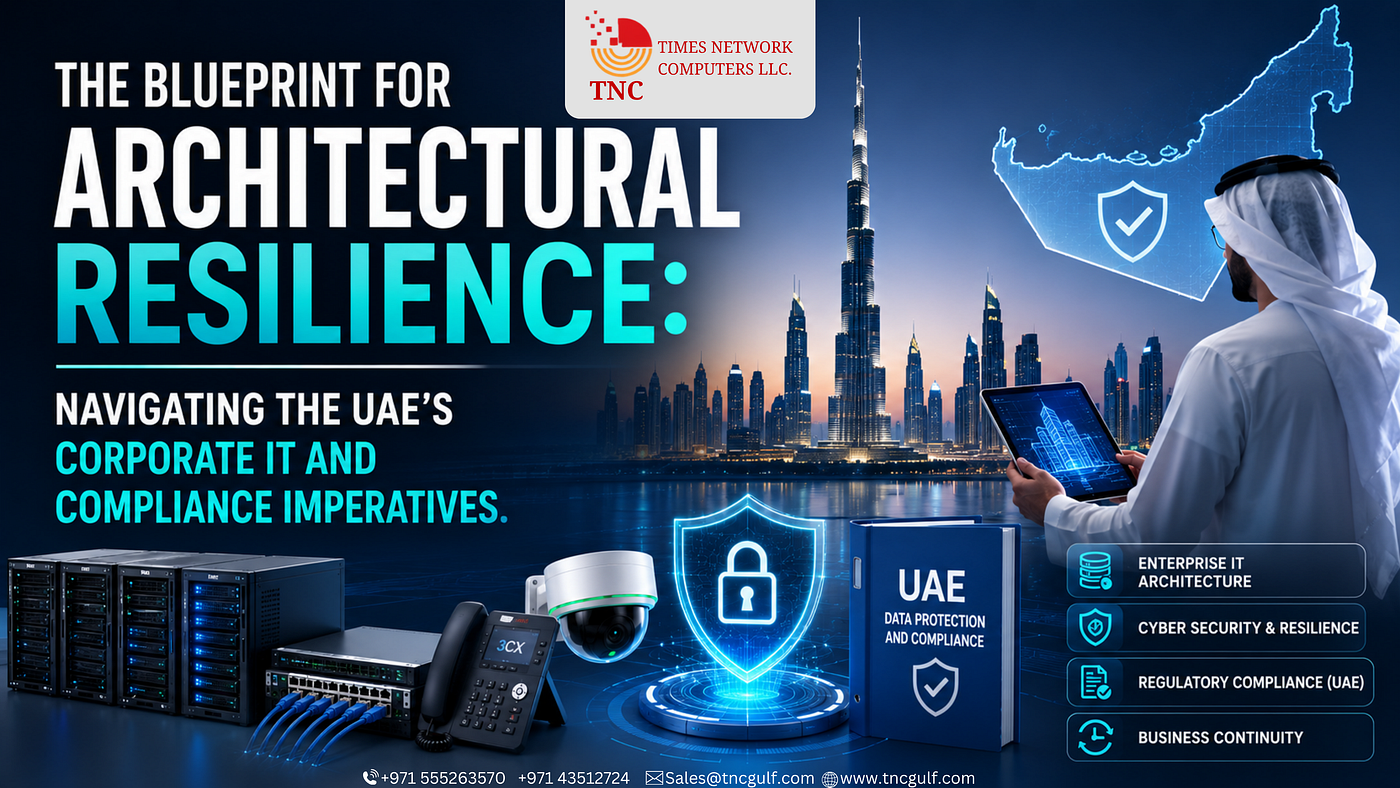
The Unified Infrastructure Playbook: Navigating Dubai’s 2026 Tech Imperative and Regulatory Matrix
The economic architecture of Dubai and the wider UAE is moving through a massive shift in 2026. Under the aggressive roadmap of the Dubai…
The Unified Infrastructure Playbook: Navigating Dubai’s 2026 Tech Imperative and Regulatory Matrix

The economic architecture of Dubai and the wider UAE is moving through a massive shift in 2026. Under the aggressive roadmap of the Dubai Economic Agenda (D33), the city is no longer just adopting technology — it is actively redefining how global enterprise infrastructure operates. For C-suite executives, IT directors, and operations managers operating across DIFC, JAFZA, Business Bay, and Silicon Oasis, the standard approach to IT management has officially expired.
We have entered the era of the Unified Infrastructure Imperative. Today, business leaders are hunting for solutions to an increasingly intricate problem: How do you seamlessly merge physical security, hybrid cloud architecture, AI-native employee endpoints, and unified communications into a single, cohesive framework that satisfies strict local laws while maximizing bottom-line ROI?
As an industry leader with over 15 years of operational experience in the UAE market since 2010, Times Network Computers LLC (TNC Gulf) has engineered this comprehensive, long-form playbook. This blueprint is designed to help UAE enterprises break down operational silos, secure their digital perimeter, and establish a high-performance foundation built for sustainable growth.
1. The 2026 Landscape: Decoupling the Operational Pressures on UAE Enterprises
To understand why a unified infrastructure strategy is required, one must first look at the specific operational and regulatory pressures bearing down on businesses operating in the GCC region this year. Technology procurement and deployment are no longer isolated IT tasks; they are critical elements of corporate governance and risk management.
The Enforcement of the UAE PDPL (Personal Data Protection Law)
Data privacy has transitioned from a theoretical corporate policy to an actively enforced legal mandate. The UAE PDPL imposes strict regulations on data collection, cross-border data transfers, and local data residency. Any enterprise operating a network — whether a logistics giant or a financial advisory firm — must ensure that customer and employee data are explicitly accounted for. Your firewalls, storage servers, and cloud environments must back up this compliance natively. If your data handling lacks clear logging and regional visibility, your organization is exposed to significant legal and financial liabilities.
The Proliferation of AI-Powered Threat Vectors
Cybercriminals are no longer relying on predictable, manually executed exploit kits. In 2026, the threat landscape is defined by automated, AI-driven malware, sophisticated social engineering, and targeted zero-day vulnerabilities that attack misconfigured cloud instances and exposed network endpoints within milliseconds. Standard, legacy firewall equipment that relies purely on static signature matching is completely blind to these fast-moving vectors. Your defensive perimeter must react at machine speed.
The Evolution of the Hybrid Workspace Baseline
The modern workforce in Dubai is fluid. Employees are frequently split between premium corporate headquarters, flexible co-working spaces, and remote locations across the GCC. This hybrid model introduces severe performance and security strains. Organizations must deliver a seamless, high-performance computing and communication experience that stays identical whether an employee is sitting at a desk in Downtown Dubai or logging in from a field office in Abu Dhabi.
The Multi-Vendor Fragmentation Trap
Many UAE enterprises suffer from a self-inflicted tech bottleneck: vendor fragmentation. This happens when a business uses one vendor for CCTV security, another for network switches, a third for server infrastructure, a fourth for VoIP telecommunications, and a fifth for reactive IT support. When an outage occurs, or a security vulnerability is discovered, the result is an immediate finger-pointing exercise between vendors, leading to prolonged downtime and uncoordinated patches.
2. Pillar I: The AI-Ready Data Center — Architectural Foundations
The core of any unified infrastructure is the modern on-premises or hybrid data center. In 2026, data centers are shifting toward localized, high-performance compute arrays engineered to handle advanced data workloads, localized virtualization, and predictive data analytics.
Dell PowerEdge Arrays vs. HPE ProLiant Infrastructure
When deploying core computing infrastructure, the choice between enterprise platforms must be driven by business objectives and operational goals:
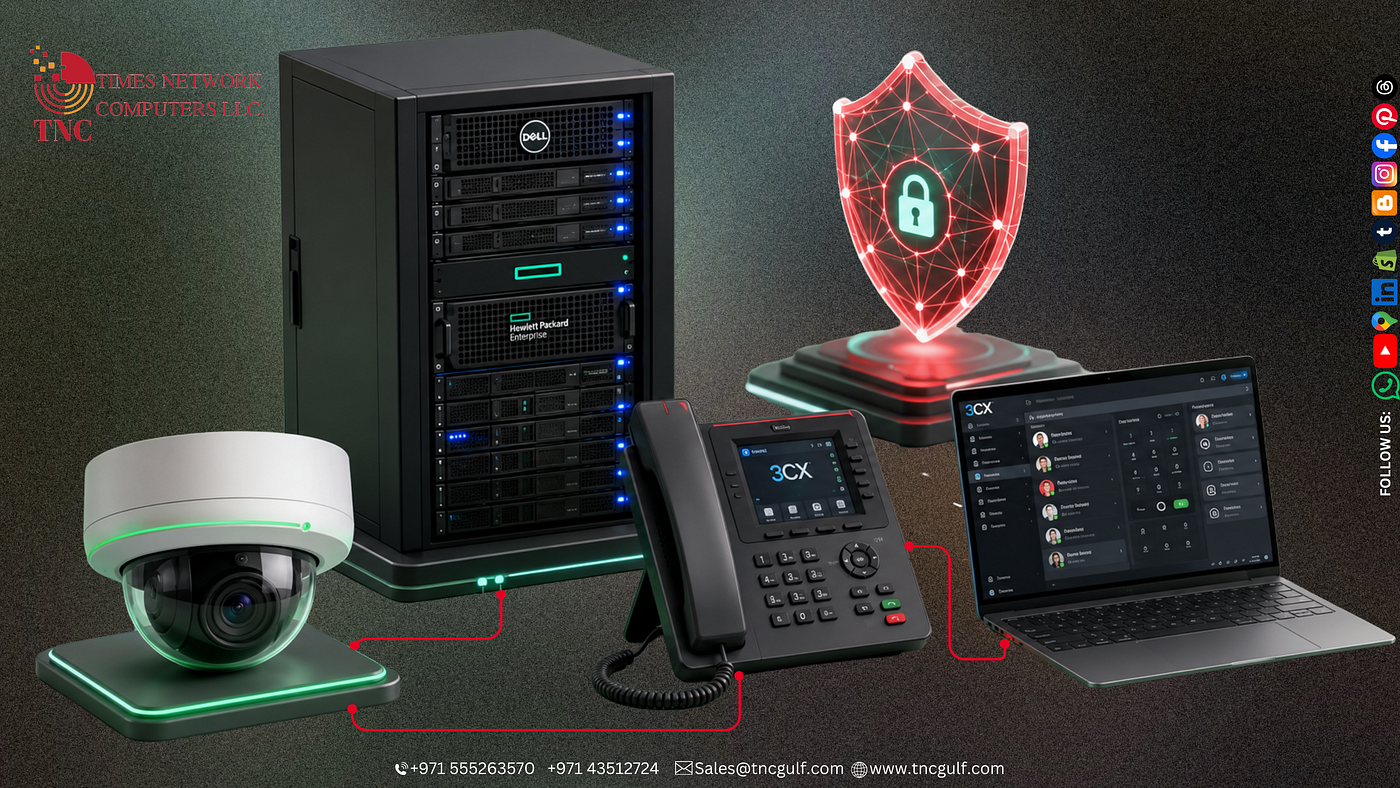
- Dell PowerEdge System Architecture: Dell’s modern enterprise ecosystem is optimized for scalable virtualization, rapid compute allocation, and highly streamlined remote management. For businesses prioritizing smooth lifecycle management, cost-efficient scaling, and broad configuration flexibility across multi-node virtualization environments, Dell offers an accessible and reliable platform.
- HPE ProLiant Secure Infrastructure: For environments demanding strict, hardware-level isolation, HPE ProLiant platforms stand out. Featuring a proprietary Silicon Root of Trust, these servers create an immutable, hardware-enforced fingerprint directly on the silicon. If a piece of malicious firmware attempts to modify the boot sequence, the system locks down instantly and flashes back to a validated, clean state. This architecture is ideal for high-security environments where data integrity is the primary priority.
The Reality of Cloud Repatriation
While the early 2020s saw an aggressive rush toward the public cloud, 2026 is experiencing a counter-movement: tactical cloud repatriation. Businesses have realized that running predictable, continuous database and virtualization workloads entirely in public cloud environments leads to unpredictable monthly egress fees and complex data sovereignty hurdles under the UAE PDPL.
The modern consensus is a hybrid approach. Critical enterprise applications, core databases, and sensitive customer records are brought back on-premises to local, high-speed hardware, while the public cloud is used exclusively for elastic bursting and external web-facing resources. This design provides businesses with complete ownership over their physical data footprint.
3. Pillar II: Intelligent Cognitive Network Defense and Firewalls
If the server array is the heart of your corporate digital infrastructure, the network firewall is the immune system. A modern defense strategy must completely discard the old “castle-and-moat” security mindset.
The Death of Perimeter-Only Security
Historically, businesses assumed that anything inside the office network cable was safe and anything outside was dangerous. In a modern hybrid workplace, this assumption is dangerous. Once an attacker compromises an exposed end-user device or a low-security IoT peripheral (such as an IP intercom or an unpatched smart sensor), a flat network allows them to move laterally across internal subnets to access critical financial servers.
Next-Generation Firewall (NGFW) Operational Architecture
A modern network perimeter requires an intelligent Next-Generation Firewall configured to enforce continuous inspection:
- Deep Packet Inspection (DPI) at Line Speed: Firewalls must inspect the payload of network traffic in real-time, matching application behavior against a continuously updated cloud threat-intelligence database to identify and block hidden malware streams.
- Encrypted Traffic Insights (ETI): With a significant majority of corporate traffic fully encrypted, attackers use SSL/TLS encryption to hide their command-and-control communication. Modern firewalls must process encrypted traffic analytics without causing network bottlenecks, catching hidden anomalies while maintaining employee privacy.
- Automated Micro-Segmentation: The corporate network must be split into isolated, secure zones. Your guest Wi-Fi, internal VoIP communications, IP surveillance systems, and core financial enterprise databases must run on completely separate virtual networks (VLANs), thoroughly managed by strict access control policies. If one segment is breached, the firewall instantly isolates that specific subnet, keeping the rest of your business secure.
4. Pillar III: End-User Devices — NPUs and Adaptive Endpoint Security
The computing devices resting on your employees’ desks or traveling in their briefcases represent the largest physical attack surface of your organization. In 2026, corporate laptops and desktops must be selected based on two specific criteria: local processing intelligence and built-in hardware security.
The NPU Revolution in Professional Computing
With AI tools seamlessly woven into modern office applications, traditional processor architectures face constant bottlenecks. Modern business laptops from tier-one manufacturers are built around a dedicated Neural Processing Unit (NPU).
The NPU acts as a specialized coprocessor, offloading background AI tasks from the main CPU and GPU. This includes handling real-time video stream enhancements, background noise cancellation, local contextual search algorithms, and behavioral on-device security monitoring. By letting the NPU take care of these processes, the computer runs cooler, experiences less performance lag, and maintains a significantly extended battery life throughout the workday.
Selecting the Right Fleet Persona
A successful hardware procurement strategy requires matching the specific machine architecture to the role of the end-user:
- Executive / Remote Traveler: Ultra-lightweight Carbon Chassis with a hardware privacy screen, exceptionally long battery capacity, and integrated 5G-Advanced connectivity modules.
- Power User / Engineer / Creative: Dedicated Workstation GPUs paired with advanced vapor-chamber thermal management and high color-accuracy display panels.
- Standard Corporate Operations: Impact-resistant aluminum alloy builds featuring a self-healing BIOS, physical webcam privacy shutters, and hardware-enforced FIDO2 biometrics.
5. Pillar IV: Unified Communications and Smart Security Integration
A unified infrastructure must cleanly bridge the gap between digital data processing and physical workplace environments. This integration relies on two critical systems: unified business communications and SIRA-compliant physical security surveillance.
Modern Business Communications: The 3CX and Avaya Framework
Modern organizations can no longer afford to operate isolated mobile lines and disconnected office desk phones. Utilizing platforms like 3CX and Avaya, businesses can implement a completely unified communication layer.
- Frictionless Portability: Desk phone extensions map identically to softphones on laptops and mobile applications, allowing workers to take high-priority client calls securely from any location globally without exposing personal mobile numbers.
- Centralized Infrastructure Consolidation: By hosting communication software directly on local virtualized server clusters, businesses eliminate expensive analog phone lines and replace them with dynamic, cost-effective SIP trunks, leading to an immediate reduction in monthly operational communication costs.
SIRA-Certified Surveillance Integration
In Dubai, physical asset security is tied directly to strict government regulatory compliance. The Department of Protective Systems (SIRA) enforces detailed technical specifications for corporate CCTV layout, camera resolution, frame rates, and minimum video data retention timelines.
A unified infrastructure incorporates these security requirements directly into the main enterprise storage network. High-definition IP cameras from trusted partners like Hikvision are deployed across network subnets, routing video streams straight to secure Network Video Recorders (NVRs). These systems are continuously monitored for uptime, storage drive health, and frame consistency, ensuring your business stays fully compliant with local security laws while protecting physical infrastructure.
6. The Lifecycle Challenge: Why Reactive “Break-Fix” IT is a Business Risk
The biggest hidden cost in corporate technology isn’t the initial hardware investment; it is the unexpected downtime caused by a reactive management strategy.
The Cost of Reactive IT Operations: Waiting for a critical hardware component — such as an enterprise storage drive, a core network switch, or a physical security camera — to fail completely before calling for support is a high-risk operational model. A single hour of unexpected system downtime at a logistics hub or an office network can stall employee productivity, disrupt client services, and cause immediate revenue loss.
To eliminate this vulnerability, forward-thinking organizations use a structured Predictive Lifecycle Management model:
- Continuous Telemetry and Asset Audits: Every server node, endpoint device, and storage array is integrated into a central tracking dashboard. System health metrics — including drive wear cycles, operating temperatures, and network response times — are logged continuously.
- Proactive Quarterly Interventions: Instead of waiting for an emergency, system engineers run scheduled physical cleanings, performance audits, and firmware updates every 90 days. This catches potential vulnerabilities well before they impact operations.
- Data-Driven Hardware Refreshes: Rather than running devices until they break, hardware performance curves are monitored over time. When a machine reaches the end of its reliable operational lifecycle, it is scheduled for replacement during off-peak hours, ensuring a smooth transition with zero disruption to daily workflows.
7. Times Network Computers LLC: Your Strategic IT Architect in the UAE
Building, securing, and maintaining an enterprise-grade unified infrastructure requires a team with deep technical capabilities and extensive regional experience. Times Network Computers LLC (TNC Gulf) has spent more than 15 years operating as a trusted, official technology partner for organizations across the UAE and the wider GCC region.
Why TNC Gulf is the Preferred Choice for UAE Enterprises:
- Comprehensive Regional Insight: We don’t just deploy technology solutions; we build infrastructure that aligns perfectly with UAE regulations. Our systems are engineered to comply fully with the UAE PDPL and SIRA surveillance standards from day one, giving your team complete peace of mind during regulatory audits.
- Proven Enterprise Experience: Established in 2010, TNC Gulf brings over 15 years of hands-on technical experience to the table. We have spent years managing complex IT projects, server migrations, and nationwide network deployments for enterprise clients and multi-national corporations across the region.
- Official Tier-One Partnerships: As an official partner with global technology leaders — including Dell, HP, Cisco, and Hikvision — we ensure your business gets direct access to authentic hardware, priority technical support, and comprehensive enterprise warranty protection.
- End-to-End Infrastructure Capabilities: TNC Gulf eliminates the headache of dealing with multiple vendors. Our engineering teams possess the specialized skills to handle your entire digital and physical technology lifecycle — including structured cabling, enterprise server deployments, advanced firewall programming, unified VoIP communications, and security surveillance.
- Proactive AMC Management: Our Annual Maintenance Contracts (AMC) are built on a foundation of proactive optimization. We monitor your entire network infrastructure, apply critical security patches, track hardware metrics, and optimize your systems to prevent failures, keeping your operations running smoothly around the clock.
8. Conclusion: Securing Your Corner of the UAE’s Digital Future
As the UAE accelerates its transition into a global digital hub, your business technology infrastructure can either serve as a launchpad for growth or act as a constant drag on productivity. Relying on fragmented, reactive IT support is an operational risk your organization shouldn’t take.
By moving to a unified infrastructure strategy — where high-performance server clusters, intelligent network firewalls, AI-ready end-user devices, and compliant security systems are managed under a single, proactive framework — you protect your data assets, maximize employee output, and build a resilient business.
Times Network Computers LLC (TNC Gulf) is ready to act as your long-term strategic technology partner. Let our experienced engineering teams design, secure, and maintain the foundation your business needs to grow confidently. Contact our Dubai headquarters today to schedule a comprehensive audit of your IT infrastructure and secure your digital assets for the future.
메타데이터
- post_id
- a720e5797ebc
- slug
- the-unified-infrastructure-playbook-navigating-dubais-2026-tech-imperative-and-regulatory-matrix-a720e5797ebc
- url
- https://medium.com/@tncllc/the-unified-infrastructure-playbook-navigating-dubais-2026-tech-imperative-and-regulatory-matrix-a720e5797ebc
- canonical_url
- https://medium.com/@tncllc/the-unified-infrastructure-playbook-navigating-dubais-2026-tech-imperative-and-regulatory-matrix-a720e5797ebc
- author_url
- https://medium.com/@tncllc
- status
- ok
- fetched_at
- 2026-06-15 20:49:13