Auction Monitoring Is a Freshness and Reliability Problem
Auction monitoring looks simple until the data becomes time-sensitive.
Auction Monitoring Is a Freshness and Reliability Problem
Auction monitoring looks simple until the data becomes time-sensitive.
A script checks a listing page. It reads the current bid, bid count, time remaining, and maybe seller or item metadata. If the bid changes or the price approaches a threshold, the system sends an alert.
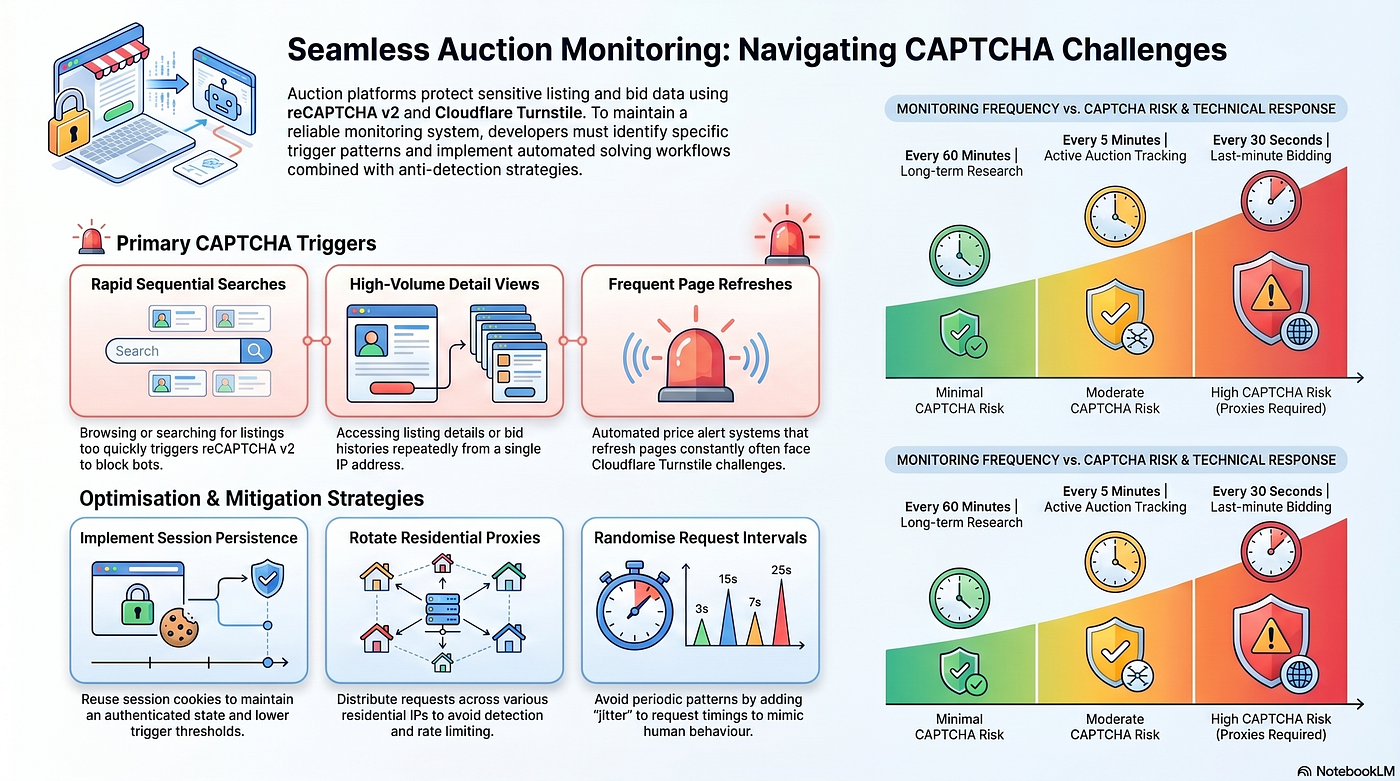
For low-frequency watchlists, this may work with a basic scheduled job. But auction platforms behave differently from static catalog pages. Prices move. Listings expire. Bid counts change. Search results shift. Detail pages may render differently as auctions approach closing time. Some workflows require authenticated sessions. Some pages trigger CAPTCHA when access patterns become too frequent or too repetitive.
This changes the engineering problem.
Auction monitoring is not only about collecting HTML. It is about maintaining data freshness, avoiding false alerts, classifying access states, validating extracted values, and making sure the monitoring system does not confuse a blocked page with a real marketplace signal.
CAPTCHA handling is one part of that system. It should not be treated as the core architecture. It should be treated as an access-state branch inside a larger reliability pipeline.
The real goal is not “solve CAPTCHA and continue.”
The real goal is “produce accurate, timely, authorized auction intelligence with clear failure states.”
Why this problem matters
Auction data has a short shelf life.
A price check that arrives 20 minutes late may be useless for an active auction. A stale bid count may cause a buyer or analyst to misunderstand demand. A false “price dropped” alert may come from a parser issue rather than a real listing change. A CAPTCHA page parsed as an empty result set can make the system believe an item disappeared.
These are not minor bugs. They directly affect trust in the monitoring system.
Auction workflows also contain different monitoring modes. A long-term price research job can run slowly and tolerate delays. A watchlist alert may need five-minute checks. A closing-window bid tracker may need stricter freshness guarantees. A bid-history lookup may require more careful access handling than a broad category page.
Because these modes have different tolerance levels, the architecture should not use one global frequency, one retry policy, or one timeout budget for every auction task.
The system needs workflow-aware scheduling.
It also needs clear source-state classification. Before parsing auction data, the monitor should identify what kind of response it received: valid listing page, search results page, CAPTCHA challenge, login page, rate-limit page, expired listing, redirected page, empty result, or malformed content.
Without this classification layer, the parser becomes dangerous. It may extract nothing and silently produce bad data.
Technical workflow breakdown
A reliable auction monitoring workflow starts with a watch registry.
The registry stores the item IDs, search queries, categories, marketplaces, thresholds, check frequency, authorization context, and freshness requirements. Not every monitored auction deserves the same schedule. High-priority closing listings should be handled differently from long-term research queries.
The second layer is the scheduler.
The scheduler decides when each monitoring job should run. It should account for auction end time, previous check result, recent failures, retry budget, and allowed monitoring policy. A listing that ends in 48 hours does not need the same frequency as a listing that ends in 10 minutes.
The third layer is session and access management.
If the workflow is authorized and requires an account or client-approved access path, the monitor should keep session state consistent. Session reuse matters because CAPTCHA challenges, form submissions, and listing pages may be tied to cookies or authenticated context.
The fourth layer is response classification.
Before parsing anything, the system should classify the page. Is it a real listing page? Did it show a CAPTCHA? Was the user redirected to login? Did the listing expire? Is the response a rate-limit page? Did the marketplace return an empty search result? Did the page partially render?
This layer protects the rest of the pipeline from bad assumptions.
The fifth layer is CAPTCHA handling.
When a CAPTCHA appears inside an approved workflow, the monitor should capture the necessary challenge parameters, submit the task, poll with a defined timeout, and apply the result inside the same session that triggered the challenge. Same-session handling is important because a valid token may be rejected if it is submitted from the wrong context.
The sixth layer is extraction.
For listings, the parser should capture current bid, bid count, time remaining, listing title, listing status, seller metadata if available, currency, shipping fields if relevant, and checked timestamp. For search pages, it should capture result count, item URLs, current prices, and page metadata. For bid history, it should preserve ordering and timestamps carefully.
The seventh layer is validation.
Auction values should not be trusted blindly. Prices should be parsed with currency awareness. Bid counts should be numeric. Time remaining should be normalized. A sudden price drop should be checked against listing status. Missing values should create a low-confidence result, not a confident alert.
The final layer is alerting.
Alerts should be based on validated state changes: price near threshold, bid count increase, auction ending soon, listing status changed, or item disappeared after confirmation. Alert quality matters because noisy auction alerts quickly lose credibility.
Production considerations
The first production consideration is freshness budgeting.
Each monitoring task should have a freshness window. If a result arrives after that window, it should be marked stale rather than treated as current. This matters most near auction close.
The second consideration is monitoring frequency.
High-frequency monitoring increases the chance of access challenges and operational noise. Use the lowest frequency that satisfies the business need. For many use cases, event-based or lower-frequency checks are more reliable than aggressive refresh loops.
The third consideration is CAPTCHA as a state, not an exception.
A CAPTCHA challenge should not crash the whole monitor. It should create a classified state: challenged, solving, solved, accepted, rejected, timed out, or skipped. This makes dashboards and alerts much clearer.
The fourth consideration is downstream acceptance.
A CAPTCHA solve is not the final success condition. The final condition is whether the listing page became accessible and valid auction data was extracted.
The fifth consideration is parser drift.
Auction platforms often change markup, classes, labels, and page rendering behavior. A parser should fail loudly when required fields disappear. Silent parsing failures create incorrect alerts.
The sixth consideration is ethical and contractual scope.
Auction data can involve platform rules, seller terms, buyer accounts, and sensitive commercial signals. Monitoring should stay within approved sources and agreed limits.
Common mistakes
One common mistake is checking every listing at the same frequency. Auction end time, priority, and freshness requirements should influence scheduling.
Another mistake is treating empty results as real results. An empty page may be caused by CAPTCHA, login redirect, parser drift, or rate limiting.
A third mistake is alerting on raw parsed values without validation. A malformed price string can trigger a false threshold alert.
A fourth mistake is separating CAPTCHA solving from session context. A token returned from a solver may fail if applied outside the session that triggered the challenge.
A fifth mistake is using unlimited retries. Repeated attempts can create more failures and obscure the real issue.
A sixth mistake is ignoring stale results. A successful check is only useful if it arrives inside the auction’s decision window.
A seventh mistake is building the system around stealth rather than permission. A reliable engineering system should be authorized, rate-aware, auditable, and governed.
Metrics to monitor
A production auction monitor should track both access metrics and data-quality metrics.
Access metrics include page access success rate, CAPTCHA challenge rate, solve latency, downstream acceptance rate, login redirects, rate-limit responses, expired listings, and blocked or malformed pages.
Freshness metrics include time since last successful check, result age at alert time, check latency, stale result rate, and missed schedule count.
Extraction metrics include successful parse rate, missing price rate, missing bid count rate, missing time-left rate, currency parsing errors, duplicate listing rate, and parser confidence.
Alert metrics include alerts generated, alerts confirmed, false-positive rate, suppressed alerts, auction-ending alerts, threshold alerts, and time from data change to notification.
Cost and capacity metrics include solve attempts per accepted listing, retries per workflow, average checks per listing, and worker utilization.
The most important metric is not “CAPTCHA solved.” It is “authorized auction monitoring workflow completed with fresh, validated data.”
Safe/authorized-use note
Auction monitoring, CAPTCHA handling, automation, bots, scraping, and third-party workflows require clear boundaries. This type of workflow should only be used in owned, client-authorized, or contractually permitted environments.
For auction workflows, that means using official APIs or approved access routes where available, respecting platform terms, honoring rate limits, and keeping monitoring behavior auditable. CAPTCHA handling should support legitimate monitoring and QA workflows, not unauthorized collection or disruptive traffic patterns.
Good auction monitoring should be accurate, governed, and operationally safe.
For the original implementation-focused guide, review the source article here:
https://blog.captchaai.com/auction-site-monitoring-captcha-handling
Use it as a reference for auction-specific CAPTCHA trigger points, listing checks, bid tracking, price alert concepts, and troubleshooting. Then extend the implementation with freshness windows, page-state classification, alert validation, parser confidence, and safe monitoring controls.
Before scaling auction monitoring, define your freshness windows, authorization boundaries, page-state classifier, retry policy, parser validation rules, and alert confidence thresholds.
메타데이터
- post_id
- a72af52be67d
- slug
- auction-monitoring-is-a-freshness-and-reliability-problem-a72af52be67d
- url
- https://medium.com/@oliverjack1999xx/auction-monitoring-is-a-freshness-and-reliability-problem-a72af52be67d
- canonical_url
- https://medium.com/@oliverjack1999xx/auction-monitoring-is-a-freshness-and-reliability-problem-a72af52be67d
- author_url
- https://medium.com/@oliverjack1999xx
- status
- ok
- fetched_at
- 2026-06-17 16:37:43