What is Shadow Work? A Guide for High-Performing Men
You’ve heard the term. Maybe from a therapist, a podcast, or someone in your orbit who seems to be doing serious personal work. Shadow…
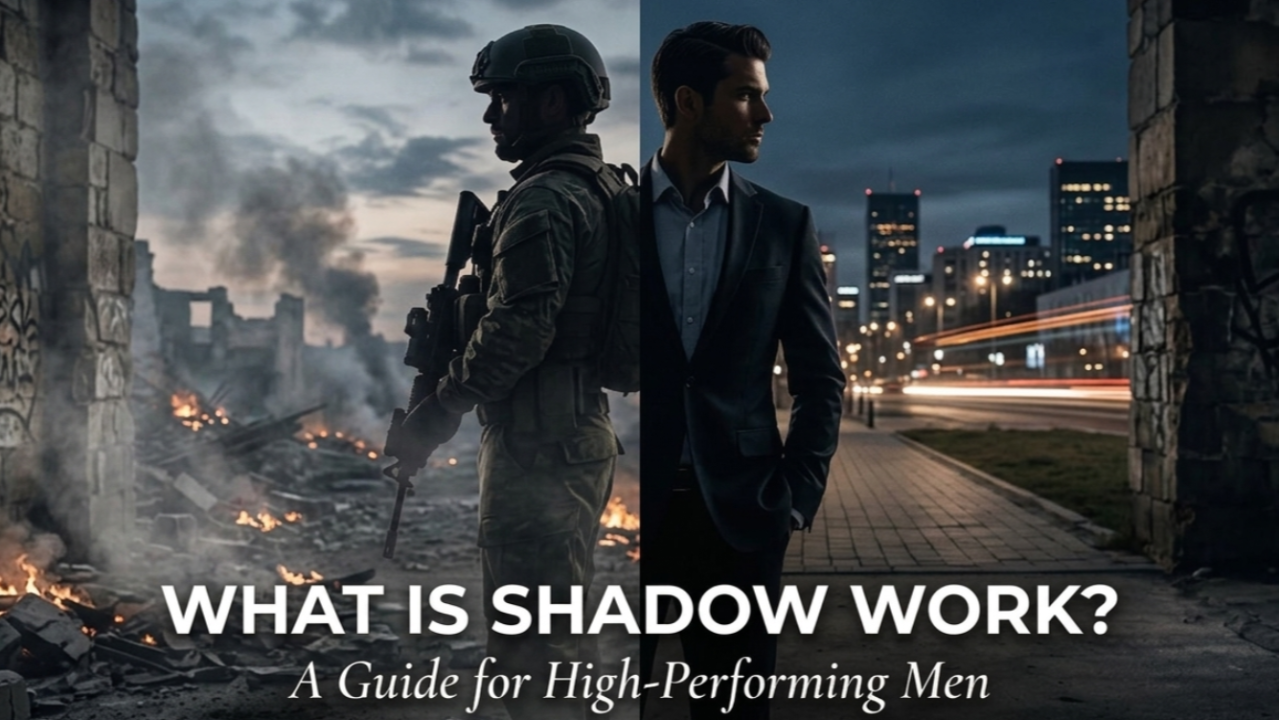
What is Shadow Work? A Guide for High-Performing Men
You’ve heard the term. Maybe from a therapist, a podcast, or someone in your orbit who seems to be doing serious personal work. Shadow Work. It sounds abstract — maybe even a little mystical.
It isn’t.
Shadow Work is one of the most practical psychological frameworks available for high-performing men who are succeeding professionally and struggling personally. Here’s what it actually is, where it comes from, and why it matters for men like you.
Where It Comes From
Carl Jung was a Swiss psychiatrist who spent his career studying the parts of the human psyche that most people spend their lives avoiding. He called these parts the Shadow — the collection of traits, impulses, emotions, and beliefs that we deem unacceptable and push out of conscious awareness.
Not because they’re evil. Because they’re inconvenient.
A boy who is told that crying is weakness learns to bury grief. A soldier who is trained that emotional expression is a liability learns to suppress vulnerability. A police officer who is conditioned to stay in control at all times learns to eliminate uncertainty from his emotional repertoire.
The feelings don’t disappear. They go underground. And underground, they run the show.
What Gets Buried
For high-performing men — veterans, first responders, law enforcement professionals, executives — the Shadow typically contains:
Grief — for the version of yourself that existed before the mission, the badge, or the role consumed you.
Vulnerability — the capacity to be affected by things, to need things, to not have the answer.
Rage — not the controlled anger of operational effectiveness, but the raw, unfiltered fury that has nowhere to go in a professional context.
Fear — not tactical fear, which is useful. The deeper fear. Of not being enough. Of being seen. Of losing the people who matter most.
Tenderness — the capacity for genuine warmth, softness, and emotional availability that got trained out of you somewhere along the way.
None of these are weaknesses. They are parts of you. And the parts you don’t own will own you.
How the Shadow Shows Up at Home
This is where Shadow Work stops being theoretical and starts being urgent.
The rage you buried downrange or on the street doesn’t disappear when you cross your threshold at night. It resurfaces as control. As impatience. As a hair-trigger response to minor domestic friction that should require a five-second pause but instead triggers a full tactical response.
The grief you never processed for the career you lost, the identity you shed, or the version of yourself that didn’t come home — it shows up as withdrawal. As distance. As the inexplicable feeling of being a stranger in your own house.
The vulnerability you armored against — the capacity to be reached — becomes the wall your partner keeps hitting when they try to connect with you. They don’t need your operational excellence. They need your presence. And presence requires the willingness to be affected.
The Shadow doesn’t care about your professional accomplishments. It will find the cracks in your armor and exploit them in the places you least expect — in your marriage, with your children, in the quiet moments when there’s nothing to execute and nowhere to be and no mission to orient around.
What Shadow Work Actually Is
Shadow Work is the deliberate process of bringing these buried parts into conscious awareness — not to indulge them, not to be controlled by them, but to integrate them.
Integration means owning the part before it owns you. It means saying: I have grief that I haven’t processed. I have rage that has no healthy outlet. I have a capacity for vulnerability that I’ve been treating as a liability. And I am going to look at these things directly rather than letting them run my relationships from the basement.
This is not therapy in the traditional sense. It doesn’t require lying on a couch and discussing your childhood for years. It requires honesty, structure, and the willingness to sit with discomfort long enough to learn something from it.
It is some of the hardest work a high-performing man can do. It is also some of the most operationally effective.
Why It Works for Men Who Resist Traditional Approaches
Most men who have operated at high levels resist conventional therapy for a reason: it doesn’t match their cognitive architecture. They are trained to identify problems, build solutions, and execute. Sitting in an open-ended conversation about feelings with no clear framework and no measurable outcome feels like a waste of operational bandwidth.
Shadow Work is different because it is structured. There is a map. There is a methodology. There are specific practices — journaling, somatic work, direct confrontation of avoided material — that produce identifiable results in identifiable timeframes.
It doesn’t ask you to become someone else. It asks you to become more fully yourself — including the parts of yourself you’ve been at war with.
Shadow Work and The Tactical Return
Shadow Work is one of the two clinical foundations of The Tactical Return — a structured 3-week cohort program for veterans, first responders, law enforcement professionals, and executives who are winning professionally and losing personally.
I combine Jungian Shadow Work with Terry Real’s Relational Life Therapy in a closed group of 12 men. The container is deliberately built for men who would never walk into a therapist’s office — men who need a framework, a mission, and a group of peers who share their operational DNA.
The pilot cohort launches October 13, 2026. Applications open August 17.
If any of this landed — that’s worth paying attention to.
thetacticalreturn.com
메타데이터
- post_id
- a766da189d82
- slug
- what-is-shadow-work-a-guide-for-high-performing-men-a766da189d82
- url
- https://medium.com/@jim_753/what-is-shadow-work-a-guide-for-high-performing-men-a766da189d82
- canonical_url
- https://medium.com/@jim_753/what-is-shadow-work-a-guide-for-high-performing-men-a766da189d82
- author_url
- https://medium.com/@jim_753
- status
- ok
- fetched_at
- 2026-08-04 22:42:38