Physicist Brian Greene’s Apologetic, Yet Strong, Physicalism
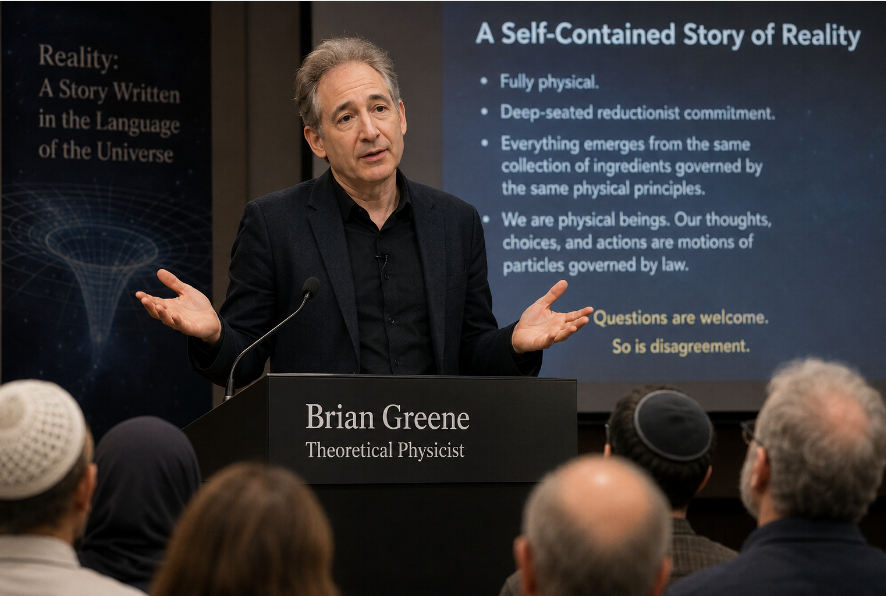
The theoretical physicist Brian Greene upholds a very strong physicalism, as well as a “deep-seated reductionist commitment” too.
Physicist Brian Greene’s Apologetic, Yet Strong, Physicalism
The theoretical physicist Brian Greene upholds a very strong physicalism, as well as a “deep-seated reductionist commitment” too.
Religious People and Anti-Materialists
It’s the case that many religious people, anti-materialists, spiritual idealists, romantics, etc. aren’t against reductionism and “materialism” in the abstract: they’re against such isms only when they trespass on the sacred realm of human persons, as well as on the related notion of human consciousness.
This essay keeps away from the subject of consciousness because that’s a can of worms to be tackled separately. However, Brian Greene himself tackles it in detail. In terms of physicalism and consciousness, this is how he sums up this subject:
“We are physical beings made of large collections of particles governed by nature’s laws. Everything we do and everything we think amounts to motions of those particles.”
In any case, Greene is extremely upfront about his physicalism, even if, at the very same time, he’s seemingly at pains to justify himself to religious people, anti-materialists, romantics, etc.
Greene is upfront about being a reductionist too. For example, he says that he has a
“deep-seated reductionist commitment, which holds the view that by fully grasping the behaviour of the universe’s fundamental ingredients we tell a rigorous and self-contained story of reality”.
Note Greene’s words “self-contained story of reality”. That isn’t the same as claiming reductionism tells the only true story of reality. However, it is a vital and important story. This is a theme that Greene often comes back to. As seen, he uses the word “story” in exactly the same way in which another American theoretical physicist, writing about the same subjects, does. That physicist is Sean Carroll. (See my ‘The Physicist Sean Carroll on (Scientific) Emergence’ and the next essay.)
In another passage, Greene states both his reductionism and his physicalism. He tells his readers that he
“can envision a future when scientists will be able to provide a mathematically complete articulation of the fundamental microphysical processes underlying anything that happens, anywhere and anywhen”.
Surely that statement must apply to all the big subjects and issues, such as consciousness, free will, war, love, hate, etc. Or does it? Note that Greene uses the word “underlying” (as in “underlying anything that happens”). This is an important caveat. Why? It’s because saying that X underlies (or underpins) Y isn’t the same as saying X “is identical to” Y, or that X can “tell us everything” about Y. In fact, if those two interpretations were true, then the word “underlying” simply wouldn’t be accurate. All this makes a big difference, despite the endless conflations uttered by some religious people and nearly all anti-materialists.
Greene goes on to tell his readers more about what his word “underlying” means, and he does so through the example of the ancient Greek philosopher Democritus. He quotes Democritus stating the following:
“‘Sweet is sweet, bitter is bitter, hot is hot, cold is cold, color is color; but in truth there are only atoms and the void.’”
Greene says that Democritus’s point is that
“everything emerges from the same collection of ingredients governed by the same physical principles”.
What’s more,
“those principles, as attested to by a few hundred years of observation, experimentation, and theorizing, will likely be expressed by a handful of symbols arranged in a small collection of mathematical equations”.
At first, Greene stated that “fundamental microphysical processes underlie[] anything that happens, anywhere and anywhen”. Then, through the voice of Democritus, he states that “everything emerges from the same collection of ingredients”. These two expressions more or less state the same thing, if from two different angles. In other words, X can underlie Y, and Y can emerge from X. Neither formulation implies or entails that X is Y. Of course, the concepts of underlying and emergence need to be explained and justified too.
Greene on Human Persons
Greene himself does trespass on the sacred realm of human persons mentioned earlier. He writes:
“Yet, maintaining our physicalist stance, you and I are nothing but constellations of particles whose behavior is fully governed by physical law.”
Oh yes!
Greene uses those terrible two words: “nothing but”! This, of course, echoes the very often-quoted passage from Francis Crick. Here it is again! —
“You, your joys and your sorrows, your memories and your ambitions, your sense of personal identity and free will, are in fact no more than the behavior of a vast assembly of nerve cells and their associated molecules.”
This all hinges on what the words “nothing but” really mean. In a past essay (2019), ‘Francis Crick’s Deliberately Provocative Reductionism’, I argued that Crick was being provocative when he used these words. Moreover, it’s hard to know what they could even mean when taken literally.
Just to take one example. If you and I were nothing but constellations of particles, then we would be indistinguishable from other constellations of particles, such as heaps of shit or rocks. So Greene is being poetic and provocative too, just like Crick. That’s because he’s already told us what he really means: particles, fields, laws, etc. underlie/underpin you and I. Alternatively, you and I emerge from particles, fields, laws, etc.
Greene on Reduction, Emergence and New Laws
Greene mentions emergence, at least indirectly, when he writes the following:
“Although voluminous data confirm that we have a deep understanding of the laws governing individual particles (electrons, quarks, neutrinos, and so on), perhaps when a hundred billion billion billion particles are arranged into a human body and brain, they are no longer governed, or at least not fully governed, by the fundamental laws of the microworld.”
This means that Greene fully acknowledges the possibility of new laws. He may even do more than merely acknowledge it.
It’s worth asking here where that (to use Greene’s own phrase) “line in the sand” is when we see a miraculous move from old laws to (possible) new ones. Greene writes:
“It’s not as though the universe comes equipped with a line in the sand separating things that are properly described by quantum mechanics from things properly described by general relativity. Dividing the universe into two separate realms seems both artificial and clumsy.”
In crude terms, why does the change need to come when we reach a hundred billion billion billion particles and not a hundred billion particles? What about a billion particles? Why not a million or even ten particles? We’d need to explain how and why higher numbers alone bring about new laws.
Greene, like many other physicists, basically states that Laplace’s Demon doesn’t actually exist. He happily concedes that "admittedly, no one has ever carried out the mathematical analysis required to make predictions for the lawful progression of particles” when it comes to large objects and systems. What’s more,
“[e]ven predicting the motion of a far simpler object like a pool ball can elude us because small inaccuracies in determining the ball’s initial speed and direction can be exponentially amplified as the ball ricochets off the banks of the table”.
All that doesn’t really concern Greene, at least not in this context. He concludes:
“So my focus here is not on predicting your next move. My focus is on the existence of laws that govern your next move.”
Greene isn’t concerned with “unexpected and impressive phenomena” (such as “typhoons and tigers”) here either. He believes that it’s still the case that
“all evidence suggests that were we able to work out the math for such large groups of interacting particles, we would be able to predict their collective behaviors”.
In a sentence. The issue here isn’t prediction: it’s the emergence of new laws.
So Greene is well aware of the limitations of reductionism. For example, he says that he
“would be stymied, of course, in trying to explain many other things in staunchly reductionist terms, from Pacific typhoons to raging volcanoes”.
However:
“But the challenge presented by these happenings, and a world chock-full of examples like them, is solely that of describing the complex dynamics of a fantastically large number of particles.”
Finally: “If we could surmount that technical hurdle, we would be done.”
On the surface, Greene seems to be ruling out emergence here, or at least ruling out strong emergence. After all, isn’t the argument from emergentists that new laws and features emerge at “higher levels”? Even so, such higher-level laws and features would still be underpinned by particles. Alternatively, they would still emerge from particles. Still, Greene doesn’t mention this. Instead, he boils the problem down to “complex dynamics” and “a fantastically large number of particles”.
If new laws and features do truly emerge, then surely this means that Greene’s ideal prediction, or ideal reduction, would still be impossible… Unless these two things can exist together. In other words, can we have an ideal prediction, or an ideal reduction, even if new laws and features do occur at higher levels?
Greene on Information
I wonder if the ideal reduction, or ideal prediction, is affected by the introduction of information into this story, as Greene does. In the following passage, we see Greene stating his reductionist and physicalist position again. Yet, this time, with the added ingredient of information:
“To describe the state of the world now, I provide information that specifies the configuration of all the dancing particles and undulating fields permeating space. The laws of physics take that information as input and yield as output information that delineates the state of the world later on. Physics, according to this framing, is in the business of information processing."
It’s worth noting that in this specific context Greene brought up information and processing in response to the position of the philosopher David Chalmers on consciousness and “inner experience”. However, it’s clear that he adopts an informationalist position generally. (Basically, one that’s in tune with the ideas of John Archibald Wheeler.)
What work is the word “information” doing in the quoted passage above? That can be asked because often when I read people talk about information, it seems to have little purpose: it’s a needless addition. Or worse, such people are referring to information as if it’s a… well, physical thing.
Take the words of the physicist Christopher Fuchs:
“‘It is amazing how many people talk about information as if it is simply some new kind of objective quantity in physics, like energy, but measured in bits instead of ergs. You’ll often hear information spoken of as if it’s a new fluid that physics has only recently taken note of.’”
Of course, in an everyday sense, physicists have always dealt with information, just as Tom, Dick and Harry have. However, information in these contexts means much more than that.
메타데이터
- post_id
- a7710f0c53ee
- slug
- physicist-brian-greenes-apologetic-yet-strong-physicalism-a7710f0c53ee
- url
- https://medium.com/@paulaustinmurphy2000/physicist-brian-greenes-apologetic-yet-strong-physicalism-a7710f0c53ee
- canonical_url
- https://medium.com/@paulaustinmurphy2000/physicist-brian-greenes-apologetic-yet-strong-physicalism-a7710f0c53ee
- author_url
- https://medium.com/@paulaustinmurphy2000
- status
- ok
- fetched_at
- 2026-06-09 15:37:30