1948: The Violence That Followed Gandhi’s Assassination — and Why We Were Never Taught About It
On 30 January 1948, Mahatma Gandhi was killed in Delhi.
1948: The Violence That Followed Gandhi’s Assassination — and Why We Were Never Taught About It — Part 1
On 30 January 1948, Mahatma Gandhi was killed in Delhi. What happened next is rarely talked about, and almost never taught.
Within a day, many parts of Maharashtra saw attacks on Brahmin families. Homes were already marked. Houses were burned and property was destroyed. Thousands of people were forced to leave their villages and run to cities like Pune and Mumbai. In some places, entire communities vanished from villages almost overnight.
This was not emotional outburst or random anger. The attacks happened too fast and in too many places at once to be accidental — especially at a time when radio was the only way news spread widely.
Yet, despite how serious this was, it has almost disappeared from India’s shared memory.
A Pattern That Should Raise Questions
When violence erupts simultaneously across distant rural regions, it usually follows preparation. Eyewitness accounts from multiple districts describe outsiders arriving with lists of Brahmin homes. The narrative used to justify the attacks was simple and repeated everywhere: Gandhi’s assassin was a Brahmin, therefore Brahmins must collectively be punished.
The outcome was predictable. Fear spread faster than fire. Families attacked, beaten mercilessly. May died. They left behind land, livelihoods, and generations of rooted life. What is now remembered as “urban migration” in post-independence Maharashtra often hides a far harsher truth — migration driven by terror.
And yet, this violence occupies no meaningful space in mainstream history books.
The Silence That Followed
History is not erased only by denying that events happened. It is also erased by omission.
School textbooks, popular histories, and public discourse move swiftly from Gandhi’s assassination to narratives of national consolidation. However, none speak of thousands of lives destroyed, families displaced and those perished for none of their fault.
This absence is not trivial. When a society forgets targeted violence that occurred within its own borders — after independence, not under colonial rule — it loses the ability to recognize warning signs when similar divisions are invoked again.
Why This Was Documented
I did not first learn about this from books or archives. I learned it through family memory.
My father was a child in 1948. He saw these events happen around him. What troubled him later was not just what happened, but how completely it faded from public memory. People spoke about it quietly, if at all. There was a feeling that bringing it up was somehow wrong.
This was written for one simple reason: witnesses do not live forever. If their stories are not recorded, silence becomes permanent. And if we don’t pass this history to the next generation, someone else will — and they may tell it very differently.
Not a Story of Collective Guilt
It is important to say this clearly.
The violence of 1948 was not the action of an entire community against another. In many villages, local leaders and ordinary citizens resisted it. Some openly defied outside mobs. Others sheltered families at great personal risk. Their actions prevented even greater loss of life.
These stories matter because they remind us that conscience survives even during engineered hatred. Such stories too need to be included in the text books.
Why This History Matters Now
Remembering 1948 is not about reopening wounds. It is about understanding how quickly the caste based fault lines can be leveraged — and how easily violence can be justified once identities are weaponized.
When political narratives reduce complex societies into black and white of blame, the past stops being past. It becomes routine!
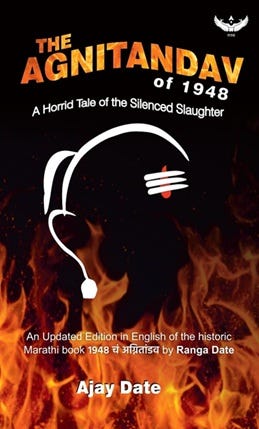
The events outlined here are drawn from eyewitness accounts, contemporary records, and testimonies collected before they fade from living memory and not interpretations or retrospective opinions. These have been documented in my book, Agnitandav of 1948, which brings together material that has remained largely absent from public discourse.
You can find the book here: https://amzn.in/d/fvxTq7z
For readers who want to explore this subject in greater depth, I have discussed the research, sources, and broader historical context in long-form conversations on independent platforms. Selected discussions are available below:
- Garuda Talks (long-form discussion in Hindi): https://www.youtube.com/live/NjNOtdMsMrM
- Politically Incorrect with Neeraj Atri (in Hindi): https://www.youtube.com/live/gHvFGtpQLBk
History does not disappear when it is ignored. It waits — in memories, in silences, and in records — until someone chooses to document it.
In Part 2, I will look more closely at how this violence was organized, how it was explained away, and why remembering it today still makes people uncomfortable.
메타데이터
- post_id
- a7785a36c9d6
- slug
- 1948-the-violence-that-followed-gandhis-assassination-and-why-we-were-never-taught-about-it-a7785a36c9d6
- url
- https://medium.com/@ajaysdate_51108/1948-the-violence-that-followed-gandhis-assassination-and-why-we-were-never-taught-about-it-a7785a36c9d6
- canonical_url
- https://medium.com/@ajaysdate_51108/1948-the-violence-that-followed-gandhis-assassination-and-why-we-were-never-taught-about-it-a7785a36c9d6
- author_url
- https://medium.com/@ajaysdate_51108
- status
- ok
- fetched_at
- 2026-07-13 06:23:13