Mearsheimer's multipolar world arrives three decades early
The U.S. faces simultaneous overextension in Ukraine, Taiwan, and the Middle East as alliance credibility erodes and rivals test every red…
Mearsheimer's multipolar world arrives three decades early

The U.S. faces simultaneous overextension in Ukraine, Taiwan, and the Middle East as alliance credibility erodes and rivals test every red line at once.
On June 20, 2026, @YS_KARASU posted a reminder that John Mearsheimer predicted a multipolar world by 2030-2040. The joke, bitter and precise, was that the multipolar system arrived early—and nobody sent the memo to Washington.
The numbers tell the story. U.S. military commitments now span three active theaters. Ukraine has consumed $175 billion in aid since 2022. Taiwan's defense budget hit $19.6 billion in 2025, up 40% from 2020, but the U.S. has no formal treaty with Taipei. The Middle East sees Iran-backed Houthis striking Red Sea shipping with impunity—over 60 attacks since October 2023. That's not a strategy. That's a liability spreadsheet.
The credibility trap
Here's the problem with reputation in rivalry. Once you claim every red line is existential, you lose the ability to retreat. The U.S. has spent 30 years telling the world that Taiwan is a vital interest, that Ukraine matters to European security, that freedom of navigation in the South China Sea is non-negotiable. All true, in isolation. But in a game with finite pieces, you cannot defend every square.
The move-countermove logic is brutal. China watches the U.S. struggle to arm Ukraine and supply Israel simultaneously. Russia watches the U.S. pivot to the Pacific while its European allies balk at 2% GDP defense spending. Iran watches the U.S. withdraw from Afghanistan, then Syria, then Niger. Each retreat signals something. Not capitulation—but scarcity.
When you're strong everywhere, you're strong nowhere. The paradox of multipolarity is that credibility isn't built by promising to defend everything. It's built by actually defending the things that matter, and being explicit about what doesn't.
The alliance reliability problem
NATO has 32 members. In 2024, only 11 met the 2% GDP defense spending target. That's not an alliance—that's a patron-client network with extra paperwork. Estonia contributes 3.4% of GDP to defense, a real commitment from a country of 1.3 million. Germany, with 84 million people and the largest economy in Europe, spends 1.5%. The asymmetry is unsustainable.
The U.S. maintains roughly 100,000 troops in Europe and 80,000 in Asia. That's 180,000 soldiers deployed permanently, plus rotating forces, plus naval assets, plus intelligence infrastructure. The total cost exceeds $150 billion annually. For context, China's entire defense budget is about $290 billion. The U.S. is spending more than half of China's total military budget just to maintain forward presence.
Alliance management in a multipolar world means accepting that not every ally will pay their share. But the U.S. can't keep subsidizing free riders forever. The tipping point comes when American voters realize that defending Lithuania costs more than fixing their own bridges. That's not isolationism—that's arithmetic.
Overextension as a weapon
Russia understands this better than the U.S. does. The Kremlin doesn't need to win in Ukraine militarily. It just needs the U.S. to bleed resources until domestic pressure forces a withdrawal. The strategy is old—Sun Tzu wrote about exhausting an enemy without fighting—but it works.
Iran plays the same game. By arming proxies in Yemen, Syria, Lebanon, and Iraq, Tehran forces the U.S. to respond across multiple fronts simultaneously. Each Houthi missile costs maybe $2,000 to manufacture. Each U.S. interceptor costs $2 million. The math is not complicated.
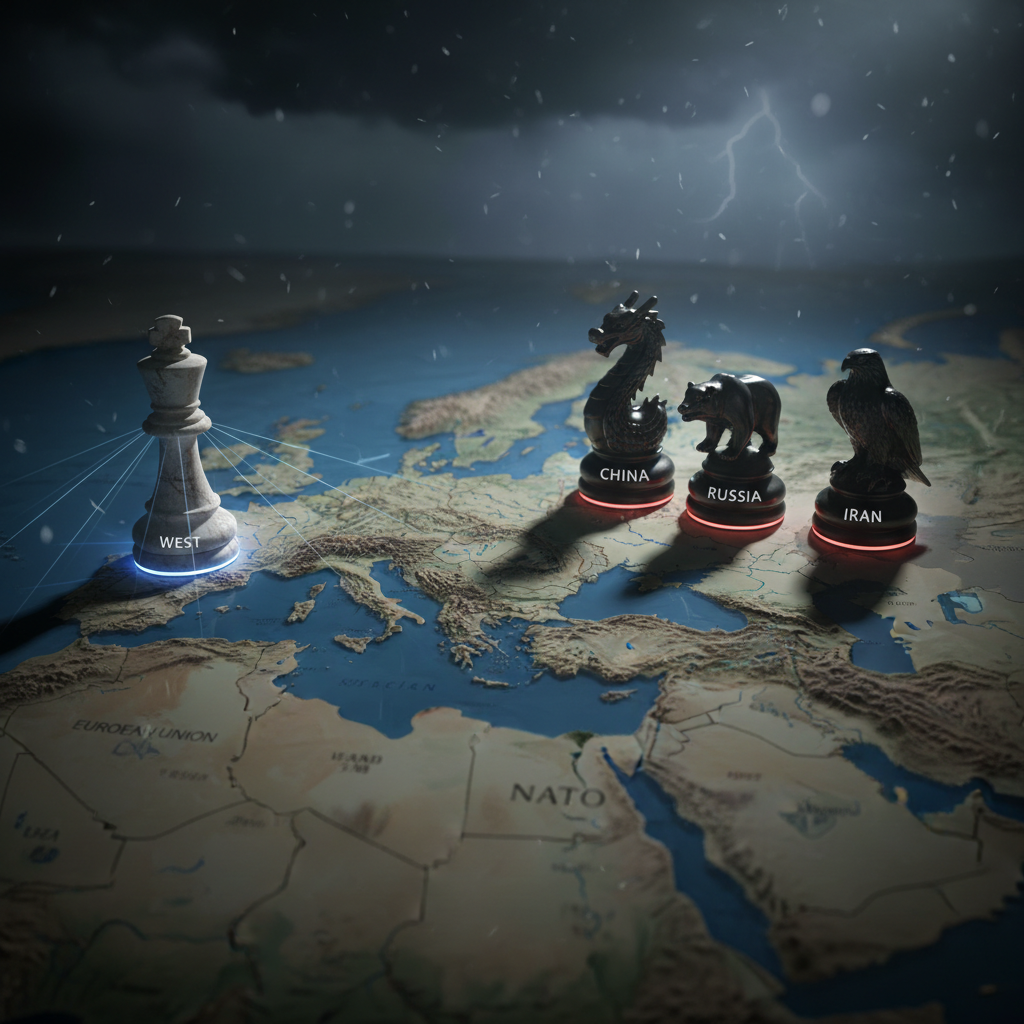
This is the chessboard strategy that Brzezinski described but never fully grappled with: the weaker player trades space for time, and the stronger player trades treasury for irrelevance. The U.S. can win every tactical engagement and still lose the strategic campaign.
The multipolar reality
Mearsheimer's original timeline assumed the U.S. would decline gradually, allowing allies to adjust. Instead, the transition has been compressed. The BRICS bloc now accounts for 35% of global GDP at purchasing power parity. China's navy has 370 ships to the U.S. Navy's 290. India, Turkey, and Saudi Arabia all pursue independent foreign policies, ignoring Washington's preferences.
The old unipolar order had a simple rule: the U.S. set the norms, and everyone else followed. The new multipolar order has no single rulebook. China follows its own. Russia follows its own. India, Brazil, and Indonesia are writing theirs. The result is chaos, but it's a predictable chaos—the kind that emerges when five or six players all believe they can win.
The U.S. response so far has been to double down. More sanctions. More alliances. More red lines. But sanctions require enforcement, alliances require trust, and red lines require credibility. All three are eroding simultaneously.
The credibility paradox
The worst move in chess is the one that commits your pieces to a position you cannot hold. The U.S. currently has pieces on every square of the board. The question isn't whether some will be captured—it's whether the king survives the endgame.
There's an old anecdote from the Cold War. In 1983, a Soviet early-warning system falsely detected an American missile attack. The officer on duty, Stanislav Petrov, decided not to report it. He gambled that the system was wrong. He was right. The lesson wasn't about technology—it was about judgment. In a crisis, the person with the most to lose makes the most conservative choice.
The U.S. is now in a position where every crisis looks like a test. Every Houthi attack. Every Chinese patrol near Taiwan. Every Russian missile strike. Treating them all as existential threats is the path to exhaustion. Choosing which ones to ignore is the path to losing credibility.
There is no good option. But there is a bad one: pretending the board hasn't changed.
메타데이터
- post_id
- a77eeff4f201
- slug
- mearsheimers-multipolar-world-arrives-three-decades-early-a77eeff4f201
- url
- https://medium.com/@makmseja/mearsheimers-multipolar-world-arrives-three-decades-early-a77eeff4f201
- canonical_url
- https://medium.com/@makmseja/mearsheimers-multipolar-world-arrives-three-decades-early-a77eeff4f201
- author_url
- https://medium.com/@makmseja
- status
- ok
- fetched_at
- 2026-07-15 07:10:03