Why Confidence Comes So Late
By the time we stop worrying about being enough, we've already spent years proving that we were.
MINDSET
Why Confidence Comes So Late
By the time we stop worrying about being enough, we've already spent years proving that we were.
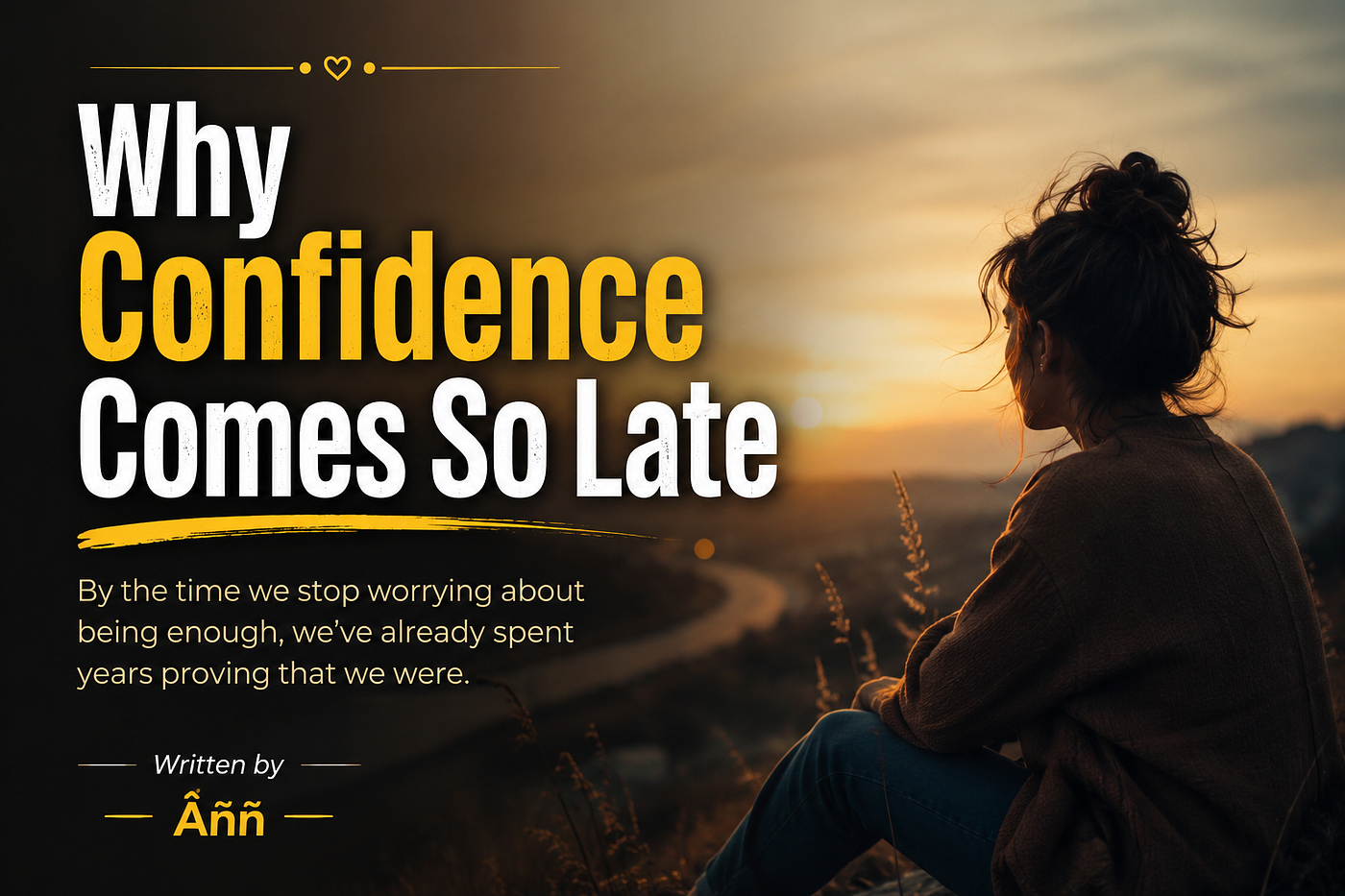
Image by Author
Someone once asked me when I finally started feeling confident. I laughed because I couldn’t think of a single birthday when confidence suddenly arrived like a long-awaited package.
It wasn't eighteen.
It wasn't twenty-five.
It wasn't thirty.
If anything, those years were filled with pretending I knew what I was doing while quietly hoping nobody noticed that I didn't.
That realization made me wonder whether confidence is something we gain—or something we stop chasing.
When we’re young, confidence looks loud. We imagine confident people as the ones who speak first, raise their hands, ask for promotions, or walk into a room as if they own it.
Many of us spend years trying to imitate that version of confidence. We rehearse conversations before making a phone call.
We overthink emails. We compare ourselves with people who seem to have everything figured out.
The strange part is that most of those people are probably doing the same thing.
Adulthood has a funny habit of revealing that certainty is much rarer than it appears.
The older I get, the more I notice that confidence doesn’t usually arrive because life becomes easier.
It arrives because life becomes familiar.
After enough disappointments, you discover you can survive disappointment.
After enough mistakes, you realize mistakes don't define you forever.
After enough embarrassing moments, you stop believing the world is paying as much attention to you as you imagined.
Experience quietly accomplishes what reassurance never could.
Somewhere along the way, confidence changes its shape.
It stops sounding like, "I’m the best person in the room."
Instead, it becomes, "I’ll be okay even if I’m not."
That feels less dramatic. It also feels far more powerful.
Real confidence isn’t the absence of doubt. It’s the decision to move anyway.
There’s another reason confidence comes late. When we’re younger, we’re busy collecting expectations.
Parents have them.
Teachers have them.
Friends have them.
Social media certainly has them.
Without noticing, we begin measuring ourselves against dozens of invisible scorecards that were never ours to begin with.
Eventually, something shifts. Not because we become fearless, but because we’re tired.
Tired of performing.
Tired of comparing.
Tired of asking strangers for permission to like our own lives.
That's often the moment confidence quietly walks in.
Not with applause, with relief.
I’ve met people in their sixties who were just beginning careers they’d always dreamed about.
I’ve met people in their forties learning to paint for the first time. I’ve met retirees who finally started travelling because they stopped worrying about looking foolish.
None of them spoke about becoming fearless. They simply reached a point where fear became less interesting than possibility. There’s wisdom in that.
Maybe confidence was never supposed to arrive early. If it did, we’d probably stop growing. We’d stop questioning ourselves.
We'd stop learning.
The uncertainty we complain about is often the same thing that pushes us toward better conversations, better decisions, and a better understanding of who we are.
Confidence isn't the reward for getting everything right.
It's what slowly grows after discovering that getting things wrong didn't destroy us.
Perhaps that’s why it feels late. It isn’t late at all.
It's simply built from experiences that can't be borrowed, rushed, or downloaded from someone else's success story.
You have to live them.
One awkward conversation.
One failed attempt.
One unexpected detour at a time and one day, almost without noticing, you’ll walk into a room without wondering whether you belong there.
Not because you've become extraordinary.
But because you've finally stopped asking for permission to be yourself.
— Âññ
©Âññ,2026. All rights reserved.
메타데이터
- post_id
- a78fe1c67c4a
- slug
- why-confidence-comes-so-late-a78fe1c67c4a
- url
- https://medium.com/everyday-rebellion/why-confidence-comes-so-late-a78fe1c67c4a
- canonical_url
- https://medium.com/everyday-rebellion/why-confidence-comes-so-late-a78fe1c67c4a
- author_url
- https://medium.com/@penpage110
- status
- ok
- fetched_at
- 2026-07-09 01:49:10