Edith, Emma & Me: The Place for Homes (Chapter 3)
Joseph Newlin Wilkins, who went by J. Newlin Wilkins, and whom I have come to call JNW, was born in 1865. When I first started seeing his…
Edith, Emma & Me: The Place for Homes (Chapter 3)
Joseph Newlin Wilkins, who went by J. Newlin Wilkins, and whom I have come to call JNW, was born in 1865. When I first started seeing his name pop up everywhere, I had a feeling that he was another interloper, like Charles Sparks — born somewhere else. But on closer look, I realized the Wilkins family had been here all along, like the Amons, the Horns, the Horners and the rest. JNW was born in what was then Stockton Township. His parents were George and Mary Wilkins; Mary was a Rudderow by birth. The family appears on the 1870 and 1880 censuses, and George is listed as a farmer in both. There appear to have been at least six siblings. Records also show George Wilkins’ father, William Wilkins, as living in the area. Plus, some Wilkins folk lived next to George Amon (relatively speaking; next on the census page) in the 1880 census.
In his book, Jeffrey Dorwart writes:
Between . . . 1901 and the opening of the Delaware River Bridge in 1926, a generation of local Progressive businessmen organized Camden County’s urban landscape and built middle-class suburban communities. They were part of an early-twentieth century national reform movement that developed in response to the dramatic social changes brought about by large-scale industrialization and the influx of millions of new Catholic and Jewish immigrants. Led for the most part by Protestant businessmen and professionals, the Progressive movement sought to create a stable, efficient, and prosperous middle-class society by reforming social, political, and economic institutions.
I don’t know if JNW thought of himself as a reformer, per se, but generally speaking he seems to qualify as a Protestant businessman who reshaped his community, as we’ll see below.
JNW married Kate Amon in 1890; he was 25 and she was 22. One child died in infancy; two lived, Mildred and Walter. As a young man, JNW worked as a stenographer and taught at the Peirce School in Philadelphia, per census records and his obituary. Later, he and his father-in-law, George Amon, started to take steps to develop the area they called “Amon Heights.” By the 1900 census, JNW, Kate, and Mildred and Walter are living at 4219 Westfield Avenue, right next to George and A. Louisa Amon, at 4301. (These two parcels are one block up the hill from Lot 23, at 43rd and Westfield.) JNW lists his occupation as “real estate broker,” while George puts down “real est agt.” There was the school that they built, and according to Mildred Wilkins, there was a small grocery store as well. JNW at some point also constructed a water tower for the area. Jack Fichter writes that the Wilkins home served as a community center of sorts: “It was open for banquets, orchestra rehearsals, Bible study classes, and the study of Shakespeare.”
Kate passed away just before both of her parents, in 1903. In his history of the Bethel M.E. Church (scroll to almost the bottom to see JNW in a group photo), JNW included a special note about his late wife:
Mrs. J. N. Wilkins (Kate O. Amon) lived on this earth for 33 years, the same number as did Jesus, and following “In His Steps”, went about doing good.
The major stroke to create Amon Heights seems to have come in 1905, after George died. JNW, the executor of George’s estate, created a “Plan of Amon Heights” and began to sell off George’s land. George owned land all along Westfield Avenue, mostly to the south of it and running east toward Merchantville, but also north of it as well — including Lot 23.
It took me a long time to piece this together. I originally assumed that Lot 23 was part of “Delaware Gardens.” This led me on a long wild goose chase, reading articles and advertisements related to Joseph Cramer, the developer of Cramer Hill, Rosedale and Delaware Gardens, among other East Camden and Pennsauken neighborhoods. I pored over listings of property sales to figure out which section of “Plan Delaware Gardens” Lot 23 might be a part of. But while Delaware Gardens is a hop, skip and a jump away from Lot 23, and was developed at roughly the same time, Lot 23 is part of Amon Heights. At least, I’m 99% sure, at this point.
The breakthrough came when I became mildly obsessed with a house located at 44th Street and Westfield Ave that has the address 4405 Westfield Ave. It’s a three-story white house that I always thought of as a “mansion” when I was little. Looking at pictures of the house online, and unable to find a date for its construction, I wondered if it could possibly be a really old house. I searched its property records online. Camden County only has records online going back to 1978, but sometimes you can leapfrog a bit further into the past by looking at the deeds to see if they have information about previous transfers of the property. In this case, I started with the current owner of 4405 and was able to leapfrog as far back as 1932. I learned/remembered along the way that this house had been a funeral home — in fact, it was the Cinoski Funeral Home, and Cinoski was a shortened form of Ciechanowski. Stanley Ciechanowski had been a major Polish American leader in Camden, and this was his family’s business. Before it was a funeral home, it was the home of a married doctor couple, Samuel and Stella Fisher. They are listed there in the 1940 census. I could not find anything older than 1932, and I suspect that the house was built along with the many others that were built in the ’20s, rather than being some kind of original Colonial-style house.
But what the property records did reveal is that the house was part of Section M of the Plan of Amon Heights. This got me thinking: Maybe I needed to revisit George Amon and Amon Heights. And the more I did, the more I realized that Lot 23 had been Amon Heights all along.
There are a couple pieces of evidence. I found a house on the 1800 block of 45th Street, which is right next to my block, that is listed as part of the Plan of Amon Heights. One big, hard-to-believe-I-missed-it piece is the fact that the cross-street at the northern end of my block was . . . Amon Avenue. I realized I had been holding an unconscious, somewhat childish belief that town officials named streets. Who else would do it? So they named it after a prominent local dude. But no. When you’re a developer, you name the streets. After yourself, if you want.
So I began focusing more on George Amon than Joseph Cramer. In the years leading up to George Amon’s death, JNW and George Amon were making moves in real estate. One newspaper item from 1895 made some vague predictions:
It is said that the entire farm tract extending from the Burlington turnpike tollgate [Westfield Ave and 36th Street] is about to be divided into building lots. If this is done it will unite Stockton, Bethel and Merchantville by an almost solid mass of houses, as most of those who have so far purchased contemplate building, and this, together with the proposed line of trolley cars, which, according to plans, are scheduled to run on Westfield avenue, will induce others to erect residences and locate. Real Estate Agent Leas and Township Committeeman George Amon are owners of a greater portion of the land to be disposed of.
Later, in December 1895, another anonymous item, part of a recurring column often titled or subtitled “‘Cross Cooper’s Creek” (i.e., on the east bank of the river, in Stockton), reported that:
[t]he Chapman farm, consisting of 200 acres lying between the old and new Cove roads and Westfield avenue and the Delaware River, is being surveyed by Surveyor Franklin and will be laid out in building lots and placed on the market.
Recall that the “new” Cove Road is 36th Street. (I didn’t have proof of this til I finally dug up one of those old fire insurance maps, but once I did it really helped everything fall into place.) And the old Cove Road is simply present-day Cove Road. And recall that we met James Chapman earlier; his farm was on the 1877 map. It seems that at some point, George Amon purchased at least some part of the Chapman farm, and that this wide swath of land that was the subject of these articles in 1895 contained Lot 23. But, despite the newspapers’ predictions, the “solid mass of houses” took a little more time to materialize.
In 1905, after George Amon’s death, the final plan for the land holdings was revealed. Beginning on June 17, 1905, the Camden Morning Post published on multiple dates a nearly full-page notice of “Executor’s Sale of Real Estate.” In it, the “sole surviving executor of the estate of George H. Amon” — J. Newlin Wilkins — states that “the following described tracts of land and premises” will go up for sale on July 13.
I read this notice — chock full of surveyors’ cryptic descriptions — beginning to end, upside down and backwards. I got out some pencil and paper and Googled distances to convert feet to miles. There may have been a compass and protractor involved. I definitely used parts of my brain that had never been used before. At the end, I was sweating, but I was pretty sure that one of the parcels included Lot 23. The only other thing I could do is drive back over there and start walking the plots with a tape measure.
It’s the first parcel described in the notice, a 30-acre plot. I traced the surveyor’s description over a present-day map of the area. The boundary starts at 42nd Street and Westfield Avenue, follows Westfield Avenue northeast, then swings back to the northwest, then southwest, southeast, east, and back to the point of beginning, drawing an irregular shape but a shape nonetheless. I realized that one of the segments of the shape seemed to line up with present-day Amon Avenue. Amon Avenue is also on the early fire insurance map (which, unfortunately, I’ve since lost track of, but I believe it dated to just after this time, and showed Amon Avenue but no houses yet).
From this point on, George Amon’s land, land that had been farmed for a long, long time, began to be sold and turned into small lots with small houses, in earnest, and into other elements of a small town/suburban neighborhood. It didn’t all happen right away. Throughout the aughts and the early teens, the newspapers show transfers of property in the Plan of Amon Heights from JNW to others. Presumably, World War I interfered with development to some degree. The end of that war, Jeffrey Dorwart writes,
brought a period of demoralization to Camden County. A terrible influenza epidemic raged through the Delaware Valley in October 1918, killing hundreds each day. Hospitals filled to capacity, and the Haddon Avenue Armory became an emergency ward. Camden County schools and public places closed for a month. Meanwhile, the New York Shipbuilding Company and other firms laid off workers as the demand for war production stopped.
But Camden County leaders responded with a push for a “Greater Camden” movement. This “grand project to stimulate recovery and optimism” included the construction of a bridge connecting Camden and Philadelphia and a grand hotel on the Camden side as well as a “countywide network of wide paved boulevards and highways.” From about 1915 on, the idea of building a bridge between the two cities began to gather real momentum. It took some time to get the “bridge bills” passed, and final approval doesn’t seem to have come until 1921. Construction on the Delaware River Bridge (today’s Ben Franklin Bridge) began in 1922. The Walt Whitman Hotel at the base of the bridge opened in 1925. In general, the Twenties in Camden and Pennsauken appear to have been just as “roaring” as elsewhere in the country. Banks lent money to real estate investors, and “[b]usinesses rushed to invest in Camden County,” Dorwart writes.
JNW was among the high-profile local leaders involved in the reorganization of the East End Trust Company (originally founded in 1905) in 1920. The bank was located at 2614–2616 Federal Street in East Camden and was “the first bank in East Camden,” with “efforts being made to dispose of all the stock in the Eleventh and Twelfth wards [i.e., Cramer Hill and East Camden],” according to an advertisement.
The concept of the Delaware River Bridge seems to have been the real catalyst for the construction of homes in Amon Heights. Most of the ads for homes in Amon Heights and Delaware Gardens are from the early and mid-1920s.
A large 1922 newspaper ad reads: “Amon Heights: The Place for Homes.” It then lists 12 bullet points explaining why this is the place to be:
This tract of 90 acres extending to Wellwood Ave [present-day Browning Road] which leads to the White Horse Pike was the farm of George H. Amon and is now being developed by his heirs who have incorporated under the name of the WILKINS REALTY CO.
By this time JNW had moved into 4301 Westfield and continued to run the business from there until his death; his daughter Mildred married sometime in the ’20s, to Elmer Ellsworth Stevens (who grew up near the Amon Heights school); by 1930, she and Elmer were living at 1932 43rd Street, which was practically connected to 4301. (Walter Wilkins died in 1928.)
This, the highest ground near the City is conveniently reached by the Trenton or Westfield trolleys which pass directly through the tract as does Westfield Ave., now known as State Highway №2, which leads directly to the heart of Camden and the new bridge terminal.
It’s true that this was some relatively high ground. The 1900 blocks of 44th Street and the surrounding streets sloped downhill dramatically as they ran away north from Westfield. I used to ride my bike at top speed down this hill on 44th Street and try to stop without going into traffic on High Street at the bottom. Another realty company hawking Amon Heights houses, Phillips Real Estate, called it “the highest point in South Jersey” in a 1921 ad. I suppose it’s possible, given how flat South Jersey is!
[O]ver one hundred attractive homes have been built . . . . Many designs have been used and but few houses have been built from the same plan.
Living in the very heart of the tract the members of the Company are naturally desirous of protecting their own homes and afford protection to their neighbors.
Mr. J. Newlin Wilkins, the president of the company, . . . has planned wisely in restricting the grade of houses and otherwise protecting the purchaser.
At this point, 1922, Lot 23 and the surrounding houses had probably not been built yet. They do not appear on the 1920 census. Fun fact: One early resident of Amon Heights, living on 47th Street south of Westfield in 1920, was seven-year-old William Cahill, future governor of New Jersey.
The first mentions of the 1800 block of 44th Street pop up in the late ’20s. At this time, the block was actually numbered in the 400s. For example, 428 44th Street, according to a 1926 for-sale ad, was still owned by JNW. It’s described as two-story, semi-detached (a twin) and stucco, and could be had for $5000, $500 cash down.
Lot 23, 1849 44th Street, was once 415 44th Street. It appears for sale in July 1928:
Real Bargain, 6 r. & b. [rooms and bath], 2 car stone gar.
I knew that two-car stone garage well, although by the time we were there, we used it only for storage: a hulking (to me), dank structure with a dirt floor, squeezed in between the alley and our small back porch.
If I had been home shopping in 1922, I’d have been more swayed by the Cramer Realty Company’s advertising. In June 1922, Cramer purchased a 230-acre tract from the Glendale Land Co. (It’s possible that some of this land was owned at some point by George Amon.) This tract ran from 47th Street to 55th Street (Merchantville Avenue) and from Westfield Avenue to the river (roughly northeast of Amon Heights). An ad from December 1922 starts off: “Think of 200 acres of rolling country, part of it dotted with century-old trees, part of it fronting on one of the finest beaches of the Delaware.” In similarly flowery fashion it goes on to detail the perks of Delaware Gardens, “the place you’ll call home.” It also has a cute little graphic. Whether Cramer or Wilkins made out better financially, I can’t say. But they both were about to run headlong into the Depression.
As 1929 approaches, nearly all the major elements of my childhood have been built, and the Amon Heights/Delaware Gardens neighborhood is established. The Delaware River Bridge has opened (July 1, 1926). My house and its neighbors have been built. St. Cecilia’s Church and the original school have been built (1926). The 1,000-seat Walt Whitman Theater was also constructed in 1926. With attached stores and apartments, it now occupies an entire block on Westfield between 46th and 47th Streets. A May 1926 article interviewed Joseph Varbalow, who was both assistant prosecutor of Camden County and a major force in the construction of local movie houses. He described the theater as having a “sixty-foot lobby finished in marble and bronze.” Later articles spoke of the walnut walls and ceilings, the chandeliers, and the decorated candy case. The theater is surrounded by six shops: by 1934, there’s an ad for the “Whitman Stanley Drug Agency” there (Stanley being a chain of the time). Isadore Mazie, a Russian immigrant, launches Pennsauken’s first self-service grocery store in one of the other theater shops in the late ’20s. Other shops have sprung up along Westfield Avenue as well; a 1927 article about improving the roadway talks about the developing business district, from Cove Road west to 42nd Street, and pictures a row of brick storefronts that are still there today. On the corner of Westfield and Wellwood (today, Browning Road), a butcher shop was converted into a bank in 1924: The Pennsauken National Bank (per Fichter’s book). The building remains a bank today, though it’s had several different banks occupy it over the years. A 1929 ad showcases the radios available for sale at the Rodier store, 4903 Westfield. Still, it seems pretty clear that downtown Camden (and Philadelphia) remained the main place to go for serious shopping.
Westfield Avenue and nearby blocks were half taken up by real estate agents hawking the homes and lots of Amon Heights, Delaware Gardens, “North Merchantville,” and Rosedale. Besides JNW at 4301 Westfield, there was the aforementioned Phillips, which moved from 227 44th Street to 4316 Westfield to 3908 Westfield; Uriah Davis, just off Westfield on 45th; N. Parker Johnson, 4917 Westfield; and George Yost, also in the 200 block of 44th, just off Westfield.
Another landmark of the immediate area, the Camden County Juvenile Detention Home, was erected in 1925, on Baugh Street (later Madison Avenue) between 44th and 43rd, down the street from Amon Heights Elementary. Some Amon Heights residents went full NIMBY on the project, but the county prevailed. “With the exception of grilled and locked windows, the Detention Home gives the impression of being a pleasant country day school set in a six-acre lot,” a newspaper article noted.
One newspaper article from 1929 described a fraught encounter that a young Mabel Mull had on Westfield Avenue after dark. Mabel is the future wife of my neighbor Carl. In 1929, when she was 22 years old, she was working as a telephone operator in Philadelphia. She commuted home each evening by bus, leaving the city around 10:30 pm. On this night, she noticed a “sheikish”-appearing young man watching her on the bus. She left the bus at 42nd Street and Westfield, “the fare limit,” and started walking to her home (at this time, on the 1700 block of 45th Street, five blocks away). At 45th and Westfield, the young man caught up to her, “grabbed her and threw her to the sidewalk. Miss Mull said she screamed, managed to regain her feet and struck her assailant several blows.” Luckily, a group of girls neared at that moment and the attacker fled east.
When the Depression struck, the good times ended for real estate and banking. According to Dorwart, “The Camden Chamber of Commerce urged county residents to place their trust in local financial institutions, assuring them that ‘there has never been a bank failure in Camden’s history.’ Nevertheless, Camden County banks failed, one by one, in every township, borough, and city.”
Realtors and other speculators all “went bankrupt when the market crashed,” and real estate investment stopped. “Fading confidence forced a run on Camden County banks.” Camden County prosecutor Clifford Baldwin, the namesake of my kindergarten public school, “threatened to lock up anyone spreading rumors that a bank might close its doors. . . . Local residents defaulted on mortgages and lost their houses and properties.”
The ’30s were also characterized by labor unrest, Dorwart writes:
The United Electrical Radio and Machine Workers closed down RCA-Victor Corporation [in Camden], which employed 6,700 men and 2,000 women, for a month during the summer of 1936. Union picketers around the big RCA plant, characterized as anarchists and communists by the local press, were attacked by strike breakers and local police.
Workers also went on strike at the Campbell Soup factory, in 1934.
Dorwart provides some further explanation:
The intensity of the local labor agitation arose in part from the failure of the New Deal to pull the county out of economic depression. It took American rearmament in the face of Japanese, German and Italian aggression throughout the world between 1937 and 1940 to restore full employment in Camden County. . . . The assignment of the 35,000-ton “Battleship X” (the South Dakota) contract to [the New York Shipbuilding Corp. in South Camden] in 1938 ended the Great Depression in Camden County.
The 1930 census shows that 81 men and women living on the 1800 block of 44th Street were employed. Thirteen listed their place of employment as the “Victrola” or “Victor” plant. If you include the men who listed their occupation as radio repairman or radio mechanic, that’s 20% of the block working at RCA-Victor. The jobs there included “polisher” and “sodderer” as well as “saleslady,” “inspector” and “superintendent.”
Another popular employer was the leather works — five people reported “leather worker/leather co.,” sometimes with the qualifier “Morocco.” This may have been the Keystone Leather Works, at 16th and Mickle Streets in Camden. (There had been another leather works not far away, at 38th Street and River Road, but it burned to the ground in 1922.) Otherwise, occupations ran the gamut from plumber to stenographer to shoe salesman to “matron” (nurse?) at the telephone company. Several were listed as self-employed in various fields. Someone also worked as a “servant” to a private family. The Holmes family at 1802 was running the little corner grocery attached to the house — mother Cecilia and the eldest of the six children, 17-year-old Violet, worked there while father Edward was a mail carrier. All in all, the occupations paint the picture of a middle- to lower-class population.
My favorite occupation for the 1930 census belongs to Oswald Taylor, living at 1854, who reported that he was a “salesman/salt.”
This census lists residents for nearly every home on the block. The wave of foreclosures would come later, as the Depression deepened. The surnames are mostly Anglo and German, with a touch of Irish. There were two sets of Wilsons, one on each side of the street. There were two sets of Bryants, living next door to each other: Henry and Florence at 1840 and Harold and Carlotta at 1838. (Henry was Harold’s father.) One lone Italian last name: Diorio, at 1826. One lone Polish name: Wisniewski, at 1858. Schweizer, Gerwens, Archible. Plunkett, Paetz, Whitehead. Gillespie, Harkins, Humbleton. Virtually all husbands and wives, with and without children, and sometimes other relatives. Only two homes featured different combinations — a woman and her father, and an adult brother and sister.
House number 1837 was advertised to be auctioned off in 1932, but apparently the Blumenstetters, Frank and Sophie, managed to prevent it, as they went on to sell the house to their son in 1934. Foreclosure notices appeared in the paper for Harold Bryant, in 1933 (1838); Henry Bryant, in 1934 (1840); Peter Carey, in 1933 (1855); Edward Griffin, in 1933 (1858); Lavina and George Wustefeld, in 1935 (1859); Henry and Florence Stites, in 1933 (1836); and George and Francine Merkle, in 1935 (1814). Joseph and Margaret Shute had a notice in 1935, but must have pulled through, as they are on the 1940 census (1842). There are 58 houses on the block. Seven houses out of 58 is a rate of about 12%, but these notices aren’t the whole story. In looking at deeds for some of the homes, many of the transactions in the ’40s listed the Metropolitan Life Insurance Company as the seller. It seems likely that these homes had been bank-owned since their first owners lost them during the Depression: 1816, 1817, 1840, 1842, 1852, 1856, and 1858. Accounting for the duplicates, that adds another five houses, making the foreclosure rate at least 21%, over several years. Owners outnumbered renters 4 to 1, so these were owner occupants losing their homes. (Five houses do not appear on the census.)
Some of the young residents of the block got their names in the paper in 1931, but not in a good way. “Thomas Maerkle [Merkle],” “Henry Wustevelt [Wustefeld],” and “David Allenbaugh [probably Hollenbaugh],” and three other boys, ranging in age from 13 to 18, were caught trying to sneak into the Walt Whitman Theater. They were caught when the manager “observed a pair of feet sliding through an open window during last night’s performance.” The longtime Pennsauken municipal judge George Yost heard their case. Yost, as mentioned above, also sold real estate and insurance and lived on 44th Street on the other side of Westfield. Yost also worked for RCA for 45 years, making him pretty much the perfect mascot of the neighborhood. Much later, when Pennsauken tore down the juvenile delinquent home cum county morgue, it created Yost Park there.
In 1930, on Halloween, A&P opened a “Combination Black and White Food Store” (I don’t know what this means) on the northwest corner of “50th Street and Westfield,” 50th Street probably being Browning Road, though it may have been present-day 49th Street (there was some renumbering of the streets that happened when someone decided to rename one of the original numbered streets West River Drive). In any event, it was opposite the bank and St. Cecilia’s. Isadore Mazie switched to selling liquor around 1934, and received Pennsauken’s first liquor license for his shop at the theater. Meanwhile, pictures of the theater that may be from the ’30s (perhaps the ’40s) depict the presence of an American Stores Co. or “ASCO” grocery store (ASCO being the forerunner of today’s Acme) in one of its shops.
Up until I began this project, I thought, as my parents had said (or I thought they said) that only one family had lived there before us. When I looked up the house on the 1930 census, I realized this wasn’t true. A family was living there that wasn’t in any way connected to the widow Edith who sold the house to my parents. This was the Davis family: Wyndham and Mary Jane, their 28-year-old daughter Mary, their 10-year-old granddaughter Maybell, and their 22-year-old grandson (or son?) Edward.
Wyndham “Davies” was born in Abedare, Glamorgan, Wales in 1868. Mary Jane was from the same place and they married there. The 1920 census shows them owning a house in Camden that is filled with many more children: John, Bella, Novella, Alice, Edward, and Mabel, plus a son-in-law and grandson. Looks like some of the children were born in Wales and some in Pennsylvania — they first lived in the Wilkes-Barre area. Wyndham is listed there as a blacksmith for a shipyard. Now, in 1930, he and Mary Jane own 1849, and it is valued at $6,000, and Wyndham still works as a blacksmith. Edward works as a clerk at the telegraph company, and young Mary is a finisher at the Victrola plant. But by 1935, the family was back in Camden, and the 1940 census places them on Fourth Street.
I have to wonder if the Davises were foreclosed on, like so many of their neighbors at that time. Or perhaps they decided they preferred the conveniences of living in Camden. I have many questions: I wonder if they planted any of the flowers that returned in our yard year after year: the lilacs, the tiger lilies, the lilies of the valley. I wonder which bedrooms each of them slept in, and if Maybell went to Amon Heights School. At the time that they lived there, there were no houses behind them on 43rd Street, and no alleyway, and few houses between them and Westfield Avenue. I picture it as so quiet and serene, and the air so clean — cleaner than today, with all the cars, and a respite from Camden at the time. But maybe I’m wrong. Maybe all the pollutants of all the industries of the time — the leather works, the Hollingshead chemical plant, the Camden Forge steel works — blew right into Amon Heights.
In the fall of 1983, I started first grade at St. Cecilia’s. The church and school occupy an entire block, between 48th Street and 49th Street and Westfield Avenue and Camden Avenue (formerly Elm Avenue). I attended school in the “new building,” which was built in 1959. The original school building from 1926 was attached to the new building, but mostly went unused, except for housing some offices and our library. Wrapping around the new building and fronting on Westfield Avenue, 48th and 49th was a sea of fenced-in blacktop. The old school and the church itself faced Camden Ave, and the rectory and the convent were on the other side of Camden Ave. Near the church were grassy, manicured areas and a statue of Saint Cecilia.
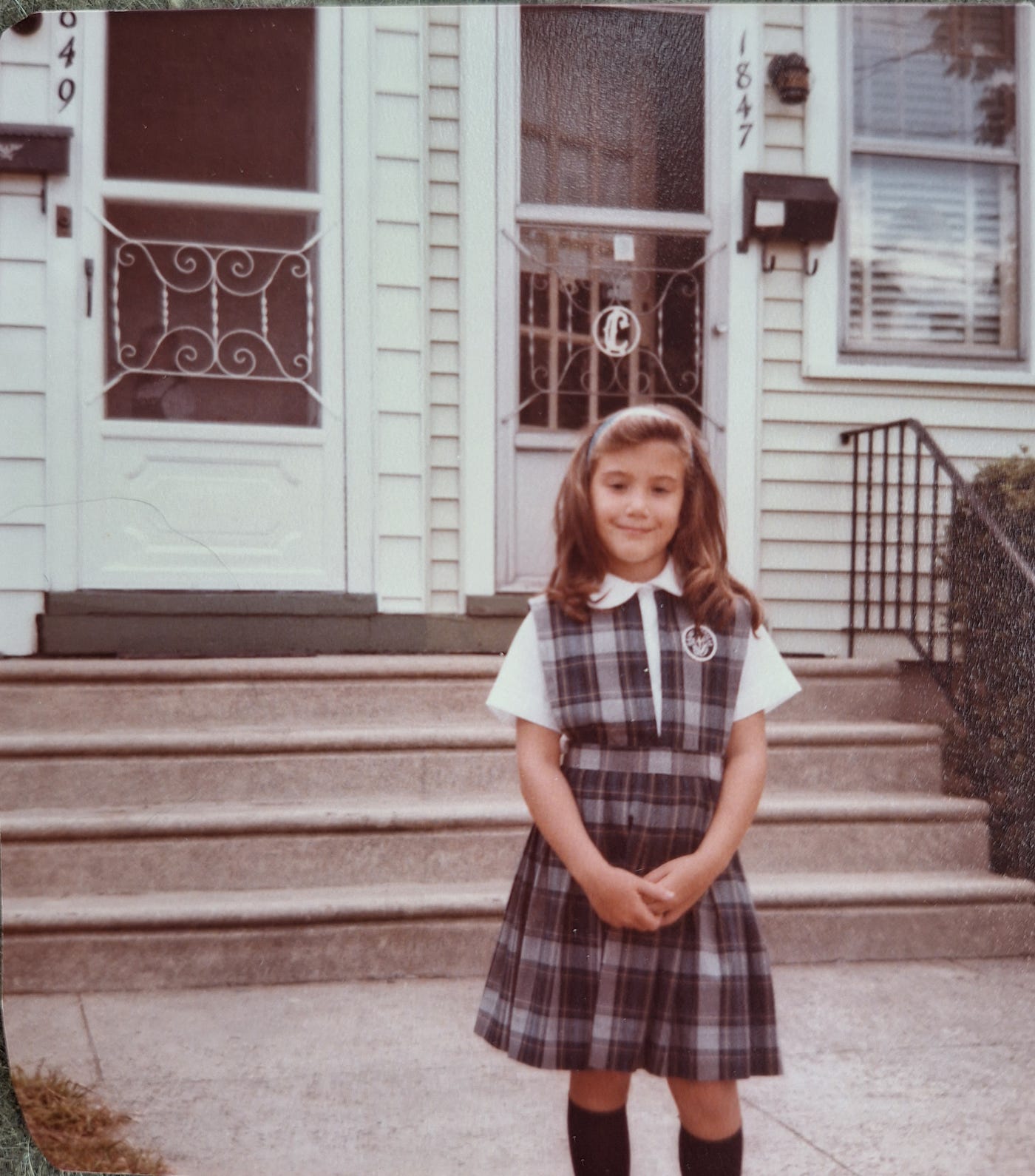
Me, 1984 (?) (photo credit: N. Croce)
My first year there was iffy. A girl named Heather Huff took it upon herself to torment me verbally: always teasing me and saying mean things, telling me I didn’t have any friends. One time I doggedly wrote out a list of my friends from the block, since bullies always respond well to logic and proof: “Kim Albrecht… Michelle Curti…” She’d also try to gaslight me: telling me I’d spelled something wrong when I knew I hadn’t. By second grade, though, she’d lost interest, and things looked up.
The main differences between public school and Catholic school were having to wear the scratchy uniform and Peter Pan blouses, and all the time we spent in church. It felt like we were always going over there for one reason or another: Stations of the Cross, practicing for some performance, or just regular old Mass. I made my first Communion there in 1985, and my first Confession.
Otherwise, it was school. We still had music and art and gym, although music might be Sister Laura and her guitar. There were a few nuns there in my early years: Sister Michelle for 2nd grade, and her helper Sister Laura. The principal was Sister Jean. They were Franciscans who wore short, light brown habits, knee-length skirts and white blouses, generally, and were sweet and well liked. The only mean nun there was Sister Theophane, but thankfully she mostly just lurked around and sometimes served as a substitute, injecting an occasional note of terror into the proceedings. I remember, though, her playing MASH with us, and refusing, jokingly, to say that she had “kids.” “The word is children. Kids are baby goats!” Ironic, playing MASH with a nun who would never have a husband, a mansion, a car or any children.
The student body was more diverse than my public school class had been. Many families living in East Camden sent their children to St. Cecilia’s, even if they weren’t Catholic. In my first-grade class, there were about eight white girls and four black girls, and later on a Hispanic girl would join. The ratio among the boys was probably about the same. When a list of addresses for the class was sent home, I pored over it. These were streets I had never heard of, never been to. We never drove west into Camden. Beideman Avenue. Harrison Avenue. Lemuel Avenue. 34th Street. The existence of 44th Street begged the existence of 34th Street, but I had never seen it. I can remember one girl retorting, in response to some question about her provenance: “I don’t live in Camden, I live in Cramer Hill!” I have to think that Joseph and Wayland Cramer would be proud.
Occasionally, I had a playdate at one of these exotic addresses. I went to Maria Maldonado’s house a few times. She had an elevated alley in the back of her yard. Like, the yard ended in a wall, and an alleyway traveled along the top of the wall. This boggled my mind, and if anyone can tell me where in East Camden this is, I’d love to know. But once I became best friends with Jennifer Gaskill, who lived right around the corner on 43rd Street, I once again didn’t have much reason to travel west.

1985: Me, Jennifer Gaskill, Jennifer Curti, my sister, Teresa Curti (photo credit: N. Croce)
Grade school seemed interminable. Each year felt like several years. It felt inconceivable to me that I would someday be an eighth-grader. All those hours, staring out the windows. There were two views: one set of classrooms faced the houses lining 49th Street, and the other looked out across the blacktop, with a panoramic view of Westfield Avenue all the way to the post office. All the times when that big stretch of sky was white-gray with imminent snow, and wishing it would start so that we could go home.
Right before I started first grade at St. Cecilia’s, there was an exciting afternoon on the block: the house of my sometimes friend Chrissy Shepherd, down near the corner of 44th and High, was raided by police. My mom later recalled watching it from our kitchen window: men storming into Chrissy’s backyard from the alley, “with long guns,” and then through her back door. Everyone had known there was something going on down there: people were coming and going all the time. I wasn’t allowed down there to play anymore. After the raid, the word on the street was that it was Chrissy’s mom who was arrested for selling drugs. This was a twist, according to my parents; everyone had assumed it was her dad who would be arrested. Soon after, they were all gone, including the rooster they’d had that would crow at dawn. The house was vacant for some time. If you poked around in their front lawn, you could find needles.
Chrissy wasn’t the only one to move away. In those years, 1983, ’84, ’85, a lot of my friends left. The Baxters were gone by 1984, and 1985 was tough: the loss of three Kims — Albrecht, Kowalski and Vogel — and the Curtis. They all moved away, and in those days, when someone moved, they were gone. I went to hang out with Kim Kowalski at her new house just one time, in another, more suburban-feeling Pennsauken neighborhood, which felt like another planet. The Curtis moved back to Philadelphia, from whence they had came, and that was that. I carefully composed a letter to Jennifer and Michelle at their new address in Kensington, but I don’t think they ever wrote back. Kim Albrecht also faded out for good around this time, though I didn’t know where she had gone, and her uncles still remained at the house where she had lived. Big Bobby and his family left around this time; so did Diana, Daphne and Dante. In 1986, Jerry, our neighbor in the wheelchair, and his parents moved away. In most cases, new people moved into these houses quickly, and we got to know most of them, some pretty well, but to me, it was just never quite the same. I was not even ten years old and I was already nostalgic for the old days.

My dad, brother and grandfather, probably 1984 (photo credit: N. Croce)
Still, it wasn’t like everyone left all at once, and those early grade-school years were filled with plenty of playtime with everyone, a shifting mix of old friends, newcomers to the block, and new friends from St. Cecilia’s. We rode our bikes up and down the block and maybe over a block or two. We converged at the corner store for water ice, Now n Laters and Bazooka gum. One of my best memories was the summer night I organized a massive game of kickball in the street — I’d gone around just rounding up everyone I could find, and finally we had enough kids on both sides to make it a really good game. We played til it got dark, and I felt such a sense of accomplishment that I’d gotten everyone together, from little kids to big ones, and from both ends of the block.
If you grew up female in the ’80s, I bet you had a sticker book. Stickers came in all types, some more coveted than others — flat, puffy, glittery, holographic, scented. My two main sticker subjects were unicorns and Michael Jackson. One of the very few times I crossed the Curtis’ threshold was to watch The Last Unicorn (1982), a Rankin and Bass animated movie in which the Unicorn squares off against the Red Bull. I was transfixed by it. As for MJ, Thriller also came out in 1982, and everybody, everybody I knew was obsessed with Michael Jackson from then on. I am nearly certain that my family were some of the millions of Americans who watched him moonwalk for the first time, on NBC on May 16, 1983 (during a Motown anniversary special).
My family didn’t have cable, and we didn’t yet have a VCR. We had a handful of TV stations, the radio, the newspaper, and a stereo system with a record player. Not much, compared to today, but I’d take whatever I could get. I’d read any book, watch any show, pore over any magazine. I’d read the TV listings in the newspaper to learn all about the shows on all the channels we didn’t have. Later, my parents gave me my own record player as a birthday gift, and I started amassing 45 rpm records of hit songs: a lot of Madonna (“True Blue,” “Open Your Heart”), Phil Collins, Bon Jovi.
One of my last conversations with Kim Albrecht before she moved involved Wham! I remember her showing me that she had gotten their cassette (must have been Make It Big! (1984)), and I think she had a Walkman to play it in. Soon, I’d move onto that format myself; for a later birthday I received a pink boom box. Music, and musical taste, became more important every year. Thankfully I could binge MTV whenever I was at my grandmothers’ houses (at least once a week).
Worldwide, there was a severe economic recession between 1980 and 1983, the worst since the Great Depression. Perhaps that’s why there seemed to be another round of foreclosures on the block around this time. At least six of these families who left in the early ’80s had their homes show up in the paper as sheriff sales. It’s possible too that this was just another side effect of the many divorces. Many of these parents were divorcing or eventually divorced. Or maybe economic problems contributed to the splits… hard to say.
I had a crush for a while on a boy named Christopher Mazzulli, who lived next to Chrissy’s old house. He was four grades ahead of me at St. Cecilia’s. One of the things that endeared him to me was his breakout performance in the school talent show, when he and some other older boys performed a song titled “You’ve Got to Fight for Your Bike (In Camden)” a la the Beastie Boys. He was short, dark-haired and very Italian-looking. I would see his dad around, but never saw his mom, and eventually found out from Jennifer Gaskill’s older sister that his mom had walked out on the family. This was whoa. Single moms I was familiar with, but this was the only single dad I had heard of, aside from Tony on Who’s the Boss? Poor motherless Christopher … my crush deepened.
One couple whose break-up seemed to play out in front of all of us was the Vogels. Jolly Mr. Vogel was known to be a bit of a drinker. They’d fight — not physically, I don’t think, but verbally, loudly, and the next thing you’d know, I’d be peeking out the front door at the flashing red and blue lights of the cop car that’d been sent over. The incident that always stuck with me was the time that little Kasey, who was maybe 5 years old, went missing. This was after they had separated, because Mrs. Vogel was out on the street screaming at the cops that Mr. Vogel must have taken her. (She turned up at a friend’s house.) Soon, they had moved away too, to parts unknown.
Another split that stuck with me had to do with a family whose name I cannot remember. They lived midblock, and I felt like I hardly just met the kids and started to play with them when they announced they were moving. In my memory — which is definitely fuzzy here — there were two girls and a boy, just like my family, and they all, parents included, had black hair, pale skin, and blue eyes. I want to say that one of the girls was named Jackie and the boy was Michael. What stands out to me is that I feel like my parents also became friendly with the parents, which, as I’ve noted, would have been unusual. I have a distinct memory of being in our kitchen and the parents, or maybe just the mom, sitting in there with my parents and explaining that she and the dad were getting divorced, and my parents clucking in sympathy.
This family, not just in its makeup, but in something else — its ordinariness — resembled my family, and this made me afraid. If the mild, unassuming, no-cop-cars So-and-So’s could get divorced, then so could my parents. I monitored my parents for any sign of stress, and worried that someday, out of the blue, my siblings and I would have to sit down and hear those dreaded words.

1985? My brother (photo credit: N. Croce)
메타데이터
- post_id
- a7a641bc3f81
- slug
- edith-emma-me-the-place-for-homes-chapter-3-a7a641bc3f81
- url
- https://medium.com/@gina.c.mcguire/edith-emma-me-the-place-for-homes-chapter-3-a7a641bc3f81
- canonical_url
- https://medium.com/@gina.c.mcguire/edith-emma-me-the-place-for-homes-chapter-3-a7a641bc3f81
- author_url
- https://medium.com/@gina.c.mcguire
- status
- ok
- fetched_at
- 2026-08-09 16:38:41




