Kampot: Quiet Streets, Jungle Roads, and the Strange Calm of Cambodia
A Chinese traveler’s experience in one of Cambodia’s slower and more atmospheric towns
Kampot: Quiet Streets, Jungle Roads, and the Strange Calm of Cambodia
A Chinese traveler’s experience in one of Cambodia’s slower and more atmospheric towns
Opening
Kampot is not a large city.
But compared to many places in Cambodia, it already feels relatively developed.
The population feels sparse.
That impression becomes even stronger when you remember Cambodia’s history.
Nearly one-third of the population died during the Khmer Rouge period.
That absence still feels visible somehow.

Chinese History
Kampot is also one of the earliest places where Chinese immigrants settled in Cambodia.
The local Chinese community has existed here for more than a century.
Over time, they became deeply integrated into local society and culture.
First Impressions
I rented a motorbike to explore the city.
At first I thought my hostel was in the countryside.
The road into town crossed a railway line with an old-style barrier that lowers when trains pass.

The infrastructure is average.
Streetlights usually exist only on one side of the road.
At night, the streets become very dark.
Street Food and the River
One roadside fried skewer stall caught my attention.
Packed with locals.
The skewers cost around:
1,000–2,000 riel each (roughly 2–4 RMB)
Mostly processed meatballs covered in sweet chili sauce.
Simple, cheap, satisfying.

There’s also a small bazaar in town.
It sells everything.
But surprisingly, prices are high.

At night, the riverside becomes lively.
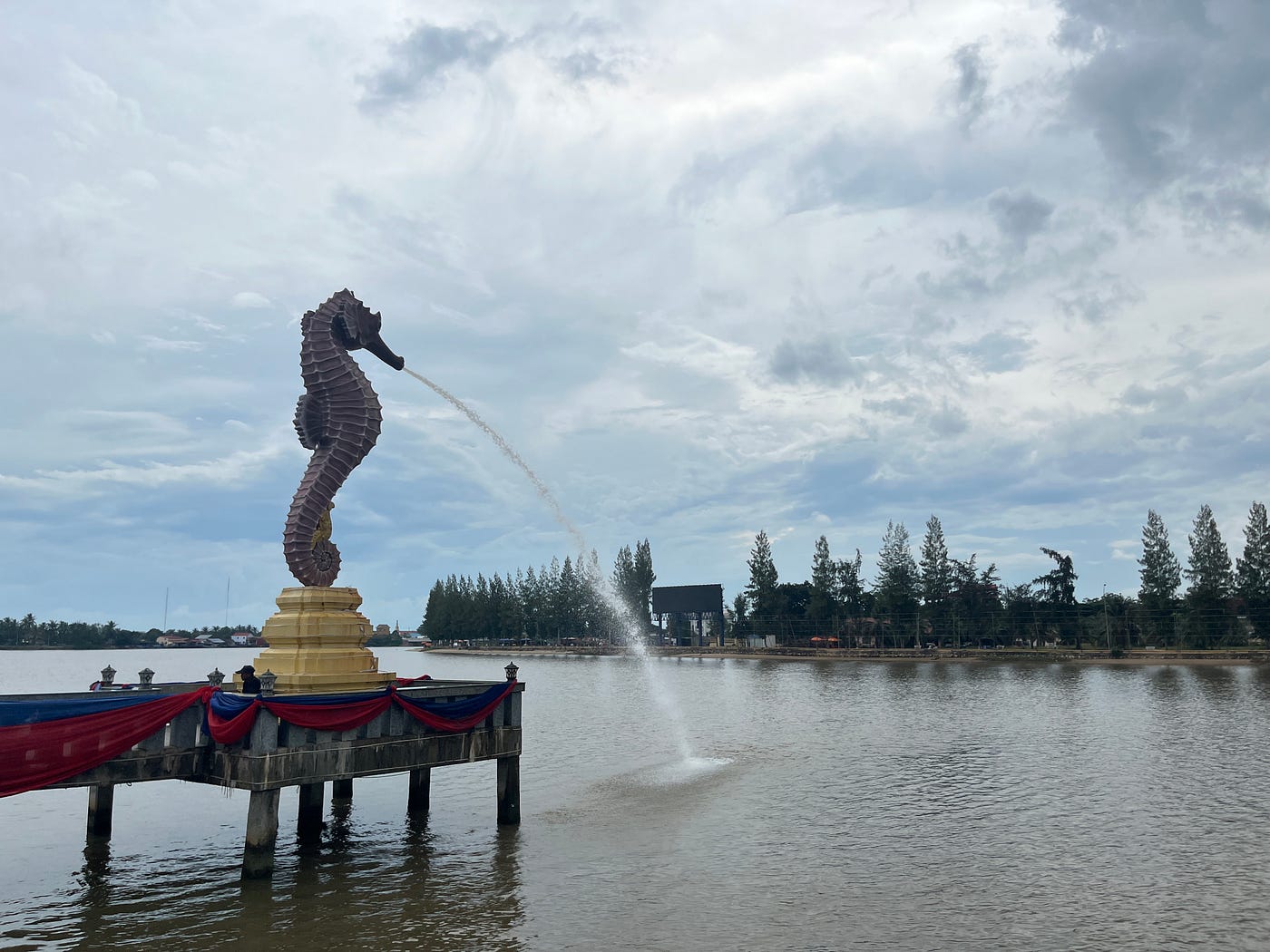
The seahorse fountain lights up.
Children play with toys from roadside stalls.
Groups of locals sit together eating snacks beside the river.
The atmosphere feels peaceful.

Chinese Presence
Chinese restaurants are everywhere.
But prices are high.
I never entered any of them.
I also noticed many unusually pale and well-dressed Chinese people around town.
Honestly, I avoided talking to them.
Partly because I worried some might be involved in gray-market businesses.
The Waterfall
The next day, locals recommended a waterfall outside town.
Getting there was difficult.
The road after heavy rain was terrible:
Mud everywhere. Slippery dirt roads. Constant bumps.
After parking, I continued on foot.
That part became even harder.
Rainy-season jungle trails are not welcoming.
The path was barely visible.
No people anywhere.
Oddly, scattered trash helped me figure out the direction.
Without it, I might have gotten lost.

I almost felt trapped inside the forest.
But eventually, I reached the waterfall.
Completely alone.
That solitude became the reward.

On the way back, I suddenly discovered locals partying beside a river valley:
Swimming. Jumping into the water. Cooking food.
Completely enjoying themselves.

Bokor National Park
Later, I rode toward Bokor National Park.
The mountain roads were excellent.
Perfect for motorcycles.
At the summit, there’s a café with wide views over the mountains.
Surprisingly, prices were almost the same as below.

I also met two Western motorcycle travelers riding expensive bikes.

This area used to be a retreat for Cambodia’s royal family and French colonial elites.
The remains are still there:
- old palaces
- French-style churches
- casinos
- hotels

When the fog rolled in, the atmosphere changed completely.
Like Silent Hill.
Misty, quiet, cinematic.
Very few tourists.

Hostel Atmosphere
The hostel had been recommended by David.
For me, it was slightly overcrowded.
Almost entirely white travelers.
I was practically the only Asian guest.
At night, there were live music performances.
Mostly Western songs.
The atmosphere felt more European than Cambodian.
One local girl seemed eager to fit in.
She performed Oasis’ Don’t Look Back in Anger.
Honestly, it sounded terrible.
But strangely, that made the moment more memorable.

Closing
Kampot is not exciting in an obvious way.
It moves slowly.
Quietly.
But underneath the calm atmosphere, there’s a strange mix of history, isolation, tourism, and fading colonial traces.

It’s the kind of place that feels more interesting the longer you stay.
메타데이터
- post_id
- a7a8acd5a4af
- slug
- kampot-quiet-streets-jungle-roads-and-the-strange-calm-of-cambodia-a7a8acd5a4af
- url
- https://medium.com/@huitravels/kampot-quiet-streets-jungle-roads-and-the-strange-calm-of-cambodia-a7a8acd5a4af
- canonical_url
- https://medium.com/@huitravels/kampot-quiet-streets-jungle-roads-and-the-strange-calm-of-cambodia-a7a8acd5a4af
- author_url
- https://medium.com/@huitravels
- status
- ok
- fetched_at
- 2026-07-30 07:39:06