How to Hire a Virtual Legal Assistant: Skills, Vetting Questions & Onboarding (2026 Guide)
What to look for, what to ask, and how to set them up for success — a practical hiring guide for attorneys.
How to Hire a Virtual Legal Assistant: Skills, Vetting Questions & Onboarding (2026 Guide)
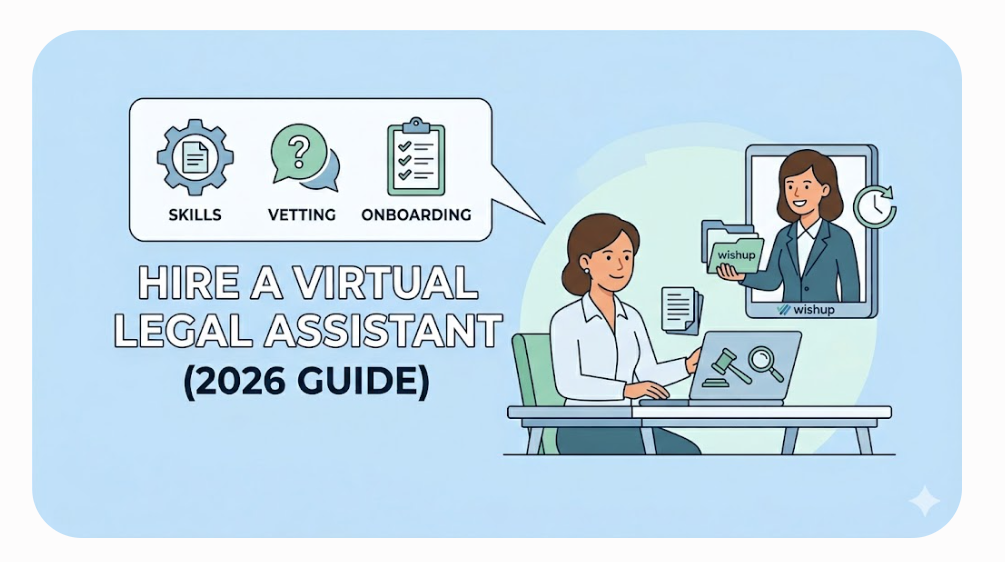
A practical 2026 hiring guide outlining essential skills, vetting questions, and onboarding steps to successfully hire a virtual legal assistant.
What to look for, what to ask, and how to set them up for success — a practical hiring guide for attorneys.
Key Takeaways
- The best legal VAs combine legal knowledge, strong communication, software skills, and discretion with client information
- Before hiring, decide where your team actually needs support and set clear expectations
- You can hire through freelance platforms or a managed VA company — each has tradeoffs
- Who does the work, how we keep your information private, and what happens if the VA is unavailable.
- A specialist provider like wishup.co handles vetting, training, and backup so you skip most of the hiring risk
Hiring a virtual legal assistant is one of the highest-leverage moves a busy attorney can make. But the difference between a great hire and a frustrating one comes down to three things: knowing what skills to look for, asking the right questions before you commit, and onboarding them properly.
This guide walks through all three, in plain language.
(New to the idea? Start with our guide on what a virtual assistant for law firms is. This article is about how to actually hire and onboard one.)
The Skills and Qualities That Matter Most
Not every assistant is built for legal work. Here’s what actually separates a strong legal VA from a generalist who’ll create more work than they save.
Legal knowledge. They should understand legal terminology, procedures, and documentation. This is the baseline that lets them work without constant hand-holding.
Strong communication. Both written and verbal. They’ll be drafting correspondence and, in many cases, speaking with clients — so clarity and professionalism matter.
Technical writing and drafting. Drafting and formatting documents is core to the role. A single typo in a legal document can cause real problems, so careful writing and self-review are essential.
File, schedule, and project management. An organized VA keeps deadlines, meetings, and case files in order so nothing slips.
Software proficiency. They should be comfortable with the legal and productivity tools your firm uses — case management, document systems, billing software, and more.
Attention to detail. Especially for court filings, where formatting and accuracy are non-negotiable.
Reliability and a proven track record. You want someone steady, not someone learning the basics on your matters.
Confidentiality and discretion. This is a core requirement, not a nice-to-have. A legal VA handles sensitive client information and must treat it with complete discretion.
Adaptability and cultural fit. The best VAs adapt to your firm’s working style and values, build a harmonious working relationship with your team, and can grow with your practice over time.
Prioritization. In a legal environment, they need to recognize what’s urgent and handle it first.
On the background side, a legal receptionist background or paralegal training/certification is a real advantage. As for education, most virtual legal assistants hold at least a high school diploma or GED, and many have bachelor’s or master’s degrees — and a good number have prior law firm experience or paralegal studies.
Here’s where a managed provider changes the math. Rather than hoping a single hire has all of these, Wishup states it selects from the top 0.1% of applicants — college graduates with at least 3 years of professional experience, screened through a 6-step vetting process by ex-entrepreneurs, and trained in legal terminology and tools before placement. The skills checklist above is, in effect, pre-screened for you.
When and How to Hire
Knowing when. The right time is usually when admin is pulling you away from billable work, deadlines are getting tight, or your team is stretched thin. (We cover the full “signs you need one” list in a companion guide.)
Where to start. Before hiring, figure out exactly where your team needs support. List the recurring tasks eating your time — those are your first delegations. Then set clear expectations about what the role covers before anyone starts.
Look for legal-specific experience. A general VA and a legal-trained VA are not the same. For anything touching legal work, prioritize legal experience.
You have two main routes to hire:
Freelance platforms (like Upwork). You hire an independent contractor directly. To vet one well, examine their background, credentials, and legal-specific skills; read reviews; and check references from previous clients. You’ll also decide between hourly and fixed-price arrangements. The upside is control; the downside is that you handle all the screening, management, and backup yourself.
A managed VA company. Here the company screens, trains, and manages the VA for you. As Wishup puts it, working with a company can give you more peace of mind because you can rely on the company to thoroughly screen its assistants for experience and professionalism — and a good provider is there to help if you need additional support.
Freelance vs. company — which is better? It depends on how much risk and management you want to take on. A freelancer can be cheaper but leaves vetting, quality control, and continuity entirely on you. A managed company costs more but removes most of that burden.
How to Choose a VA Company
If you go the managed route, evaluate a company carefully before signing. Things worth checking:
- Their vetting and screening process — how do they qualify candidates?
- Training — what do they teach VAs about legal workflows specifically?
- Backup and continuity — is there a plan when your VA is unavailable?
- Oversight — is there a manager ensuring quality?
- References and outcomes — what results can they point to?
On these points, here’s what Wishup specifically claims about its own model:
- Vetting: a 6-step process covering aptitude, cognitive assessment, English proficiency, and more; only the top 0.1% of applicants pass; VAs score in the 99.9th percentile on aptitude.
- Training: an 8-week mandatory program covering 120+ AI and no-code tools, plus 200+ hours of legal-specific training, including tools like Clio, MyCase, PracticePanther, Westlaw, LexisNexis, and QuickBooks.
- Backup and continuity: an instant replacement guarantee, with replacements provided within 24 hours at no extra cost, plus backup coverage when your VA is on planned leave.
- Oversight: a dedicated Customer Success Manager and a VA manager, with weekly QA reviews and SOP adherence checks.
- Track record: rated 4.9 on Clutch and 4.7 on Trustpilot, with a 36-month average VA retention rate, and a 7-day trial / money-back guarantee so you can test the fit.
A note on a few hiring concepts in your research — pilot programs, W-2 vs. independent contractor classification, and “operations manager oversight” — these are useful general things to weigh, but I’m not attributing them to Wishup beyond what’s above, since Wishup’s pages describe its model in its own terms (managed service, dedicated CSM + VA manager, instant replacement). Wishup does state it operates as an “employee-as-a-service” model with no long-term lock-in.
12 Questions to Ask Before You Hire
Use these before signing with any VA or VA company. Where Wishup gives a clear answer on its pages, I’ve noted it.
- Who will actually do the work? Is it a dedicated person or an anonymous subcontractor pool? (Wishup assigns a dedicated VA to your firm, not a rotating pool.)
- How is confidentiality handled day to day? (Wishup: NDA signed before day one, SOC 2/GDPR-aligned security, background-checked VAs, need-to-know access only.)
- Where are the professional boundaries? A VA should not give legal advice, conduct full conflict checks, represent you in court, or draft legal documents without attorney direction — Wishup states these boundaries explicitly.
- How will the VA integrate with your existing tools? (Wishup VAs are trained on 120+ tools, including major legal platforms, before placement.)
- What safeguards exist for court dates and filings? Ask about deadline tracking and reminders. (Wishup describes case management and court-calendar/deadline tracking as core tasks.)
- How is quality controlled? Look for SOPs, checklists, and managerial oversight. (Wishup: weekly QA reviews, SOP adherence checks, CSM cadence.)
- What happens when the VA is unavailable? (Wishup: instant replacement within 24 hours at no cost, plus backup coverage on leave.)
- How will you track progress without extra meetings? (Wishup provides end-of-day reports and time tracking via its management app.)
- What happens if you discontinue service? Ask about data ownership and a clean exit. (Wishup states no long-term lock-in and month-to-month flexibility; confirm data-handling specifics directly with them.)
- How does the company price and scope the work? (Wishup publishes flat pricing — $1,299/month part-time, $1,999/month full-time — with no setup fees or per-minute charges.)
- What training does the company provide on legal workflows? (Wishup: 200+ hours legal-specific training plus the 8-week program.)
- What references or outcomes can they share? (Wishup cites client case studies, such as a 25% reduction in client intake time using Clio, and its Clutch/Trustpilot ratings.)
Onboarding and Training Your VA

An organized onboarding workflow helps law firms seamlessly integrate virtual assistants into daily operations, software systems, and secure communication channels.
Hiring is only half the job. How you onboard determines how useful your VA becomes.
A few practical principles:
- Define roles and responsibilities from day one. Be clear about what the VA owns and what stays with the attorney.
- Train them on your systems. Give clear guidance on your calendar, billing, and case management software so they work the way your firm does.
- Set up secure access properly. Establish confidentiality and security protocols before any access is granted.
- Write SOPs for recurring workflows. Documented steps make the work consistent and easy to hand off.
- Communicate regularly. Use video calls and secure messaging for updates, and keep a steady rhythm of check-ins.
- Get written updates. Daily updates and weekly summaries keep you informed without endless meetings.
This is an area where Wishup’s managed model does much of the heavy lifting. According to its pages, Wishup onboards a VA in about 60 minutes, then handles custom onboarding to your firm’s scripts, tools, and protocols. You get end-of-day reports, time tracking through its app, weekly QA reviews, and a dedicated CSM — so the management layer that usually falls on you is handled for you. Wishup also notes its VAs tend to stay long-term (a 36-month average retention), which means a VA can genuinely grow with your practice over time rather than churning out.
Frequently Asked Questions
1. What skills should I look for in a virtual legal assistant? Legal knowledge and terminology, strong written and verbal communication, document drafting, software proficiency, attention to detail, organization, reliability, and — critically — discretion with confidential client information.
2. When should I hire a virtual legal assistant? When admin work is pulling you away from billable work, deadlines are getting tight, or your team is stretched thin. Start by listing the recurring tasks eating your time.
3. Is it better to hire a freelancer or a VA company? A freelancer can be cheaper but leaves vetting, quality control, and backup on you. A managed company costs more but handles screening, training, and continuity. Wishup notes that working with a company can offer more peace of mind because the company screens its assistants for you.
4. How does Wishup vet its legal VAs? Wishup states it uses a 6-step vetting process (aptitude, cognitive, English proficiency, and more), accepts only the top 0.1% of applicants, and requires college graduates with at least 3 years of experience.
5. What happens if my VA is unavailable? With Wishup, there’s an instant replacement guarantee — a replacement within 24 hours at no additional cost — plus backup coverage when your VA is on planned leave.
6. How is client confidentiality protected? Wishup states every VA signs an NDA before day one, with SOC 2/GDPR-aligned security, background checks, and need-to-know access only.
7. How quickly can I onboard a virtual legal assistant? Wishup states it can onboard a pre-vetted, trained VA in about 60 minutes, followed by custom onboarding to your firm’s tools and protocols.
Final Word
Hiring a virtual legal assistant comes down to three things: look for the right skills (legal knowledge, communication, software fluency, and discretion above all), ask the right questions before you commit, and onboard them properly with clear roles, SOPs, and steady communication.
You can do all the vetting and management yourself through a freelance platform, or use a managed provider that handles it for you. If you’d rather skip the screening and backup risk, a specialist is built for exactly that.
Want to skip the hiring guesswork? wishup.co — a leader in trained virtual assistant support for law firms — pre-vets the top 0.1% of applicants, trains them on legal workflows and 120+ tools, signs NDAs before day one, and can onboard a dedicated VA in about 60 minutes, with an instant replacement guarantee and a 7-day money-back trial.
메타데이터
- post_id
- a7bb1265f949
- slug
- how-to-hire-a-virtual-legal-assistant-skills-vetting-questions-onboarding-2026-guide-a7bb1265f949
- url
- https://medium.com/@williamdavis4309/how-to-hire-a-virtual-legal-assistant-skills-vetting-questions-onboarding-2026-guide-a7bb1265f949
- canonical_url
- https://medium.com/@williamdavis4309/how-to-hire-a-virtual-legal-assistant-skills-vetting-questions-onboarding-2026-guide-a7bb1265f949
- author_url
- https://medium.com/@williamdavis4309
- status
- ok
- fetched_at
- 2026-07-15 18:51:36