Why American Homes All Look the Same
Beyond the beige: How financial fears stoke aesthetic conformity, and how you can be your authentic self anyway
CULTURE
Why American Homes All Look the Same
Beyond the beige: How financial fears stoke aesthetic conformity, and how you can be your authentic self anyway
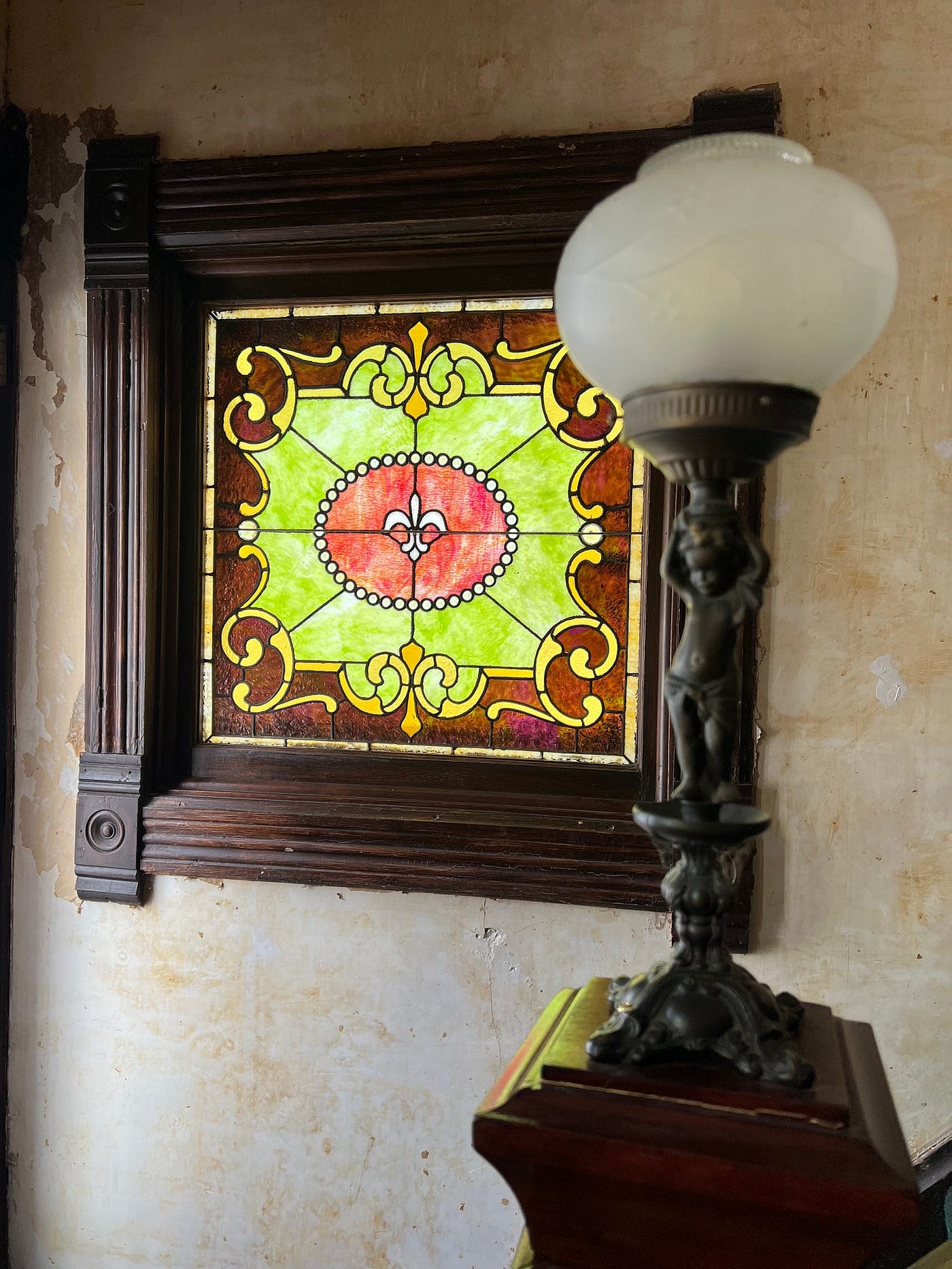
My house is not market-ready. But isn’t my newel post cool? And one of my stained windows is said to have come from my city’s old Carnegie Library. (Photo by Michelle Teheux)
The gray-beige color scheme that dominates American houses today exists for one reason: Like Muzak, it offends the fewest possible people.
Americans pay extra to live lives drained of color because we’re afraid to look poor.
Houses have become investments first and places to live second, so millions of Americans now design their kitchens, walls and furniture for the hypothetical tastes of the next buyer.
It’s not that anybody actually loves greige. But color itself has become ethnic-coded and poverty-coded.
You see it in both home decor and fashion. If you want to look rich, we are told, wear muted colors. I am not rich and am not attempting to look rich, so I am free to ignore this advice.
Which is ironic, because we used to have sumptuary laws that made it a crime for the poor to wear bright colors, which were legally reserved for the wealthy.
Minimalism is now a class signal: It takes a lot of money to make a bare room look expensive and if the architecture is not first-rate, there’s no softening that. Cozy, colorful, comfortable spaces filled with meaningful objects are, in my opinion, inherently preferable — but unfashionable.
Decorating for the Imaginary Buyer
Your furniture, art and every remodeling decision say something about you. Very often they say, “This person is willing to conform.”
And if you’re conforming, when trends shift you will feel obliged to rip everything out to avoid having the dreaded dated decor.
But my house will never look dated because it was never in style.
What a Punk Apartment Taught Me
Reading a New York Times feature on the apartment punk legend Richard Hell has lived in for 50 years is what inspired this piece.
If you are not a punk fan, you may not know the name. I am a punk fan — I identify deeply with the non-consumerist, non-conformist and working class roots of punk music.
Hell’s NYC apartment reminded me so much of my central Illinois house that I immediately felt better about all my bad plaster — and although I have two claw-foot bathtubs, at least I don’t have one in the kitchen as he does.
He and I both live in spaces that reflect our personal selves and could use a lot of help with plaster and repairs.
But if a legendary musician can live this way unapologetically, surely a working class writer can.
A House That Accumulated a Life
My house was built in 1897 and retains much of the character from that time, which is why I bought it. I’ve spent decades adding furniture and art that appeals to me.
I’ve never furnished a room in one shot and you can generally tell when someone has. That look can be very nice but such rooms tell you nothing about the person who furnished them except that they had enough money to buy everything at once.
Your stuff should tell a story.
If the only story you can tell about the pieces in your home is the name of the store where you bought them, you might need to get some better stories.
You can only get good stories by living life. There are things you cannot buy.
The first thing you’ll notice when you walk into my parlor is that we’ve removed a century of wallpaper but have not yet managed to patch the plaster or repaint it.
It looks terrible.
But I spend all my time writing and my husband spends all his time recording and mixing music, and to be honest we just forget how bad it looks until someone new is coming over.
Then I apologize.
I am going to stop doing that. I bet Richard Hell doesn’t tell people, “Don’t mind the cracked plaster. I’ve been busy making music and just haven’t gotten around to it for 50 years.”
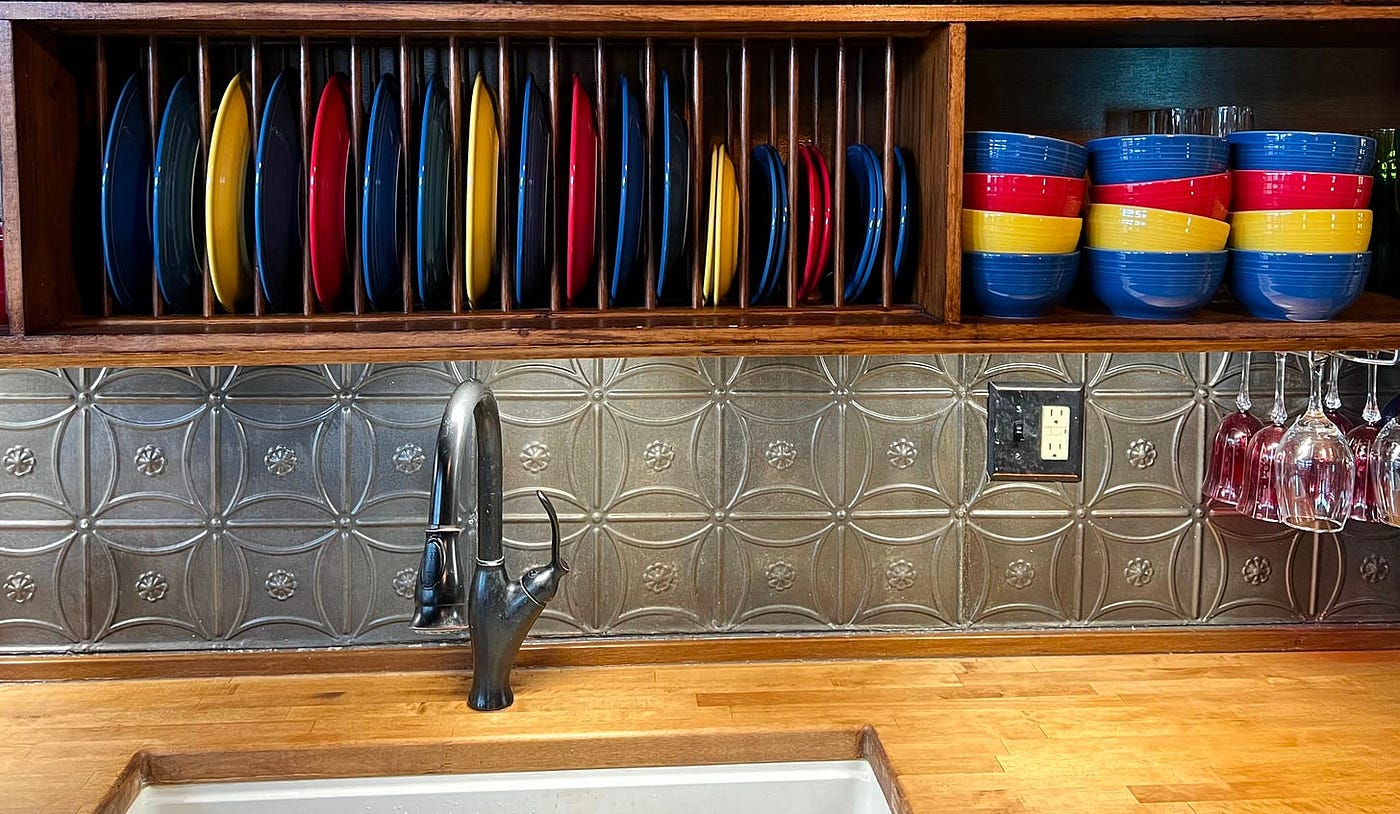
We made many of the cabinets including the plate rail. We chose butcher block partly because we could cut and install it ourselves. The backsplash comes from a tin ceiling we salvaged from the newspaper where I used to serve as editor. For more about our unique kitchen project, click here. (Photo by Michelle Teheux)
Conformity Is a Financial Choice
All creativity is a matter of revealing yourself. Nobody but me could have written most of the things I publish. Nobody but me could have decorated my house this way. Why would I want to look, sound, write or live like anyone else? I think Hell’s spaces are exponentially cooler than those done by Joanna Gaines.
In this nation that supposedly values the individual above all else, we are all trying so hard to blend in.
People who have corporate jobs are afraid to express themselves with their hair and dress, just as people who have most of their wealth tied up in their house are afraid to do anything to it that the next buyer might not like.
When you see a really unusual house profiled, it’s usually something owned by the very wealthy. Such a house will be built and decorated in a unique but visibly expensive way.
Well, smoke ’em if you’ve got ’em, I suppose.
But your family pieces and thrift shop finds and things you’ve picked up on your adventures tell a story worth seeing.
Conformity is a consequence of money.
You can decide whether you really want to live that way.
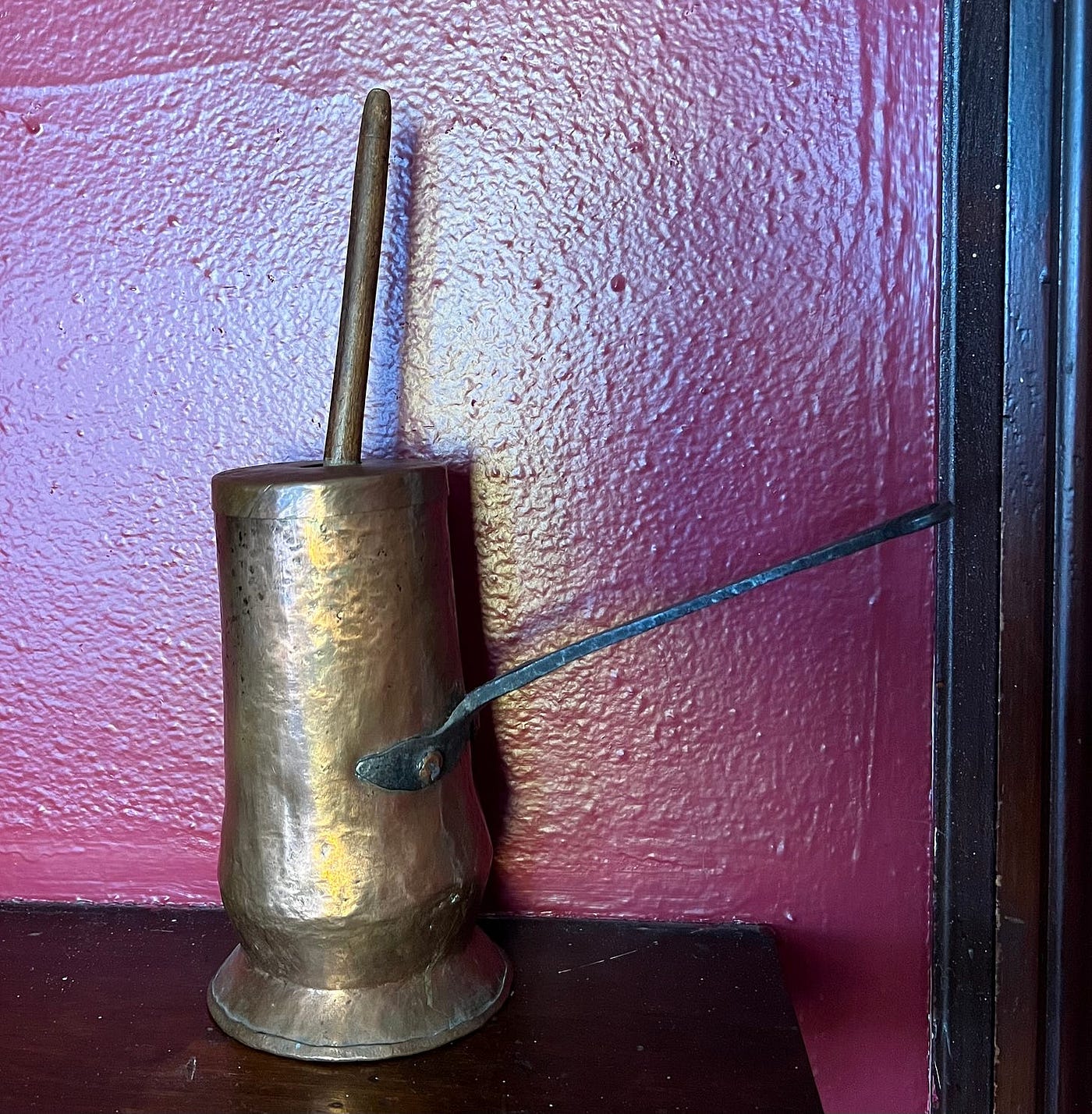
The oldest thing in my house is this mid-1700s European chocolatière for making drinking chocolate. I bought it from a street market in Belgium when we were visiting my husband’s family years ago. Making hot chocolate was a whole production then. (Photo by Michelle Teheux)
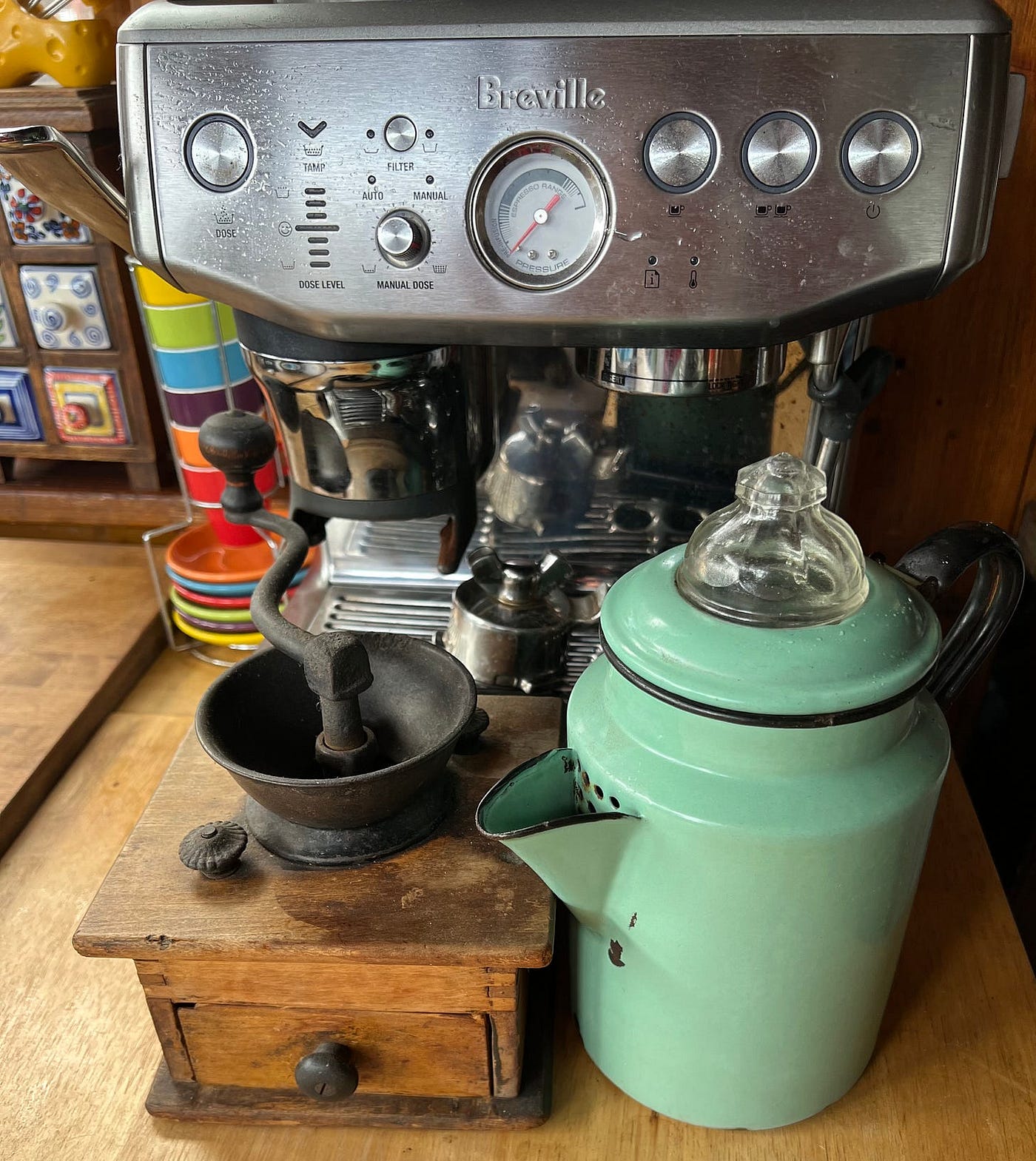
I display this old coffee grinder — my paternal grandparents had one just like it — and an old stovetop percolator in my kitchen. For this picture, I placed them in front of a modern espresso maker just for the contrast. If the apocalypse hits, these objects declare we will have coffee in this house one way or another. (Photo by Michelle Teheux)
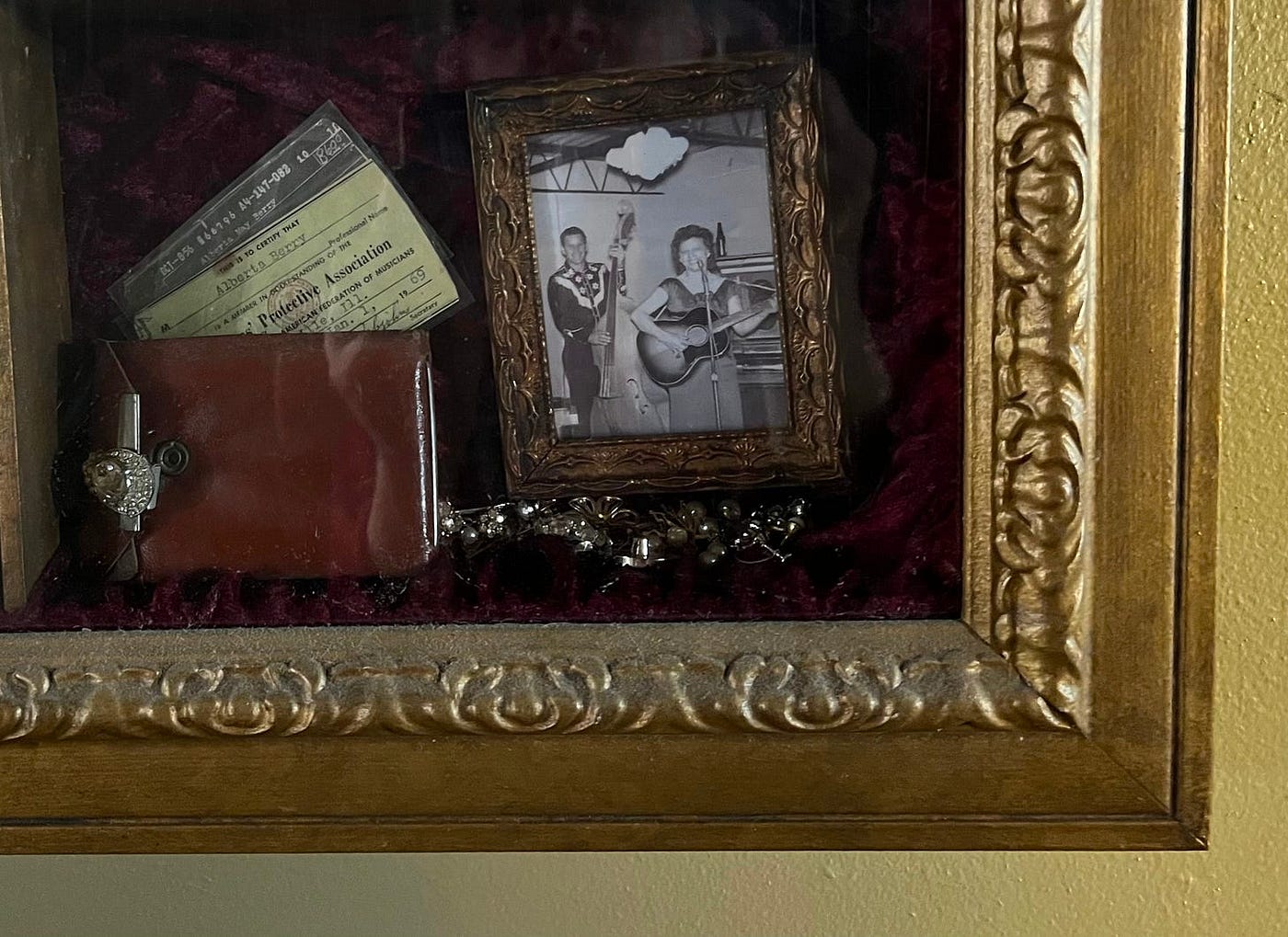
My sister designed a shadowbox to hold some family memorabilia. My mother’s family was musical and used to host bluegrass jams in their dining room. In this section, we see that Grandma Berry was a member in good standing of the musicians’ union in 1969. In the pictures, she’s playing a Hummingbird guitar and Grandpa is playing the bass. (Photo by Michelle Teheux)
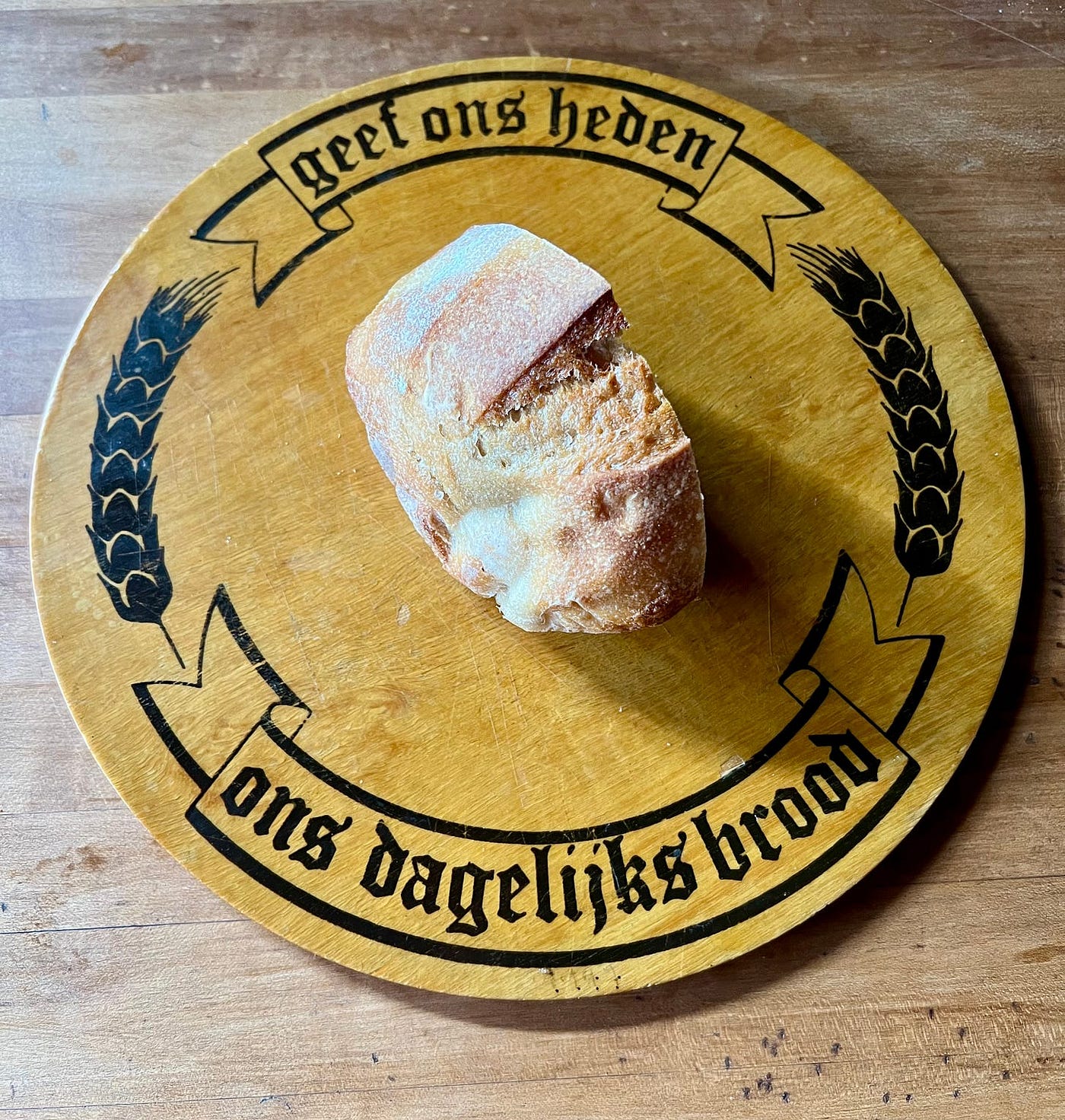
This breadboard has been in my Dutch husband’s family since 1947, according to an inscription on the back. It was a wedding gift. No, I wouldn’t dare actually cut my bread on it. (Photo by Michelle Teheux)
About Michelle Teheux
I’m a writer in central Illinois. If you like my work, subscribe! I also have a Substack about economic inequality called *Untrickled and another aimed at authors who want to self-publish books called[ The Indie Author](https://selfpublishingbookauthors.substack.com/). My new book is[ Strapped: Fighting for the soul of the American working class](https://www.amazon.com/dp/B0DJNRCQSJ). And yes, those are my husband’s actual boots on the cover! My most recent novel is[ The Trailer Park Rules](https://www.amazon.com/dp/B0CTHT43L9).* Tips joyfully accepted via Ko-fi:

**All wealthy families are alike; each poor family is poor in its own way. ** — Leo Tolstoy, if he had written about a trailer park
For residents of the Loire Mobile Home Park, surviving means understanding which rules to follow and which to break. Each has landed in the trailer park for wildly different reasons.
Jonesy is a failed journalist with one dream left. Angel is the kind of irresponsible single mother society just shakes its head about, and her daughter Maya is the kid everybody overlooks. Jimmy and Janiece Jackson wanted to be the first in their families to achieve the American dream, but all the positive attitude in the world can’t solve their predicament. Darren is a disabled man trying to enjoy his life despite a dark past. Kaitlin is a former stripper with a sugar daddy, while Shirley is an older lady who has come down in the world and lives in denial. Nancy runs the park like a tyrant but finds out when a larger corporation takes over that she’s not different from the residents.
When the new owners jack up the lot rent, the lives of everyone in the park shift dramatically and in some cases tragically.
Welcome to the Loire Mobile Home Park! Please observe all rules.
메타데이터
- post_id
- a7c39b59110e
- slug
- why-american-homes-all-look-the-same-a7c39b59110e
- url
- https://medium.com/minds-without-borders/why-american-homes-all-look-the-same-a7c39b59110e
- canonical_url
- https://medium.com/minds-without-borders/why-american-homes-all-look-the-same-a7c39b59110e
- author_url
- https://medium.com/@michelleteheux
- status
- ok
- fetched_at
- 2026-06-13 12:55:53