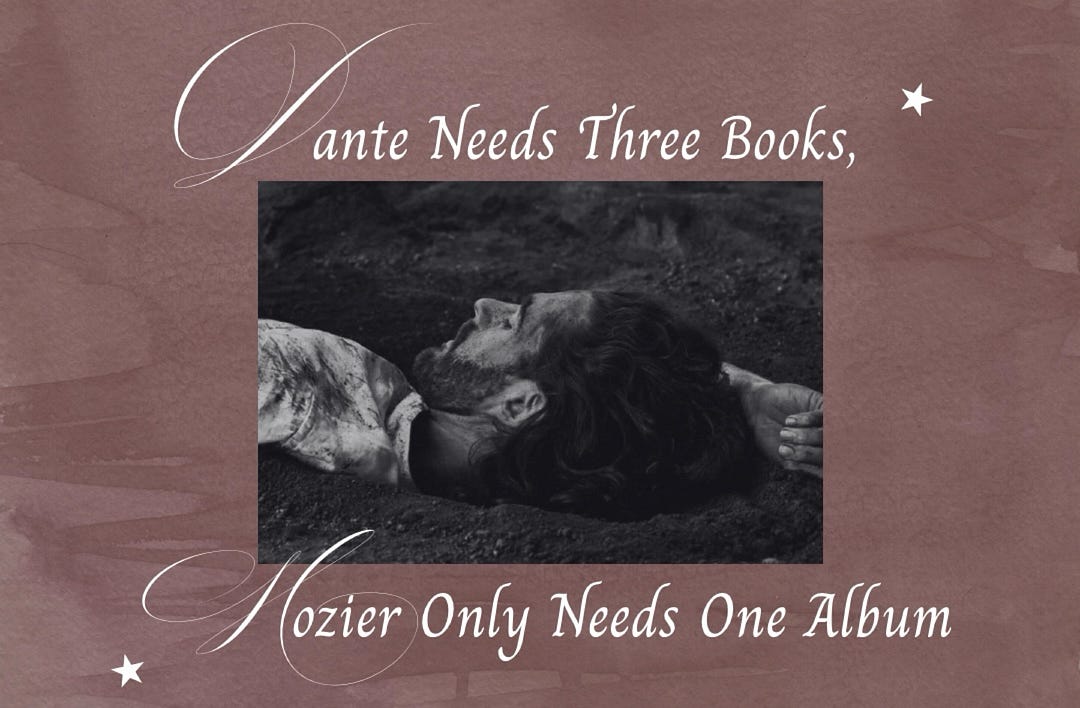
Dante Needs Three Books, Hozier Only Needs One Album
Hozier only needs 16 songs and 62 minutes to explain Dante’s “Inferno”. Can music actually tell something that books can’t?
Dante Needs Three Books, Hozier Only Needs One Album
One random Tuesday I lay down in my bed and mindlessly scrolled YouTube to find new music to listen to. I came across two ladies on a podcast talking about Hozier’s song titled “Francesca.” They absolutely love that song and recommend it to everyone who’s watching. Curious, my fingers slowly search for Hozier’s song titled “Francesca.” Is it really good and worth so much to talk about? Quietly, I start to listen to that song for four minutes. Damn. That was the best four minutes in my life. The beat drop in the chorus really settled it for me. I keep repeating it over and over again. Later, I play it in Spotify and then add it to my playlist. Little did I know that would be my obsession for the next couple days.
Another curiosity starts to appear. Why is it titled “Francesca”? He doesn’t even mention her name at all in that song. I begin to dig deeper. Then I find an answer to that question. That song was titled “Francesca” because it is written from the perspective of Paolo, two characters that appear in Dante Alighieri’s book “The Divine Comedy Part 1: Inferno.” As I find out more about this, I keep digging into these two characters and their tragic love story, and suddenly I come to a very mind-blowing conclusion. Hozier actually making the whole album “Unreal Unearth” inspired by Dante’s book “Inferno.” As someone who loves both music and books, I was thrilled from excitement. Can someone make a whole album based on a book and completely able to tell emotion as sharply as it appears in the book?
If I really want to understand more about this, I should learn more about Dante’s “Inferno.” Previously I was familiar with Dan Brown’s book “Inferno” and also R.F. Kuang’s book “Katabasis,” in which two of them are also borrowing the idea of descending through hell, but I am not familiar with Dante’s “Inferno,” which ironically is the main source of these two masterpieces. Dante Alighieri wrote a book titled “The Divine Comedy.” That book was divided into three parts where he explained the journey through hell, purgatory, and heaven. The first part of the book titled “Inferno” tells us about Dante’s journey through hell. Guided by the Roman poet, Virgil, Dante began his journey through 9 circles of hell. Each circle represents human sins based on Christians’ afterlife. Dante uses linear narrative storytelling to describe his journey through hell.
Unlike Dante, who’s obviously a writer, Hozier, as a singer, wrote an album consisting of 16 songs to describe his journey of descending through hell. By listening to the album track by track, in only 62 minutes we can experience descending through hell with Hozier. As if Hozier were the Roman poet Virgil who guides us through 9 circles of hell. Unlike Dante, Hozier doesn’t explicitly explain which song represents which part of the 9 circles of hell in Inferno. I also realize that his way of storytelling is not linear like in the book; sometimes he puts a song as a side story that doesn’t connect with the 9 circles of hell, but it contains his perspective of death. This is exactly why it becomes more interesting. Dante needs hundreds of pages and thousands of words to describe his story. Hozier only needs 16 songs and 62 minutes to explain that very same story. Can music actually tell something that books can’t? To answer this, I begin to analyze his songs through lyrics and metaphors. I realize that analyzing 16 songs will probably be too long for this essay, so I decided to analyze 3 songs that I think have the deepest connection to Dante’s “Inferno.”
Hozier opened the album with two songs titled “De Selby Part 1 & Part 2,” which represent Dante’s journey before he descended through hell. Dante is lost in the dark wood on a Good Friday in the year 1300. The singer uses De Selby, who is a fictional character from “The Third Policeman” written by Flann O’Brien. In the novel, De Selby is an eccentric philosopher from Ireland who argues that night is the accumulation of a black air and that a mirror holds the secret of eternity. The lyrics from “De Selby Part 1” tell the idea of darkness and losing sense of identity, some thoughts that seem borrowed from the De Selby character. The song later ended with a Gaelic phrase about transformation or metamorphosis. With slow melody and pacing, this song symbolizes something is about to change, much like the calm before the storm. It mirrors Dante’s life that is about to change before he’s descending through hell. In “De Selby Part 2” the singer describes darkness as something freeing and not something to be scared of. He even said in his lyrics that he welcomes the darkness and wants to block the sun. With stronger melody and bass drops, this song symbolizes Dante, who’s finally ready to descend through hell and welcome the darkness. These two songs already show something special about music that books can’t do. When you read a book, you need to pay attention to the context and situation of the story for you to be able to feel the character’s emotion. You might feel nothing in the beginning of the book, but as you read deeper, you begin to understand the character’s feelings and emotions. Sometimes you need to read a hundred pages first to feel a strong sense of emotion and finally begin to resonate with the character. Different things happen with music. You don’t need to read hundreds of pages or even understand the character’s background to feel the emotion. Only with a few seconds since the melody dropped to your ear, you automatically captured the emotion Hozier’s trying to explain in his songs. First, something is about to change. Second, we are jumping freely to celebrate the darkness through hell.
In Dante’s “Inferno,” the third circle of hell is gluttony, which is the act of excessive indulgence in food and drink. Something is considered greedy, wasteful, and even included in the 7 deadly sins. In his journey, Dante meets Ciacco, a Florentine citizen who is damned for the sin of gluttony. Hozier writes the song “Eat Your Young” from the first-person perspective as if he’s Ciacco himself, who can’t stop eating and always wants more. This aligns well with the melody that’s more playful, emphasizing Ciacco, who doesn’t regret his acts by wanting more food. Interestingly, the singer doesn’t use food as an object, but he uses children as the object for gluttony. It emphasizes people who eat the children by selling guns and bombs and serving their corpses to eat. That’s why the song is titled “Eat Your Young.” It scarily reflects on the actual phenomena where the company that sells food to eat is also the same company that pays for genocide. With its upbeat melody and sarcastic lyrics, Hozier’s able to tell stories about a character who is so greedy that he doesn’t even care about his food source as long as he keeps eating. For me, that’s so disturbing, and maybe that’s exactly the emotion that the singer wants to tell us.
3. First Light
This is the last song on the album and personally my favorite track. The previous tracks in the album definitely have some sense of darkness, both in lyrics and melody. You can hear how his songs in the beginning of the album are slow, which represents descending into hell, and gradually become heavy and darker as we deep dive into 9 circles of hell. But this last song acts as the complete opposite from the rest of the track. It serves as the only bright light in the album. As the last song, it perfectly mirrors Dante’s end of journey, where he ascends back to earth and goes back home. The singer uses a layered choir as the melody that perfectly captures the feeling of going home and finding the first light. Wondering if everyday always looks so bright like this after his long journey from hell.
After analyzing this album, there’s another question that lingers in my mind. Of course I can say it’s a great album because I analyze it and compare it to the original book. But what about someone else who doesn’t know anything about Dante’s “Inferno” at all? Could they still think it’s a great album? Without all of the explanation? For me, the answer is yes. They could still be enjoying this and say this album is a masterpiece. Why? Because in this album, Hozier doesn’t tell us specifically what or who the song refers to. Maybe the only exception is for the song “Francesca,” but the rest of the songs remain ambiguous. The rest of the songs in the album follow the subject “I” and “You” without explaining directly who those terms refer to. For me, this isn’t weakness. In fact, this is the strength many singers have. The subject who remains ambiguous in the song becomes so universal it can connect listeners from all around the world with different backgrounds and experiences. If I listen to a heartbreak song, the subject “You” in that song would probably make me think of my first love, but that could be different for someone else; they could probably think about their recent ex. The ambiguous lyrics can connect someone in a different context. Even someone who hasn’t read Dante’s “Inferno” could relate to the songs personally.
Overall, I think with this album Hozier does a really great job in translating the feeling of Dante’s journey through hell. It would be too simple to say music is better than books in capturing feelings because I think both have their own strengths. Books can tell stories much deeper and more detailed, while music, with its melody, could transport feelings much faster and more universally. Dante’s going through 9 circles of hell to make humans reflect back on their sins, whereas Hozier, as a singer, serves as Charon, who transported souls across the River Styx or should I say transported the listener through hell in 62 minutes.
메타데이터
- post_id
- a7c87cd6fe85
- slug
- dante-needs-three-books-hozier-only-needs-one-album-a7c87cd6fe85
- url
- https://medium.com/@gesyiam/dante-needs-three-books-hozier-only-needs-one-album-a7c87cd6fe85
- canonical_url
- https://medium.com/@gesyiam/dante-needs-three-books-hozier-only-needs-one-album-a7c87cd6fe85
- author_url
- https://medium.com/@gesyiam
- status
- ok
- fetched_at
- 2026-07-11 10:54:37




