Registered nurse resume tips and examples
If you are unable to Pass your Exams, Quizzes, Tests or Unable to Handle Homework Assignments or full course online, Get paid help from…
Registered nurse resume tips and examples
If you are unable to Pass your Exams, Quizzes, Tests or Unable to Handle Homework Assignments or full course online, Get paid help from Online Helpers at Hiraedu! Contact Details for HiraEdu Helper: WEBSITE: hiraedu. com WhatsApp: +12136359834 Email: info@hiraedu. com Call: +12136359834
Quick answer
This article is a complete, search-friendly guide to Registered nurse resume tips and examples. It is written for students, new nurses, career changers, faculty, advisors, and working professionals who want clear answers without confusing jargon. The goal is to help you understand your options, choose reliable resources, and make a practical plan.
Because this topic is connected to nursing careers, the guide explains how to compare job settings, build a resume, prepare for interviews, choose a specialty, and keep learning after graduation. It also covers how to use clinical experiences and school projects as proof of readiness.
Because this topic is connected to studying, the guide includes practical study methods, books, apps, drug guides, question banks, NCLEX-style practice, classroom habits, and weekly planning ideas. The focus is on learning for safe practice, not just memorizing for a test.
Why this topic matters in 2026
Nursing is a large career field, but it is also a licensed profession. That means the safest way to plan your path is to combine career research with official school, board, and employer information. A helpful article should not simply tell you which choice sounds popular. It should show you how to compare programs, how to build study habits, how to prepare for clinical learning, and how to move from student life into practice.
In the United States, registered nurses commonly enter practice through diploma, associate degree, or bachelor degree pathways, depending on the school and state. Many students continue later into BSN, MSN, DNP, educator, leadership, informatics, research, or nurse practitioner roles. Program titles can look similar, but prerequisites, clinical hours, tuition, accreditation, transfer rules, and licensure eligibility can be very different. Read every program page carefully before applying.
Current employment data are encouraging for many nursing roles, but job market strength does not remove the need for careful planning. Hospitals, clinics, schools, long-term care facilities, public health agencies, telehealth groups, research sites, and community organizations all hire nurses for different kinds of work. A student who understands those settings early can choose clinical rotations, electives, certifications, and volunteer experiences more wisely.
The best nursing resources are usually the ones that are accurate, current, and connected to real practice. Useful sources include official textbooks, school learning platforms, drug guides, skills videos, state board websites, NCLEX test plans, peer-reviewed journals, reputable continuing education, and employer transition-to-practice programs. Social media can help you hear student experiences, but it should not replace official sources.
Important current references used in this article include the U.S. Bureau of Labor Statistics, NCSBN, AACN, CCNE, ACEN, ANA, ANCC, NLN, AANP, AANA, PharmCAS, PTCB, ASHP, and relevant state board resources. Always confirm licensing, admissions, and scope-of-practice rules with your own state board, school, employer, or credentialing body.
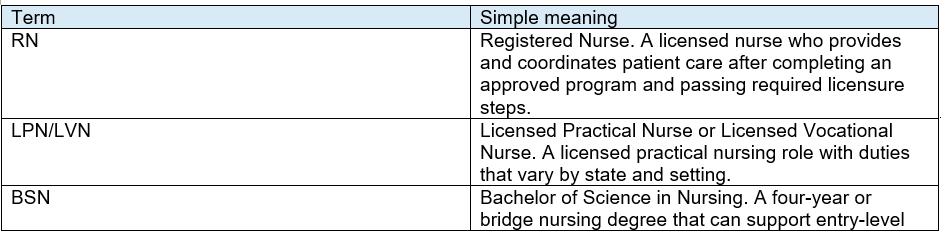
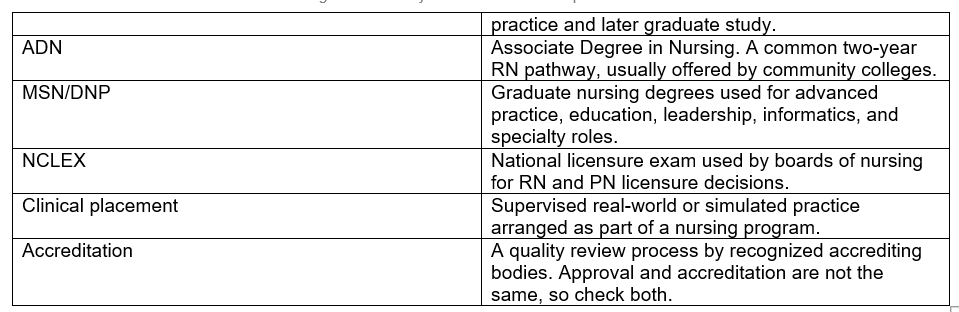
Key terms and simple definitions
How to think about this topic
A good plan starts with the end goal. In nursing and pharmacy, the end goal may be a license, a first job, a clinical placement, a stronger resume, a graduate program, a specialty role, or better exam performance. Once you know the goal, you can work backward. Ask what proof you need, what deadline matters, what documents are required, what skills must be practiced, and what support system will help you keep going.
Simple planning beats panic studying. Many students wait until they are overwhelmed and then try to fix everything in one week. A better approach is to build small routines: review notes the same day, practice questions several times per week, keep a running list of weak topics, and ask for help before grades drop. This method works for anatomy, pharmacology, dosage calculations, care plans, NCLEX preparation, and job applications.
Reliable information matters because rules change. A blog post can be helpful, but official sources should guide final decisions. For school decisions, use the school catalog, state board, accreditation databases, and admissions office. For exam decisions, use NCSBN, NCLEX resources, and your program faculty. For job decisions, use the employer job posting, HR contact, professional organizations, and state scope-of-practice rules.
Study resources, books, and tools
Textbooks are still important because they match course objectives and provide depth. Common resource categories include fundamentals of nursing texts, health assessment texts, pathophysiology texts, pharmacology texts, medical-surgical nursing texts, maternal-child and pediatric nursing texts, mental health nursing texts, community health texts, leadership texts, evidence-based practice texts, drug guides, lab value references, and NCLEX review books.
Practice-question resources are useful when they include rationales. Do not only ask, ‘Did I get this right?’ Ask, ‘Why is this answer safest, why are the other answers wrong, and what thinking pattern does this question test?’ Nursing questions often test priority, delegation, safety, infection control, clinical judgment, patient teaching, and recognizing changes in patient condition.
Apps can help, but they should not control your learning. A flashcard app may be excellent for lab values and medication classes, while a question-bank app may help with NCLEX-style thinking. However, apps can become passive if you only tap through questions. Always write down missed concepts, explain them out loud, and connect them to patient care.
For pharmacology, use a current drug guide or school-approved database. Review medication action, route, dose range if required by your course, adverse effects, contraindications, nursing assessments, patient teaching, and what to do if a serious reaction occurs. Medication safety requires accuracy and judgment, so always follow your program and facility policies.
Practice tests and exam preparation
Practice tests are most useful when you review them slowly. Many students take a practice test, check the score, and move on. That wastes the learning opportunity. After every test, divide missed questions into categories: content gap, reading error, priority error, safety error, test anxiety, or careless mistake. Then choose the next study action based on the error type.
A realistic exam plan includes content review, practice questions, review of rationales, and timed practice. For nursing exams, spend time on ‘first action’ questions, ‘best response’ questions, delegation questions, and patient-safety questions. For dosage calculation tests, practice slowly until the method is consistent, then practice with time limits.
NCLEX-style practice should be connected to the current test plan and the Next Generation NCLEX focus on clinical judgment. Students should understand assessment, analysis, decision-making, action, and evaluation. Case studies can feel difficult at first, but they become more manageable when you learn to identify relevant cues, ignore distractors, and connect data to nursing action.
Clinical learning and professional behavior
Clinical learning is not just about completing hours. It is where students learn communication, time management, safety checks, teamwork, documentation, patient education, and professional accountability. A student who arrives prepared, asks thoughtful questions, accepts feedback, and follows safety rules builds trust with instructors and staff.
Before clinical, review the unit focus, common diagnoses, common medications, expected skills, and facility policies. Bring required documents and supplies. During clinical, write down learning points, not patient identifiers. After clinical, review what went well, what needs practice, and what questions should be asked in post-conference or office hours.
Professional behavior matters because nursing is a trust-based profession. Be on time, protect privacy, use respectful language, follow uniform rules, report safety concerns, and avoid posting about clinical experiences online. Small habits create your reputation long before your first job application.
Career planning and job search
The nursing job search should begin before graduation. Students can attend employer panels, ask about nurse residencies, build a simple resume, collect references, and learn which specialties hire new graduates. A new graduate does not need to know everything, but they should show readiness to learn, safe judgment, and respect for teamwork.
Job postings are study guides for your career. Highlight repeated requirements such as BLS certification, ACLS, telemetry, EHR experience, pediatric experience, weekend availability, or BSN preferred. Then look for ways to build those qualifications through school, clinicals, simulation, volunteer work, continuing education, or entry-level experience.
A strong interview answer is specific. Instead of saying, ‘I am a team player,’ describe a clinical situation where you communicated with a nurse, instructor, patient, or classmate to solve a problem. Instead of saying, ‘I handle stress well,’ explain how you prioritize, ask for help, and keep patient safety first.
How to compare programs and resources
When comparing programs, avoid choosing only by reputation or convenience. Reputation matters, but it is only one factor. Compare approval, accreditation, outcomes, clinical access, faculty support, schedule, total cost, graduation requirements, and how students are supported when they struggle. A program that looks cheaper may cost more if it has hidden fees, long travel requirements, or limited support.
When comparing resources, ask whether the resource is current, evidence-based, easy to use, aligned with your course, and appropriate for your level. A beginner needs clear explanations and practice. An advanced student needs application questions, case studies, research literacy, specialty content, and professional standards.
For online programs, check state authorization and clinical placement support. Many programs can teach theory online, but prelicensure and advanced clinical programs require hands-on practice. Ask who arranges clinical placements, what happens if a placement falls through, and whether the school has existing relationships in your region.
Common mistakes to avoid
Do not wait until the last minute to ask for help. Nursing and pharmacy content builds quickly. If dosage calculations, pathophysiology, or pharmacology are weak, later courses become harder. Use tutoring, faculty office hours, study groups, and practice questions early.
Do not choose a school without checking licensure eligibility. A program may advertise nursing education, but your state board determines whether graduates meet requirements for licensure. This is especially important for online, out-of-state, international, and bridge programs.
Do not treat clinical placement as a minor detail. Clinical access affects your schedule, transportation, learning experience, and sometimes your ability to graduate on time. Ask direct questions before committing to a program.
Do not copy care plans, medication cards, or AI-generated answers without understanding them. Tools can support learning, but nurses are responsible for safe judgment. Use tools to check your thinking, not replace it.
Simple weekly action plan
Monday: Review new lecture notes within 24 hours. Turn headings into questions. Make a short list of confusing points to ask about.
Tuesday: Complete practice questions related to the week’s content. Review rationales carefully and record missed concepts.
Wednesday: Build one concept map or medication-class chart. Focus on assessment findings, nursing interventions, safety risks, and patient teaching.
Thursday: Review clinical preparation, skills videos, lab values, and common medications. Practice communication and documentation language.
Friday: Meet with a study group or tutor. Teach one topic to someone else and ask them to question your reasoning.
Saturday: Take a timed mini-test or complete a larger practice set. Review mistakes by category.
Sunday: Plan the next week, organize assignments, rest, and protect sleep. Burnout makes learning harder, so recovery is part of preparation.
Ethics, safety, and responsible use of technology
Health care learning requires privacy and professionalism. Never put patient names, dates of birth, medical record numbers, photos, unique details, or identifiable stories into public tools, social media, or unsecured apps. When using AI or online tools, use fictional examples or remove identifying details completely.
Technology can support study, but it cannot replace clinical judgment. Use AI to quiz yourself, explain difficult concepts in simpler words, create a study schedule, or generate practice questions. Do not use it to write clinical documentation, replace policy, or make patient-care decisions.
Evidence-based practice means asking good questions, finding trustworthy sources, and applying information safely. Students can build this habit by reading assigned articles, learning basic research terms, checking dates, and asking how evidence connects to real patient outcomes.
Final decision framework
Use a four-part decision framework: fit, safety, evidence, and next step. Fit means the option matches your goals, schedule, finances, learning style, and life responsibilities. Safety means the option supports licensure, patient safety, and professional standards. Evidence means you checked official sources and outcomes. Next step means you know what action to take this week.
For a school decision, the next step may be requesting the curriculum map, checking accreditation, comparing total cost, or attending an information session. For a job decision, it may be updating a resume, applying to a residency, asking for a reference, or practicing interview answers. For a study problem, it may be scheduling tutoring, taking a diagnostic quiz, or reviewing one weak topic daily.
Progress does not have to be dramatic to matter. Nursing and pharmacy success often comes from repeated small actions: one more practice set, one better clinical question, one stronger resume bullet, one office-hour visit, one medication class reviewed correctly, and one honest reflection after feedback.
Detailed career recommendations for this topic
Career planning checklist
· Write down the patient population you enjoy: adults, children, older adults, families, mental health patients, surgical patients, emergency patients, community groups, or people with chronic conditions.
· Match each interest to a setting. For example, emergency care usually means fast triage and teamwork, while outpatient care may mean education, follow-up, prevention, and long-term relationships.
· Review required credentials. Some jobs need an RN license only, while others prefer a BSN, specialty certification, graduate degree, preceptor experience, teaching ability, or research experience.
· Build proof of readiness. Keep a record of clinical rotations, skills, leadership roles, simulations, projects, volunteer work, quality-improvement examples, and patient-education experiences.
· Use informational interviews. Talk with nurses who work in the specialty you are considering. Ask what a typical shift looks like, what skills matter most, and what they wish they had learned earlier.
Resume and interview advice
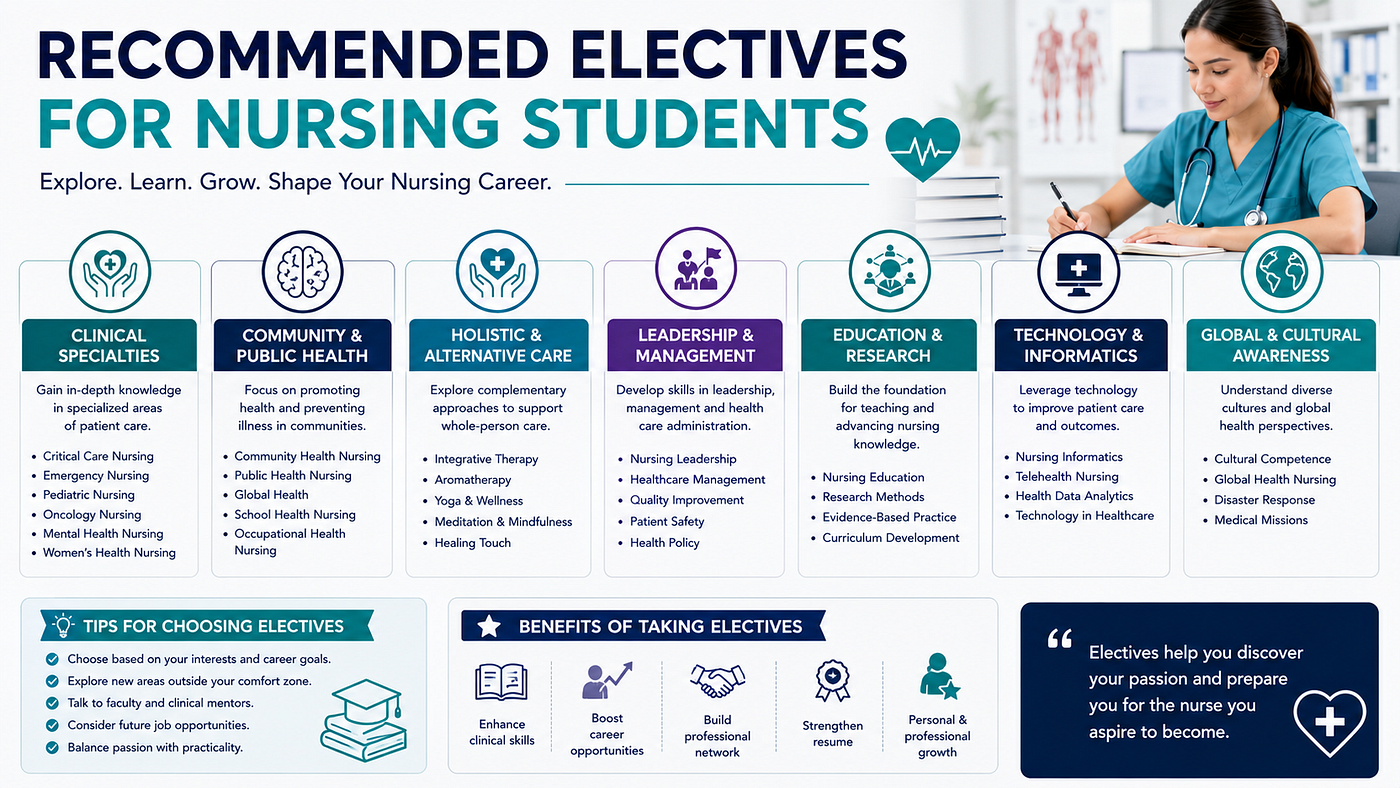
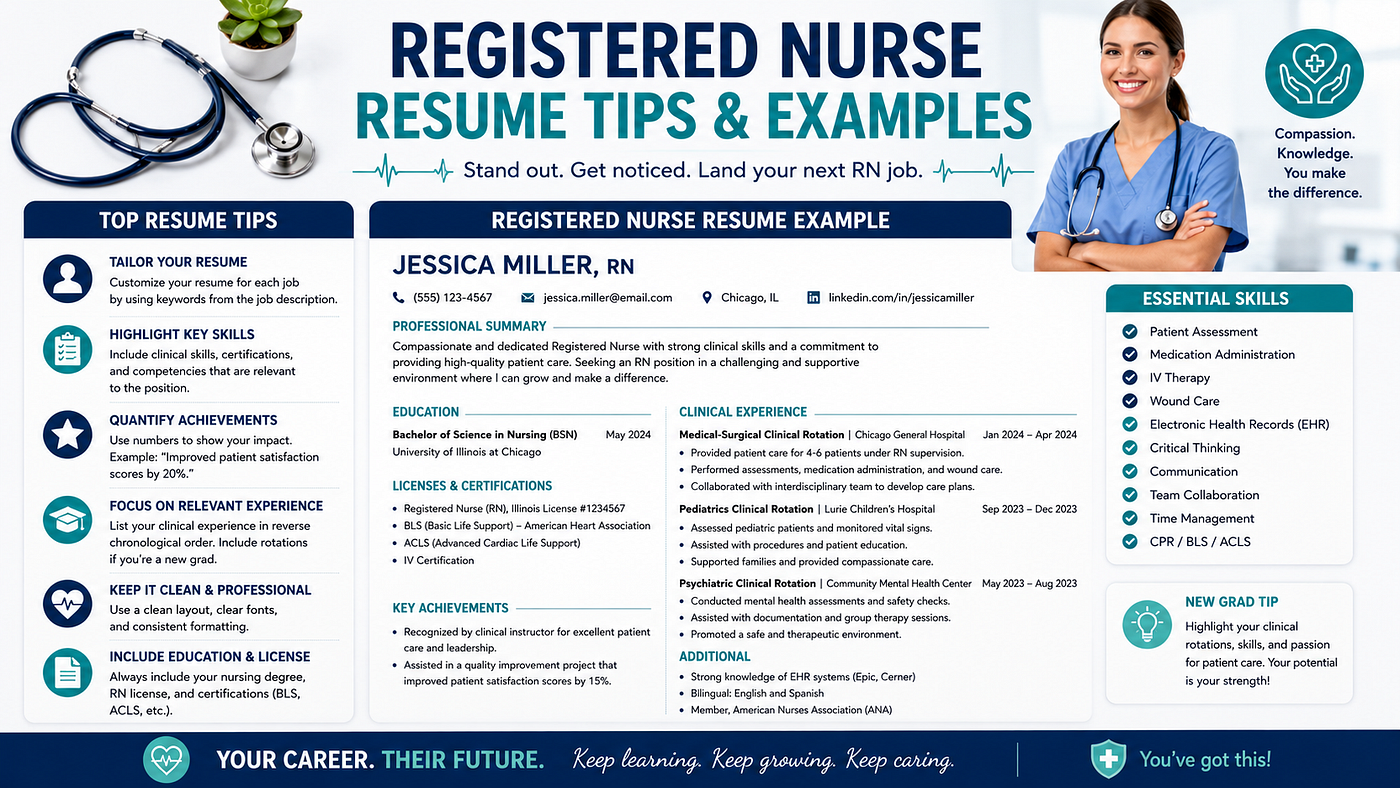
A nursing resume should be clean, specific, and easy to scan. Lead with license status, degree, clinical hours, certifications, and the type of role you want. New graduates can include clinical rotations, capstone experiences, simulation labs, medication administration practice, electronic health record exposure, and patient education projects.
Strong resume bullets use action words and measurable context. Instead of writing, ‘helped patients,’ write, ‘Provided supervised care for adult medical-surgical patients during 180 clinical hours, including vital signs, medication preparation, patient teaching, and safety checks.’
For interviews, prepare examples using a simple story structure: situation, action, result, and lesson. Good examples include handling a difficult patient interaction, catching a safety concern, working through feedback, organizing a busy clinical day, or learning from a mistake.
Detailed study recommendations for this topic
Study methods that work in nursing school
· Use active recall every day. Close the book and explain the concept in plain language. If you cannot explain it, you do not fully know it yet.
· Use spaced review. Review difficult content after one day, three days, one week, and two weeks. Nursing school moves too fast for one-time studying.
· Practice application questions. Nursing exams often ask what the nurse should do first, what action is safest, or what data matters most. That means memorization alone is not enough.
· Make concept maps. Put the disease, risk factors, assessment findings, labs, medications, nursing interventions, patient teaching, and complications on one page.
· Study pharmacology by drug class. Learn the action, side effects, contraindications, nursing assessments, patient teaching, and safety alerts for the whole class before memorizing individual drug names.
Best study resources
· Use your required textbooks and course objectives first. Professors usually write exams from assigned content and lecture priorities.
· Use an NCLEX review book early, not only after graduation. It helps you understand the style of nursing questions.
· Use a current drug guide or school-approved drug database for pharmacology. Do not rely on random internet summaries for medication safety.
· Use skills videos from your school, professional organizations, or hospital education systems to review procedures before lab checkoffs.
· Use practice questions with rationales. The rationale is often more valuable than the question because it teaches how nurses think.
Books, websites, and tools to consider
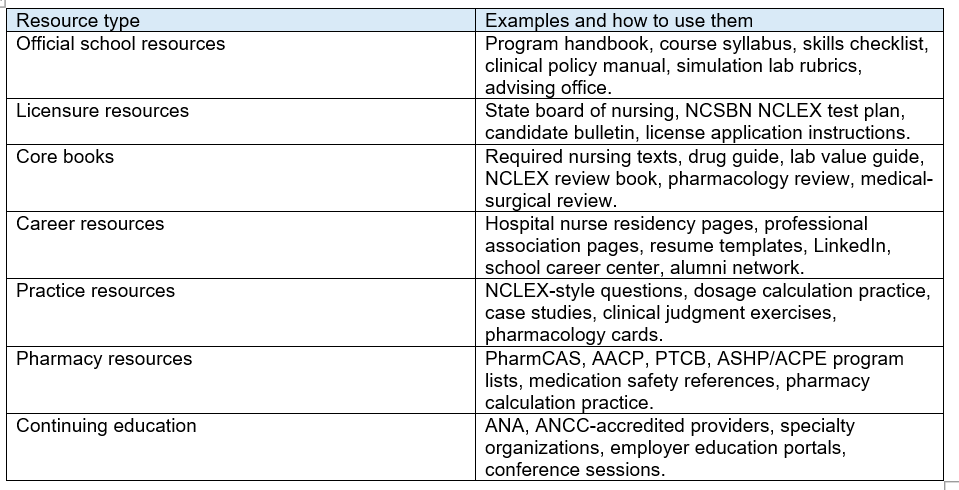
Sample practice questions and mini exercises
Priority question
A patient reports chest discomfort, shortness of breath, and sweating. What should the nurse do first?
Suggested answer: Assess the patient immediately and activate the appropriate clinical response according to facility policy. Nursing questions often reward safety, assessment, and escalation before routine tasks.
Pharmacology question
A student is learning a new medication class. What should the student study first?
Suggested answer: Start with drug class action, major side effects, contraindications, nursing assessments, patient teaching, and safety concerns. Individual drug names become easier after the class pattern is clear.
Program selection question
Two schools both advertise excellent nursing programs. What should the applicant compare?
Suggested answer: Compare board approval, accreditation, NCLEX pass rates, clinical support, cost, schedule, completion rates, student support, and licensure eligibility.
Career question
A new grad wants an ICU job but has no ICU experience. What can help?
Suggested answer: A nurse residency, strong clinical references, ACLS or telemetry readiness when appropriate, clear examples of learning under pressure, and willingness to accept structured orientation can help.
Reflection prompts
· What is the next concrete step I can take for registered nurse resume tips and examples this week?
· Which official source do I need to check before making a final decision?
· What skill, course, certification, or clinical experience would make me more prepared?
· Who can give me accurate feedback: faculty member, advisor, preceptor, tutor, recruiter, or working professional?
SEO content ideas for this article topic
People searching for this topic often want a simple answer first, then a detailed checklist. Use the main keyword in the title, first paragraph, one H2 heading, and conclusion. Use related phrases naturally, such as nursing resources, nursing study guide, nursing school tips, nursing career path, new grad nurse advice, nursing resume examples, clinical placement resources, nursing degree requirements, and NCLEX preparation.
Suggested internal links for a website: nursing school admissions guide, NCLEX study plan, nursing pharmacology guide, new grad nurse resume guide, nurse practitioner career guide, nursing clinical placement checklist, and pharmacy technician career guide.
Frequently asked questions
What is the best first step?
Start by checking the official requirement for your goal. For school, check admissions and licensure eligibility. For jobs, check license, degree, certification, experience, and schedule requirements. Then build a written plan instead of relying on memory.
Do I need a BSN to become a nurse?
Many students become RNs through associate degree or diploma pathways, while others complete a BSN first. Requirements and employer preferences vary. A BSN can open doors to leadership, specialty, public health, and graduate study, but the best pathway depends on your location, finances, timeline, and goals.
How early should I prepare for NCLEX-style questions?
Start during school. Early practice helps you learn prioritization, safety, delegation, and clinical judgment. Use practice questions to learn reasoning, not just to count scores.
What should I ask before choosing a nursing school?
Ask about board approval, accreditation, NCLEX pass rates, clinical sites, distance to clinical placements, faculty support, tutoring, simulation, schedule flexibility, total cost, and what happens if you fail or repeat a course.
What makes a strong new grad nurse application?
A clear resume, license status, clinical rotations, certifications, references, teamwork examples, patient-safety mindset, and a realistic understanding of the unit. New grads should show coachability and good judgment.
Can nurses change specialties?
Yes. Nurses often change settings over time. The safest way is to identify skill gaps, take continuing education, ask for transition support, and apply to employers that offer structured orientation or residency support.
Are online nursing programs a good choice?
Some online or hybrid programs are excellent, especially for RN-to-BSN, MSN, and DNP study. Prelicensure nursing programs still require in-person clinical practice. Always confirm state authorization, clinical placement support, accreditation, and licensure eligibility.
How should I use this article?
Use it as a planning guide. Confirm official rules with your school, state board, employer, or credentialing organization before making final decisions.
Extra questions about Registered nurse resume tips and examples
Is registered nurse resume tips and examples important for nursing students?
Yes. Even when the topic looks narrow, it usually connects to licensing, patient safety, school success, career readiness, or long-term professional growth. Students who understand the bigger picture make better choices.
Can beginners use this registered nurse resume tips and examples guide?
Yes. The language is designed for beginners, but advanced students can still use the checklists to compare resources, prepare for jobs, or organize study plans.
What is the most common mistake?
The most common mistake is relying on one source or one opinion. Compare official sources, school policies, faculty advice, and real-world job requirements before making a decision.
How often should I update my plan?
Review your plan at least once per semester, after each clinical rotation, before applying to jobs, and whenever licensing or program requirements change.
Conclusion
The best approach to registered nurse resume tips and examples is practical, verified, and student-centered. Use official sources for rules, use strong study habits for learning, use clinical experiences to build judgment, and use career resources to move toward the job or program you want. Nursing and pharmacy pathways can feel complicated, but they become easier when you break them into steps: confirm the requirement, choose the resource, practice the skill, ask for feedback, and take the next action.
References and official resources
· [U.S. Bureau of Labor Statistics, Registered Nurses, Occupational Outlook Handbook](http://Sample practice questions and mini exercises Priority question A patient reports chest discomfort, shortness of breath, and sweating. What should the nurse do first? Suggested answer: Assess the patient immediately and activate the appropriate clinical response according to facility policy. Nursing questions often reward safety, assessment, and escalation before routine tasks. Pharmacology question A student is learning a new medication class. What should the student study first? Suggested answer: Start with drug class action, major side effects, contraindications, nursing assessments, patient teaching, and safety concerns. Individual drug names become easier after the class pattern is clear. Program selection question Two schools both advertise excellent nursing programs. What should the applicant compare? Suggested answer: Compare board approval, accreditation, NCLEX pass rates, clinical support, cost, schedule, completion rates, student support, and licensure eligibility. Career question A new grad wants an ICU job but has no ICU experience. What can help? Suggested answer: A nurse residency, strong clinical references, ACLS or telemetry readiness when appropriate, clear examples of learning under pressure, and willingness to accept structured orientation can help. Reflection prompts • What is the next concrete step I can take for registered nurse resume tips and examples this week? • Which official source do I need to check before making a final decision? • What skill, course, certification, or clinical experience would make me more prepared? • Who can give me accurate feedback: faculty member, advisor, preceptor, tutor, recruiter, or working professional? SEO content ideas for this article topic People searching for this topic often want a simple answer first, then a detailed checklist. Use the main keyword in the title, first paragraph, one H2 heading, and conclusion. Use related phrases naturally, such as nursing resources, nursing study guide, nursing school tips, nursing career path, new grad nurse advice, nursing resume examples, clinical placement resources, nursing degree requirements, and NCLEX preparation. Suggested internal links for a website: nursing school admissions guide, NCLEX study plan, nursing pharmacology guide, new grad nurse resume guide, nurse practitioner career guide, nursing clinical placement checklist, and pharmacy technician career guide. Frequently asked questions What is the best first step? Start by checking the official requirement for your goal. For school, check admissions and licensure eligibility. For jobs, check license, degree, certification, experience, and schedule requirements. Then build a written plan instead of relying on memory. Do I need a BSN to become a nurse? Many students become RNs through associate degree or diploma pathways, while others complete a BSN first. Requirements and employer preferences vary. A BSN can open doors to leadership, specialty, public health, and graduate study, but the best pathway depends on your location, finances, timeline, and goals. How early should I prepare for NCLEX-style questions? Start during school. Early practice helps you learn prioritization, safety, delegation, and clinical judgment. Use practice questions to learn reasoning, not just to count scores. What should I ask before choosing a nursing school? Ask about board approval, accreditation, NCLEX pass rates, clinical sites, distance to clinical placements, faculty support, tutoring, simulation, schedule flexibility, total cost, and what happens if you fail or repeat a course. What makes a strong new grad nurse application? A clear resume, license status, clinical rotations, certifications, references, teamwork examples, patient-safety mindset, and a realistic understanding of the unit. New grads should show coachability and good judgment. Can nurses change specialties? Yes. Nurses often change settings over time. The safest way is to identify skill gaps, take continuing education, ask for transition support, and apply to employers that offer structured orientation or residency support. Are online nursing programs a good choice? Some online or hybrid programs are excellent, especially for RN-to-BSN, MSN, and DNP study. Prelicensure nursing programs still require in-person clinical practice. Always confirm state authorization, clinical placement support, accreditation, and licensure eligibility. How should I use this article? Use it as a planning guide. Confirm official rules with your school, state board, employer, or credentialing organization before making final decisions. Extra questions about Registered nurse resume tips and examples Is registered nurse resume tips and examples important for nursing students? Yes. Even when the topic looks narrow, it usually connects to licensing, patient safety, school success, career readiness, or long-term professional growth. Students who understand the bigger picture make better choices. Can beginners use this registered nurse resume tips and examples guide? Yes. The language is designed for beginners, but advanced students can still use the checklists to compare resources, prepare for jobs, or organize study plans. What is the most common mistake? The most common mistake is relying on one source or one opinion. Compare official sources, school policies, faculty advice, and real-world job requirements before making a decision. How often should I update my plan? Review your plan at least once per semester, after each clinical rotation, before applying to jobs, and whenever licensing or program requirements change. Conclusion The best approach to registered nurse resume tips and examples is practical, verified, and student-centered. Use official sources for rules, use strong study habits for learning, use clinical experiences to build judgment, and use career resources to move toward the job or program you want. Nursing and pharmacy pathways can feel complicated, but they become easier when you break them into steps: confirm the requirement, choose the resource, practice the skill, ask for feedback, and take the next action. References and official resources • U.S. Bureau of Labor Statistics, Registered Nurses, Occupational Outlook Handbook: https://www.bls.gov/ooh/healthcare/registered-nurses.htm • U.S. Bureau of Labor Statistics, Nurse Anesthetists, Nurse Midwives, and Nurse Practitioners, Occupational Outlook Handbook: https://www.bls.gov/ooh/healthcare/nurse-anesthetists-nurse-midwives-and-nurse-practitioners.htm • U.S. Bureau of Labor Statistics, Pharmacy Technicians, Occupational Outlook Handbook: https://www.bls.gov/ooh/healthcare/pharmacy-technicians.htm • U.S. Bureau of Labor Statistics, Postsecondary Teachers, Occupational Outlook Handbook: https://www.bls.gov/ooh/education-training-and-library/postsecondary-teachers.htm • NCSBN, 2026 NCLEX-RN Test Plan and Candidate Bulletin: https://www.ncsbn.org/publications/2026-nclex-rn-test-plan • AACN, Nursing Education Pathways: https://www.aacnnursing.org/students/nursing-education-pathways • AACN, Baccalaureate Education: https://www.aacnnursing.org/students/nursing-education-pathways/baccalaureate-education • AACN, The Essentials: https://www.aacnnursing.org/essentials • CCNE, Find Accredited Programs: https://www.aacnnursing.org/ccne-accreditation/find-accredited-programs • ACEN, Search Accredited Nursing Programs: https://www.acenursing.org/search-programs • NursingCAS, Centralized Application for Nursing Programs: https://nursingcas.org/ • AANP, What is a Nurse Practitioner?: https://www.aanp.org/about/all-about-nps/whats-a-nurse-practitioner • AANA, How to Become a CRNA: https://www.aana.com/about-us/about-crnas/become-a-crna/ • ANA, Continuing Education for Nurses: https://www.nursingworld.org/continuing-education/ • ANCC, Practice Transition Accreditation Program: https://www.nursingworld.org/organizational-programs/accreditation/ptap/ • NLN, Core Competencies for Academic Nurse Educators: https://www.nln.org/education/nursing-education-competencies/core-competencies-for-academic-nurse-educators • O*NET, Nursing Instructors and Teachers, Postsecondary: https://www.onetonline.org/link/summary/25-1072.00 • PharmCAS, School Directory: https://www.pharmcas.org/school-directory • AACP, Pharmacy School Admission Requirements: https://www.aacp.org/resource/pharmacy-school-admission-requirements • PTCB, Certified Pharmacy Technician: https://ptcb.org/credentials/certification/certified-pharmacy-technician/ • ASHP, Pharmacy Technician Program Accreditation: https://www.ashp.org/professional-development/technician-program-accreditation • North Carolina Board of Nursing, Approved Nursing Programs: https://www.ncbon.com/approved-nursing-programs Supplemental resource plan Build a personal resource folder with five sections: official requirements, class notes, practice questions, clinical tools, and career documents. In the official requirements section, keep admissions pages, board links, accreditation information, exam rules, and program handbooks. In the class notes section, keep weekly lecture summaries, concept maps, and clarified questions. In the practice section, keep missed-question logs, dosage calculation sheets, pharmacology charts, and NCLEX-style rationales. In the clinical section, keep skills checklists, reflection notes, and patient-safety reminders without patient identifiers. In the career section, keep your resume, references, certifications, cover letters, and job postings. Use a learning cycle for every major topic. Preview the topic before lecture, attend class actively, review the same day, practice questions within forty-eight hours, teach the topic to someone else, and revisit weak points one week later. This method turns short-term recognition into long-term understanding. It also reduces the stress that comes from trying to relearn a full unit right before an exam. When using books, avoid buying every popular title at once. Choose one primary textbook, one review book, one question source, and one reference tool. If you buy too many resources, you may spend more time switching between them than actually learning. A small set used consistently is usually better than a large set used randomly. When planning a career move, use job postings as a map. Print three postings for roles you want. Highlight common skills, certifications, experience requirements, and preferred qualifications. Then make a two-column list: what you already have and what you need to build. This creates a realistic action plan instead of a vague wish. When choosing a program, speak with admissions, current students if possible, graduates, and your state board or equivalent authority. Ask direct questions about clinical placement, course repeats, online requirements, technical standards, background checks, immunizations, transfer credit, and licensure eligibility. Good questions protect you from expensive surprises. Extended practical toolkit for this topic A complete plan for this topic should connect three things: learning, documentation, and action. Learning means understanding the content well enough to explain it and apply it safely. Documentation means keeping records of courses, clinical hours, certifications, skills, references, and deadlines. Action means doing the next step on time, such as emailing an advisor, updating a resume, practicing questions, checking accreditation, or applying to a program. Many students know what they want, but they lose progress because they do not turn the goal into small visible tasks. A simple planner, spreadsheet, or notebook can prevent that problem. One practical system is the weekly evidence folder. Each week, save one item that proves growth: a corrected care plan, a medication chart, a clinical reflection without patient identifiers, a practice test review, a faculty email, a skills checklist, a resume bullet, or a leadership example. At the end of a semester, this folder becomes useful for interviews, scholarships, residency applications, graduate school applications, and self-reflection. It also helps students notice progress during stressful periods when they feel behind. For study success, students should separate recognition from mastery. Recognition happens when a topic looks familiar. Mastery happens when you can use the topic in a new situation. Nursing exams often test mastery through patient scenarios, priority decisions, safety risks, and changing conditions. Pharmacy and pharmacology work the same way: it is not enough to remember a medication name; you need to know what to watch for, what to teach, and when to report a concern. Always practice with scenarios, not only flashcards. For resource selection, use a three-source rule. First, use the official source for rules or requirements. Second, use your assigned school resource for course expectations. Third, use one trusted review resource for extra practice. This keeps the plan simple and prevents resource overload. Students often buy too many books, apps, and subscriptions. More resources do not automatically create better learning. The best resource is the one you use consistently, review carefully, and connect to your class or career goal. For time management, use blocks rather than vague goals. A weak goal is, 'study pharmacology.' A strong goal is, 'review beta blockers for forty minutes, complete twenty practice questions, write down all missed rationales, and teach the safety points out loud.' A weak goal is, 'work on resume.' A strong goal is, 'write five clinical rotation bullets, add license status, proofread formatting, and send it to career services.' Clear tasks reduce stress because you know when the work is finished. Clinical confidence grows from preparation and reflection. Before clinical, review common diagnoses, medications, safety risks, lab values, and communication needs for the unit. During clinical, focus on safe basics: identification, privacy, hand hygiene, assessment, documentation, escalation, and respectful communication. After clinical, ask what you learned, what you need to practice, and what feedback you received. This cycle turns clinical days into professional development rather than just a requirement to complete. For career planning, do not wait until graduation. Students can begin early by researching specialties, attending school career events, volunteering, networking with alumni, asking about nurse residency programs, and keeping a clean resume. New graduates do not need to present themselves as experts. They need to show patient safety, reliability, curiosity, teamwork, and openness to feedback. Employers often know that new graduates need training, but they want to see maturity and realistic expectations. For program decisions, look beyond marketing language. A program can call itself flexible, affordable, accelerated, high quality, or student-centered, but you still need facts. Ask about board approval, accreditation, clinical placement, NCLEX pass rates, faculty access, simulation labs, course repeat policies, graduation rates, total cost, and state authorization. If you are a working adult, also ask about evening, weekend, hybrid, or part-time options. The best program is the one that fits your goals and has clear support systems. For continuing education, make learning part of professional life. Nurses and pharmacy professionals must keep up with new evidence, technology, safety practices, and policy changes. Continuing education can come from professional organizations, employers, conferences, journals, specialty courses, certification review, and academic programs. Choose CE that improves your current role or prepares you for the next one. Keep certificates organized because renewal periods and employer audits can come quickly. For ethical use of online tools, remember that patient privacy comes first. Never upload or share patient identifiers, clinical documentation, unique patient stories, facility names tied to a case, or confidential school materials. AI tools, study apps, and online forums can explain concepts and generate practice questions, but they should not replace faculty guidance, official policies, or professional judgment. When in doubt, ask your instructor, preceptor, advisor, or supervisor before using a tool for clinical or academic work. Career-focused expansion Career-focused readers should create a skill inventory. List your clinical rotations, patient populations, procedures observed, documentation systems used, safety practices, leadership roles, volunteer work, certifications, languages, and communication strengths. Then compare the inventory to job postings. If a posting asks for telemetry, wound care, behavioral health, pediatric experience, case management, research coordination, or teaching ability, decide how you can build or demonstrate that skill honestly. Resume bullets should show context and judgment. A good new graduate bullet might say, 'Completed supervised clinical rotation on a medical-surgical unit with focus on assessment, medication preparation, fall prevention, patient teaching, and documentation.' A stronger bullet adds scale when available, such as total clinical hours, unit type, patient population, or project outcome. Avoid exaggeration. Nursing employers value honesty, safety, and coachability more than inflated wording. Interview preparation should include patient safety stories, teamwork stories, feedback stories, and learning stories. Use examples that show how you think. A new graduate may not have years of experience, but they can show judgment by explaining how they prepared for clinical, clarified an order with supervision, responded to feedback, organized tasks, or recognized a change in patient condition and reported it appropriately. Study-focused expansion Study-focused readers should use a missed-question log. For every missed practice question, write the topic, why you missed it, the correct reasoning, and the next review date. Over time, patterns appear. You may find that you miss questions about priority, delegation, infection control, lab values, or medication side effects. Those patterns are more useful than a single score because they tell you exactly what to fix. Pharmacology should be studied in layers. First learn the drug class and what it does. Then learn major side effects and safety warnings. Then learn nursing assessments and patient teaching. Finally, learn exceptions and high-alert details. This order prevents random memorization. It also helps you answer application questions because you can connect the medication to the patient’s condition and risk factors. Exam preparation should include active recall, spaced repetition, practice questions, and sleep. Sleep may sound unrelated to studying, but fatigue hurts memory, attention, and emotional control. Nursing school is demanding, so students need sustainable routines. Short daily review is usually better than long panic sessions right before an exam. Final personal action checklist • Write one sentence explaining why registered nurse resume tips and examples matters for your current goal. • Check one official source before making a final choice. • Choose one book, one practice source, and one advisor or mentor for support. • Create a weekly schedule with study, application, clinical, or career tasks. • Save proof of progress in a folder so you can use it for applications, interviews, or reflection. • Review your plan every month and update it when deadlines, grades, clinical experiences, or career interests change. Additional 2026 planning notes and study support Use a decision journal for major nursing and pharmacy choices. Write the date, the choice you are considering, the information you checked, the people you contacted, the risks you noticed, and the next action. This habit is helpful for school applications, job offers, clinical placements, graduate programs, and specialty decisions. It also prevents emotional decisions made only because a program sounds popular or a job title sounds impressive. Build a support map. Put your faculty advisor, academic tutor, clinical instructor, career center, financial aid office, mental health support, librarian, preceptor, alumni contact, and trusted classmate into one list. Add contact details and office hours. Students often fail to use support because they do not know where to start when stress rises. A support map gives you a plan before a problem becomes urgent. Use office hours with a purpose. Bring two or three specific questions, one example of your work, and one goal for improvement. Instead of saying, 'I do not understand anything,' say, 'I understand the disease process, but I miss priority questions when several symptoms appear together.' Specific questions help faculty give specific advice, and specific advice is easier to act on. Practice professional communication early. In emails, use a clear subject line, greet the person respectfully, explain the question briefly, include deadlines, and thank the person for their time. In clinical settings, use clear, calm, and accurate language. In interviews, answer with examples instead of general claims. Communication is one of the easiest professional skills to practice every day. Keep finances in the plan. Tuition is only one part of the cost. Add fees, uniforms, supplies, books, testing platforms, transportation, parking, immunizations, background checks, lost work hours, childcare, and exam fees. If a program or career path requires moving, commuting, or reducing work hours, include that too. A realistic budget protects your education plan from avoidable surprises. Use reflective practice after hard experiences. Nursing school, pharmacy school, and new graduate work can be emotionally demanding. Reflection does not mean blaming yourself. It means asking what happened, what you learned, what you can control, what support you need, and what you will do differently next time. This habit builds resilience and professional maturity. Learn the language of patient safety. Important themes include fall prevention, medication reconciliation, infection control, identification, escalation, documentation, handoff communication, delegation, and scope of practice. Even if your article topic is about school, resumes, jobs, or study tools, patient safety is the center of the profession. Strong students and applicants make safety visible in their work. Use practice questions as a thinking workout. Read the stem carefully, identify the patient problem, decide whether the question tests assessment, intervention, priority, teaching, or evaluation, and then eliminate unsafe or irrelevant answers. After reviewing the rationale, write the rule in your own words. This turns each question into a mini lesson rather than a quick score. For clinical placements and first jobs, learn to accept feedback without becoming defensive. Feedback can be uncomfortable, but it is part of professional growth. Write down the feedback, ask for an example if needed, thank the person, and create one behavior change. Over time, this makes you easier to teach and safer to trust with more responsibility. For online learning, create a distraction-reduced environment. Use a weekly schedule, test your technology early, keep course links organized, and set specific deadlines for videos, readings, quizzes, and discussion posts. Online courses can feel flexible, but flexibility can become procrastination without structure. Treat online learning with the same seriousness as in-person class. For leadership growth, look for small opportunities: organize a study group, teach a difficult concept, volunteer for a class role, help with a quality project, present a patient education topic, or mentor a newer student. Leadership does not always require a formal title. It often begins with reliability, service, and clear communication. For long-term career satisfaction, review your goals every semester or every six months. Ask whether you still like your target setting, whether your strengths have changed, whether a clinical rotation surprised you, and whether your life needs have changed. Nursing and pharmacy careers offer many paths, so changing direction is not failure. It is part of building a career that fits. Additional career notes If this topic involves jobs or resumes, save three versions of your resume: a new graduate version, a specialty-focused version, and a leadership or education version. Tailor the top summary and bullets for each role. Applicant tracking systems and recruiters look for matching terms from the job description, but the resume should still sound honest and human. For new graduate positions, ask about orientation length, preceptor matching, classroom days, simulation support, patient ratios during orientation, evaluation points, and what happens if a new nurse needs extra help. A strong first job is not only about prestige; it is about safe transition and supportive learning. Additional study notes If this topic involves studying, use a two-pass reading method. First, skim headings, objectives, charts, and summaries. Second, read carefully and turn key ideas into questions. This makes textbook reading active. After reading, close the book and answer the questions without looking. This is much more effective than highlighting large sections of text. For pharmacology and pathophysiology, connect every fact to a patient. Ask what the nurse would assess, what can go wrong, what teaching is needed, what labs matter, and what action is urgent. Patient-centered study helps with clinical judgment and exam questions. • Confirm requirements from official sources before making final decisions. • Keep your resume, transcript, certification records, and clinical documents organized. • Use practice questions, rationales, and reflection to turn study time into clinical reasoning. • Ask for help early from advisors, faculty, tutors, preceptors, career services, or professional mentors.)
·[ U.S. Bureau of Labor Statistics, Nurse Anesthetists, Nurse Midwives, and Nurse Practitioners, Occupational Outlook Handbook](http://Sample practice questions and mini exercises Priority question A patient reports chest discomfort, shortness of breath, and sweating. What should the nurse do first? Suggested answer: Assess the patient immediately and activate the appropriate clinical response according to facility policy. Nursing questions often reward safety, assessment, and escalation before routine tasks. Pharmacology question A student is learning a new medication class. What should the student study first? Suggested answer: Start with drug class action, major side effects, contraindications, nursing assessments, patient teaching, and safety concerns. Individual drug names become easier after the class pattern is clear. Program selection question Two schools both advertise excellent nursing programs. What should the applicant compare? Suggested answer: Compare board approval, accreditation, NCLEX pass rates, clinical support, cost, schedule, completion rates, student support, and licensure eligibility. Career question A new grad wants an ICU job but has no ICU experience. What can help? Suggested answer: A nurse residency, strong clinical references, ACLS or telemetry readiness when appropriate, clear examples of learning under pressure, and willingness to accept structured orientation can help. Reflection prompts • What is the next concrete step I can take for registered nurse resume tips and examples this week? • Which official source do I need to check before making a final decision? • What skill, course, certification, or clinical experience would make me more prepared? • Who can give me accurate feedback: faculty member, advisor, preceptor, tutor, recruiter, or working professional? SEO content ideas for this article topic People searching for this topic often want a simple answer first, then a detailed checklist. Use the main keyword in the title, first paragraph, one H2 heading, and conclusion. Use related phrases naturally, such as nursing resources, nursing study guide, nursing school tips, nursing career path, new grad nurse advice, nursing resume examples, clinical placement resources, nursing degree requirements, and NCLEX preparation. Suggested internal links for a website: nursing school admissions guide, NCLEX study plan, nursing pharmacology guide, new grad nurse resume guide, nurse practitioner career guide, nursing clinical placement checklist, and pharmacy technician career guide. Frequently asked questions What is the best first step? Start by checking the official requirement for your goal. For school, check admissions and licensure eligibility. For jobs, check license, degree, certification, experience, and schedule requirements. Then build a written plan instead of relying on memory. Do I need a BSN to become a nurse? Many students become RNs through associate degree or diploma pathways, while others complete a BSN first. Requirements and employer preferences vary. A BSN can open doors to leadership, specialty, public health, and graduate study, but the best pathway depends on your location, finances, timeline, and goals. How early should I prepare for NCLEX-style questions? Start during school. Early practice helps you learn prioritization, safety, delegation, and clinical judgment. Use practice questions to learn reasoning, not just to count scores. What should I ask before choosing a nursing school? Ask about board approval, accreditation, NCLEX pass rates, clinical sites, distance to clinical placements, faculty support, tutoring, simulation, schedule flexibility, total cost, and what happens if you fail or repeat a course. What makes a strong new grad nurse application? A clear resume, license status, clinical rotations, certifications, references, teamwork examples, patient-safety mindset, and a realistic understanding of the unit. New grads should show coachability and good judgment. Can nurses change specialties? Yes. Nurses often change settings over time. The safest way is to identify skill gaps, take continuing education, ask for transition support, and apply to employers that offer structured orientation or residency support. Are online nursing programs a good choice? Some online or hybrid programs are excellent, especially for RN-to-BSN, MSN, and DNP study. Prelicensure nursing programs still require in-person clinical practice. Always confirm state authorization, clinical placement support, accreditation, and licensure eligibility. How should I use this article? Use it as a planning guide. Confirm official rules with your school, state board, employer, or credentialing organization before making final decisions. Extra questions about Registered nurse resume tips and examples Is registered nurse resume tips and examples important for nursing students? Yes. Even when the topic looks narrow, it usually connects to licensing, patient safety, school success, career readiness, or long-term professional growth. Students who understand the bigger picture make better choices. Can beginners use this registered nurse resume tips and examples guide? Yes. The language is designed for beginners, but advanced students can still use the checklists to compare resources, prepare for jobs, or organize study plans. What is the most common mistake? The most common mistake is relying on one source or one opinion. Compare official sources, school policies, faculty advice, and real-world job requirements before making a decision. How often should I update my plan? Review your plan at least once per semester, after each clinical rotation, before applying to jobs, and whenever licensing or program requirements change. Conclusion The best approach to registered nurse resume tips and examples is practical, verified, and student-centered. Use official sources for rules, use strong study habits for learning, use clinical experiences to build judgment, and use career resources to move toward the job or program you want. Nursing and pharmacy pathways can feel complicated, but they become easier when you break them into steps: confirm the requirement, choose the resource, practice the skill, ask for feedback, and take the next action. References and official resources • U.S. Bureau of Labor Statistics, Registered Nurses, Occupational Outlook Handbook: https://www.bls.gov/ooh/healthcare/registered-nurses.htm • U.S. Bureau of Labor Statistics, Nurse Anesthetists, Nurse Midwives, and Nurse Practitioners, Occupational Outlook Handbook: https://www.bls.gov/ooh/healthcare/nurse-anesthetists-nurse-midwives-and-nurse-practitioners.htm • U.S. Bureau of Labor Statistics, Pharmacy Technicians, Occupational Outlook Handbook: https://www.bls.gov/ooh/healthcare/pharmacy-technicians.htm • U.S. Bureau of Labor Statistics, Postsecondary Teachers, Occupational Outlook Handbook: https://www.bls.gov/ooh/education-training-and-library/postsecondary-teachers.htm • NCSBN, 2026 NCLEX-RN Test Plan and Candidate Bulletin: https://www.ncsbn.org/publications/2026-nclex-rn-test-plan • AACN, Nursing Education Pathways: https://www.aacnnursing.org/students/nursing-education-pathways • AACN, Baccalaureate Education: https://www.aacnnursing.org/students/nursing-education-pathways/baccalaureate-education • AACN, The Essentials: https://www.aacnnursing.org/essentials • CCNE, Find Accredited Programs: https://www.aacnnursing.org/ccne-accreditation/find-accredited-programs • ACEN, Search Accredited Nursing Programs: https://www.acenursing.org/search-programs • NursingCAS, Centralized Application for Nursing Programs: https://nursingcas.org/ • AANP, What is a Nurse Practitioner?: https://www.aanp.org/about/all-about-nps/whats-a-nurse-practitioner • AANA, How to Become a CRNA: https://www.aana.com/about-us/about-crnas/become-a-crna/ • ANA, Continuing Education for Nurses: https://www.nursingworld.org/continuing-education/ • ANCC, Practice Transition Accreditation Program: https://www.nursingworld.org/organizational-programs/accreditation/ptap/ • NLN, Core Competencies for Academic Nurse Educators: https://www.nln.org/education/nursing-education-competencies/core-competencies-for-academic-nurse-educators • O*NET, Nursing Instructors and Teachers, Postsecondary: https://www.onetonline.org/link/summary/25-1072.00 • PharmCAS, School Directory: https://www.pharmcas.org/school-directory • AACP, Pharmacy School Admission Requirements: https://www.aacp.org/resource/pharmacy-school-admission-requirements • PTCB, Certified Pharmacy Technician: https://ptcb.org/credentials/certification/certified-pharmacy-technician/ • ASHP, Pharmacy Technician Program Accreditation: https://www.ashp.org/professional-development/technician-program-accreditation • North Carolina Board of Nursing, Approved Nursing Programs: https://www.ncbon.com/approved-nursing-programs Supplemental resource plan Build a personal resource folder with five sections: official requirements, class notes, practice questions, clinical tools, and career documents. In the official requirements section, keep admissions pages, board links, accreditation information, exam rules, and program handbooks. In the class notes section, keep weekly lecture summaries, concept maps, and clarified questions. In the practice section, keep missed-question logs, dosage calculation sheets, pharmacology charts, and NCLEX-style rationales. In the clinical section, keep skills checklists, reflection notes, and patient-safety reminders without patient identifiers. In the career section, keep your resume, references, certifications, cover letters, and job postings. Use a learning cycle for every major topic. Preview the topic before lecture, attend class actively, review the same day, practice questions within forty-eight hours, teach the topic to someone else, and revisit weak points one week later. This method turns short-term recognition into long-term understanding. It also reduces the stress that comes from trying to relearn a full unit right before an exam. When using books, avoid buying every popular title at once. Choose one primary textbook, one review book, one question source, and one reference tool. If you buy too many resources, you may spend more time switching between them than actually learning. A small set used consistently is usually better than a large set used randomly. When planning a career move, use job postings as a map. Print three postings for roles you want. Highlight common skills, certifications, experience requirements, and preferred qualifications. Then make a two-column list: what you already have and what you need to build. This creates a realistic action plan instead of a vague wish. When choosing a program, speak with admissions, current students if possible, graduates, and your state board or equivalent authority. Ask direct questions about clinical placement, course repeats, online requirements, technical standards, background checks, immunizations, transfer credit, and licensure eligibility. Good questions protect you from expensive surprises. Extended practical toolkit for this topic A complete plan for this topic should connect three things: learning, documentation, and action. Learning means understanding the content well enough to explain it and apply it safely. Documentation means keeping records of courses, clinical hours, certifications, skills, references, and deadlines. Action means doing the next step on time, such as emailing an advisor, updating a resume, practicing questions, checking accreditation, or applying to a program. Many students know what they want, but they lose progress because they do not turn the goal into small visible tasks. A simple planner, spreadsheet, or notebook can prevent that problem. One practical system is the weekly evidence folder. Each week, save one item that proves growth: a corrected care plan, a medication chart, a clinical reflection without patient identifiers, a practice test review, a faculty email, a skills checklist, a resume bullet, or a leadership example. At the end of a semester, this folder becomes useful for interviews, scholarships, residency applications, graduate school applications, and self-reflection. It also helps students notice progress during stressful periods when they feel behind. For study success, students should separate recognition from mastery. Recognition happens when a topic looks familiar. Mastery happens when you can use the topic in a new situation. Nursing exams often test mastery through patient scenarios, priority decisions, safety risks, and changing conditions. Pharmacy and pharmacology work the same way: it is not enough to remember a medication name; you need to know what to watch for, what to teach, and when to report a concern. Always practice with scenarios, not only flashcards. For resource selection, use a three-source rule. First, use the official source for rules or requirements. Second, use your assigned school resource for course expectations. Third, use one trusted review resource for extra practice. This keeps the plan simple and prevents resource overload. Students often buy too many books, apps, and subscriptions. More resources do not automatically create better learning. The best resource is the one you use consistently, review carefully, and connect to your class or career goal. For time management, use blocks rather than vague goals. A weak goal is, 'study pharmacology.' A strong goal is, 'review beta blockers for forty minutes, complete twenty practice questions, write down all missed rationales, and teach the safety points out loud.' A weak goal is, 'work on resume.' A strong goal is, 'write five clinical rotation bullets, add license status, proofread formatting, and send it to career services.' Clear tasks reduce stress because you know when the work is finished. Clinical confidence grows from preparation and reflection. Before clinical, review common diagnoses, medications, safety risks, lab values, and communication needs for the unit. During clinical, focus on safe basics: identification, privacy, hand hygiene, assessment, documentation, escalation, and respectful communication. After clinical, ask what you learned, what you need to practice, and what feedback you received. This cycle turns clinical days into professional development rather than just a requirement to complete. For career planning, do not wait until graduation. Students can begin early by researching specialties, attending school career events, volunteering, networking with alumni, asking about nurse residency programs, and keeping a clean resume. New graduates do not need to present themselves as experts. They need to show patient safety, reliability, curiosity, teamwork, and openness to feedback. Employers often know that new graduates need training, but they want to see maturity and realistic expectations. For program decisions, look beyond marketing language. A program can call itself flexible, affordable, accelerated, high quality, or student-centered, but you still need facts. Ask about board approval, accreditation, clinical placement, NCLEX pass rates, faculty access, simulation labs, course repeat policies, graduation rates, total cost, and state authorization. If you are a working adult, also ask about evening, weekend, hybrid, or part-time options. The best program is the one that fits your goals and has clear support systems. For continuing education, make learning part of professional life. Nurses and pharmacy professionals must keep up with new evidence, technology, safety practices, and policy changes. Continuing education can come from professional organizations, employers, conferences, journals, specialty courses, certification review, and academic programs. Choose CE that improves your current role or prepares you for the next one. Keep certificates organized because renewal periods and employer audits can come quickly. For ethical use of online tools, remember that patient privacy comes first. Never upload or share patient identifiers, clinical documentation, unique patient stories, facility names tied to a case, or confidential school materials. AI tools, study apps, and online forums can explain concepts and generate practice questions, but they should not replace faculty guidance, official policies, or professional judgment. When in doubt, ask your instructor, preceptor, advisor, or supervisor before using a tool for clinical or academic work. Career-focused expansion Career-focused readers should create a skill inventory. List your clinical rotations, patient populations, procedures observed, documentation systems used, safety practices, leadership roles, volunteer work, certifications, languages, and communication strengths. Then compare the inventory to job postings. If a posting asks for telemetry, wound care, behavioral health, pediatric experience, case management, research coordination, or teaching ability, decide how you can build or demonstrate that skill honestly. Resume bullets should show context and judgment. A good new graduate bullet might say, 'Completed supervised clinical rotation on a medical-surgical unit with focus on assessment, medication preparation, fall prevention, patient teaching, and documentation.' A stronger bullet adds scale when available, such as total clinical hours, unit type, patient population, or project outcome. Avoid exaggeration. Nursing employers value honesty, safety, and coachability more than inflated wording. Interview preparation should include patient safety stories, teamwork stories, feedback stories, and learning stories. Use examples that show how you think. A new graduate may not have years of experience, but they can show judgment by explaining how they prepared for clinical, clarified an order with supervision, responded to feedback, organized tasks, or recognized a change in patient condition and reported it appropriately. Study-focused expansion Study-focused readers should use a missed-question log. For every missed practice question, write the topic, why you missed it, the correct reasoning, and the next review date. Over time, patterns appear. You may find that you miss questions about priority, delegation, infection control, lab values, or medication side effects. Those patterns are more useful than a single score because they tell you exactly what to fix. Pharmacology should be studied in layers. First learn the drug class and what it does. Then learn major side effects and safety warnings. Then learn nursing assessments and patient teaching. Finally, learn exceptions and high-alert details. This order prevents random memorization. It also helps you answer application questions because you can connect the medication to the patient’s condition and risk factors. Exam preparation should include active recall, spaced repetition, practice questions, and sleep. Sleep may sound unrelated to studying, but fatigue hurts memory, attention, and emotional control. Nursing school is demanding, so students need sustainable routines. Short daily review is usually better than long panic sessions right before an exam. Final personal action checklist • Write one sentence explaining why registered nurse resume tips and examples matters for your current goal. • Check one official source before making a final choice. • Choose one book, one practice source, and one advisor or mentor for support. • Create a weekly schedule with study, application, clinical, or career tasks. • Save proof of progress in a folder so you can use it for applications, interviews, or reflection. • Review your plan every month and update it when deadlines, grades, clinical experiences, or career interests change. Additional 2026 planning notes and study support Use a decision journal for major nursing and pharmacy choices. Write the date, the choice you are considering, the information you checked, the people you contacted, the risks you noticed, and the next action. This habit is helpful for school applications, job offers, clinical placements, graduate programs, and specialty decisions. It also prevents emotional decisions made only because a program sounds popular or a job title sounds impressive. Build a support map. Put your faculty advisor, academic tutor, clinical instructor, career center, financial aid office, mental health support, librarian, preceptor, alumni contact, and trusted classmate into one list. Add contact details and office hours. Students often fail to use support because they do not know where to start when stress rises. A support map gives you a plan before a problem becomes urgent. Use office hours with a purpose. Bring two or three specific questions, one example of your work, and one goal for improvement. Instead of saying, 'I do not understand anything,' say, 'I understand the disease process, but I miss priority questions when several symptoms appear together.' Specific questions help faculty give specific advice, and specific advice is easier to act on. Practice professional communication early. In emails, use a clear subject line, greet the person respectfully, explain the question briefly, include deadlines, and thank the person for their time. In clinical settings, use clear, calm, and accurate language. In interviews, answer with examples instead of general claims. Communication is one of the easiest professional skills to practice every day. Keep finances in the plan. Tuition is only one part of the cost. Add fees, uniforms, supplies, books, testing platforms, transportation, parking, immunizations, background checks, lost work hours, childcare, and exam fees. If a program or career path requires moving, commuting, or reducing work hours, include that too. A realistic budget protects your education plan from avoidable surprises. Use reflective practice after hard experiences. Nursing school, pharmacy school, and new graduate work can be emotionally demanding. Reflection does not mean blaming yourself. It means asking what happened, what you learned, what you can control, what support you need, and what you will do differently next time. This habit builds resilience and professional maturity. Learn the language of patient safety. Important themes include fall prevention, medication reconciliation, infection control, identification, escalation, documentation, handoff communication, delegation, and scope of practice. Even if your article topic is about school, resumes, jobs, or study tools, patient safety is the center of the profession. Strong students and applicants make safety visible in their work. Use practice questions as a thinking workout. Read the stem carefully, identify the patient problem, decide whether the question tests assessment, intervention, priority, teaching, or evaluation, and then eliminate unsafe or irrelevant answers. After reviewing the rationale, write the rule in your own words. This turns each question into a mini lesson rather than a quick score. For clinical placements and first jobs, learn to accept feedback without becoming defensive. Feedback can be uncomfortable, but it is part of professional growth. Write down the feedback, ask for an example if needed, thank the person, and create one behavior change. Over time, this makes you easier to teach and safer to trust with more responsibility. For online learning, create a distraction-reduced environment. Use a weekly schedule, test your technology early, keep course links organized, and set specific deadlines for videos, readings, quizzes, and discussion posts. Online courses can feel flexible, but flexibility can become procrastination without structure. Treat online learning with the same seriousness as in-person class. For leadership growth, look for small opportunities: organize a study group, teach a difficult concept, volunteer for a class role, help with a quality project, present a patient education topic, or mentor a newer student. Leadership does not always require a formal title. It often begins with reliability, service, and clear communication. For long-term career satisfaction, review your goals every semester or every six months. Ask whether you still like your target setting, whether your strengths have changed, whether a clinical rotation surprised you, and whether your life needs have changed. Nursing and pharmacy careers offer many paths, so changing direction is not failure. It is part of building a career that fits. Additional career notes If this topic involves jobs or resumes, save three versions of your resume: a new graduate version, a specialty-focused version, and a leadership or education version. Tailor the top summary and bullets for each role. Applicant tracking systems and recruiters look for matching terms from the job description, but the resume should still sound honest and human. For new graduate positions, ask about orientation length, preceptor matching, classroom days, simulation support, patient ratios during orientation, evaluation points, and what happens if a new nurse needs extra help. A strong first job is not only about prestige; it is about safe transition and supportive learning. Additional study notes If this topic involves studying, use a two-pass reading method. First, skim headings, objectives, charts, and summaries. Second, read carefully and turn key ideas into questions. This makes textbook reading active. After reading, close the book and answer the questions without looking. This is much more effective than highlighting large sections of text. For pharmacology and pathophysiology, connect every fact to a patient. Ask what the nurse would assess, what can go wrong, what teaching is needed, what labs matter, and what action is urgent. Patient-centered study helps with clinical judgment and exam questions. • Confirm requirements from official sources before making final decisions. • Keep your resume, transcript, certification records, and clinical documents organized. • Use practice questions, rationales, and reflection to turn study time into clinical reasoning. • Ask for help early from advisors, faculty, tutors, preceptors, career services, or professional mentors.)
· [U.S. Bureau of Labor Statistics, Pharmacy Technicians, Occupational Outlook Handbook](http://Sample practice questions and mini exercises Priority question A patient reports chest discomfort, shortness of breath, and sweating. What should the nurse do first? Suggested answer: Assess the patient immediately and activate the appropriate clinical response according to facility policy. Nursing questions often reward safety, assessment, and escalation before routine tasks. Pharmacology question A student is learning a new medication class. What should the student study first? Suggested answer: Start with drug class action, major side effects, contraindications, nursing assessments, patient teaching, and safety concerns. Individual drug names become easier after the class pattern is clear. Program selection question Two schools both advertise excellent nursing programs. What should the applicant compare? Suggested answer: Compare board approval, accreditation, NCLEX pass rates, clinical support, cost, schedule, completion rates, student support, and licensure eligibility. Career question A new grad wants an ICU job but has no ICU experience. What can help? Suggested answer: A nurse residency, strong clinical references, ACLS or telemetry readiness when appropriate, clear examples of learning under pressure, and willingness to accept structured orientation can help. Reflection prompts • What is the next concrete step I can take for registered nurse resume tips and examples this week? • Which official source do I need to check before making a final decision? • What skill, course, certification, or clinical experience would make me more prepared? • Who can give me accurate feedback: faculty member, advisor, preceptor, tutor, recruiter, or working professional? SEO content ideas for this article topic People searching for this topic often want a simple answer first, then a detailed checklist. Use the main keyword in the title, first paragraph, one H2 heading, and conclusion. Use related phrases naturally, such as nursing resources, nursing study guide, nursing school tips, nursing career path, new grad nurse advice, nursing resume examples, clinical placement resources, nursing degree requirements, and NCLEX preparation. Suggested internal links for a website: nursing school admissions guide, NCLEX study plan, nursing pharmacology guide, new grad nurse resume guide, nurse practitioner career guide, nursing clinical placement checklist, and pharmacy technician career guide. Frequently asked questions What is the best first step? Start by checking the official requirement for your goal. For school, check admissions and licensure eligibility. For jobs, check license, degree, certification, experience, and schedule requirements. Then build a written plan instead of relying on memory. Do I need a BSN to become a nurse? Many students become RNs through associate degree or diploma pathways, while others complete a BSN first. Requirements and employer preferences vary. A BSN can open doors to leadership, specialty, public health, and graduate study, but the best pathway depends on your location, finances, timeline, and goals. How early should I prepare for NCLEX-style questions? Start during school. Early practice helps you learn prioritization, safety, delegation, and clinical judgment. Use practice questions to learn reasoning, not just to count scores. What should I ask before choosing a nursing school? Ask about board approval, accreditation, NCLEX pass rates, clinical sites, distance to clinical placements, faculty support, tutoring, simulation, schedule flexibility, total cost, and what happens if you fail or repeat a course. What makes a strong new grad nurse application? A clear resume, license status, clinical rotations, certifications, references, teamwork examples, patient-safety mindset, and a realistic understanding of the unit. New grads should show coachability and good judgment. Can nurses change specialties? Yes. Nurses often change settings over time. The safest way is to identify skill gaps, take continuing education, ask for transition support, and apply to employers that offer structured orientation or residency support. Are online nursing programs a good choice? Some online or hybrid programs are excellent, especially for RN-to-BSN, MSN, and DNP study. Prelicensure nursing programs still require in-person clinical practice. Always confirm state authorization, clinical placement support, accreditation, and licensure eligibility. How should I use this article? Use it as a planning guide. Confirm official rules with your school, state board, employer, or credentialing organization before making final decisions. Extra questions about Registered nurse resume tips and examples Is registered nurse resume tips and examples important for nursing students? Yes. Even when the topic looks narrow, it usually connects to licensing, patient safety, school success, career readiness, or long-term professional growth. Students who understand the bigger picture make better choices. Can beginners use this registered nurse resume tips and examples guide? Yes. The language is designed for beginners, but advanced students can still use the checklists to compare resources, prepare for jobs, or organize study plans. What is the most common mistake? The most common mistake is relying on one source or one opinion. Compare official sources, school policies, faculty advice, and real-world job requirements before making a decision. How often should I update my plan? Review your plan at least once per semester, after each clinical rotation, before applying to jobs, and whenever licensing or program requirements change. Conclusion The best approach to registered nurse resume tips and examples is practical, verified, and student-centered. Use official sources for rules, use strong study habits for learning, use clinical experiences to build judgment, and use career resources to move toward the job or program you want. Nursing and pharmacy pathways can feel complicated, but they become easier when you break them into steps: confirm the requirement, choose the resource, practice the skill, ask for feedback, and take the next action. References and official resources • U.S. Bureau of Labor Statistics, Registered Nurses, Occupational Outlook Handbook: https://www.bls.gov/ooh/healthcare/registered-nurses.htm • U.S. Bureau of Labor Statistics, Nurse Anesthetists, Nurse Midwives, and Nurse Practitioners, Occupational Outlook Handbook: https://www.bls.gov/ooh/healthcare/nurse-anesthetists-nurse-midwives-and-nurse-practitioners.htm • U.S. Bureau of Labor Statistics, Pharmacy Technicians, Occupational Outlook Handbook: https://www.bls.gov/ooh/healthcare/pharmacy-technicians.htm • U.S. Bureau of Labor Statistics, Postsecondary Teachers, Occupational Outlook Handbook: https://www.bls.gov/ooh/education-training-and-library/postsecondary-teachers.htm • NCSBN, 2026 NCLEX-RN Test Plan and Candidate Bulletin: https://www.ncsbn.org/publications/2026-nclex-rn-test-plan • AACN, Nursing Education Pathways: https://www.aacnnursing.org/students/nursing-education-pathways • AACN, Baccalaureate Education: https://www.aacnnursing.org/students/nursing-education-pathways/baccalaureate-education • AACN, The Essentials: https://www.aacnnursing.org/essentials • CCNE, Find Accredited Programs: https://www.aacnnursing.org/ccne-accreditation/find-accredited-programs • ACEN, Search Accredited Nursing Programs: https://www.acenursing.org/search-programs • NursingCAS, Centralized Application for Nursing Programs: https://nursingcas.org/ • AANP, What is a Nurse Practitioner?: https://www.aanp.org/about/all-about-nps/whats-a-nurse-practitioner • AANA, How to Become a CRNA: https://www.aana.com/about-us/about-crnas/become-a-crna/ • ANA, Continuing Education for Nurses: https://www.nursingworld.org/continuing-education/ • ANCC, Practice Transition Accreditation Program: https://www.nursingworld.org/organizational-programs/accreditation/ptap/ • NLN, Core Competencies for Academic Nurse Educators: https://www.nln.org/education/nursing-education-competencies/core-competencies-for-academic-nurse-educators • O*NET, Nursing Instructors and Teachers, Postsecondary: https://www.onetonline.org/link/summary/25-1072.00 • PharmCAS, School Directory: https://www.pharmcas.org/school-directory • AACP, Pharmacy School Admission Requirements: https://www.aacp.org/resource/pharmacy-school-admission-requirements • PTCB, Certified Pharmacy Technician: https://ptcb.org/credentials/certification/certified-pharmacy-technician/ • ASHP, Pharmacy Technician Program Accreditation: https://www.ashp.org/professional-development/technician-program-accreditation • North Carolina Board of Nursing, Approved Nursing Programs: https://www.ncbon.com/approved-nursing-programs Supplemental resource plan Build a personal resource folder with five sections: official requirements, class notes, practice questions, clinical tools, and career documents. In the official requirements section, keep admissions pages, board links, accreditation information, exam rules, and program handbooks. In the class notes section, keep weekly lecture summaries, concept maps, and clarified questions. In the practice section, keep missed-question logs, dosage calculation sheets, pharmacology charts, and NCLEX-style rationales. In the clinical section, keep skills checklists, reflection notes, and patient-safety reminders without patient identifiers. In the career section, keep your resume, references, certifications, cover letters, and job postings. Use a learning cycle for every major topic. Preview the topic before lecture, attend class actively, review the same day, practice questions within forty-eight hours, teach the topic to someone else, and revisit weak points one week later. This method turns short-term recognition into long-term understanding. It also reduces the stress that comes from trying to relearn a full unit right before an exam. When using books, avoid buying every popular title at once. Choose one primary textbook, one review book, one question source, and one reference tool. If you buy too many resources, you may spend more time switching between them than actually learning. A small set used consistently is usually better than a large set used randomly. When planning a career move, use job postings as a map. Print three postings for roles you want. Highlight common skills, certifications, experience requirements, and preferred qualifications. Then make a two-column list: what you already have and what you need to build. This creates a realistic action plan instead of a vague wish. When choosing a program, speak with admissions, current students if possible, graduates, and your state board or equivalent authority. Ask direct questions about clinical placement, course repeats, online requirements, technical standards, background checks, immunizations, transfer credit, and licensure eligibility. Good questions protect you from expensive surprises. Extended practical toolkit for this topic A complete plan for this topic should connect three things: learning, documentation, and action. Learning means understanding the content well enough to explain it and apply it safely. Documentation means keeping records of courses, clinical hours, certifications, skills, references, and deadlines. Action means doing the next step on time, such as emailing an advisor, updating a resume, practicing questions, checking accreditation, or applying to a program. Many students know what they want, but they lose progress because they do not turn the goal into small visible tasks. A simple planner, spreadsheet, or notebook can prevent that problem. One practical system is the weekly evidence folder. Each week, save one item that proves growth: a corrected care plan, a medication chart, a clinical reflection without patient identifiers, a practice test review, a faculty email, a skills checklist, a resume bullet, or a leadership example. At the end of a semester, this folder becomes useful for interviews, scholarships, residency applications, graduate school applications, and self-reflection. It also helps students notice progress during stressful periods when they feel behind. For study success, students should separate recognition from mastery. Recognition happens when a topic looks familiar. Mastery happens when you can use the topic in a new situation. Nursing exams often test mastery through patient scenarios, priority decisions, safety risks, and changing conditions. Pharmacy and pharmacology work the same way: it is not enough to remember a medication name; you need to know what to watch for, what to teach, and when to report a concern. Always practice with scenarios, not only flashcards. For resource selection, use a three-source rule. First, use the official source for rules or requirements. Second, use your assigned school resource for course expectations. Third, use one trusted review resource for extra practice. This keeps the plan simple and prevents resource overload. Students often buy too many books, apps, and subscriptions. More resources do not automatically create better learning. The best resource is the one you use consistently, review carefully, and connect to your class or career goal. For time management, use blocks rather than vague goals. A weak goal is, 'study pharmacology.' A strong goal is, 'review beta blockers for forty minutes, complete twenty practice questions, write down all missed rationales, and teach the safety points out loud.' A weak goal is, 'work on resume.' A strong goal is, 'write five clinical rotation bullets, add license status, proofread formatting, and send it to career services.' Clear tasks reduce stress because you know when the work is finished. Clinical confidence grows from preparation and reflection. Before clinical, review common diagnoses, medications, safety risks, lab values, and communication needs for the unit. During clinical, focus on safe basics: identification, privacy, hand hygiene, assessment, documentation, escalation, and respectful communication. After clinical, ask what you learned, what you need to practice, and what feedback you received. This cycle turns clinical days into professional development rather than just a requirement to complete. For career planning, do not wait until graduation. Students can begin early by researching specialties, attending school career events, volunteering, networking with alumni, asking about nurse residency programs, and keeping a clean resume. New graduates do not need to present themselves as experts. They need to show patient safety, reliability, curiosity, teamwork, and openness to feedback. Employers often know that new graduates need training, but they want to see maturity and realistic expectations. For program decisions, look beyond marketing language. A program can call itself flexible, affordable, accelerated, high quality, or student-centered, but you still need facts. Ask about board approval, accreditation, clinical placement, NCLEX pass rates, faculty access, simulation labs, course repeat policies, graduation rates, total cost, and state authorization. If you are a working adult, also ask about evening, weekend, hybrid, or part-time options. The best program is the one that fits your goals and has clear support systems. For continuing education, make learning part of professional life. Nurses and pharmacy professionals must keep up with new evidence, technology, safety practices, and policy changes. Continuing education can come from professional organizations, employers, conferences, journals, specialty courses, certification review, and academic programs. Choose CE that improves your current role or prepares you for the next one. Keep certificates organized because renewal periods and employer audits can come quickly. For ethical use of online tools, remember that patient privacy comes first. Never upload or share patient identifiers, clinical documentation, unique patient stories, facility names tied to a case, or confidential school materials. AI tools, study apps, and online forums can explain concepts and generate practice questions, but they should not replace faculty guidance, official policies, or professional judgment. When in doubt, ask your instructor, preceptor, advisor, or supervisor before using a tool for clinical or academic work. Career-focused expansion Career-focused readers should create a skill inventory. List your clinical rotations, patient populations, procedures observed, documentation systems used, safety practices, leadership roles, volunteer work, certifications, languages, and communication strengths. Then compare the inventory to job postings. If a posting asks for telemetry, wound care, behavioral health, pediatric experience, case management, research coordination, or teaching ability, decide how you can build or demonstrate that skill honestly. Resume bullets should show context and judgment. A good new graduate bullet might say, 'Completed supervised clinical rotation on a medical-surgical unit with focus on assessment, medication preparation, fall prevention, patient teaching, and documentation.' A stronger bullet adds scale when available, such as total clinical hours, unit type, patient population, or project outcome. Avoid exaggeration. Nursing employers value honesty, safety, and coachability more than inflated wording. Interview preparation should include patient safety stories, teamwork stories, feedback stories, and learning stories. Use examples that show how you think. A new graduate may not have years of experience, but they can show judgment by explaining how they prepared for clinical, clarified an order with supervision, responded to feedback, organized tasks, or recognized a change in patient condition and reported it appropriately. Study-focused expansion Study-focused readers should use a missed-question log. For every missed practice question, write the topic, why you missed it, the correct reasoning, and the next review date. Over time, patterns appear. You may find that you miss questions about priority, delegation, infection control, lab values, or medication side effects. Those patterns are more useful than a single score because they tell you exactly what to fix. Pharmacology should be studied in layers. First learn the drug class and what it does. Then learn major side effects and safety warnings. Then learn nursing assessments and patient teaching. Finally, learn exceptions and high-alert details. This order prevents random memorization. It also helps you answer application questions because you can connect the medication to the patient’s condition and risk factors. Exam preparation should include active recall, spaced repetition, practice questions, and sleep. Sleep may sound unrelated to studying, but fatigue hurts memory, attention, and emotional control. Nursing school is demanding, so students need sustainable routines. Short daily review is usually better than long panic sessions right before an exam. Final personal action checklist • Write one sentence explaining why registered nurse resume tips and examples matters for your current goal. • Check one official source before making a final choice. • Choose one book, one practice source, and one advisor or mentor for support. • Create a weekly schedule with study, application, clinical, or career tasks. • Save proof of progress in a folder so you can use it for applications, interviews, or reflection. • Review your plan every month and update it when deadlines, grades, clinical experiences, or career interests change. Additional 2026 planning notes and study support Use a decision journal for major nursing and pharmacy choices. Write the date, the choice you are considering, the information you checked, the people you contacted, the risks you noticed, and the next action. This habit is helpful for school applications, job offers, clinical placements, graduate programs, and specialty decisions. It also prevents emotional decisions made only because a program sounds popular or a job title sounds impressive. Build a support map. Put your faculty advisor, academic tutor, clinical instructor, career center, financial aid office, mental health support, librarian, preceptor, alumni contact, and trusted classmate into one list. Add contact details and office hours. Students often fail to use support because they do not know where to start when stress rises. A support map gives you a plan before a problem becomes urgent. Use office hours with a purpose. Bring two or three specific questions, one example of your work, and one goal for improvement. Instead of saying, 'I do not understand anything,' say, 'I understand the disease process, but I miss priority questions when several symptoms appear together.' Specific questions help faculty give specific advice, and specific advice is easier to act on. Practice professional communication early. In emails, use a clear subject line, greet the person respectfully, explain the question briefly, include deadlines, and thank the person for their time. In clinical settings, use clear, calm, and accurate language. In interviews, answer with examples instead of general claims. Communication is one of the easiest professional skills to practice every day. Keep finances in the plan. Tuition is only one part of the cost. Add fees, uniforms, supplies, books, testing platforms, transportation, parking, immunizations, background checks, lost work hours, childcare, and exam fees. If a program or career path requires moving, commuting, or reducing work hours, include that too. A realistic budget protects your education plan from avoidable surprises. Use reflective practice after hard experiences. Nursing school, pharmacy school, and new graduate work can be emotionally demanding. Reflection does not mean blaming yourself. It means asking what happened, what you learned, what you can control, what support you need, and what you will do differently next time. This habit builds resilience and professional maturity. Learn the language of patient safety. Important themes include fall prevention, medication reconciliation, infection control, identification, escalation, documentation, handoff communication, delegation, and scope of practice. Even if your article topic is about school, resumes, jobs, or study tools, patient safety is the center of the profession. Strong students and applicants make safety visible in their work. Use practice questions as a thinking workout. Read the stem carefully, identify the patient problem, decide whether the question tests assessment, intervention, priority, teaching, or evaluation, and then eliminate unsafe or irrelevant answers. After reviewing the rationale, write the rule in your own words. This turns each question into a mini lesson rather than a quick score. For clinical placements and first jobs, learn to accept feedback without becoming defensive. Feedback can be uncomfortable, but it is part of professional growth. Write down the feedback, ask for an example if needed, thank the person, and create one behavior change. Over time, this makes you easier to teach and safer to trust with more responsibility. For online learning, create a distraction-reduced environment. Use a weekly schedule, test your technology early, keep course links organized, and set specific deadlines for videos, readings, quizzes, and discussion posts. Online courses can feel flexible, but flexibility can become procrastination without structure. Treat online learning with the same seriousness as in-person class. For leadership growth, look for small opportunities: organize a study group, teach a difficult concept, volunteer for a class role, help with a quality project, present a patient education topic, or mentor a newer student. Leadership does not always require a formal title. It often begins with reliability, service, and clear communication. For long-term career satisfaction, review your goals every semester or every six months. Ask whether you still like your target setting, whether your strengths have changed, whether a clinical rotation surprised you, and whether your life needs have changed. Nursing and pharmacy careers offer many paths, so changing direction is not failure. It is part of building a career that fits. Additional career notes If this topic involves jobs or resumes, save three versions of your resume: a new graduate version, a specialty-focused version, and a leadership or education version. Tailor the top summary and bullets for each role. Applicant tracking systems and recruiters look for matching terms from the job description, but the resume should still sound honest and human. For new graduate positions, ask about orientation length, preceptor matching, classroom days, simulation support, patient ratios during orientation, evaluation points, and what happens if a new nurse needs extra help. A strong first job is not only about prestige; it is about safe transition and supportive learning. Additional study notes If this topic involves studying, use a two-pass reading method. First, skim headings, objectives, charts, and summaries. Second, read carefully and turn key ideas into questions. This makes textbook reading active. After reading, close the book and answer the questions without looking. This is much more effective than highlighting large sections of text. For pharmacology and pathophysiology, connect every fact to a patient. Ask what the nurse would assess, what can go wrong, what teaching is needed, what labs matter, and what action is urgent. Patient-centered study helps with clinical judgment and exam questions. • Confirm requirements from official sources before making final decisions. • Keep your resume, transcript, certification records, and clinical documents organized. • Use practice questions, rationales, and reflection to turn study time into clinical reasoning. • Ask for help early from advisors, faculty, tutors, preceptors, career services, or professional mentors.)
· [U.S. Bureau of Labor Statistics, Postsecondary Teachers, Occupational Outlook Handbook](http://Sample practice questions and mini exercises Priority question A patient reports chest discomfort, shortness of breath, and sweating. What should the nurse do first? Suggested answer: Assess the patient immediately and activate the appropriate clinical response according to facility policy. Nursing questions often reward safety, assessment, and escalation before routine tasks. Pharmacology question A student is learning a new medication class. What should the student study first? Suggested answer: Start with drug class action, major side effects, contraindications, nursing assessments, patient teaching, and safety concerns. Individual drug names become easier after the class pattern is clear. Program selection question Two schools both advertise excellent nursing programs. What should the applicant compare? Suggested answer: Compare board approval, accreditation, NCLEX pass rates, clinical support, cost, schedule, completion rates, student support, and licensure eligibility. Career question A new grad wants an ICU job but has no ICU experience. What can help? Suggested answer: A nurse residency, strong clinical references, ACLS or telemetry readiness when appropriate, clear examples of learning under pressure, and willingness to accept structured orientation can help. Reflection prompts • What is the next concrete step I can take for registered nurse resume tips and examples this week? • Which official source do I need to check before making a final decision? • What skill, course, certification, or clinical experience would make me more prepared? • Who can give me accurate feedback: faculty member, advisor, preceptor, tutor, recruiter, or working professional? SEO content ideas for this article topic People searching for this topic often want a simple answer first, then a detailed checklist. Use the main keyword in the title, first paragraph, one H2 heading, and conclusion. Use related phrases naturally, such as nursing resources, nursing study guide, nursing school tips, nursing career path, new grad nurse advice, nursing resume examples, clinical placement resources, nursing degree requirements, and NCLEX preparation. Suggested internal links for a website: nursing school admissions guide, NCLEX study plan, nursing pharmacology guide, new grad nurse resume guide, nurse practitioner career guide, nursing clinical placement checklist, and pharmacy technician career guide. Frequently asked questions What is the best first step? Start by checking the official requirement for your goal. For school, check admissions and licensure eligibility. For jobs, check license, degree, certification, experience, and schedule requirements. Then build a written plan instead of relying on memory. Do I need a BSN to become a nurse? Many students become RNs through associate degree or diploma pathways, while others complete a BSN first. Requirements and employer preferences vary. A BSN can open doors to leadership, specialty, public health, and graduate study, but the best pathway depends on your location, finances, timeline, and goals. How early should I prepare for NCLEX-style questions? Start during school. Early practice helps you learn prioritization, safety, delegation, and clinical judgment. Use practice questions to learn reasoning, not just to count scores. What should I ask before choosing a nursing school? Ask about board approval, accreditation, NCLEX pass rates, clinical sites, distance to clinical placements, faculty support, tutoring, simulation, schedule flexibility, total cost, and what happens if you fail or repeat a course. What makes a strong new grad nurse application? A clear resume, license status, clinical rotations, certifications, references, teamwork examples, patient-safety mindset, and a realistic understanding of the unit. New grads should show coachability and good judgment. Can nurses change specialties? Yes. Nurses often change settings over time. The safest way is to identify skill gaps, take continuing education, ask for transition support, and apply to employers that offer structured orientation or residency support. Are online nursing programs a good choice? Some online or hybrid programs are excellent, especially for RN-to-BSN, MSN, and DNP study. Prelicensure nursing programs still require in-person clinical practice. Always confirm state authorization, clinical placement support, accreditation, and licensure eligibility. How should I use this article? Use it as a planning guide. Confirm official rules with your school, state board, employer, or credentialing organization before making final decisions. Extra questions about Registered nurse resume tips and examples Is registered nurse resume tips and examples important for nursing students? Yes. Even when the topic looks narrow, it usually connects to licensing, patient safety, school success, career readiness, or long-term professional growth. Students who understand the bigger picture make better choices. Can beginners use this registered nurse resume tips and examples guide? Yes. The language is designed for beginners, but advanced students can still use the checklists to compare resources, prepare for jobs, or organize study plans. What is the most common mistake? The most common mistake is relying on one source or one opinion. Compare official sources, school policies, faculty advice, and real-world job requirements before making a decision. How often should I update my plan? Review your plan at least once per semester, after each clinical rotation, before applying to jobs, and whenever licensing or program requirements change. Conclusion The best approach to registered nurse resume tips and examples is practical, verified, and student-centered. Use official sources for rules, use strong study habits for learning, use clinical experiences to build judgment, and use career resources to move toward the job or program you want. Nursing and pharmacy pathways can feel complicated, but they become easier when you break them into steps: confirm the requirement, choose the resource, practice the skill, ask for feedback, and take the next action. References and official resources • U.S. Bureau of Labor Statistics, Registered Nurses, Occupational Outlook Handbook: https://www.bls.gov/ooh/healthcare/registered-nurses.htm • U.S. Bureau of Labor Statistics, Nurse Anesthetists, Nurse Midwives, and Nurse Practitioners, Occupational Outlook Handbook: https://www.bls.gov/ooh/healthcare/nurse-anesthetists-nurse-midwives-and-nurse-practitioners.htm • U.S. Bureau of Labor Statistics, Pharmacy Technicians, Occupational Outlook Handbook: https://www.bls.gov/ooh/healthcare/pharmacy-technicians.htm • U.S. Bureau of Labor Statistics, Postsecondary Teachers, Occupational Outlook Handbook: https://www.bls.gov/ooh/education-training-and-library/postsecondary-teachers.htm • NCSBN, 2026 NCLEX-RN Test Plan and Candidate Bulletin: https://www.ncsbn.org/publications/2026-nclex-rn-test-plan • AACN, Nursing Education Pathways: https://www.aacnnursing.org/students/nursing-education-pathways • AACN, Baccalaureate Education: https://www.aacnnursing.org/students/nursing-education-pathways/baccalaureate-education • AACN, The Essentials: https://www.aacnnursing.org/essentials • CCNE, Find Accredited Programs: https://www.aacnnursing.org/ccne-accreditation/find-accredited-programs • ACEN, Search Accredited Nursing Programs: https://www.acenursing.org/search-programs • NursingCAS, Centralized Application for Nursing Programs: https://nursingcas.org/ • AANP, What is a Nurse Practitioner?: https://www.aanp.org/about/all-about-nps/whats-a-nurse-practitioner • AANA, How to Become a CRNA: https://www.aana.com/about-us/about-crnas/become-a-crna/ • ANA, Continuing Education for Nurses: https://www.nursingworld.org/continuing-education/ • ANCC, Practice Transition Accreditation Program: https://www.nursingworld.org/organizational-programs/accreditation/ptap/ • NLN, Core Competencies for Academic Nurse Educators: https://www.nln.org/education/nursing-education-competencies/core-competencies-for-academic-nurse-educators • O*NET, Nursing Instructors and Teachers, Postsecondary: https://www.onetonline.org/link/summary/25-1072.00 • PharmCAS, School Directory: https://www.pharmcas.org/school-directory • AACP, Pharmacy School Admission Requirements: https://www.aacp.org/resource/pharmacy-school-admission-requirements • PTCB, Certified Pharmacy Technician: https://ptcb.org/credentials/certification/certified-pharmacy-technician/ • ASHP, Pharmacy Technician Program Accreditation: https://www.ashp.org/professional-development/technician-program-accreditation • North Carolina Board of Nursing, Approved Nursing Programs: https://www.ncbon.com/approved-nursing-programs Supplemental resource plan Build a personal resource folder with five sections: official requirements, class notes, practice questions, clinical tools, and career documents. In the official requirements section, keep admissions pages, board links, accreditation information, exam rules, and program handbooks. In the class notes section, keep weekly lecture summaries, concept maps, and clarified questions. In the practice section, keep missed-question logs, dosage calculation sheets, pharmacology charts, and NCLEX-style rationales. In the clinical section, keep skills checklists, reflection notes, and patient-safety reminders without patient identifiers. In the career section, keep your resume, references, certifications, cover letters, and job postings. Use a learning cycle for every major topic. Preview the topic before lecture, attend class actively, review the same day, practice questions within forty-eight hours, teach the topic to someone else, and revisit weak points one week later. This method turns short-term recognition into long-term understanding. It also reduces the stress that comes from trying to relearn a full unit right before an exam. When using books, avoid buying every popular title at once. Choose one primary textbook, one review book, one question source, and one reference tool. If you buy too many resources, you may spend more time switching between them than actually learning. A small set used consistently is usually better than a large set used randomly. When planning a career move, use job postings as a map. Print three postings for roles you want. Highlight common skills, certifications, experience requirements, and preferred qualifications. Then make a two-column list: what you already have and what you need to build. This creates a realistic action plan instead of a vague wish. When choosing a program, speak with admissions, current students if possible, graduates, and your state board or equivalent authority. Ask direct questions about clinical placement, course repeats, online requirements, technical standards, background checks, immunizations, transfer credit, and licensure eligibility. Good questions protect you from expensive surprises. Extended practical toolkit for this topic A complete plan for this topic should connect three things: learning, documentation, and action. Learning means understanding the content well enough to explain it and apply it safely. Documentation means keeping records of courses, clinical hours, certifications, skills, references, and deadlines. Action means doing the next step on time, such as emailing an advisor, updating a resume, practicing questions, checking accreditation, or applying to a program. Many students know what they want, but they lose progress because they do not turn the goal into small visible tasks. A simple planner, spreadsheet, or notebook can prevent that problem. One practical system is the weekly evidence folder. Each week, save one item that proves growth: a corrected care plan, a medication chart, a clinical reflection without patient identifiers, a practice test review, a faculty email, a skills checklist, a resume bullet, or a leadership example. At the end of a semester, this folder becomes useful for interviews, scholarships, residency applications, graduate school applications, and self-reflection. It also helps students notice progress during stressful periods when they feel behind. For study success, students should separate recognition from mastery. Recognition happens when a topic looks familiar. Mastery happens when you can use the topic in a new situation. Nursing exams often test mastery through patient scenarios, priority decisions, safety risks, and changing conditions. Pharmacy and pharmacology work the same way: it is not enough to remember a medication name; you need to know what to watch for, what to teach, and when to report a concern. Always practice with scenarios, not only flashcards. For resource selection, use a three-source rule. First, use the official source for rules or requirements. Second, use your assigned school resource for course expectations. Third, use one trusted review resource for extra practice. This keeps the plan simple and prevents resource overload. Students often buy too many books, apps, and subscriptions. More resources do not automatically create better learning. The best resource is the one you use consistently, review carefully, and connect to your class or career goal. For time management, use blocks rather than vague goals. A weak goal is, 'study pharmacology.' A strong goal is, 'review beta blockers for forty minutes, complete twenty practice questions, write down all missed rationales, and teach the safety points out loud.' A weak goal is, 'work on resume.' A strong goal is, 'write five clinical rotation bullets, add license status, proofread formatting, and send it to career services.' Clear tasks reduce stress because you know when the work is finished. Clinical confidence grows from preparation and reflection. Before clinical, review common diagnoses, medications, safety risks, lab values, and communication needs for the unit. During clinical, focus on safe basics: identification, privacy, hand hygiene, assessment, documentation, escalation, and respectful communication. After clinical, ask what you learned, what you need to practice, and what feedback you received. This cycle turns clinical days into professional development rather than just a requirement to complete. For career planning, do not wait until graduation. Students can begin early by researching specialties, attending school career events, volunteering, networking with alumni, asking about nurse residency programs, and keeping a clean resume. New graduates do not need to present themselves as experts. They need to show patient safety, reliability, curiosity, teamwork, and openness to feedback. Employers often know that new graduates need training, but they want to see maturity and realistic expectations. For program decisions, look beyond marketing language. A program can call itself flexible, affordable, accelerated, high quality, or student-centered, but you still need facts. Ask about board approval, accreditation, clinical placement, NCLEX pass rates, faculty access, simulation labs, course repeat policies, graduation rates, total cost, and state authorization. If you are a working adult, also ask about evening, weekend, hybrid, or part-time options. The best program is the one that fits your goals and has clear support systems. For continuing education, make learning part of professional life. Nurses and pharmacy professionals must keep up with new evidence, technology, safety practices, and policy changes. Continuing education can come from professional organizations, employers, conferences, journals, specialty courses, certification review, and academic programs. Choose CE that improves your current role or prepares you for the next one. Keep certificates organized because renewal periods and employer audits can come quickly. For ethical use of online tools, remember that patient privacy comes first. Never upload or share patient identifiers, clinical documentation, unique patient stories, facility names tied to a case, or confidential school materials. AI tools, study apps, and online forums can explain concepts and generate practice questions, but they should not replace faculty guidance, official policies, or professional judgment. When in doubt, ask your instructor, preceptor, advisor, or supervisor before using a tool for clinical or academic work. Career-focused expansion Career-focused readers should create a skill inventory. List your clinical rotations, patient populations, procedures observed, documentation systems used, safety practices, leadership roles, volunteer work, certifications, languages, and communication strengths. Then compare the inventory to job postings. If a posting asks for telemetry, wound care, behavioral health, pediatric experience, case management, research coordination, or teaching ability, decide how you can build or demonstrate that skill honestly. Resume bullets should show context and judgment. A good new graduate bullet might say, 'Completed supervised clinical rotation on a medical-surgical unit with focus on assessment, medication preparation, fall prevention, patient teaching, and documentation.' A stronger bullet adds scale when available, such as total clinical hours, unit type, patient population, or project outcome. Avoid exaggeration. Nursing employers value honesty, safety, and coachability more than inflated wording. Interview preparation should include patient safety stories, teamwork stories, feedback stories, and learning stories. Use examples that show how you think. A new graduate may not have years of experience, but they can show judgment by explaining how they prepared for clinical, clarified an order with supervision, responded to feedback, organized tasks, or recognized a change in patient condition and reported it appropriately. Study-focused expansion Study-focused readers should use a missed-question log. For every missed practice question, write the topic, why you missed it, the correct reasoning, and the next review date. Over time, patterns appear. You may find that you miss questions about priority, delegation, infection control, lab values, or medication side effects. Those patterns are more useful than a single score because they tell you exactly what to fix. Pharmacology should be studied in layers. First learn the drug class and what it does. Then learn major side effects and safety warnings. Then learn nursing assessments and patient teaching. Finally, learn exceptions and high-alert details. This order prevents random memorization. It also helps you answer application questions because you can connect the medication to the patient’s condition and risk factors. Exam preparation should include active recall, spaced repetition, practice questions, and sleep. Sleep may sound unrelated to studying, but fatigue hurts memory, attention, and emotional control. Nursing school is demanding, so students need sustainable routines. Short daily review is usually better than long panic sessions right before an exam. Final personal action checklist • Write one sentence explaining why registered nurse resume tips and examples matters for your current goal. • Check one official source before making a final choice. • Choose one book, one practice source, and one advisor or mentor for support. • Create a weekly schedule with study, application, clinical, or career tasks. • Save proof of progress in a folder so you can use it for applications, interviews, or reflection. • Review your plan every month and update it when deadlines, grades, clinical experiences, or career interests change. Additional 2026 planning notes and study support Use a decision journal for major nursing and pharmacy choices. Write the date, the choice you are considering, the information you checked, the people you contacted, the risks you noticed, and the next action. This habit is helpful for school applications, job offers, clinical placements, graduate programs, and specialty decisions. It also prevents emotional decisions made only because a program sounds popular or a job title sounds impressive. Build a support map. Put your faculty advisor, academic tutor, clinical instructor, career center, financial aid office, mental health support, librarian, preceptor, alumni contact, and trusted classmate into one list. Add contact details and office hours. Students often fail to use support because they do not know where to start when stress rises. A support map gives you a plan before a problem becomes urgent. Use office hours with a purpose. Bring two or three specific questions, one example of your work, and one goal for improvement. Instead of saying, 'I do not understand anything,' say, 'I understand the disease process, but I miss priority questions when several symptoms appear together.' Specific questions help faculty give specific advice, and specific advice is easier to act on. Practice professional communication early. In emails, use a clear subject line, greet the person respectfully, explain the question briefly, include deadlines, and thank the person for their time. In clinical settings, use clear, calm, and accurate language. In interviews, answer with examples instead of general claims. Communication is one of the easiest professional skills to practice every day. Keep finances in the plan. Tuition is only one part of the cost. Add fees, uniforms, supplies, books, testing platforms, transportation, parking, immunizations, background checks, lost work hours, childcare, and exam fees. If a program or career path requires moving, commuting, or reducing work hours, include that too. A realistic budget protects your education plan from avoidable surprises. Use reflective practice after hard experiences. Nursing school, pharmacy school, and new graduate work can be emotionally demanding. Reflection does not mean blaming yourself. It means asking what happened, what you learned, what you can control, what support you need, and what you will do differently next time. This habit builds resilience and professional maturity. Learn the language of patient safety. Important themes include fall prevention, medication reconciliation, infection control, identification, escalation, documentation, handoff communication, delegation, and scope of practice. Even if your article topic is about school, resumes, jobs, or study tools, patient safety is the center of the profession. Strong students and applicants make safety visible in their work. Use practice questions as a thinking workout. Read the stem carefully, identify the patient problem, decide whether the question tests assessment, intervention, priority, teaching, or evaluation, and then eliminate unsafe or irrelevant answers. After reviewing the rationale, write the rule in your own words. This turns each question into a mini lesson rather than a quick score. For clinical placements and first jobs, learn to accept feedback without becoming defensive. Feedback can be uncomfortable, but it is part of professional growth. Write down the feedback, ask for an example if needed, thank the person, and create one behavior change. Over time, this makes you easier to teach and safer to trust with more responsibility. For online learning, create a distraction-reduced environment. Use a weekly schedule, test your technology early, keep course links organized, and set specific deadlines for videos, readings, quizzes, and discussion posts. Online courses can feel flexible, but flexibility can become procrastination without structure. Treat online learning with the same seriousness as in-person class. For leadership growth, look for small opportunities: organize a study group, teach a difficult concept, volunteer for a class role, help with a quality project, present a patient education topic, or mentor a newer student. Leadership does not always require a formal title. It often begins with reliability, service, and clear communication. For long-term career satisfaction, review your goals every semester or every six months. Ask whether you still like your target setting, whether your strengths have changed, whether a clinical rotation surprised you, and whether your life needs have changed. Nursing and pharmacy careers offer many paths, so changing direction is not failure. It is part of building a career that fits. Additional career notes If this topic involves jobs or resumes, save three versions of your resume: a new graduate version, a specialty-focused version, and a leadership or education version. Tailor the top summary and bullets for each role. Applicant tracking systems and recruiters look for matching terms from the job description, but the resume should still sound honest and human. For new graduate positions, ask about orientation length, preceptor matching, classroom days, simulation support, patient ratios during orientation, evaluation points, and what happens if a new nurse needs extra help. A strong first job is not only about prestige; it is about safe transition and supportive learning. Additional study notes If this topic involves studying, use a two-pass reading method. First, skim headings, objectives, charts, and summaries. Second, read carefully and turn key ideas into questions. This makes textbook reading active. After reading, close the book and answer the questions without looking. This is much more effective than highlighting large sections of text. For pharmacology and pathophysiology, connect every fact to a patient. Ask what the nurse would assess, what can go wrong, what teaching is needed, what labs matter, and what action is urgent. Patient-centered study helps with clinical judgment and exam questions. • Confirm requirements from official sources before making final decisions. • Keep your resume, transcript, certification records, and clinical documents organized. • Use practice questions, rationales, and reflection to turn study time into clinical reasoning. • Ask for help early from advisors, faculty, tutors, preceptors, career services, or professional mentors.)
· [NCSBN, 2026 NCLEX-RN Test Plan and Candidate Bulletin](http://Sample practice questions and mini exercises Priority question A patient reports chest discomfort, shortness of breath, and sweating. What should the nurse do first? Suggested answer: Assess the patient immediately and activate the appropriate clinical response according to facility policy. Nursing questions often reward safety, assessment, and escalation before routine tasks. Pharmacology question A student is learning a new medication class. What should the student study first? Suggested answer: Start with drug class action, major side effects, contraindications, nursing assessments, patient teaching, and safety concerns. Individual drug names become easier after the class pattern is clear. Program selection question Two schools both advertise excellent nursing programs. What should the applicant compare? Suggested answer: Compare board approval, accreditation, NCLEX pass rates, clinical support, cost, schedule, completion rates, student support, and licensure eligibility. Career question A new grad wants an ICU job but has no ICU experience. What can help? Suggested answer: A nurse residency, strong clinical references, ACLS or telemetry readiness when appropriate, clear examples of learning under pressure, and willingness to accept structured orientation can help. Reflection prompts • What is the next concrete step I can take for registered nurse resume tips and examples this week? • Which official source do I need to check before making a final decision? • What skill, course, certification, or clinical experience would make me more prepared? • Who can give me accurate feedback: faculty member, advisor, preceptor, tutor, recruiter, or working professional? SEO content ideas for this article topic People searching for this topic often want a simple answer first, then a detailed checklist. Use the main keyword in the title, first paragraph, one H2 heading, and conclusion. Use related phrases naturally, such as nursing resources, nursing study guide, nursing school tips, nursing career path, new grad nurse advice, nursing resume examples, clinical placement resources, nursing degree requirements, and NCLEX preparation. Suggested internal links for a website: nursing school admissions guide, NCLEX study plan, nursing pharmacology guide, new grad nurse resume guide, nurse practitioner career guide, nursing clinical placement checklist, and pharmacy technician career guide. Frequently asked questions What is the best first step? Start by checking the official requirement for your goal. For school, check admissions and licensure eligibility. For jobs, check license, degree, certification, experience, and schedule requirements. Then build a written plan instead of relying on memory. Do I need a BSN to become a nurse? Many students become RNs through associate degree or diploma pathways, while others complete a BSN first. Requirements and employer preferences vary. A BSN can open doors to leadership, specialty, public health, and graduate study, but the best pathway depends on your location, finances, timeline, and goals. How early should I prepare for NCLEX-style questions? Start during school. Early practice helps you learn prioritization, safety, delegation, and clinical judgment. Use practice questions to learn reasoning, not just to count scores. What should I ask before choosing a nursing school? Ask about board approval, accreditation, NCLEX pass rates, clinical sites, distance to clinical placements, faculty support, tutoring, simulation, schedule flexibility, total cost, and what happens if you fail or repeat a course. What makes a strong new grad nurse application? A clear resume, license status, clinical rotations, certifications, references, teamwork examples, patient-safety mindset, and a realistic understanding of the unit. New grads should show coachability and good judgment. Can nurses change specialties? Yes. Nurses often change settings over time. The safest way is to identify skill gaps, take continuing education, ask for transition support, and apply to employers that offer structured orientation or residency support. Are online nursing programs a good choice? Some online or hybrid programs are excellent, especially for RN-to-BSN, MSN, and DNP study. Prelicensure nursing programs still require in-person clinical practice. Always confirm state authorization, clinical placement support, accreditation, and licensure eligibility. How should I use this article? Use it as a planning guide. Confirm official rules with your school, state board, employer, or credentialing organization before making final decisions. Extra questions about Registered nurse resume tips and examples Is registered nurse resume tips and examples important for nursing students? Yes. Even when the topic looks narrow, it usually connects to licensing, patient safety, school success, career readiness, or long-term professional growth. Students who understand the bigger picture make better choices. Can beginners use this registered nurse resume tips and examples guide? Yes. The language is designed for beginners, but advanced students can still use the checklists to compare resources, prepare for jobs, or organize study plans. What is the most common mistake? The most common mistake is relying on one source or one opinion. Compare official sources, school policies, faculty advice, and real-world job requirements before making a decision. How often should I update my plan? Review your plan at least once per semester, after each clinical rotation, before applying to jobs, and whenever licensing or program requirements change. Conclusion The best approach to registered nurse resume tips and examples is practical, verified, and student-centered. Use official sources for rules, use strong study habits for learning, use clinical experiences to build judgment, and use career resources to move toward the job or program you want. Nursing and pharmacy pathways can feel complicated, but they become easier when you break them into steps: confirm the requirement, choose the resource, practice the skill, ask for feedback, and take the next action. References and official resources • U.S. Bureau of Labor Statistics, Registered Nurses, Occupational Outlook Handbook: https://www.bls.gov/ooh/healthcare/registered-nurses.htm • U.S. Bureau of Labor Statistics, Nurse Anesthetists, Nurse Midwives, and Nurse Practitioners, Occupational Outlook Handbook: https://www.bls.gov/ooh/healthcare/nurse-anesthetists-nurse-midwives-and-nurse-practitioners.htm • U.S. Bureau of Labor Statistics, Pharmacy Technicians, Occupational Outlook Handbook: https://www.bls.gov/ooh/healthcare/pharmacy-technicians.htm • U.S. Bureau of Labor Statistics, Postsecondary Teachers, Occupational Outlook Handbook: https://www.bls.gov/ooh/education-training-and-library/postsecondary-teachers.htm • NCSBN, 2026 NCLEX-RN Test Plan and Candidate Bulletin: https://www.ncsbn.org/publications/2026-nclex-rn-test-plan • AACN, Nursing Education Pathways: https://www.aacnnursing.org/students/nursing-education-pathways • AACN, Baccalaureate Education: https://www.aacnnursing.org/students/nursing-education-pathways/baccalaureate-education • AACN, The Essentials: https://www.aacnnursing.org/essentials • CCNE, Find Accredited Programs: https://www.aacnnursing.org/ccne-accreditation/find-accredited-programs • ACEN, Search Accredited Nursing Programs: https://www.acenursing.org/search-programs • NursingCAS, Centralized Application for Nursing Programs: https://nursingcas.org/ • AANP, What is a Nurse Practitioner?: https://www.aanp.org/about/all-about-nps/whats-a-nurse-practitioner • AANA, How to Become a CRNA: https://www.aana.com/about-us/about-crnas/become-a-crna/ • ANA, Continuing Education for Nurses: https://www.nursingworld.org/continuing-education/ • ANCC, Practice Transition Accreditation Program: https://www.nursingworld.org/organizational-programs/accreditation/ptap/ • NLN, Core Competencies for Academic Nurse Educators: https://www.nln.org/education/nursing-education-competencies/core-competencies-for-academic-nurse-educators • O*NET, Nursing Instructors and Teachers, Postsecondary: https://www.onetonline.org/link/summary/25-1072.00 • PharmCAS, School Directory: https://www.pharmcas.org/school-directory • AACP, Pharmacy School Admission Requirements: https://www.aacp.org/resource/pharmacy-school-admission-requirements • PTCB, Certified Pharmacy Technician: https://ptcb.org/credentials/certification/certified-pharmacy-technician/ • ASHP, Pharmacy Technician Program Accreditation: https://www.ashp.org/professional-development/technician-program-accreditation • North Carolina Board of Nursing, Approved Nursing Programs: https://www.ncbon.com/approved-nursing-programs Supplemental resource plan Build a personal resource folder with five sections: official requirements, class notes, practice questions, clinical tools, and career documents. In the official requirements section, keep admissions pages, board links, accreditation information, exam rules, and program handbooks. In the class notes section, keep weekly lecture summaries, concept maps, and clarified questions. In the practice section, keep missed-question logs, dosage calculation sheets, pharmacology charts, and NCLEX-style rationales. In the clinical section, keep skills checklists, reflection notes, and patient-safety reminders without patient identifiers. In the career section, keep your resume, references, certifications, cover letters, and job postings. Use a learning cycle for every major topic. Preview the topic before lecture, attend class actively, review the same day, practice questions within forty-eight hours, teach the topic to someone else, and revisit weak points one week later. This method turns short-term recognition into long-term understanding. It also reduces the stress that comes from trying to relearn a full unit right before an exam. When using books, avoid buying every popular title at once. Choose one primary textbook, one review book, one question source, and one reference tool. If you buy too many resources, you may spend more time switching between them than actually learning. A small set used consistently is usually better than a large set used randomly. When planning a career move, use job postings as a map. Print three postings for roles you want. Highlight common skills, certifications, experience requirements, and preferred qualifications. Then make a two-column list: what you already have and what you need to build. This creates a realistic action plan instead of a vague wish. When choosing a program, speak with admissions, current students if possible, graduates, and your state board or equivalent authority. Ask direct questions about clinical placement, course repeats, online requirements, technical standards, background checks, immunizations, transfer credit, and licensure eligibility. Good questions protect you from expensive surprises. Extended practical toolkit for this topic A complete plan for this topic should connect three things: learning, documentation, and action. Learning means understanding the content well enough to explain it and apply it safely. Documentation means keeping records of courses, clinical hours, certifications, skills, references, and deadlines. Action means doing the next step on time, such as emailing an advisor, updating a resume, practicing questions, checking accreditation, or applying to a program. Many students know what they want, but they lose progress because they do not turn the goal into small visible tasks. A simple planner, spreadsheet, or notebook can prevent that problem. One practical system is the weekly evidence folder. Each week, save one item that proves growth: a corrected care plan, a medication chart, a clinical reflection without patient identifiers, a practice test review, a faculty email, a skills checklist, a resume bullet, or a leadership example. At the end of a semester, this folder becomes useful for interviews, scholarships, residency applications, graduate school applications, and self-reflection. It also helps students notice progress during stressful periods when they feel behind. For study success, students should separate recognition from mastery. Recognition happens when a topic looks familiar. Mastery happens when you can use the topic in a new situation. Nursing exams often test mastery through patient scenarios, priority decisions, safety risks, and changing conditions. Pharmacy and pharmacology work the same way: it is not enough to remember a medication name; you need to know what to watch for, what to teach, and when to report a concern. Always practice with scenarios, not only flashcards. For resource selection, use a three-source rule. First, use the official source for rules or requirements. Second, use your assigned school resource for course expectations. Third, use one trusted review resource for extra practice. This keeps the plan simple and prevents resource overload. Students often buy too many books, apps, and subscriptions. More resources do not automatically create better learning. The best resource is the one you use consistently, review carefully, and connect to your class or career goal. For time management, use blocks rather than vague goals. A weak goal is, 'study pharmacology.' A strong goal is, 'review beta blockers for forty minutes, complete twenty practice questions, write down all missed rationales, and teach the safety points out loud.' A weak goal is, 'work on resume.' A strong goal is, 'write five clinical rotation bullets, add license status, proofread formatting, and send it to career services.' Clear tasks reduce stress because you know when the work is finished. Clinical confidence grows from preparation and reflection. Before clinical, review common diagnoses, medications, safety risks, lab values, and communication needs for the unit. During clinical, focus on safe basics: identification, privacy, hand hygiene, assessment, documentation, escalation, and respectful communication. After clinical, ask what you learned, what you need to practice, and what feedback you received. This cycle turns clinical days into professional development rather than just a requirement to complete. For career planning, do not wait until graduation. Students can begin early by researching specialties, attending school career events, volunteering, networking with alumni, asking about nurse residency programs, and keeping a clean resume. New graduates do not need to present themselves as experts. They need to show patient safety, reliability, curiosity, teamwork, and openness to feedback. Employers often know that new graduates need training, but they want to see maturity and realistic expectations. For program decisions, look beyond marketing language. A program can call itself flexible, affordable, accelerated, high quality, or student-centered, but you still need facts. Ask about board approval, accreditation, clinical placement, NCLEX pass rates, faculty access, simulation labs, course repeat policies, graduation rates, total cost, and state authorization. If you are a working adult, also ask about evening, weekend, hybrid, or part-time options. The best program is the one that fits your goals and has clear support systems. For continuing education, make learning part of professional life. Nurses and pharmacy professionals must keep up with new evidence, technology, safety practices, and policy changes. Continuing education can come from professional organizations, employers, conferences, journals, specialty courses, certification review, and academic programs. Choose CE that improves your current role or prepares you for the next one. Keep certificates organized because renewal periods and employer audits can come quickly. For ethical use of online tools, remember that patient privacy comes first. Never upload or share patient identifiers, clinical documentation, unique patient stories, facility names tied to a case, or confidential school materials. AI tools, study apps, and online forums can explain concepts and generate practice questions, but they should not replace faculty guidance, official policies, or professional judgment. When in doubt, ask your instructor, preceptor, advisor, or supervisor before using a tool for clinical or academic work. Career-focused expansion Career-focused readers should create a skill inventory. List your clinical rotations, patient populations, procedures observed, documentation systems used, safety practices, leadership roles, volunteer work, certifications, languages, and communication strengths. Then compare the inventory to job postings. If a posting asks for telemetry, wound care, behavioral health, pediatric experience, case management, research coordination, or teaching ability, decide how you can build or demonstrate that skill honestly. Resume bullets should show context and judgment. A good new graduate bullet might say, 'Completed supervised clinical rotation on a medical-surgical unit with focus on assessment, medication preparation, fall prevention, patient teaching, and documentation.' A stronger bullet adds scale when available, such as total clinical hours, unit type, patient population, or project outcome. Avoid exaggeration. Nursing employers value honesty, safety, and coachability more than inflated wording. Interview preparation should include patient safety stories, teamwork stories, feedback stories, and learning stories. Use examples that show how you think. A new graduate may not have years of experience, but they can show judgment by explaining how they prepared for clinical, clarified an order with supervision, responded to feedback, organized tasks, or recognized a change in patient condition and reported it appropriately. Study-focused expansion Study-focused readers should use a missed-question log. For every missed practice question, write the topic, why you missed it, the correct reasoning, and the next review date. Over time, patterns appear. You may find that you miss questions about priority, delegation, infection control, lab values, or medication side effects. Those patterns are more useful than a single score because they tell you exactly what to fix. Pharmacology should be studied in layers. First learn the drug class and what it does. Then learn major side effects and safety warnings. Then learn nursing assessments and patient teaching. Finally, learn exceptions and high-alert details. This order prevents random memorization. It also helps you answer application questions because you can connect the medication to the patient’s condition and risk factors. Exam preparation should include active recall, spaced repetition, practice questions, and sleep. Sleep may sound unrelated to studying, but fatigue hurts memory, attention, and emotional control. Nursing school is demanding, so students need sustainable routines. Short daily review is usually better than long panic sessions right before an exam. Final personal action checklist • Write one sentence explaining why registered nurse resume tips and examples matters for your current goal. • Check one official source before making a final choice. • Choose one book, one practice source, and one advisor or mentor for support. • Create a weekly schedule with study, application, clinical, or career tasks. • Save proof of progress in a folder so you can use it for applications, interviews, or reflection. • Review your plan every month and update it when deadlines, grades, clinical experiences, or career interests change. Additional 2026 planning notes and study support Use a decision journal for major nursing and pharmacy choices. Write the date, the choice you are considering, the information you checked, the people you contacted, the risks you noticed, and the next action. This habit is helpful for school applications, job offers, clinical placements, graduate programs, and specialty decisions. It also prevents emotional decisions made only because a program sounds popular or a job title sounds impressive. Build a support map. Put your faculty advisor, academic tutor, clinical instructor, career center, financial aid office, mental health support, librarian, preceptor, alumni contact, and trusted classmate into one list. Add contact details and office hours. Students often fail to use support because they do not know where to start when stress rises. A support map gives you a plan before a problem becomes urgent. Use office hours with a purpose. Bring two or three specific questions, one example of your work, and one goal for improvement. Instead of saying, 'I do not understand anything,' say, 'I understand the disease process, but I miss priority questions when several symptoms appear together.' Specific questions help faculty give specific advice, and specific advice is easier to act on. Practice professional communication early. In emails, use a clear subject line, greet the person respectfully, explain the question briefly, include deadlines, and thank the person for their time. In clinical settings, use clear, calm, and accurate language. In interviews, answer with examples instead of general claims. Communication is one of the easiest professional skills to practice every day. Keep finances in the plan. Tuition is only one part of the cost. Add fees, uniforms, supplies, books, testing platforms, transportation, parking, immunizations, background checks, lost work hours, childcare, and exam fees. If a program or career path requires moving, commuting, or reducing work hours, include that too. A realistic budget protects your education plan from avoidable surprises. Use reflective practice after hard experiences. Nursing school, pharmacy school, and new graduate work can be emotionally demanding. Reflection does not mean blaming yourself. It means asking what happened, what you learned, what you can control, what support you need, and what you will do differently next time. This habit builds resilience and professional maturity. Learn the language of patient safety. Important themes include fall prevention, medication reconciliation, infection control, identification, escalation, documentation, handoff communication, delegation, and scope of practice. Even if your article topic is about school, resumes, jobs, or study tools, patient safety is the center of the profession. Strong students and applicants make safety visible in their work. Use practice questions as a thinking workout. Read the stem carefully, identify the patient problem, decide whether the question tests assessment, intervention, priority, teaching, or evaluation, and then eliminate unsafe or irrelevant answers. After reviewing the rationale, write the rule in your own words. This turns each question into a mini lesson rather than a quick score. For clinical placements and first jobs, learn to accept feedback without becoming defensive. Feedback can be uncomfortable, but it is part of professional growth. Write down the feedback, ask for an example if needed, thank the person, and create one behavior change. Over time, this makes you easier to teach and safer to trust with more responsibility. For online learning, create a distraction-reduced environment. Use a weekly schedule, test your technology early, keep course links organized, and set specific deadlines for videos, readings, quizzes, and discussion posts. Online courses can feel flexible, but flexibility can become procrastination without structure. Treat online learning with the same seriousness as in-person class. For leadership growth, look for small opportunities: organize a study group, teach a difficult concept, volunteer for a class role, help with a quality project, present a patient education topic, or mentor a newer student. Leadership does not always require a formal title. It often begins with reliability, service, and clear communication. For long-term career satisfaction, review your goals every semester or every six months. Ask whether you still like your target setting, whether your strengths have changed, whether a clinical rotation surprised you, and whether your life needs have changed. Nursing and pharmacy careers offer many paths, so changing direction is not failure. It is part of building a career that fits. Additional career notes If this topic involves jobs or resumes, save three versions of your resume: a new graduate version, a specialty-focused version, and a leadership or education version. Tailor the top summary and bullets for each role. Applicant tracking systems and recruiters look for matching terms from the job description, but the resume should still sound honest and human. For new graduate positions, ask about orientation length, preceptor matching, classroom days, simulation support, patient ratios during orientation, evaluation points, and what happens if a new nurse needs extra help. A strong first job is not only about prestige; it is about safe transition and supportive learning. Additional study notes If this topic involves studying, use a two-pass reading method. First, skim headings, objectives, charts, and summaries. Second, read carefully and turn key ideas into questions. This makes textbook reading active. After reading, close the book and answer the questions without looking. This is much more effective than highlighting large sections of text. For pharmacology and pathophysiology, connect every fact to a patient. Ask what the nurse would assess, what can go wrong, what teaching is needed, what labs matter, and what action is urgent. Patient-centered study helps with clinical judgment and exam questions. • Confirm requirements from official sources before making final decisions. • Keep your resume, transcript, certification records, and clinical documents organized. • Use practice questions, rationales, and reflection to turn study time into clinical reasoning. • Ask for help early from advisors, faculty, tutors, preceptors, career services, or professional mentors.)
· [AACN, Nursing Education Pathways](http://Sample practice questions and mini exercises Priority question A patient reports chest discomfort, shortness of breath, and sweating. What should the nurse do first? Suggested answer: Assess the patient immediately and activate the appropriate clinical response according to facility policy. Nursing questions often reward safety, assessment, and escalation before routine tasks. Pharmacology question A student is learning a new medication class. What should the student study first? Suggested answer: Start with drug class action, major side effects, contraindications, nursing assessments, patient teaching, and safety concerns. Individual drug names become easier after the class pattern is clear. Program selection question Two schools both advertise excellent nursing programs. What should the applicant compare? Suggested answer: Compare board approval, accreditation, NCLEX pass rates, clinical support, cost, schedule, completion rates, student support, and licensure eligibility. Career question A new grad wants an ICU job but has no ICU experience. What can help? Suggested answer: A nurse residency, strong clinical references, ACLS or telemetry readiness when appropriate, clear examples of learning under pressure, and willingness to accept structured orientation can help. Reflection prompts • What is the next concrete step I can take for registered nurse resume tips and examples this week? • Which official source do I need to check before making a final decision? • What skill, course, certification, or clinical experience would make me more prepared? • Who can give me accurate feedback: faculty member, advisor, preceptor, tutor, recruiter, or working professional? SEO content ideas for this article topic People searching for this topic often want a simple answer first, then a detailed checklist. Use the main keyword in the title, first paragraph, one H2 heading, and conclusion. Use related phrases naturally, such as nursing resources, nursing study guide, nursing school tips, nursing career path, new grad nurse advice, nursing resume examples, clinical placement resources, nursing degree requirements, and NCLEX preparation. Suggested internal links for a website: nursing school admissions guide, NCLEX study plan, nursing pharmacology guide, new grad nurse resume guide, nurse practitioner career guide, nursing clinical placement checklist, and pharmacy technician career guide. Frequently asked questions What is the best first step? Start by checking the official requirement for your goal. For school, check admissions and licensure eligibility. For jobs, check license, degree, certification, experience, and schedule requirements. Then build a written plan instead of relying on memory. Do I need a BSN to become a nurse? Many students become RNs through associate degree or diploma pathways, while others complete a BSN first. Requirements and employer preferences vary. A BSN can open doors to leadership, specialty, public health, and graduate study, but the best pathway depends on your location, finances, timeline, and goals. How early should I prepare for NCLEX-style questions? Start during school. Early practice helps you learn prioritization, safety, delegation, and clinical judgment. Use practice questions to learn reasoning, not just to count scores. What should I ask before choosing a nursing school? Ask about board approval, accreditation, NCLEX pass rates, clinical sites, distance to clinical placements, faculty support, tutoring, simulation, schedule flexibility, total cost, and what happens if you fail or repeat a course. What makes a strong new grad nurse application? A clear resume, license status, clinical rotations, certifications, references, teamwork examples, patient-safety mindset, and a realistic understanding of the unit. New grads should show coachability and good judgment. Can nurses change specialties? Yes. Nurses often change settings over time. The safest way is to identify skill gaps, take continuing education, ask for transition support, and apply to employers that offer structured orientation or residency support. Are online nursing programs a good choice? Some online or hybrid programs are excellent, especially for RN-to-BSN, MSN, and DNP study. Prelicensure nursing programs still require in-person clinical practice. Always confirm state authorization, clinical placement support, accreditation, and licensure eligibility. How should I use this article? Use it as a planning guide. Confirm official rules with your school, state board, employer, or credentialing organization before making final decisions. Extra questions about Registered nurse resume tips and examples Is registered nurse resume tips and examples important for nursing students? Yes. Even when the topic looks narrow, it usually connects to licensing, patient safety, school success, career readiness, or long-term professional growth. Students who understand the bigger picture make better choices. Can beginners use this registered nurse resume tips and examples guide? Yes. The language is designed for beginners, but advanced students can still use the checklists to compare resources, prepare for jobs, or organize study plans. What is the most common mistake? The most common mistake is relying on one source or one opinion. Compare official sources, school policies, faculty advice, and real-world job requirements before making a decision. How often should I update my plan? Review your plan at least once per semester, after each clinical rotation, before applying to jobs, and whenever licensing or program requirements change. Conclusion The best approach to registered nurse resume tips and examples is practical, verified, and student-centered. Use official sources for rules, use strong study habits for learning, use clinical experiences to build judgment, and use career resources to move toward the job or program you want. Nursing and pharmacy pathways can feel complicated, but they become easier when you break them into steps: confirm the requirement, choose the resource, practice the skill, ask for feedback, and take the next action. References and official resources • U.S. Bureau of Labor Statistics, Registered Nurses, Occupational Outlook Handbook: https://www.bls.gov/ooh/healthcare/registered-nurses.htm • U.S. Bureau of Labor Statistics, Nurse Anesthetists, Nurse Midwives, and Nurse Practitioners, Occupational Outlook Handbook: https://www.bls.gov/ooh/healthcare/nurse-anesthetists-nurse-midwives-and-nurse-practitioners.htm • U.S. Bureau of Labor Statistics, Pharmacy Technicians, Occupational Outlook Handbook: https://www.bls.gov/ooh/healthcare/pharmacy-technicians.htm • U.S. Bureau of Labor Statistics, Postsecondary Teachers, Occupational Outlook Handbook: https://www.bls.gov/ooh/education-training-and-library/postsecondary-teachers.htm • NCSBN, 2026 NCLEX-RN Test Plan and Candidate Bulletin: https://www.ncsbn.org/publications/2026-nclex-rn-test-plan • AACN, Nursing Education Pathways: https://www.aacnnursing.org/students/nursing-education-pathways • AACN, Baccalaureate Education: https://www.aacnnursing.org/students/nursing-education-pathways/baccalaureate-education • AACN, The Essentials: https://www.aacnnursing.org/essentials • CCNE, Find Accredited Programs: https://www.aacnnursing.org/ccne-accreditation/find-accredited-programs • ACEN, Search Accredited Nursing Programs: https://www.acenursing.org/search-programs • NursingCAS, Centralized Application for Nursing Programs: https://nursingcas.org/ • AANP, What is a Nurse Practitioner?: https://www.aanp.org/about/all-about-nps/whats-a-nurse-practitioner • AANA, How to Become a CRNA: https://www.aana.com/about-us/about-crnas/become-a-crna/ • ANA, Continuing Education for Nurses: https://www.nursingworld.org/continuing-education/ • ANCC, Practice Transition Accreditation Program: https://www.nursingworld.org/organizational-programs/accreditation/ptap/ • NLN, Core Competencies for Academic Nurse Educators: https://www.nln.org/education/nursing-education-competencies/core-competencies-for-academic-nurse-educators • O*NET, Nursing Instructors and Teachers, Postsecondary: https://www.onetonline.org/link/summary/25-1072.00 • PharmCAS, School Directory: https://www.pharmcas.org/school-directory • AACP, Pharmacy School Admission Requirements: https://www.aacp.org/resource/pharmacy-school-admission-requirements • PTCB, Certified Pharmacy Technician: https://ptcb.org/credentials/certification/certified-pharmacy-technician/ • ASHP, Pharmacy Technician Program Accreditation: https://www.ashp.org/professional-development/technician-program-accreditation • North Carolina Board of Nursing, Approved Nursing Programs: https://www.ncbon.com/approved-nursing-programs Supplemental resource plan Build a personal resource folder with five sections: official requirements, class notes, practice questions, clinical tools, and career documents. In the official requirements section, keep admissions pages, board links, accreditation information, exam rules, and program handbooks. In the class notes section, keep weekly lecture summaries, concept maps, and clarified questions. In the practice section, keep missed-question logs, dosage calculation sheets, pharmacology charts, and NCLEX-style rationales. In the clinical section, keep skills checklists, reflection notes, and patient-safety reminders without patient identifiers. In the career section, keep your resume, references, certifications, cover letters, and job postings. Use a learning cycle for every major topic. Preview the topic before lecture, attend class actively, review the same day, practice questions within forty-eight hours, teach the topic to someone else, and revisit weak points one week later. This method turns short-term recognition into long-term understanding. It also reduces the stress that comes from trying to relearn a full unit right before an exam. When using books, avoid buying every popular title at once. Choose one primary textbook, one review book, one question source, and one reference tool. If you buy too many resources, you may spend more time switching between them than actually learning. A small set used consistently is usually better than a large set used randomly. When planning a career move, use job postings as a map. Print three postings for roles you want. Highlight common skills, certifications, experience requirements, and preferred qualifications. Then make a two-column list: what you already have and what you need to build. This creates a realistic action plan instead of a vague wish. When choosing a program, speak with admissions, current students if possible, graduates, and your state board or equivalent authority. Ask direct questions about clinical placement, course repeats, online requirements, technical standards, background checks, immunizations, transfer credit, and licensure eligibility. Good questions protect you from expensive surprises. Extended practical toolkit for this topic A complete plan for this topic should connect three things: learning, documentation, and action. Learning means understanding the content well enough to explain it and apply it safely. Documentation means keeping records of courses, clinical hours, certifications, skills, references, and deadlines. Action means doing the next step on time, such as emailing an advisor, updating a resume, practicing questions, checking accreditation, or applying to a program. Many students know what they want, but they lose progress because they do not turn the goal into small visible tasks. A simple planner, spreadsheet, or notebook can prevent that problem. One practical system is the weekly evidence folder. Each week, save one item that proves growth: a corrected care plan, a medication chart, a clinical reflection without patient identifiers, a practice test review, a faculty email, a skills checklist, a resume bullet, or a leadership example. At the end of a semester, this folder becomes useful for interviews, scholarships, residency applications, graduate school applications, and self-reflection. It also helps students notice progress during stressful periods when they feel behind. For study success, students should separate recognition from mastery. Recognition happens when a topic looks familiar. Mastery happens when you can use the topic in a new situation. Nursing exams often test mastery through patient scenarios, priority decisions, safety risks, and changing conditions. Pharmacy and pharmacology work the same way: it is not enough to remember a medication name; you need to know what to watch for, what to teach, and when to report a concern. Always practice with scenarios, not only flashcards. For resource selection, use a three-source rule. First, use the official source for rules or requirements. Second, use your assigned school resource for course expectations. Third, use one trusted review resource for extra practice. This keeps the plan simple and prevents resource overload. Students often buy too many books, apps, and subscriptions. More resources do not automatically create better learning. The best resource is the one you use consistently, review carefully, and connect to your class or career goal. For time management, use blocks rather than vague goals. A weak goal is, 'study pharmacology.' A strong goal is, 'review beta blockers for forty minutes, complete twenty practice questions, write down all missed rationales, and teach the safety points out loud.' A weak goal is, 'work on resume.' A strong goal is, 'write five clinical rotation bullets, add license status, proofread formatting, and send it to career services.' Clear tasks reduce stress because you know when the work is finished. Clinical confidence grows from preparation and reflection. Before clinical, review common diagnoses, medications, safety risks, lab values, and communication needs for the unit. During clinical, focus on safe basics: identification, privacy, hand hygiene, assessment, documentation, escalation, and respectful communication. After clinical, ask what you learned, what you need to practice, and what feedback you received. This cycle turns clinical days into professional development rather than just a requirement to complete. For career planning, do not wait until graduation. Students can begin early by researching specialties, attending school career events, volunteering, networking with alumni, asking about nurse residency programs, and keeping a clean resume. New graduates do not need to present themselves as experts. They need to show patient safety, reliability, curiosity, teamwork, and openness to feedback. Employers often know that new graduates need training, but they want to see maturity and realistic expectations. For program decisions, look beyond marketing language. A program can call itself flexible, affordable, accelerated, high quality, or student-centered, but you still need facts. Ask about board approval, accreditation, clinical placement, NCLEX pass rates, faculty access, simulation labs, course repeat policies, graduation rates, total cost, and state authorization. If you are a working adult, also ask about evening, weekend, hybrid, or part-time options. The best program is the one that fits your goals and has clear support systems. For continuing education, make learning part of professional life. Nurses and pharmacy professionals must keep up with new evidence, technology, safety practices, and policy changes. Continuing education can come from professional organizations, employers, conferences, journals, specialty courses, certification review, and academic programs. Choose CE that improves your current role or prepares you for the next one. Keep certificates organized because renewal periods and employer audits can come quickly. For ethical use of online tools, remember that patient privacy comes first. Never upload or share patient identifiers, clinical documentation, unique patient stories, facility names tied to a case, or confidential school materials. AI tools, study apps, and online forums can explain concepts and generate practice questions, but they should not replace faculty guidance, official policies, or professional judgment. When in doubt, ask your instructor, preceptor, advisor, or supervisor before using a tool for clinical or academic work. Career-focused expansion Career-focused readers should create a skill inventory. List your clinical rotations, patient populations, procedures observed, documentation systems used, safety practices, leadership roles, volunteer work, certifications, languages, and communication strengths. Then compare the inventory to job postings. If a posting asks for telemetry, wound care, behavioral health, pediatric experience, case management, research coordination, or teaching ability, decide how you can build or demonstrate that skill honestly. Resume bullets should show context and judgment. A good new graduate bullet might say, 'Completed supervised clinical rotation on a medical-surgical unit with focus on assessment, medication preparation, fall prevention, patient teaching, and documentation.' A stronger bullet adds scale when available, such as total clinical hours, unit type, patient population, or project outcome. Avoid exaggeration. Nursing employers value honesty, safety, and coachability more than inflated wording. Interview preparation should include patient safety stories, teamwork stories, feedback stories, and learning stories. Use examples that show how you think. A new graduate may not have years of experience, but they can show judgment by explaining how they prepared for clinical, clarified an order with supervision, responded to feedback, organized tasks, or recognized a change in patient condition and reported it appropriately. Study-focused expansion Study-focused readers should use a missed-question log. For every missed practice question, write the topic, why you missed it, the correct reasoning, and the next review date. Over time, patterns appear. You may find that you miss questions about priority, delegation, infection control, lab values, or medication side effects. Those patterns are more useful than a single score because they tell you exactly what to fix. Pharmacology should be studied in layers. First learn the drug class and what it does. Then learn major side effects and safety warnings. Then learn nursing assessments and patient teaching. Finally, learn exceptions and high-alert details. This order prevents random memorization. It also helps you answer application questions because you can connect the medication to the patient’s condition and risk factors. Exam preparation should include active recall, spaced repetition, practice questions, and sleep. Sleep may sound unrelated to studying, but fatigue hurts memory, attention, and emotional control. Nursing school is demanding, so students need sustainable routines. Short daily review is usually better than long panic sessions right before an exam. Final personal action checklist • Write one sentence explaining why registered nurse resume tips and examples matters for your current goal. • Check one official source before making a final choice. • Choose one book, one practice source, and one advisor or mentor for support. • Create a weekly schedule with study, application, clinical, or career tasks. • Save proof of progress in a folder so you can use it for applications, interviews, or reflection. • Review your plan every month and update it when deadlines, grades, clinical experiences, or career interests change. Additional 2026 planning notes and study support Use a decision journal for major nursing and pharmacy choices. Write the date, the choice you are considering, the information you checked, the people you contacted, the risks you noticed, and the next action. This habit is helpful for school applications, job offers, clinical placements, graduate programs, and specialty decisions. It also prevents emotional decisions made only because a program sounds popular or a job title sounds impressive. Build a support map. Put your faculty advisor, academic tutor, clinical instructor, career center, financial aid office, mental health support, librarian, preceptor, alumni contact, and trusted classmate into one list. Add contact details and office hours. Students often fail to use support because they do not know where to start when stress rises. A support map gives you a plan before a problem becomes urgent. Use office hours with a purpose. Bring two or three specific questions, one example of your work, and one goal for improvement. Instead of saying, 'I do not understand anything,' say, 'I understand the disease process, but I miss priority questions when several symptoms appear together.' Specific questions help faculty give specific advice, and specific advice is easier to act on. Practice professional communication early. In emails, use a clear subject line, greet the person respectfully, explain the question briefly, include deadlines, and thank the person for their time. In clinical settings, use clear, calm, and accurate language. In interviews, answer with examples instead of general claims. Communication is one of the easiest professional skills to practice every day. Keep finances in the plan. Tuition is only one part of the cost. Add fees, uniforms, supplies, books, testing platforms, transportation, parking, immunizations, background checks, lost work hours, childcare, and exam fees. If a program or career path requires moving, commuting, or reducing work hours, include that too. A realistic budget protects your education plan from avoidable surprises. Use reflective practice after hard experiences. Nursing school, pharmacy school, and new graduate work can be emotionally demanding. Reflection does not mean blaming yourself. It means asking what happened, what you learned, what you can control, what support you need, and what you will do differently next time. This habit builds resilience and professional maturity. Learn the language of patient safety. Important themes include fall prevention, medication reconciliation, infection control, identification, escalation, documentation, handoff communication, delegation, and scope of practice. Even if your article topic is about school, resumes, jobs, or study tools, patient safety is the center of the profession. Strong students and applicants make safety visible in their work. Use practice questions as a thinking workout. Read the stem carefully, identify the patient problem, decide whether the question tests assessment, intervention, priority, teaching, or evaluation, and then eliminate unsafe or irrelevant answers. After reviewing the rationale, write the rule in your own words. This turns each question into a mini lesson rather than a quick score. For clinical placements and first jobs, learn to accept feedback without becoming defensive. Feedback can be uncomfortable, but it is part of professional growth. Write down the feedback, ask for an example if needed, thank the person, and create one behavior change. Over time, this makes you easier to teach and safer to trust with more responsibility. For online learning, create a distraction-reduced environment. Use a weekly schedule, test your technology early, keep course links organized, and set specific deadlines for videos, readings, quizzes, and discussion posts. Online courses can feel flexible, but flexibility can become procrastination without structure. Treat online learning with the same seriousness as in-person class. For leadership growth, look for small opportunities: organize a study group, teach a difficult concept, volunteer for a class role, help with a quality project, present a patient education topic, or mentor a newer student. Leadership does not always require a formal title. It often begins with reliability, service, and clear communication. For long-term career satisfaction, review your goals every semester or every six months. Ask whether you still like your target setting, whether your strengths have changed, whether a clinical rotation surprised you, and whether your life needs have changed. Nursing and pharmacy careers offer many paths, so changing direction is not failure. It is part of building a career that fits. Additional career notes If this topic involves jobs or resumes, save three versions of your resume: a new graduate version, a specialty-focused version, and a leadership or education version. Tailor the top summary and bullets for each role. Applicant tracking systems and recruiters look for matching terms from the job description, but the resume should still sound honest and human. For new graduate positions, ask about orientation length, preceptor matching, classroom days, simulation support, patient ratios during orientation, evaluation points, and what happens if a new nurse needs extra help. A strong first job is not only about prestige; it is about safe transition and supportive learning. Additional study notes If this topic involves studying, use a two-pass reading method. First, skim headings, objectives, charts, and summaries. Second, read carefully and turn key ideas into questions. This makes textbook reading active. After reading, close the book and answer the questions without looking. This is much more effective than highlighting large sections of text. For pharmacology and pathophysiology, connect every fact to a patient. Ask what the nurse would assess, what can go wrong, what teaching is needed, what labs matter, and what action is urgent. Patient-centered study helps with clinical judgment and exam questions. • Confirm requirements from official sources before making final decisions. • Keep your resume, transcript, certification records, and clinical documents organized. • Use practice questions, rationales, and reflection to turn study time into clinical reasoning. • Ask for help early from advisors, faculty, tutors, preceptors, career services, or professional mentors.)
·[ AACN, Baccalaureate Education](http://Sample practice questions and mini exercises Priority question A patient reports chest discomfort, shortness of breath, and sweating. What should the nurse do first? Suggested answer: Assess the patient immediately and activate the appropriate clinical response according to facility policy. Nursing questions often reward safety, assessment, and escalation before routine tasks. Pharmacology question A student is learning a new medication class. What should the student study first? Suggested answer: Start with drug class action, major side effects, contraindications, nursing assessments, patient teaching, and safety concerns. Individual drug names become easier after the class pattern is clear. Program selection question Two schools both advertise excellent nursing programs. What should the applicant compare? Suggested answer: Compare board approval, accreditation, NCLEX pass rates, clinical support, cost, schedule, completion rates, student support, and licensure eligibility. Career question A new grad wants an ICU job but has no ICU experience. What can help? Suggested answer: A nurse residency, strong clinical references, ACLS or telemetry readiness when appropriate, clear examples of learning under pressure, and willingness to accept structured orientation can help. Reflection prompts • What is the next concrete step I can take for registered nurse resume tips and examples this week? • Which official source do I need to check before making a final decision? • What skill, course, certification, or clinical experience would make me more prepared? • Who can give me accurate feedback: faculty member, advisor, preceptor, tutor, recruiter, or working professional? SEO content ideas for this article topic People searching for this topic often want a simple answer first, then a detailed checklist. Use the main keyword in the title, first paragraph, one H2 heading, and conclusion. Use related phrases naturally, such as nursing resources, nursing study guide, nursing school tips, nursing career path, new grad nurse advice, nursing resume examples, clinical placement resources, nursing degree requirements, and NCLEX preparation. Suggested internal links for a website: nursing school admissions guide, NCLEX study plan, nursing pharmacology guide, new grad nurse resume guide, nurse practitioner career guide, nursing clinical placement checklist, and pharmacy technician career guide. Frequently asked questions What is the best first step? Start by checking the official requirement for your goal. For school, check admissions and licensure eligibility. For jobs, check license, degree, certification, experience, and schedule requirements. Then build a written plan instead of relying on memory. Do I need a BSN to become a nurse? Many students become RNs through associate degree or diploma pathways, while others complete a BSN first. Requirements and employer preferences vary. A BSN can open doors to leadership, specialty, public health, and graduate study, but the best pathway depends on your location, finances, timeline, and goals. How early should I prepare for NCLEX-style questions? Start during school. Early practice helps you learn prioritization, safety, delegation, and clinical judgment. Use practice questions to learn reasoning, not just to count scores. What should I ask before choosing a nursing school? Ask about board approval, accreditation, NCLEX pass rates, clinical sites, distance to clinical placements, faculty support, tutoring, simulation, schedule flexibility, total cost, and what happens if you fail or repeat a course. What makes a strong new grad nurse application? A clear resume, license status, clinical rotations, certifications, references, teamwork examples, patient-safety mindset, and a realistic understanding of the unit. New grads should show coachability and good judgment. Can nurses change specialties? Yes. Nurses often change settings over time. The safest way is to identify skill gaps, take continuing education, ask for transition support, and apply to employers that offer structured orientation or residency support. Are online nursing programs a good choice? Some online or hybrid programs are excellent, especially for RN-to-BSN, MSN, and DNP study. Prelicensure nursing programs still require in-person clinical practice. Always confirm state authorization, clinical placement support, accreditation, and licensure eligibility. How should I use this article? Use it as a planning guide. Confirm official rules with your school, state board, employer, or credentialing organization before making final decisions. Extra questions about Registered nurse resume tips and examples Is registered nurse resume tips and examples important for nursing students? Yes. Even when the topic looks narrow, it usually connects to licensing, patient safety, school success, career readiness, or long-term professional growth. Students who understand the bigger picture make better choices. Can beginners use this registered nurse resume tips and examples guide? Yes. The language is designed for beginners, but advanced students can still use the checklists to compare resources, prepare for jobs, or organize study plans. What is the most common mistake? The most common mistake is relying on one source or one opinion. Compare official sources, school policies, faculty advice, and real-world job requirements before making a decision. How often should I update my plan? Review your plan at least once per semester, after each clinical rotation, before applying to jobs, and whenever licensing or program requirements change. Conclusion The best approach to registered nurse resume tips and examples is practical, verified, and student-centered. Use official sources for rules, use strong study habits for learning, use clinical experiences to build judgment, and use career resources to move toward the job or program you want. Nursing and pharmacy pathways can feel complicated, but they become easier when you break them into steps: confirm the requirement, choose the resource, practice the skill, ask for feedback, and take the next action. References and official resources • U.S. Bureau of Labor Statistics, Registered Nurses, Occupational Outlook Handbook: https://www.bls.gov/ooh/healthcare/registered-nurses.htm • U.S. Bureau of Labor Statistics, Nurse Anesthetists, Nurse Midwives, and Nurse Practitioners, Occupational Outlook Handbook: https://www.bls.gov/ooh/healthcare/nurse-anesthetists-nurse-midwives-and-nurse-practitioners.htm • U.S. Bureau of Labor Statistics, Pharmacy Technicians, Occupational Outlook Handbook: https://www.bls.gov/ooh/healthcare/pharmacy-technicians.htm • U.S. Bureau of Labor Statistics, Postsecondary Teachers, Occupational Outlook Handbook: https://www.bls.gov/ooh/education-training-and-library/postsecondary-teachers.htm • NCSBN, 2026 NCLEX-RN Test Plan and Candidate Bulletin: https://www.ncsbn.org/publications/2026-nclex-rn-test-plan • AACN, Nursing Education Pathways: https://www.aacnnursing.org/students/nursing-education-pathways • AACN, Baccalaureate Education: https://www.aacnnursing.org/students/nursing-education-pathways/baccalaureate-education • AACN, The Essentials: https://www.aacnnursing.org/essentials • CCNE, Find Accredited Programs: https://www.aacnnursing.org/ccne-accreditation/find-accredited-programs • ACEN, Search Accredited Nursing Programs: https://www.acenursing.org/search-programs • NursingCAS, Centralized Application for Nursing Programs: https://nursingcas.org/ • AANP, What is a Nurse Practitioner?: https://www.aanp.org/about/all-about-nps/whats-a-nurse-practitioner • AANA, How to Become a CRNA: https://www.aana.com/about-us/about-crnas/become-a-crna/ • ANA, Continuing Education for Nurses: https://www.nursingworld.org/continuing-education/ • ANCC, Practice Transition Accreditation Program: https://www.nursingworld.org/organizational-programs/accreditation/ptap/ • NLN, Core Competencies for Academic Nurse Educators: https://www.nln.org/education/nursing-education-competencies/core-competencies-for-academic-nurse-educators • O*NET, Nursing Instructors and Teachers, Postsecondary: https://www.onetonline.org/link/summary/25-1072.00 • PharmCAS, School Directory: https://www.pharmcas.org/school-directory • AACP, Pharmacy School Admission Requirements: https://www.aacp.org/resource/pharmacy-school-admission-requirements • PTCB, Certified Pharmacy Technician: https://ptcb.org/credentials/certification/certified-pharmacy-technician/ • ASHP, Pharmacy Technician Program Accreditation: https://www.ashp.org/professional-development/technician-program-accreditation • North Carolina Board of Nursing, Approved Nursing Programs: https://www.ncbon.com/approved-nursing-programs Supplemental resource plan Build a personal resource folder with five sections: official requirements, class notes, practice questions, clinical tools, and career documents. In the official requirements section, keep admissions pages, board links, accreditation information, exam rules, and program handbooks. In the class notes section, keep weekly lecture summaries, concept maps, and clarified questions. In the practice section, keep missed-question logs, dosage calculation sheets, pharmacology charts, and NCLEX-style rationales. In the clinical section, keep skills checklists, reflection notes, and patient-safety reminders without patient identifiers. In the career section, keep your resume, references, certifications, cover letters, and job postings. Use a learning cycle for every major topic. Preview the topic before lecture, attend class actively, review the same day, practice questions within forty-eight hours, teach the topic to someone else, and revisit weak points one week later. This method turns short-term recognition into long-term understanding. It also reduces the stress that comes from trying to relearn a full unit right before an exam. When using books, avoid buying every popular title at once. Choose one primary textbook, one review book, one question source, and one reference tool. If you buy too many resources, you may spend more time switching between them than actually learning. A small set used consistently is usually better than a large set used randomly. When planning a career move, use job postings as a map. Print three postings for roles you want. Highlight common skills, certifications, experience requirements, and preferred qualifications. Then make a two-column list: what you already have and what you need to build. This creates a realistic action plan instead of a vague wish. When choosing a program, speak with admissions, current students if possible, graduates, and your state board or equivalent authority. Ask direct questions about clinical placement, course repeats, online requirements, technical standards, background checks, immunizations, transfer credit, and licensure eligibility. Good questions protect you from expensive surprises. Extended practical toolkit for this topic A complete plan for this topic should connect three things: learning, documentation, and action. Learning means understanding the content well enough to explain it and apply it safely. Documentation means keeping records of courses, clinical hours, certifications, skills, references, and deadlines. Action means doing the next step on time, such as emailing an advisor, updating a resume, practicing questions, checking accreditation, or applying to a program. Many students know what they want, but they lose progress because they do not turn the goal into small visible tasks. A simple planner, spreadsheet, or notebook can prevent that problem. One practical system is the weekly evidence folder. Each week, save one item that proves growth: a corrected care plan, a medication chart, a clinical reflection without patient identifiers, a practice test review, a faculty email, a skills checklist, a resume bullet, or a leadership example. At the end of a semester, this folder becomes useful for interviews, scholarships, residency applications, graduate school applications, and self-reflection. It also helps students notice progress during stressful periods when they feel behind. For study success, students should separate recognition from mastery. Recognition happens when a topic looks familiar. Mastery happens when you can use the topic in a new situation. Nursing exams often test mastery through patient scenarios, priority decisions, safety risks, and changing conditions. Pharmacy and pharmacology work the same way: it is not enough to remember a medication name; you need to know what to watch for, what to teach, and when to report a concern. Always practice with scenarios, not only flashcards. For resource selection, use a three-source rule. First, use the official source for rules or requirements. Second, use your assigned school resource for course expectations. Third, use one trusted review resource for extra practice. This keeps the plan simple and prevents resource overload. Students often buy too many books, apps, and subscriptions. More resources do not automatically create better learning. The best resource is the one you use consistently, review carefully, and connect to your class or career goal. For time management, use blocks rather than vague goals. A weak goal is, 'study pharmacology.' A strong goal is, 'review beta blockers for forty minutes, complete twenty practice questions, write down all missed rationales, and teach the safety points out loud.' A weak goal is, 'work on resume.' A strong goal is, 'write five clinical rotation bullets, add license status, proofread formatting, and send it to career services.' Clear tasks reduce stress because you know when the work is finished. Clinical confidence grows from preparation and reflection. Before clinical, review common diagnoses, medications, safety risks, lab values, and communication needs for the unit. During clinical, focus on safe basics: identification, privacy, hand hygiene, assessment, documentation, escalation, and respectful communication. After clinical, ask what you learned, what you need to practice, and what feedback you received. This cycle turns clinical days into professional development rather than just a requirement to complete. For career planning, do not wait until graduation. Students can begin early by researching specialties, attending school career events, volunteering, networking with alumni, asking about nurse residency programs, and keeping a clean resume. New graduates do not need to present themselves as experts. They need to show patient safety, reliability, curiosity, teamwork, and openness to feedback. Employers often know that new graduates need training, but they want to see maturity and realistic expectations. For program decisions, look beyond marketing language. A program can call itself flexible, affordable, accelerated, high quality, or student-centered, but you still need facts. Ask about board approval, accreditation, clinical placement, NCLEX pass rates, faculty access, simulation labs, course repeat policies, graduation rates, total cost, and state authorization. If you are a working adult, also ask about evening, weekend, hybrid, or part-time options. The best program is the one that fits your goals and has clear support systems. For continuing education, make learning part of professional life. Nurses and pharmacy professionals must keep up with new evidence, technology, safety practices, and policy changes. Continuing education can come from professional organizations, employers, conferences, journals, specialty courses, certification review, and academic programs. Choose CE that improves your current role or prepares you for the next one. Keep certificates organized because renewal periods and employer audits can come quickly. For ethical use of online tools, remember that patient privacy comes first. Never upload or share patient identifiers, clinical documentation, unique patient stories, facility names tied to a case, or confidential school materials. AI tools, study apps, and online forums can explain concepts and generate practice questions, but they should not replace faculty guidance, official policies, or professional judgment. When in doubt, ask your instructor, preceptor, advisor, or supervisor before using a tool for clinical or academic work. Career-focused expansion Career-focused readers should create a skill inventory. List your clinical rotations, patient populations, procedures observed, documentation systems used, safety practices, leadership roles, volunteer work, certifications, languages, and communication strengths. Then compare the inventory to job postings. If a posting asks for telemetry, wound care, behavioral health, pediatric experience, case management, research coordination, or teaching ability, decide how you can build or demonstrate that skill honestly. Resume bullets should show context and judgment. A good new graduate bullet might say, 'Completed supervised clinical rotation on a medical-surgical unit with focus on assessment, medication preparation, fall prevention, patient teaching, and documentation.' A stronger bullet adds scale when available, such as total clinical hours, unit type, patient population, or project outcome. Avoid exaggeration. Nursing employers value honesty, safety, and coachability more than inflated wording. Interview preparation should include patient safety stories, teamwork stories, feedback stories, and learning stories. Use examples that show how you think. A new graduate may not have years of experience, but they can show judgment by explaining how they prepared for clinical, clarified an order with supervision, responded to feedback, organized tasks, or recognized a change in patient condition and reported it appropriately. Study-focused expansion Study-focused readers should use a missed-question log. For every missed practice question, write the topic, why you missed it, the correct reasoning, and the next review date. Over time, patterns appear. You may find that you miss questions about priority, delegation, infection control, lab values, or medication side effects. Those patterns are more useful than a single score because they tell you exactly what to fix. Pharmacology should be studied in layers. First learn the drug class and what it does. Then learn major side effects and safety warnings. Then learn nursing assessments and patient teaching. Finally, learn exceptions and high-alert details. This order prevents random memorization. It also helps you answer application questions because you can connect the medication to the patient’s condition and risk factors. Exam preparation should include active recall, spaced repetition, practice questions, and sleep. Sleep may sound unrelated to studying, but fatigue hurts memory, attention, and emotional control. Nursing school is demanding, so students need sustainable routines. Short daily review is usually better than long panic sessions right before an exam. Final personal action checklist • Write one sentence explaining why registered nurse resume tips and examples matters for your current goal. • Check one official source before making a final choice. • Choose one book, one practice source, and one advisor or mentor for support. • Create a weekly schedule with study, application, clinical, or career tasks. • Save proof of progress in a folder so you can use it for applications, interviews, or reflection. • Review your plan every month and update it when deadlines, grades, clinical experiences, or career interests change. Additional 2026 planning notes and study support Use a decision journal for major nursing and pharmacy choices. Write the date, the choice you are considering, the information you checked, the people you contacted, the risks you noticed, and the next action. This habit is helpful for school applications, job offers, clinical placements, graduate programs, and specialty decisions. It also prevents emotional decisions made only because a program sounds popular or a job title sounds impressive. Build a support map. Put your faculty advisor, academic tutor, clinical instructor, career center, financial aid office, mental health support, librarian, preceptor, alumni contact, and trusted classmate into one list. Add contact details and office hours. Students often fail to use support because they do not know where to start when stress rises. A support map gives you a plan before a problem becomes urgent. Use office hours with a purpose. Bring two or three specific questions, one example of your work, and one goal for improvement. Instead of saying, 'I do not understand anything,' say, 'I understand the disease process, but I miss priority questions when several symptoms appear together.' Specific questions help faculty give specific advice, and specific advice is easier to act on. Practice professional communication early. In emails, use a clear subject line, greet the person respectfully, explain the question briefly, include deadlines, and thank the person for their time. In clinical settings, use clear, calm, and accurate language. In interviews, answer with examples instead of general claims. Communication is one of the easiest professional skills to practice every day. Keep finances in the plan. Tuition is only one part of the cost. Add fees, uniforms, supplies, books, testing platforms, transportation, parking, immunizations, background checks, lost work hours, childcare, and exam fees. If a program or career path requires moving, commuting, or reducing work hours, include that too. A realistic budget protects your education plan from avoidable surprises. Use reflective practice after hard experiences. Nursing school, pharmacy school, and new graduate work can be emotionally demanding. Reflection does not mean blaming yourself. It means asking what happened, what you learned, what you can control, what support you need, and what you will do differently next time. This habit builds resilience and professional maturity. Learn the language of patient safety. Important themes include fall prevention, medication reconciliation, infection control, identification, escalation, documentation, handoff communication, delegation, and scope of practice. Even if your article topic is about school, resumes, jobs, or study tools, patient safety is the center of the profession. Strong students and applicants make safety visible in their work. Use practice questions as a thinking workout. Read the stem carefully, identify the patient problem, decide whether the question tests assessment, intervention, priority, teaching, or evaluation, and then eliminate unsafe or irrelevant answers. After reviewing the rationale, write the rule in your own words. This turns each question into a mini lesson rather than a quick score. For clinical placements and first jobs, learn to accept feedback without becoming defensive. Feedback can be uncomfortable, but it is part of professional growth. Write down the feedback, ask for an example if needed, thank the person, and create one behavior change. Over time, this makes you easier to teach and safer to trust with more responsibility. For online learning, create a distraction-reduced environment. Use a weekly schedule, test your technology early, keep course links organized, and set specific deadlines for videos, readings, quizzes, and discussion posts. Online courses can feel flexible, but flexibility can become procrastination without structure. Treat online learning with the same seriousness as in-person class. For leadership growth, look for small opportunities: organize a study group, teach a difficult concept, volunteer for a class role, help with a quality project, present a patient education topic, or mentor a newer student. Leadership does not always require a formal title. It often begins with reliability, service, and clear communication. For long-term career satisfaction, review your goals every semester or every six months. Ask whether you still like your target setting, whether your strengths have changed, whether a clinical rotation surprised you, and whether your life needs have changed. Nursing and pharmacy careers offer many paths, so changing direction is not failure. It is part of building a career that fits. Additional career notes If this topic involves jobs or resumes, save three versions of your resume: a new graduate version, a specialty-focused version, and a leadership or education version. Tailor the top summary and bullets for each role. Applicant tracking systems and recruiters look for matching terms from the job description, but the resume should still sound honest and human. For new graduate positions, ask about orientation length, preceptor matching, classroom days, simulation support, patient ratios during orientation, evaluation points, and what happens if a new nurse needs extra help. A strong first job is not only about prestige; it is about safe transition and supportive learning. Additional study notes If this topic involves studying, use a two-pass reading method. First, skim headings, objectives, charts, and summaries. Second, read carefully and turn key ideas into questions. This makes textbook reading active. After reading, close the book and answer the questions without looking. This is much more effective than highlighting large sections of text. For pharmacology and pathophysiology, connect every fact to a patient. Ask what the nurse would assess, what can go wrong, what teaching is needed, what labs matter, and what action is urgent. Patient-centered study helps with clinical judgment and exam questions. • Confirm requirements from official sources before making final decisions. • Keep your resume, transcript, certification records, and clinical documents organized. • Use practice questions, rationales, and reflection to turn study time into clinical reasoning. • Ask for help early from advisors, faculty, tutors, preceptors, career services, or professional mentors.)
· [AACN, The Essentials](http://Sample practice questions and mini exercises Priority question A patient reports chest discomfort, shortness of breath, and sweating. What should the nurse do first? Suggested answer: Assess the patient immediately and activate the appropriate clinical response according to facility policy. Nursing questions often reward safety, assessment, and escalation before routine tasks. Pharmacology question A student is learning a new medication class. What should the student study first? Suggested answer: Start with drug class action, major side effects, contraindications, nursing assessments, patient teaching, and safety concerns. Individual drug names become easier after the class pattern is clear. Program selection question Two schools both advertise excellent nursing programs. What should the applicant compare? Suggested answer: Compare board approval, accreditation, NCLEX pass rates, clinical support, cost, schedule, completion rates, student support, and licensure eligibility. Career question A new grad wants an ICU job but has no ICU experience. What can help? Suggested answer: A nurse residency, strong clinical references, ACLS or telemetry readiness when appropriate, clear examples of learning under pressure, and willingness to accept structured orientation can help. Reflection prompts • What is the next concrete step I can take for registered nurse resume tips and examples this week? • Which official source do I need to check before making a final decision? • What skill, course, certification, or clinical experience would make me more prepared? • Who can give me accurate feedback: faculty member, advisor, preceptor, tutor, recruiter, or working professional? SEO content ideas for this article topic People searching for this topic often want a simple answer first, then a detailed checklist. Use the main keyword in the title, first paragraph, one H2 heading, and conclusion. Use related phrases naturally, such as nursing resources, nursing study guide, nursing school tips, nursing career path, new grad nurse advice, nursing resume examples, clinical placement resources, nursing degree requirements, and NCLEX preparation. Suggested internal links for a website: nursing school admissions guide, NCLEX study plan, nursing pharmacology guide, new grad nurse resume guide, nurse practitioner career guide, nursing clinical placement checklist, and pharmacy technician career guide. Frequently asked questions What is the best first step? Start by checking the official requirement for your goal. For school, check admissions and licensure eligibility. For jobs, check license, degree, certification, experience, and schedule requirements. Then build a written plan instead of relying on memory. Do I need a BSN to become a nurse? Many students become RNs through associate degree or diploma pathways, while others complete a BSN first. Requirements and employer preferences vary. A BSN can open doors to leadership, specialty, public health, and graduate study, but the best pathway depends on your location, finances, timeline, and goals. How early should I prepare for NCLEX-style questions? Start during school. Early practice helps you learn prioritization, safety, delegation, and clinical judgment. Use practice questions to learn reasoning, not just to count scores. What should I ask before choosing a nursing school? Ask about board approval, accreditation, NCLEX pass rates, clinical sites, distance to clinical placements, faculty support, tutoring, simulation, schedule flexibility, total cost, and what happens if you fail or repeat a course. What makes a strong new grad nurse application? A clear resume, license status, clinical rotations, certifications, references, teamwork examples, patient-safety mindset, and a realistic understanding of the unit. New grads should show coachability and good judgment. Can nurses change specialties? Yes. Nurses often change settings over time. The safest way is to identify skill gaps, take continuing education, ask for transition support, and apply to employers that offer structured orientation or residency support. Are online nursing programs a good choice? Some online or hybrid programs are excellent, especially for RN-to-BSN, MSN, and DNP study. Prelicensure nursing programs still require in-person clinical practice. Always confirm state authorization, clinical placement support, accreditation, and licensure eligibility. How should I use this article? Use it as a planning guide. Confirm official rules with your school, state board, employer, or credentialing organization before making final decisions. Extra questions about Registered nurse resume tips and examples Is registered nurse resume tips and examples important for nursing students? Yes. Even when the topic looks narrow, it usually connects to licensing, patient safety, school success, career readiness, or long-term professional growth. Students who understand the bigger picture make better choices. Can beginners use this registered nurse resume tips and examples guide? Yes. The language is designed for beginners, but advanced students can still use the checklists to compare resources, prepare for jobs, or organize study plans. What is the most common mistake? The most common mistake is relying on one source or one opinion. Compare official sources, school policies, faculty advice, and real-world job requirements before making a decision. How often should I update my plan? Review your plan at least once per semester, after each clinical rotation, before applying to jobs, and whenever licensing or program requirements change. Conclusion The best approach to registered nurse resume tips and examples is practical, verified, and student-centered. Use official sources for rules, use strong study habits for learning, use clinical experiences to build judgment, and use career resources to move toward the job or program you want. Nursing and pharmacy pathways can feel complicated, but they become easier when you break them into steps: confirm the requirement, choose the resource, practice the skill, ask for feedback, and take the next action. References and official resources • U.S. Bureau of Labor Statistics, Registered Nurses, Occupational Outlook Handbook: https://www.bls.gov/ooh/healthcare/registered-nurses.htm • U.S. Bureau of Labor Statistics, Nurse Anesthetists, Nurse Midwives, and Nurse Practitioners, Occupational Outlook Handbook: https://www.bls.gov/ooh/healthcare/nurse-anesthetists-nurse-midwives-and-nurse-practitioners.htm • U.S. Bureau of Labor Statistics, Pharmacy Technicians, Occupational Outlook Handbook: https://www.bls.gov/ooh/healthcare/pharmacy-technicians.htm • U.S. Bureau of Labor Statistics, Postsecondary Teachers, Occupational Outlook Handbook: https://www.bls.gov/ooh/education-training-and-library/postsecondary-teachers.htm • NCSBN, 2026 NCLEX-RN Test Plan and Candidate Bulletin: https://www.ncsbn.org/publications/2026-nclex-rn-test-plan • AACN, Nursing Education Pathways: https://www.aacnnursing.org/students/nursing-education-pathways • AACN, Baccalaureate Education: https://www.aacnnursing.org/students/nursing-education-pathways/baccalaureate-education • AACN, The Essentials: https://www.aacnnursing.org/essentials • CCNE, Find Accredited Programs: https://www.aacnnursing.org/ccne-accreditation/find-accredited-programs • ACEN, Search Accredited Nursing Programs: https://www.acenursing.org/search-programs • NursingCAS, Centralized Application for Nursing Programs: https://nursingcas.org/ • AANP, What is a Nurse Practitioner?: https://www.aanp.org/about/all-about-nps/whats-a-nurse-practitioner • AANA, How to Become a CRNA: https://www.aana.com/about-us/about-crnas/become-a-crna/ • ANA, Continuing Education for Nurses: https://www.nursingworld.org/continuing-education/ • ANCC, Practice Transition Accreditation Program: https://www.nursingworld.org/organizational-programs/accreditation/ptap/ • NLN, Core Competencies for Academic Nurse Educators: https://www.nln.org/education/nursing-education-competencies/core-competencies-for-academic-nurse-educators • O*NET, Nursing Instructors and Teachers, Postsecondary: https://www.onetonline.org/link/summary/25-1072.00 • PharmCAS, School Directory: https://www.pharmcas.org/school-directory • AACP, Pharmacy School Admission Requirements: https://www.aacp.org/resource/pharmacy-school-admission-requirements • PTCB, Certified Pharmacy Technician: https://ptcb.org/credentials/certification/certified-pharmacy-technician/ • ASHP, Pharmacy Technician Program Accreditation: https://www.ashp.org/professional-development/technician-program-accreditation • North Carolina Board of Nursing, Approved Nursing Programs: https://www.ncbon.com/approved-nursing-programs Supplemental resource plan Build a personal resource folder with five sections: official requirements, class notes, practice questions, clinical tools, and career documents. In the official requirements section, keep admissions pages, board links, accreditation information, exam rules, and program handbooks. In the class notes section, keep weekly lecture summaries, concept maps, and clarified questions. In the practice section, keep missed-question logs, dosage calculation sheets, pharmacology charts, and NCLEX-style rationales. In the clinical section, keep skills checklists, reflection notes, and patient-safety reminders without patient identifiers. In the career section, keep your resume, references, certifications, cover letters, and job postings. Use a learning cycle for every major topic. Preview the topic before lecture, attend class actively, review the same day, practice questions within forty-eight hours, teach the topic to someone else, and revisit weak points one week later. This method turns short-term recognition into long-term understanding. It also reduces the stress that comes from trying to relearn a full unit right before an exam. When using books, avoid buying every popular title at once. Choose one primary textbook, one review book, one question source, and one reference tool. If you buy too many resources, you may spend more time switching between them than actually learning. A small set used consistently is usually better than a large set used randomly. When planning a career move, use job postings as a map. Print three postings for roles you want. Highlight common skills, certifications, experience requirements, and preferred qualifications. Then make a two-column list: what you already have and what you need to build. This creates a realistic action plan instead of a vague wish. When choosing a program, speak with admissions, current students if possible, graduates, and your state board or equivalent authority. Ask direct questions about clinical placement, course repeats, online requirements, technical standards, background checks, immunizations, transfer credit, and licensure eligibility. Good questions protect you from expensive surprises. Extended practical toolkit for this topic A complete plan for this topic should connect three things: learning, documentation, and action. Learning means understanding the content well enough to explain it and apply it safely. Documentation means keeping records of courses, clinical hours, certifications, skills, references, and deadlines. Action means doing the next step on time, such as emailing an advisor, updating a resume, practicing questions, checking accreditation, or applying to a program. Many students know what they want, but they lose progress because they do not turn the goal into small visible tasks. A simple planner, spreadsheet, or notebook can prevent that problem. One practical system is the weekly evidence folder. Each week, save one item that proves growth: a corrected care plan, a medication chart, a clinical reflection without patient identifiers, a practice test review, a faculty email, a skills checklist, a resume bullet, or a leadership example. At the end of a semester, this folder becomes useful for interviews, scholarships, residency applications, graduate school applications, and self-reflection. It also helps students notice progress during stressful periods when they feel behind. For study success, students should separate recognition from mastery. Recognition happens when a topic looks familiar. Mastery happens when you can use the topic in a new situation. Nursing exams often test mastery through patient scenarios, priority decisions, safety risks, and changing conditions. Pharmacy and pharmacology work the same way: it is not enough to remember a medication name; you need to know what to watch for, what to teach, and when to report a concern. Always practice with scenarios, not only flashcards. For resource selection, use a three-source rule. First, use the official source for rules or requirements. Second, use your assigned school resource for course expectations. Third, use one trusted review resource for extra practice. This keeps the plan simple and prevents resource overload. Students often buy too many books, apps, and subscriptions. More resources do not automatically create better learning. The best resource is the one you use consistently, review carefully, and connect to your class or career goal. For time management, use blocks rather than vague goals. A weak goal is, 'study pharmacology.' A strong goal is, 'review beta blockers for forty minutes, complete twenty practice questions, write down all missed rationales, and teach the safety points out loud.' A weak goal is, 'work on resume.' A strong goal is, 'write five clinical rotation bullets, add license status, proofread formatting, and send it to career services.' Clear tasks reduce stress because you know when the work is finished. Clinical confidence grows from preparation and reflection. Before clinical, review common diagnoses, medications, safety risks, lab values, and communication needs for the unit. During clinical, focus on safe basics: identification, privacy, hand hygiene, assessment, documentation, escalation, and respectful communication. After clinical, ask what you learned, what you need to practice, and what feedback you received. This cycle turns clinical days into professional development rather than just a requirement to complete. For career planning, do not wait until graduation. Students can begin early by researching specialties, attending school career events, volunteering, networking with alumni, asking about nurse residency programs, and keeping a clean resume. New graduates do not need to present themselves as experts. They need to show patient safety, reliability, curiosity, teamwork, and openness to feedback. Employers often know that new graduates need training, but they want to see maturity and realistic expectations. For program decisions, look beyond marketing language. A program can call itself flexible, affordable, accelerated, high quality, or student-centered, but you still need facts. Ask about board approval, accreditation, clinical placement, NCLEX pass rates, faculty access, simulation labs, course repeat policies, graduation rates, total cost, and state authorization. If you are a working adult, also ask about evening, weekend, hybrid, or part-time options. The best program is the one that fits your goals and has clear support systems. For continuing education, make learning part of professional life. Nurses and pharmacy professionals must keep up with new evidence, technology, safety practices, and policy changes. Continuing education can come from professional organizations, employers, conferences, journals, specialty courses, certification review, and academic programs. Choose CE that improves your current role or prepares you for the next one. Keep certificates organized because renewal periods and employer audits can come quickly. For ethical use of online tools, remember that patient privacy comes first. Never upload or share patient identifiers, clinical documentation, unique patient stories, facility names tied to a case, or confidential school materials. AI tools, study apps, and online forums can explain concepts and generate practice questions, but they should not replace faculty guidance, official policies, or professional judgment. When in doubt, ask your instructor, preceptor, advisor, or supervisor before using a tool for clinical or academic work. Career-focused expansion Career-focused readers should create a skill inventory. List your clinical rotations, patient populations, procedures observed, documentation systems used, safety practices, leadership roles, volunteer work, certifications, languages, and communication strengths. Then compare the inventory to job postings. If a posting asks for telemetry, wound care, behavioral health, pediatric experience, case management, research coordination, or teaching ability, decide how you can build or demonstrate that skill honestly. Resume bullets should show context and judgment. A good new graduate bullet might say, 'Completed supervised clinical rotation on a medical-surgical unit with focus on assessment, medication preparation, fall prevention, patient teaching, and documentation.' A stronger bullet adds scale when available, such as total clinical hours, unit type, patient population, or project outcome. Avoid exaggeration. Nursing employers value honesty, safety, and coachability more than inflated wording. Interview preparation should include patient safety stories, teamwork stories, feedback stories, and learning stories. Use examples that show how you think. A new graduate may not have years of experience, but they can show judgment by explaining how they prepared for clinical, clarified an order with supervision, responded to feedback, organized tasks, or recognized a change in patient condition and reported it appropriately. Study-focused expansion Study-focused readers should use a missed-question log. For every missed practice question, write the topic, why you missed it, the correct reasoning, and the next review date. Over time, patterns appear. You may find that you miss questions about priority, delegation, infection control, lab values, or medication side effects. Those patterns are more useful than a single score because they tell you exactly what to fix. Pharmacology should be studied in layers. First learn the drug class and what it does. Then learn major side effects and safety warnings. Then learn nursing assessments and patient teaching. Finally, learn exceptions and high-alert details. This order prevents random memorization. It also helps you answer application questions because you can connect the medication to the patient’s condition and risk factors. Exam preparation should include active recall, spaced repetition, practice questions, and sleep. Sleep may sound unrelated to studying, but fatigue hurts memory, attention, and emotional control. Nursing school is demanding, so students need sustainable routines. Short daily review is usually better than long panic sessions right before an exam. Final personal action checklist • Write one sentence explaining why registered nurse resume tips and examples matters for your current goal. • Check one official source before making a final choice. • Choose one book, one practice source, and one advisor or mentor for support. • Create a weekly schedule with study, application, clinical, or career tasks. • Save proof of progress in a folder so you can use it for applications, interviews, or reflection. • Review your plan every month and update it when deadlines, grades, clinical experiences, or career interests change. Additional 2026 planning notes and study support Use a decision journal for major nursing and pharmacy choices. Write the date, the choice you are considering, the information you checked, the people you contacted, the risks you noticed, and the next action. This habit is helpful for school applications, job offers, clinical placements, graduate programs, and specialty decisions. It also prevents emotional decisions made only because a program sounds popular or a job title sounds impressive. Build a support map. Put your faculty advisor, academic tutor, clinical instructor, career center, financial aid office, mental health support, librarian, preceptor, alumni contact, and trusted classmate into one list. Add contact details and office hours. Students often fail to use support because they do not know where to start when stress rises. A support map gives you a plan before a problem becomes urgent. Use office hours with a purpose. Bring two or three specific questions, one example of your work, and one goal for improvement. Instead of saying, 'I do not understand anything,' say, 'I understand the disease process, but I miss priority questions when several symptoms appear together.' Specific questions help faculty give specific advice, and specific advice is easier to act on. Practice professional communication early. In emails, use a clear subject line, greet the person respectfully, explain the question briefly, include deadlines, and thank the person for their time. In clinical settings, use clear, calm, and accurate language. In interviews, answer with examples instead of general claims. Communication is one of the easiest professional skills to practice every day. Keep finances in the plan. Tuition is only one part of the cost. Add fees, uniforms, supplies, books, testing platforms, transportation, parking, immunizations, background checks, lost work hours, childcare, and exam fees. If a program or career path requires moving, commuting, or reducing work hours, include that too. A realistic budget protects your education plan from avoidable surprises. Use reflective practice after hard experiences. Nursing school, pharmacy school, and new graduate work can be emotionally demanding. Reflection does not mean blaming yourself. It means asking what happened, what you learned, what you can control, what support you need, and what you will do differently next time. This habit builds resilience and professional maturity. Learn the language of patient safety. Important themes include fall prevention, medication reconciliation, infection control, identification, escalation, documentation, handoff communication, delegation, and scope of practice. Even if your article topic is about school, resumes, jobs, or study tools, patient safety is the center of the profession. Strong students and applicants make safety visible in their work. Use practice questions as a thinking workout. Read the stem carefully, identify the patient problem, decide whether the question tests assessment, intervention, priority, teaching, or evaluation, and then eliminate unsafe or irrelevant answers. After reviewing the rationale, write the rule in your own words. This turns each question into a mini lesson rather than a quick score. For clinical placements and first jobs, learn to accept feedback without becoming defensive. Feedback can be uncomfortable, but it is part of professional growth. Write down the feedback, ask for an example if needed, thank the person, and create one behavior change. Over time, this makes you easier to teach and safer to trust with more responsibility. For online learning, create a distraction-reduced environment. Use a weekly schedule, test your technology early, keep course links organized, and set specific deadlines for videos, readings, quizzes, and discussion posts. Online courses can feel flexible, but flexibility can become procrastination without structure. Treat online learning with the same seriousness as in-person class. For leadership growth, look for small opportunities: organize a study group, teach a difficult concept, volunteer for a class role, help with a quality project, present a patient education topic, or mentor a newer student. Leadership does not always require a formal title. It often begins with reliability, service, and clear communication. For long-term career satisfaction, review your goals every semester or every six months. Ask whether you still like your target setting, whether your strengths have changed, whether a clinical rotation surprised you, and whether your life needs have changed. Nursing and pharmacy careers offer many paths, so changing direction is not failure. It is part of building a career that fits. Additional career notes If this topic involves jobs or resumes, save three versions of your resume: a new graduate version, a specialty-focused version, and a leadership or education version. Tailor the top summary and bullets for each role. Applicant tracking systems and recruiters look for matching terms from the job description, but the resume should still sound honest and human. For new graduate positions, ask about orientation length, preceptor matching, classroom days, simulation support, patient ratios during orientation, evaluation points, and what happens if a new nurse needs extra help. A strong first job is not only about prestige; it is about safe transition and supportive learning. Additional study notes If this topic involves studying, use a two-pass reading method. First, skim headings, objectives, charts, and summaries. Second, read carefully and turn key ideas into questions. This makes textbook reading active. After reading, close the book and answer the questions without looking. This is much more effective than highlighting large sections of text. For pharmacology and pathophysiology, connect every fact to a patient. Ask what the nurse would assess, what can go wrong, what teaching is needed, what labs matter, and what action is urgent. Patient-centered study helps with clinical judgment and exam questions. • Confirm requirements from official sources before making final decisions. • Keep your resume, transcript, certification records, and clinical documents organized. • Use practice questions, rationales, and reflection to turn study time into clinical reasoning. • Ask for help early from advisors, faculty, tutors, preceptors, career services, or professional mentors.)
· [CCNE, Find Accredited Programs](http://Sample practice questions and mini exercises Priority question A patient reports chest discomfort, shortness of breath, and sweating. What should the nurse do first? Suggested answer: Assess the patient immediately and activate the appropriate clinical response according to facility policy. Nursing questions often reward safety, assessment, and escalation before routine tasks. Pharmacology question A student is learning a new medication class. What should the student study first? Suggested answer: Start with drug class action, major side effects, contraindications, nursing assessments, patient teaching, and safety concerns. Individual drug names become easier after the class pattern is clear. Program selection question Two schools both advertise excellent nursing programs. What should the applicant compare? Suggested answer: Compare board approval, accreditation, NCLEX pass rates, clinical support, cost, schedule, completion rates, student support, and licensure eligibility. Career question A new grad wants an ICU job but has no ICU experience. What can help? Suggested answer: A nurse residency, strong clinical references, ACLS or telemetry readiness when appropriate, clear examples of learning under pressure, and willingness to accept structured orientation can help. Reflection prompts • What is the next concrete step I can take for registered nurse resume tips and examples this week? • Which official source do I need to check before making a final decision? • What skill, course, certification, or clinical experience would make me more prepared? • Who can give me accurate feedback: faculty member, advisor, preceptor, tutor, recruiter, or working professional? SEO content ideas for this article topic People searching for this topic often want a simple answer first, then a detailed checklist. Use the main keyword in the title, first paragraph, one H2 heading, and conclusion. Use related phrases naturally, such as nursing resources, nursing study guide, nursing school tips, nursing career path, new grad nurse advice, nursing resume examples, clinical placement resources, nursing degree requirements, and NCLEX preparation. Suggested internal links for a website: nursing school admissions guide, NCLEX study plan, nursing pharmacology guide, new grad nurse resume guide, nurse practitioner career guide, nursing clinical placement checklist, and pharmacy technician career guide. Frequently asked questions What is the best first step? Start by checking the official requirement for your goal. For school, check admissions and licensure eligibility. For jobs, check license, degree, certification, experience, and schedule requirements. Then build a written plan instead of relying on memory. Do I need a BSN to become a nurse? Many students become RNs through associate degree or diploma pathways, while others complete a BSN first. Requirements and employer preferences vary. A BSN can open doors to leadership, specialty, public health, and graduate study, but the best pathway depends on your location, finances, timeline, and goals. How early should I prepare for NCLEX-style questions? Start during school. Early practice helps you learn prioritization, safety, delegation, and clinical judgment. Use practice questions to learn reasoning, not just to count scores. What should I ask before choosing a nursing school? Ask about board approval, accreditation, NCLEX pass rates, clinical sites, distance to clinical placements, faculty support, tutoring, simulation, schedule flexibility, total cost, and what happens if you fail or repeat a course. What makes a strong new grad nurse application? A clear resume, license status, clinical rotations, certifications, references, teamwork examples, patient-safety mindset, and a realistic understanding of the unit. New grads should show coachability and good judgment. Can nurses change specialties? Yes. Nurses often change settings over time. The safest way is to identify skill gaps, take continuing education, ask for transition support, and apply to employers that offer structured orientation or residency support. Are online nursing programs a good choice? Some online or hybrid programs are excellent, especially for RN-to-BSN, MSN, and DNP study. Prelicensure nursing programs still require in-person clinical practice. Always confirm state authorization, clinical placement support, accreditation, and licensure eligibility. How should I use this article? Use it as a planning guide. Confirm official rules with your school, state board, employer, or credentialing organization before making final decisions. Extra questions about Registered nurse resume tips and examples Is registered nurse resume tips and examples important for nursing students? Yes. Even when the topic looks narrow, it usually connects to licensing, patient safety, school success, career readiness, or long-term professional growth. Students who understand the bigger picture make better choices. Can beginners use this registered nurse resume tips and examples guide? Yes. The language is designed for beginners, but advanced students can still use the checklists to compare resources, prepare for jobs, or organize study plans. What is the most common mistake? The most common mistake is relying on one source or one opinion. Compare official sources, school policies, faculty advice, and real-world job requirements before making a decision. How often should I update my plan? Review your plan at least once per semester, after each clinical rotation, before applying to jobs, and whenever licensing or program requirements change. Conclusion The best approach to registered nurse resume tips and examples is practical, verified, and student-centered. Use official sources for rules, use strong study habits for learning, use clinical experiences to build judgment, and use career resources to move toward the job or program you want. Nursing and pharmacy pathways can feel complicated, but they become easier when you break them into steps: confirm the requirement, choose the resource, practice the skill, ask for feedback, and take the next action. References and official resources • U.S. Bureau of Labor Statistics, Registered Nurses, Occupational Outlook Handbook: https://www.bls.gov/ooh/healthcare/registered-nurses.htm • U.S. Bureau of Labor Statistics, Nurse Anesthetists, Nurse Midwives, and Nurse Practitioners, Occupational Outlook Handbook: https://www.bls.gov/ooh/healthcare/nurse-anesthetists-nurse-midwives-and-nurse-practitioners.htm • U.S. Bureau of Labor Statistics, Pharmacy Technicians, Occupational Outlook Handbook: https://www.bls.gov/ooh/healthcare/pharmacy-technicians.htm • U.S. Bureau of Labor Statistics, Postsecondary Teachers, Occupational Outlook Handbook: https://www.bls.gov/ooh/education-training-and-library/postsecondary-teachers.htm • NCSBN, 2026 NCLEX-RN Test Plan and Candidate Bulletin: https://www.ncsbn.org/publications/2026-nclex-rn-test-plan • AACN, Nursing Education Pathways: https://www.aacnnursing.org/students/nursing-education-pathways • AACN, Baccalaureate Education: https://www.aacnnursing.org/students/nursing-education-pathways/baccalaureate-education • AACN, The Essentials: https://www.aacnnursing.org/essentials • CCNE, Find Accredited Programs: https://www.aacnnursing.org/ccne-accreditation/find-accredited-programs • ACEN, Search Accredited Nursing Programs: https://www.acenursing.org/search-programs • NursingCAS, Centralized Application for Nursing Programs: https://nursingcas.org/ • AANP, What is a Nurse Practitioner?: https://www.aanp.org/about/all-about-nps/whats-a-nurse-practitioner • AANA, How to Become a CRNA: https://www.aana.com/about-us/about-crnas/become-a-crna/ • ANA, Continuing Education for Nurses: https://www.nursingworld.org/continuing-education/ • ANCC, Practice Transition Accreditation Program: https://www.nursingworld.org/organizational-programs/accreditation/ptap/ • NLN, Core Competencies for Academic Nurse Educators: https://www.nln.org/education/nursing-education-competencies/core-competencies-for-academic-nurse-educators • O*NET, Nursing Instructors and Teachers, Postsecondary: https://www.onetonline.org/link/summary/25-1072.00 • PharmCAS, School Directory: https://www.pharmcas.org/school-directory • AACP, Pharmacy School Admission Requirements: https://www.aacp.org/resource/pharmacy-school-admission-requirements • PTCB, Certified Pharmacy Technician: https://ptcb.org/credentials/certification/certified-pharmacy-technician/ • ASHP, Pharmacy Technician Program Accreditation: https://www.ashp.org/professional-development/technician-program-accreditation • North Carolina Board of Nursing, Approved Nursing Programs: https://www.ncbon.com/approved-nursing-programs Supplemental resource plan Build a personal resource folder with five sections: official requirements, class notes, practice questions, clinical tools, and career documents. In the official requirements section, keep admissions pages, board links, accreditation information, exam rules, and program handbooks. In the class notes section, keep weekly lecture summaries, concept maps, and clarified questions. In the practice section, keep missed-question logs, dosage calculation sheets, pharmacology charts, and NCLEX-style rationales. In the clinical section, keep skills checklists, reflection notes, and patient-safety reminders without patient identifiers. In the career section, keep your resume, references, certifications, cover letters, and job postings. Use a learning cycle for every major topic. Preview the topic before lecture, attend class actively, review the same day, practice questions within forty-eight hours, teach the topic to someone else, and revisit weak points one week later. This method turns short-term recognition into long-term understanding. It also reduces the stress that comes from trying to relearn a full unit right before an exam. When using books, avoid buying every popular title at once. Choose one primary textbook, one review book, one question source, and one reference tool. If you buy too many resources, you may spend more time switching between them than actually learning. A small set used consistently is usually better than a large set used randomly. When planning a career move, use job postings as a map. Print three postings for roles you want. Highlight common skills, certifications, experience requirements, and preferred qualifications. Then make a two-column list: what you already have and what you need to build. This creates a realistic action plan instead of a vague wish. When choosing a program, speak with admissions, current students if possible, graduates, and your state board or equivalent authority. Ask direct questions about clinical placement, course repeats, online requirements, technical standards, background checks, immunizations, transfer credit, and licensure eligibility. Good questions protect you from expensive surprises. Extended practical toolkit for this topic A complete plan for this topic should connect three things: learning, documentation, and action. Learning means understanding the content well enough to explain it and apply it safely. Documentation means keeping records of courses, clinical hours, certifications, skills, references, and deadlines. Action means doing the next step on time, such as emailing an advisor, updating a resume, practicing questions, checking accreditation, or applying to a program. Many students know what they want, but they lose progress because they do not turn the goal into small visible tasks. A simple planner, spreadsheet, or notebook can prevent that problem. One practical system is the weekly evidence folder. Each week, save one item that proves growth: a corrected care plan, a medication chart, a clinical reflection without patient identifiers, a practice test review, a faculty email, a skills checklist, a resume bullet, or a leadership example. At the end of a semester, this folder becomes useful for interviews, scholarships, residency applications, graduate school applications, and self-reflection. It also helps students notice progress during stressful periods when they feel behind. For study success, students should separate recognition from mastery. Recognition happens when a topic looks familiar. Mastery happens when you can use the topic in a new situation. Nursing exams often test mastery through patient scenarios, priority decisions, safety risks, and changing conditions. Pharmacy and pharmacology work the same way: it is not enough to remember a medication name; you need to know what to watch for, what to teach, and when to report a concern. Always practice with scenarios, not only flashcards. For resource selection, use a three-source rule. First, use the official source for rules or requirements. Second, use your assigned school resource for course expectations. Third, use one trusted review resource for extra practice. This keeps the plan simple and prevents resource overload. Students often buy too many books, apps, and subscriptions. More resources do not automatically create better learning. The best resource is the one you use consistently, review carefully, and connect to your class or career goal. For time management, use blocks rather than vague goals. A weak goal is, 'study pharmacology.' A strong goal is, 'review beta blockers for forty minutes, complete twenty practice questions, write down all missed rationales, and teach the safety points out loud.' A weak goal is, 'work on resume.' A strong goal is, 'write five clinical rotation bullets, add license status, proofread formatting, and send it to career services.' Clear tasks reduce stress because you know when the work is finished. Clinical confidence grows from preparation and reflection. Before clinical, review common diagnoses, medications, safety risks, lab values, and communication needs for the unit. During clinical, focus on safe basics: identification, privacy, hand hygiene, assessment, documentation, escalation, and respectful communication. After clinical, ask what you learned, what you need to practice, and what feedback you received. This cycle turns clinical days into professional development rather than just a requirement to complete. For career planning, do not wait until graduation. Students can begin early by researching specialties, attending school career events, volunteering, networking with alumni, asking about nurse residency programs, and keeping a clean resume. New graduates do not need to present themselves as experts. They need to show patient safety, reliability, curiosity, teamwork, and openness to feedback. Employers often know that new graduates need training, but they want to see maturity and realistic expectations. For program decisions, look beyond marketing language. A program can call itself flexible, affordable, accelerated, high quality, or student-centered, but you still need facts. Ask about board approval, accreditation, clinical placement, NCLEX pass rates, faculty access, simulation labs, course repeat policies, graduation rates, total cost, and state authorization. If you are a working adult, also ask about evening, weekend, hybrid, or part-time options. The best program is the one that fits your goals and has clear support systems. For continuing education, make learning part of professional life. Nurses and pharmacy professionals must keep up with new evidence, technology, safety practices, and policy changes. Continuing education can come from professional organizations, employers, conferences, journals, specialty courses, certification review, and academic programs. Choose CE that improves your current role or prepares you for the next one. Keep certificates organized because renewal periods and employer audits can come quickly. For ethical use of online tools, remember that patient privacy comes first. Never upload or share patient identifiers, clinical documentation, unique patient stories, facility names tied to a case, or confidential school materials. AI tools, study apps, and online forums can explain concepts and generate practice questions, but they should not replace faculty guidance, official policies, or professional judgment. When in doubt, ask your instructor, preceptor, advisor, or supervisor before using a tool for clinical or academic work. Career-focused expansion Career-focused readers should create a skill inventory. List your clinical rotations, patient populations, procedures observed, documentation systems used, safety practices, leadership roles, volunteer work, certifications, languages, and communication strengths. Then compare the inventory to job postings. If a posting asks for telemetry, wound care, behavioral health, pediatric experience, case management, research coordination, or teaching ability, decide how you can build or demonstrate that skill honestly. Resume bullets should show context and judgment. A good new graduate bullet might say, 'Completed supervised clinical rotation on a medical-surgical unit with focus on assessment, medication preparation, fall prevention, patient teaching, and documentation.' A stronger bullet adds scale when available, such as total clinical hours, unit type, patient population, or project outcome. Avoid exaggeration. Nursing employers value honesty, safety, and coachability more than inflated wording. Interview preparation should include patient safety stories, teamwork stories, feedback stories, and learning stories. Use examples that show how you think. A new graduate may not have years of experience, but they can show judgment by explaining how they prepared for clinical, clarified an order with supervision, responded to feedback, organized tasks, or recognized a change in patient condition and reported it appropriately. Study-focused expansion Study-focused readers should use a missed-question log. For every missed practice question, write the topic, why you missed it, the correct reasoning, and the next review date. Over time, patterns appear. You may find that you miss questions about priority, delegation, infection control, lab values, or medication side effects. Those patterns are more useful than a single score because they tell you exactly what to fix. Pharmacology should be studied in layers. First learn the drug class and what it does. Then learn major side effects and safety warnings. Then learn nursing assessments and patient teaching. Finally, learn exceptions and high-alert details. This order prevents random memorization. It also helps you answer application questions because you can connect the medication to the patient’s condition and risk factors. Exam preparation should include active recall, spaced repetition, practice questions, and sleep. Sleep may sound unrelated to studying, but fatigue hurts memory, attention, and emotional control. Nursing school is demanding, so students need sustainable routines. Short daily review is usually better than long panic sessions right before an exam. Final personal action checklist • Write one sentence explaining why registered nurse resume tips and examples matters for your current goal. • Check one official source before making a final choice. • Choose one book, one practice source, and one advisor or mentor for support. • Create a weekly schedule with study, application, clinical, or career tasks. • Save proof of progress in a folder so you can use it for applications, interviews, or reflection. • Review your plan every month and update it when deadlines, grades, clinical experiences, or career interests change. Additional 2026 planning notes and study support Use a decision journal for major nursing and pharmacy choices. Write the date, the choice you are considering, the information you checked, the people you contacted, the risks you noticed, and the next action. This habit is helpful for school applications, job offers, clinical placements, graduate programs, and specialty decisions. It also prevents emotional decisions made only because a program sounds popular or a job title sounds impressive. Build a support map. Put your faculty advisor, academic tutor, clinical instructor, career center, financial aid office, mental health support, librarian, preceptor, alumni contact, and trusted classmate into one list. Add contact details and office hours. Students often fail to use support because they do not know where to start when stress rises. A support map gives you a plan before a problem becomes urgent. Use office hours with a purpose. Bring two or three specific questions, one example of your work, and one goal for improvement. Instead of saying, 'I do not understand anything,' say, 'I understand the disease process, but I miss priority questions when several symptoms appear together.' Specific questions help faculty give specific advice, and specific advice is easier to act on. Practice professional communication early. In emails, use a clear subject line, greet the person respectfully, explain the question briefly, include deadlines, and thank the person for their time. In clinical settings, use clear, calm, and accurate language. In interviews, answer with examples instead of general claims. Communication is one of the easiest professional skills to practice every day. Keep finances in the plan. Tuition is only one part of the cost. Add fees, uniforms, supplies, books, testing platforms, transportation, parking, immunizations, background checks, lost work hours, childcare, and exam fees. If a program or career path requires moving, commuting, or reducing work hours, include that too. A realistic budget protects your education plan from avoidable surprises. Use reflective practice after hard experiences. Nursing school, pharmacy school, and new graduate work can be emotionally demanding. Reflection does not mean blaming yourself. It means asking what happened, what you learned, what you can control, what support you need, and what you will do differently next time. This habit builds resilience and professional maturity. Learn the language of patient safety. Important themes include fall prevention, medication reconciliation, infection control, identification, escalation, documentation, handoff communication, delegation, and scope of practice. Even if your article topic is about school, resumes, jobs, or study tools, patient safety is the center of the profession. Strong students and applicants make safety visible in their work. Use practice questions as a thinking workout. Read the stem carefully, identify the patient problem, decide whether the question tests assessment, intervention, priority, teaching, or evaluation, and then eliminate unsafe or irrelevant answers. After reviewing the rationale, write the rule in your own words. This turns each question into a mini lesson rather than a quick score. For clinical placements and first jobs, learn to accept feedback without becoming defensive. Feedback can be uncomfortable, but it is part of professional growth. Write down the feedback, ask for an example if needed, thank the person, and create one behavior change. Over time, this makes you easier to teach and safer to trust with more responsibility. For online learning, create a distraction-reduced environment. Use a weekly schedule, test your technology early, keep course links organized, and set specific deadlines for videos, readings, quizzes, and discussion posts. Online courses can feel flexible, but flexibility can become procrastination without structure. Treat online learning with the same seriousness as in-person class. For leadership growth, look for small opportunities: organize a study group, teach a difficult concept, volunteer for a class role, help with a quality project, present a patient education topic, or mentor a newer student. Leadership does not always require a formal title. It often begins with reliability, service, and clear communication. For long-term career satisfaction, review your goals every semester or every six months. Ask whether you still like your target setting, whether your strengths have changed, whether a clinical rotation surprised you, and whether your life needs have changed. Nursing and pharmacy careers offer many paths, so changing direction is not failure. It is part of building a career that fits. Additional career notes If this topic involves jobs or resumes, save three versions of your resume: a new graduate version, a specialty-focused version, and a leadership or education version. Tailor the top summary and bullets for each role. Applicant tracking systems and recruiters look for matching terms from the job description, but the resume should still sound honest and human. For new graduate positions, ask about orientation length, preceptor matching, classroom days, simulation support, patient ratios during orientation, evaluation points, and what happens if a new nurse needs extra help. A strong first job is not only about prestige; it is about safe transition and supportive learning. Additional study notes If this topic involves studying, use a two-pass reading method. First, skim headings, objectives, charts, and summaries. Second, read carefully and turn key ideas into questions. This makes textbook reading active. After reading, close the book and answer the questions without looking. This is much more effective than highlighting large sections of text. For pharmacology and pathophysiology, connect every fact to a patient. Ask what the nurse would assess, what can go wrong, what teaching is needed, what labs matter, and what action is urgent. Patient-centered study helps with clinical judgment and exam questions. • Confirm requirements from official sources before making final decisions. • Keep your resume, transcript, certification records, and clinical documents organized. • Use practice questions, rationales, and reflection to turn study time into clinical reasoning. • Ask for help early from advisors, faculty, tutors, preceptors, career services, or professional mentors.)
· [ACEN, Search Accredited Nursing Programs](http://Sample practice questions and mini exercises Priority question A patient reports chest discomfort, shortness of breath, and sweating. What should the nurse do first? Suggested answer: Assess the patient immediately and activate the appropriate clinical response according to facility policy. Nursing questions often reward safety, assessment, and escalation before routine tasks. Pharmacology question A student is learning a new medication class. What should the student study first? Suggested answer: Start with drug class action, major side effects, contraindications, nursing assessments, patient teaching, and safety concerns. Individual drug names become easier after the class pattern is clear. Program selection question Two schools both advertise excellent nursing programs. What should the applicant compare? Suggested answer: Compare board approval, accreditation, NCLEX pass rates, clinical support, cost, schedule, completion rates, student support, and licensure eligibility. Career question A new grad wants an ICU job but has no ICU experience. What can help? Suggested answer: A nurse residency, strong clinical references, ACLS or telemetry readiness when appropriate, clear examples of learning under pressure, and willingness to accept structured orientation can help. Reflection prompts • What is the next concrete step I can take for registered nurse resume tips and examples this week? • Which official source do I need to check before making a final decision? • What skill, course, certification, or clinical experience would make me more prepared? • Who can give me accurate feedback: faculty member, advisor, preceptor, tutor, recruiter, or working professional? SEO content ideas for this article topic People searching for this topic often want a simple answer first, then a detailed checklist. Use the main keyword in the title, first paragraph, one H2 heading, and conclusion. Use related phrases naturally, such as nursing resources, nursing study guide, nursing school tips, nursing career path, new grad nurse advice, nursing resume examples, clinical placement resources, nursing degree requirements, and NCLEX preparation. Suggested internal links for a website: nursing school admissions guide, NCLEX study plan, nursing pharmacology guide, new grad nurse resume guide, nurse practitioner career guide, nursing clinical placement checklist, and pharmacy technician career guide. Frequently asked questions What is the best first step? Start by checking the official requirement for your goal. For school, check admissions and licensure eligibility. For jobs, check license, degree, certification, experience, and schedule requirements. Then build a written plan instead of relying on memory. Do I need a BSN to become a nurse? Many students become RNs through associate degree or diploma pathways, while others complete a BSN first. Requirements and employer preferences vary. A BSN can open doors to leadership, specialty, public health, and graduate study, but the best pathway depends on your location, finances, timeline, and goals. How early should I prepare for NCLEX-style questions? Start during school. Early practice helps you learn prioritization, safety, delegation, and clinical judgment. Use practice questions to learn reasoning, not just to count scores. What should I ask before choosing a nursing school? Ask about board approval, accreditation, NCLEX pass rates, clinical sites, distance to clinical placements, faculty support, tutoring, simulation, schedule flexibility, total cost, and what happens if you fail or repeat a course. What makes a strong new grad nurse application? A clear resume, license status, clinical rotations, certifications, references, teamwork examples, patient-safety mindset, and a realistic understanding of the unit. New grads should show coachability and good judgment. Can nurses change specialties? Yes. Nurses often change settings over time. The safest way is to identify skill gaps, take continuing education, ask for transition support, and apply to employers that offer structured orientation or residency support. Are online nursing programs a good choice? Some online or hybrid programs are excellent, especially for RN-to-BSN, MSN, and DNP study. Prelicensure nursing programs still require in-person clinical practice. Always confirm state authorization, clinical placement support, accreditation, and licensure eligibility. How should I use this article? Use it as a planning guide. Confirm official rules with your school, state board, employer, or credentialing organization before making final decisions. Extra questions about Registered nurse resume tips and examples Is registered nurse resume tips and examples important for nursing students? Yes. Even when the topic looks narrow, it usually connects to licensing, patient safety, school success, career readiness, or long-term professional growth. Students who understand the bigger picture make better choices. Can beginners use this registered nurse resume tips and examples guide? Yes. The language is designed for beginners, but advanced students can still use the checklists to compare resources, prepare for jobs, or organize study plans. What is the most common mistake? The most common mistake is relying on one source or one opinion. Compare official sources, school policies, faculty advice, and real-world job requirements before making a decision. How often should I update my plan? Review your plan at least once per semester, after each clinical rotation, before applying to jobs, and whenever licensing or program requirements change. Conclusion The best approach to registered nurse resume tips and examples is practical, verified, and student-centered. Use official sources for rules, use strong study habits for learning, use clinical experiences to build judgment, and use career resources to move toward the job or program you want. Nursing and pharmacy pathways can feel complicated, but they become easier when you break them into steps: confirm the requirement, choose the resource, practice the skill, ask for feedback, and take the next action. References and official resources • U.S. Bureau of Labor Statistics, Registered Nurses, Occupational Outlook Handbook: https://www.bls.gov/ooh/healthcare/registered-nurses.htm • U.S. Bureau of Labor Statistics, Nurse Anesthetists, Nurse Midwives, and Nurse Practitioners, Occupational Outlook Handbook: https://www.bls.gov/ooh/healthcare/nurse-anesthetists-nurse-midwives-and-nurse-practitioners.htm • U.S. Bureau of Labor Statistics, Pharmacy Technicians, Occupational Outlook Handbook: https://www.bls.gov/ooh/healthcare/pharmacy-technicians.htm • U.S. Bureau of Labor Statistics, Postsecondary Teachers, Occupational Outlook Handbook: https://www.bls.gov/ooh/education-training-and-library/postsecondary-teachers.htm • NCSBN, 2026 NCLEX-RN Test Plan and Candidate Bulletin: https://www.ncsbn.org/publications/2026-nclex-rn-test-plan • AACN, Nursing Education Pathways: https://www.aacnnursing.org/students/nursing-education-pathways • AACN, Baccalaureate Education: https://www.aacnnursing.org/students/nursing-education-pathways/baccalaureate-education • AACN, The Essentials: https://www.aacnnursing.org/essentials • CCNE, Find Accredited Programs: https://www.aacnnursing.org/ccne-accreditation/find-accredited-programs • ACEN, Search Accredited Nursing Programs: https://www.acenursing.org/search-programs • NursingCAS, Centralized Application for Nursing Programs: https://nursingcas.org/ • AANP, What is a Nurse Practitioner?: https://www.aanp.org/about/all-about-nps/whats-a-nurse-practitioner • AANA, How to Become a CRNA: https://www.aana.com/about-us/about-crnas/become-a-crna/ • ANA, Continuing Education for Nurses: https://www.nursingworld.org/continuing-education/ • ANCC, Practice Transition Accreditation Program: https://www.nursingworld.org/organizational-programs/accreditation/ptap/ • NLN, Core Competencies for Academic Nurse Educators: https://www.nln.org/education/nursing-education-competencies/core-competencies-for-academic-nurse-educators • O*NET, Nursing Instructors and Teachers, Postsecondary: https://www.onetonline.org/link/summary/25-1072.00 • PharmCAS, School Directory: https://www.pharmcas.org/school-directory • AACP, Pharmacy School Admission Requirements: https://www.aacp.org/resource/pharmacy-school-admission-requirements • PTCB, Certified Pharmacy Technician: https://ptcb.org/credentials/certification/certified-pharmacy-technician/ • ASHP, Pharmacy Technician Program Accreditation: https://www.ashp.org/professional-development/technician-program-accreditation • North Carolina Board of Nursing, Approved Nursing Programs: https://www.ncbon.com/approved-nursing-programs Supplemental resource plan Build a personal resource folder with five sections: official requirements, class notes, practice questions, clinical tools, and career documents. In the official requirements section, keep admissions pages, board links, accreditation information, exam rules, and program handbooks. In the class notes section, keep weekly lecture summaries, concept maps, and clarified questions. In the practice section, keep missed-question logs, dosage calculation sheets, pharmacology charts, and NCLEX-style rationales. In the clinical section, keep skills checklists, reflection notes, and patient-safety reminders without patient identifiers. In the career section, keep your resume, references, certifications, cover letters, and job postings. Use a learning cycle for every major topic. Preview the topic before lecture, attend class actively, review the same day, practice questions within forty-eight hours, teach the topic to someone else, and revisit weak points one week later. This method turns short-term recognition into long-term understanding. It also reduces the stress that comes from trying to relearn a full unit right before an exam. When using books, avoid buying every popular title at once. Choose one primary textbook, one review book, one question source, and one reference tool. If you buy too many resources, you may spend more time switching between them than actually learning. A small set used consistently is usually better than a large set used randomly. When planning a career move, use job postings as a map. Print three postings for roles you want. Highlight common skills, certifications, experience requirements, and preferred qualifications. Then make a two-column list: what you already have and what you need to build. This creates a realistic action plan instead of a vague wish. When choosing a program, speak with admissions, current students if possible, graduates, and your state board or equivalent authority. Ask direct questions about clinical placement, course repeats, online requirements, technical standards, background checks, immunizations, transfer credit, and licensure eligibility. Good questions protect you from expensive surprises. Extended practical toolkit for this topic A complete plan for this topic should connect three things: learning, documentation, and action. Learning means understanding the content well enough to explain it and apply it safely. Documentation means keeping records of courses, clinical hours, certifications, skills, references, and deadlines. Action means doing the next step on time, such as emailing an advisor, updating a resume, practicing questions, checking accreditation, or applying to a program. Many students know what they want, but they lose progress because they do not turn the goal into small visible tasks. A simple planner, spreadsheet, or notebook can prevent that problem. One practical system is the weekly evidence folder. Each week, save one item that proves growth: a corrected care plan, a medication chart, a clinical reflection without patient identifiers, a practice test review, a faculty email, a skills checklist, a resume bullet, or a leadership example. At the end of a semester, this folder becomes useful for interviews, scholarships, residency applications, graduate school applications, and self-reflection. It also helps students notice progress during stressful periods when they feel behind. For study success, students should separate recognition from mastery. Recognition happens when a topic looks familiar. Mastery happens when you can use the topic in a new situation. Nursing exams often test mastery through patient scenarios, priority decisions, safety risks, and changing conditions. Pharmacy and pharmacology work the same way: it is not enough to remember a medication name; you need to know what to watch for, what to teach, and when to report a concern. Always practice with scenarios, not only flashcards. For resource selection, use a three-source rule. First, use the official source for rules or requirements. Second, use your assigned school resource for course expectations. Third, use one trusted review resource for extra practice. This keeps the plan simple and prevents resource overload. Students often buy too many books, apps, and subscriptions. More resources do not automatically create better learning. The best resource is the one you use consistently, review carefully, and connect to your class or career goal. For time management, use blocks rather than vague goals. A weak goal is, 'study pharmacology.' A strong goal is, 'review beta blockers for forty minutes, complete twenty practice questions, write down all missed rationales, and teach the safety points out loud.' A weak goal is, 'work on resume.' A strong goal is, 'write five clinical rotation bullets, add license status, proofread formatting, and send it to career services.' Clear tasks reduce stress because you know when the work is finished. Clinical confidence grows from preparation and reflection. Before clinical, review common diagnoses, medications, safety risks, lab values, and communication needs for the unit. During clinical, focus on safe basics: identification, privacy, hand hygiene, assessment, documentation, escalation, and respectful communication. After clinical, ask what you learned, what you need to practice, and what feedback you received. This cycle turns clinical days into professional development rather than just a requirement to complete. For career planning, do not wait until graduation. Students can begin early by researching specialties, attending school career events, volunteering, networking with alumni, asking about nurse residency programs, and keeping a clean resume. New graduates do not need to present themselves as experts. They need to show patient safety, reliability, curiosity, teamwork, and openness to feedback. Employers often know that new graduates need training, but they want to see maturity and realistic expectations. For program decisions, look beyond marketing language. A program can call itself flexible, affordable, accelerated, high quality, or student-centered, but you still need facts. Ask about board approval, accreditation, clinical placement, NCLEX pass rates, faculty access, simulation labs, course repeat policies, graduation rates, total cost, and state authorization. If you are a working adult, also ask about evening, weekend, hybrid, or part-time options. The best program is the one that fits your goals and has clear support systems. For continuing education, make learning part of professional life. Nurses and pharmacy professionals must keep up with new evidence, technology, safety practices, and policy changes. Continuing education can come from professional organizations, employers, conferences, journals, specialty courses, certification review, and academic programs. Choose CE that improves your current role or prepares you for the next one. Keep certificates organized because renewal periods and employer audits can come quickly. For ethical use of online tools, remember that patient privacy comes first. Never upload or share patient identifiers, clinical documentation, unique patient stories, facility names tied to a case, or confidential school materials. AI tools, study apps, and online forums can explain concepts and generate practice questions, but they should not replace faculty guidance, official policies, or professional judgment. When in doubt, ask your instructor, preceptor, advisor, or supervisor before using a tool for clinical or academic work. Career-focused expansion Career-focused readers should create a skill inventory. List your clinical rotations, patient populations, procedures observed, documentation systems used, safety practices, leadership roles, volunteer work, certifications, languages, and communication strengths. Then compare the inventory to job postings. If a posting asks for telemetry, wound care, behavioral health, pediatric experience, case management, research coordination, or teaching ability, decide how you can build or demonstrate that skill honestly. Resume bullets should show context and judgment. A good new graduate bullet might say, 'Completed supervised clinical rotation on a medical-surgical unit with focus on assessment, medication preparation, fall prevention, patient teaching, and documentation.' A stronger bullet adds scale when available, such as total clinical hours, unit type, patient population, or project outcome. Avoid exaggeration. Nursing employers value honesty, safety, and coachability more than inflated wording. Interview preparation should include patient safety stories, teamwork stories, feedback stories, and learning stories. Use examples that show how you think. A new graduate may not have years of experience, but they can show judgment by explaining how they prepared for clinical, clarified an order with supervision, responded to feedback, organized tasks, or recognized a change in patient condition and reported it appropriately. Study-focused expansion Study-focused readers should use a missed-question log. For every missed practice question, write the topic, why you missed it, the correct reasoning, and the next review date. Over time, patterns appear. You may find that you miss questions about priority, delegation, infection control, lab values, or medication side effects. Those patterns are more useful than a single score because they tell you exactly what to fix. Pharmacology should be studied in layers. First learn the drug class and what it does. Then learn major side effects and safety warnings. Then learn nursing assessments and patient teaching. Finally, learn exceptions and high-alert details. This order prevents random memorization. It also helps you answer application questions because you can connect the medication to the patient’s condition and risk factors. Exam preparation should include active recall, spaced repetition, practice questions, and sleep. Sleep may sound unrelated to studying, but fatigue hurts memory, attention, and emotional control. Nursing school is demanding, so students need sustainable routines. Short daily review is usually better than long panic sessions right before an exam. Final personal action checklist • Write one sentence explaining why registered nurse resume tips and examples matters for your current goal. • Check one official source before making a final choice. • Choose one book, one practice source, and one advisor or mentor for support. • Create a weekly schedule with study, application, clinical, or career tasks. • Save proof of progress in a folder so you can use it for applications, interviews, or reflection. • Review your plan every month and update it when deadlines, grades, clinical experiences, or career interests change. Additional 2026 planning notes and study support Use a decision journal for major nursing and pharmacy choices. Write the date, the choice you are considering, the information you checked, the people you contacted, the risks you noticed, and the next action. This habit is helpful for school applications, job offers, clinical placements, graduate programs, and specialty decisions. It also prevents emotional decisions made only because a program sounds popular or a job title sounds impressive. Build a support map. Put your faculty advisor, academic tutor, clinical instructor, career center, financial aid office, mental health support, librarian, preceptor, alumni contact, and trusted classmate into one list. Add contact details and office hours. Students often fail to use support because they do not know where to start when stress rises. A support map gives you a plan before a problem becomes urgent. Use office hours with a purpose. Bring two or three specific questions, one example of your work, and one goal for improvement. Instead of saying, 'I do not understand anything,' say, 'I understand the disease process, but I miss priority questions when several symptoms appear together.' Specific questions help faculty give specific advice, and specific advice is easier to act on. Practice professional communication early. In emails, use a clear subject line, greet the person respectfully, explain the question briefly, include deadlines, and thank the person for their time. In clinical settings, use clear, calm, and accurate language. In interviews, answer with examples instead of general claims. Communication is one of the easiest professional skills to practice every day. Keep finances in the plan. Tuition is only one part of the cost. Add fees, uniforms, supplies, books, testing platforms, transportation, parking, immunizations, background checks, lost work hours, childcare, and exam fees. If a program or career path requires moving, commuting, or reducing work hours, include that too. A realistic budget protects your education plan from avoidable surprises. Use reflective practice after hard experiences. Nursing school, pharmacy school, and new graduate work can be emotionally demanding. Reflection does not mean blaming yourself. It means asking what happened, what you learned, what you can control, what support you need, and what you will do differently next time. This habit builds resilience and professional maturity. Learn the language of patient safety. Important themes include fall prevention, medication reconciliation, infection control, identification, escalation, documentation, handoff communication, delegation, and scope of practice. Even if your article topic is about school, resumes, jobs, or study tools, patient safety is the center of the profession. Strong students and applicants make safety visible in their work. Use practice questions as a thinking workout. Read the stem carefully, identify the patient problem, decide whether the question tests assessment, intervention, priority, teaching, or evaluation, and then eliminate unsafe or irrelevant answers. After reviewing the rationale, write the rule in your own words. This turns each question into a mini lesson rather than a quick score. For clinical placements and first jobs, learn to accept feedback without becoming defensive. Feedback can be uncomfortable, but it is part of professional growth. Write down the feedback, ask for an example if needed, thank the person, and create one behavior change. Over time, this makes you easier to teach and safer to trust with more responsibility. For online learning, create a distraction-reduced environment. Use a weekly schedule, test your technology early, keep course links organized, and set specific deadlines for videos, readings, quizzes, and discussion posts. Online courses can feel flexible, but flexibility can become procrastination without structure. Treat online learning with the same seriousness as in-person class. For leadership growth, look for small opportunities: organize a study group, teach a difficult concept, volunteer for a class role, help with a quality project, present a patient education topic, or mentor a newer student. Leadership does not always require a formal title. It often begins with reliability, service, and clear communication. For long-term career satisfaction, review your goals every semester or every six months. Ask whether you still like your target setting, whether your strengths have changed, whether a clinical rotation surprised you, and whether your life needs have changed. Nursing and pharmacy careers offer many paths, so changing direction is not failure. It is part of building a career that fits. Additional career notes If this topic involves jobs or resumes, save three versions of your resume: a new graduate version, a specialty-focused version, and a leadership or education version. Tailor the top summary and bullets for each role. Applicant tracking systems and recruiters look for matching terms from the job description, but the resume should still sound honest and human. For new graduate positions, ask about orientation length, preceptor matching, classroom days, simulation support, patient ratios during orientation, evaluation points, and what happens if a new nurse needs extra help. A strong first job is not only about prestige; it is about safe transition and supportive learning. Additional study notes If this topic involves studying, use a two-pass reading method. First, skim headings, objectives, charts, and summaries. Second, read carefully and turn key ideas into questions. This makes textbook reading active. After reading, close the book and answer the questions without looking. This is much more effective than highlighting large sections of text. For pharmacology and pathophysiology, connect every fact to a patient. Ask what the nurse would assess, what can go wrong, what teaching is needed, what labs matter, and what action is urgent. Patient-centered study helps with clinical judgment and exam questions. • Confirm requirements from official sources before making final decisions. • Keep your resume, transcript, certification records, and clinical documents organized. • Use practice questions, rationales, and reflection to turn study time into clinical reasoning. • Ask for help early from advisors, faculty, tutors, preceptors, career services, or professional mentors.)
· [NursingCAS, Centralized Application for Nursing Programs](http://Sample practice questions and mini exercises Priority question A patient reports chest discomfort, shortness of breath, and sweating. What should the nurse do first? Suggested answer: Assess the patient immediately and activate the appropriate clinical response according to facility policy. Nursing questions often reward safety, assessment, and escalation before routine tasks. Pharmacology question A student is learning a new medication class. What should the student study first? Suggested answer: Start with drug class action, major side effects, contraindications, nursing assessments, patient teaching, and safety concerns. Individual drug names become easier after the class pattern is clear. Program selection question Two schools both advertise excellent nursing programs. What should the applicant compare? Suggested answer: Compare board approval, accreditation, NCLEX pass rates, clinical support, cost, schedule, completion rates, student support, and licensure eligibility. Career question A new grad wants an ICU job but has no ICU experience. What can help? Suggested answer: A nurse residency, strong clinical references, ACLS or telemetry readiness when appropriate, clear examples of learning under pressure, and willingness to accept structured orientation can help. Reflection prompts • What is the next concrete step I can take for registered nurse resume tips and examples this week? • Which official source do I need to check before making a final decision? • What skill, course, certification, or clinical experience would make me more prepared? • Who can give me accurate feedback: faculty member, advisor, preceptor, tutor, recruiter, or working professional? SEO content ideas for this article topic People searching for this topic often want a simple answer first, then a detailed checklist. Use the main keyword in the title, first paragraph, one H2 heading, and conclusion. Use related phrases naturally, such as nursing resources, nursing study guide, nursing school tips, nursing career path, new grad nurse advice, nursing resume examples, clinical placement resources, nursing degree requirements, and NCLEX preparation. Suggested internal links for a website: nursing school admissions guide, NCLEX study plan, nursing pharmacology guide, new grad nurse resume guide, nurse practitioner career guide, nursing clinical placement checklist, and pharmacy technician career guide. Frequently asked questions What is the best first step? Start by checking the official requirement for your goal. For school, check admissions and licensure eligibility. For jobs, check license, degree, certification, experience, and schedule requirements. Then build a written plan instead of relying on memory. Do I need a BSN to become a nurse? Many students become RNs through associate degree or diploma pathways, while others complete a BSN first. Requirements and employer preferences vary. A BSN can open doors to leadership, specialty, public health, and graduate study, but the best pathway depends on your location, finances, timeline, and goals. How early should I prepare for NCLEX-style questions? Start during school. Early practice helps you learn prioritization, safety, delegation, and clinical judgment. Use practice questions to learn reasoning, not just to count scores. What should I ask before choosing a nursing school? Ask about board approval, accreditation, NCLEX pass rates, clinical sites, distance to clinical placements, faculty support, tutoring, simulation, schedule flexibility, total cost, and what happens if you fail or repeat a course. What makes a strong new grad nurse application? A clear resume, license status, clinical rotations, certifications, references, teamwork examples, patient-safety mindset, and a realistic understanding of the unit. New grads should show coachability and good judgment. Can nurses change specialties? Yes. Nurses often change settings over time. The safest way is to identify skill gaps, take continuing education, ask for transition support, and apply to employers that offer structured orientation or residency support. Are online nursing programs a good choice? Some online or hybrid programs are excellent, especially for RN-to-BSN, MSN, and DNP study. Prelicensure nursing programs still require in-person clinical practice. Always confirm state authorization, clinical placement support, accreditation, and licensure eligibility. How should I use this article? Use it as a planning guide. Confirm official rules with your school, state board, employer, or credentialing organization before making final decisions. Extra questions about Registered nurse resume tips and examples Is registered nurse resume tips and examples important for nursing students? Yes. Even when the topic looks narrow, it usually connects to licensing, patient safety, school success, career readiness, or long-term professional growth. Students who understand the bigger picture make better choices. Can beginners use this registered nurse resume tips and examples guide? Yes. The language is designed for beginners, but advanced students can still use the checklists to compare resources, prepare for jobs, or organize study plans. What is the most common mistake? The most common mistake is relying on one source or one opinion. Compare official sources, school policies, faculty advice, and real-world job requirements before making a decision. How often should I update my plan? Review your plan at least once per semester, after each clinical rotation, before applying to jobs, and whenever licensing or program requirements change. Conclusion The best approach to registered nurse resume tips and examples is practical, verified, and student-centered. Use official sources for rules, use strong study habits for learning, use clinical experiences to build judgment, and use career resources to move toward the job or program you want. Nursing and pharmacy pathways can feel complicated, but they become easier when you break them into steps: confirm the requirement, choose the resource, practice the skill, ask for feedback, and take the next action. References and official resources • U.S. Bureau of Labor Statistics, Registered Nurses, Occupational Outlook Handbook: https://www.bls.gov/ooh/healthcare/registered-nurses.htm • U.S. Bureau of Labor Statistics, Nurse Anesthetists, Nurse Midwives, and Nurse Practitioners, Occupational Outlook Handbook: https://www.bls.gov/ooh/healthcare/nurse-anesthetists-nurse-midwives-and-nurse-practitioners.htm • U.S. Bureau of Labor Statistics, Pharmacy Technicians, Occupational Outlook Handbook: https://www.bls.gov/ooh/healthcare/pharmacy-technicians.htm • U.S. Bureau of Labor Statistics, Postsecondary Teachers, Occupational Outlook Handbook: https://www.bls.gov/ooh/education-training-and-library/postsecondary-teachers.htm • NCSBN, 2026 NCLEX-RN Test Plan and Candidate Bulletin: https://www.ncsbn.org/publications/2026-nclex-rn-test-plan • AACN, Nursing Education Pathways: https://www.aacnnursing.org/students/nursing-education-pathways • AACN, Baccalaureate Education: https://www.aacnnursing.org/students/nursing-education-pathways/baccalaureate-education • AACN, The Essentials: https://www.aacnnursing.org/essentials • CCNE, Find Accredited Programs: https://www.aacnnursing.org/ccne-accreditation/find-accredited-programs • ACEN, Search Accredited Nursing Programs: https://www.acenursing.org/search-programs • NursingCAS, Centralized Application for Nursing Programs: https://nursingcas.org/ • AANP, What is a Nurse Practitioner?: https://www.aanp.org/about/all-about-nps/whats-a-nurse-practitioner • AANA, How to Become a CRNA: https://www.aana.com/about-us/about-crnas/become-a-crna/ • ANA, Continuing Education for Nurses: https://www.nursingworld.org/continuing-education/ • ANCC, Practice Transition Accreditation Program: https://www.nursingworld.org/organizational-programs/accreditation/ptap/ • NLN, Core Competencies for Academic Nurse Educators: https://www.nln.org/education/nursing-education-competencies/core-competencies-for-academic-nurse-educators • O*NET, Nursing Instructors and Teachers, Postsecondary: https://www.onetonline.org/link/summary/25-1072.00 • PharmCAS, School Directory: https://www.pharmcas.org/school-directory • AACP, Pharmacy School Admission Requirements: https://www.aacp.org/resource/pharmacy-school-admission-requirements • PTCB, Certified Pharmacy Technician: https://ptcb.org/credentials/certification/certified-pharmacy-technician/ • ASHP, Pharmacy Technician Program Accreditation: https://www.ashp.org/professional-development/technician-program-accreditation • North Carolina Board of Nursing, Approved Nursing Programs: https://www.ncbon.com/approved-nursing-programs Supplemental resource plan Build a personal resource folder with five sections: official requirements, class notes, practice questions, clinical tools, and career documents. In the official requirements section, keep admissions pages, board links, accreditation information, exam rules, and program handbooks. In the class notes section, keep weekly lecture summaries, concept maps, and clarified questions. In the practice section, keep missed-question logs, dosage calculation sheets, pharmacology charts, and NCLEX-style rationales. In the clinical section, keep skills checklists, reflection notes, and patient-safety reminders without patient identifiers. In the career section, keep your resume, references, certifications, cover letters, and job postings. Use a learning cycle for every major topic. Preview the topic before lecture, attend class actively, review the same day, practice questions within forty-eight hours, teach the topic to someone else, and revisit weak points one week later. This method turns short-term recognition into long-term understanding. It also reduces the stress that comes from trying to relearn a full unit right before an exam. When using books, avoid buying every popular title at once. Choose one primary textbook, one review book, one question source, and one reference tool. If you buy too many resources, you may spend more time switching between them than actually learning. A small set used consistently is usually better than a large set used randomly. When planning a career move, use job postings as a map. Print three postings for roles you want. Highlight common skills, certifications, experience requirements, and preferred qualifications. Then make a two-column list: what you already have and what you need to build. This creates a realistic action plan instead of a vague wish. When choosing a program, speak with admissions, current students if possible, graduates, and your state board or equivalent authority. Ask direct questions about clinical placement, course repeats, online requirements, technical standards, background checks, immunizations, transfer credit, and licensure eligibility. Good questions protect you from expensive surprises. Extended practical toolkit for this topic A complete plan for this topic should connect three things: learning, documentation, and action. Learning means understanding the content well enough to explain it and apply it safely. Documentation means keeping records of courses, clinical hours, certifications, skills, references, and deadlines. Action means doing the next step on time, such as emailing an advisor, updating a resume, practicing questions, checking accreditation, or applying to a program. Many students know what they want, but they lose progress because they do not turn the goal into small visible tasks. A simple planner, spreadsheet, or notebook can prevent that problem. One practical system is the weekly evidence folder. Each week, save one item that proves growth: a corrected care plan, a medication chart, a clinical reflection without patient identifiers, a practice test review, a faculty email, a skills checklist, a resume bullet, or a leadership example. At the end of a semester, this folder becomes useful for interviews, scholarships, residency applications, graduate school applications, and self-reflection. It also helps students notice progress during stressful periods when they feel behind. For study success, students should separate recognition from mastery. Recognition happens when a topic looks familiar. Mastery happens when you can use the topic in a new situation. Nursing exams often test mastery through patient scenarios, priority decisions, safety risks, and changing conditions. Pharmacy and pharmacology work the same way: it is not enough to remember a medication name; you need to know what to watch for, what to teach, and when to report a concern. Always practice with scenarios, not only flashcards. For resource selection, use a three-source rule. First, use the official source for rules or requirements. Second, use your assigned school resource for course expectations. Third, use one trusted review resource for extra practice. This keeps the plan simple and prevents resource overload. Students often buy too many books, apps, and subscriptions. More resources do not automatically create better learning. The best resource is the one you use consistently, review carefully, and connect to your class or career goal. For time management, use blocks rather than vague goals. A weak goal is, 'study pharmacology.' A strong goal is, 'review beta blockers for forty minutes, complete twenty practice questions, write down all missed rationales, and teach the safety points out loud.' A weak goal is, 'work on resume.' A strong goal is, 'write five clinical rotation bullets, add license status, proofread formatting, and send it to career services.' Clear tasks reduce stress because you know when the work is finished. Clinical confidence grows from preparation and reflection. Before clinical, review common diagnoses, medications, safety risks, lab values, and communication needs for the unit. During clinical, focus on safe basics: identification, privacy, hand hygiene, assessment, documentation, escalation, and respectful communication. After clinical, ask what you learned, what you need to practice, and what feedback you received. This cycle turns clinical days into professional development rather than just a requirement to complete. For career planning, do not wait until graduation. Students can begin early by researching specialties, attending school career events, volunteering, networking with alumni, asking about nurse residency programs, and keeping a clean resume. New graduates do not need to present themselves as experts. They need to show patient safety, reliability, curiosity, teamwork, and openness to feedback. Employers often know that new graduates need training, but they want to see maturity and realistic expectations. For program decisions, look beyond marketing language. A program can call itself flexible, affordable, accelerated, high quality, or student-centered, but you still need facts. Ask about board approval, accreditation, clinical placement, NCLEX pass rates, faculty access, simulation labs, course repeat policies, graduation rates, total cost, and state authorization. If you are a working adult, also ask about evening, weekend, hybrid, or part-time options. The best program is the one that fits your goals and has clear support systems. For continuing education, make learning part of professional life. Nurses and pharmacy professionals must keep up with new evidence, technology, safety practices, and policy changes. Continuing education can come from professional organizations, employers, conferences, journals, specialty courses, certification review, and academic programs. Choose CE that improves your current role or prepares you for the next one. Keep certificates organized because renewal periods and employer audits can come quickly. For ethical use of online tools, remember that patient privacy comes first. Never upload or share patient identifiers, clinical documentation, unique patient stories, facility names tied to a case, or confidential school materials. AI tools, study apps, and online forums can explain concepts and generate practice questions, but they should not replace faculty guidance, official policies, or professional judgment. When in doubt, ask your instructor, preceptor, advisor, or supervisor before using a tool for clinical or academic work. Career-focused expansion Career-focused readers should create a skill inventory. List your clinical rotations, patient populations, procedures observed, documentation systems used, safety practices, leadership roles, volunteer work, certifications, languages, and communication strengths. Then compare the inventory to job postings. If a posting asks for telemetry, wound care, behavioral health, pediatric experience, case management, research coordination, or teaching ability, decide how you can build or demonstrate that skill honestly. Resume bullets should show context and judgment. A good new graduate bullet might say, 'Completed supervised clinical rotation on a medical-surgical unit with focus on assessment, medication preparation, fall prevention, patient teaching, and documentation.' A stronger bullet adds scale when available, such as total clinical hours, unit type, patient population, or project outcome. Avoid exaggeration. Nursing employers value honesty, safety, and coachability more than inflated wording. Interview preparation should include patient safety stories, teamwork stories, feedback stories, and learning stories. Use examples that show how you think. A new graduate may not have years of experience, but they can show judgment by explaining how they prepared for clinical, clarified an order with supervision, responded to feedback, organized tasks, or recognized a change in patient condition and reported it appropriately. Study-focused expansion Study-focused readers should use a missed-question log. For every missed practice question, write the topic, why you missed it, the correct reasoning, and the next review date. Over time, patterns appear. You may find that you miss questions about priority, delegation, infection control, lab values, or medication side effects. Those patterns are more useful than a single score because they tell you exactly what to fix. Pharmacology should be studied in layers. First learn the drug class and what it does. Then learn major side effects and safety warnings. Then learn nursing assessments and patient teaching. Finally, learn exceptions and high-alert details. This order prevents random memorization. It also helps you answer application questions because you can connect the medication to the patient’s condition and risk factors. Exam preparation should include active recall, spaced repetition, practice questions, and sleep. Sleep may sound unrelated to studying, but fatigue hurts memory, attention, and emotional control. Nursing school is demanding, so students need sustainable routines. Short daily review is usually better than long panic sessions right before an exam. Final personal action checklist • Write one sentence explaining why registered nurse resume tips and examples matters for your current goal. • Check one official source before making a final choice. • Choose one book, one practice source, and one advisor or mentor for support. • Create a weekly schedule with study, application, clinical, or career tasks. • Save proof of progress in a folder so you can use it for applications, interviews, or reflection. • Review your plan every month and update it when deadlines, grades, clinical experiences, or career interests change. Additional 2026 planning notes and study support Use a decision journal for major nursing and pharmacy choices. Write the date, the choice you are considering, the information you checked, the people you contacted, the risks you noticed, and the next action. This habit is helpful for school applications, job offers, clinical placements, graduate programs, and specialty decisions. It also prevents emotional decisions made only because a program sounds popular or a job title sounds impressive. Build a support map. Put your faculty advisor, academic tutor, clinical instructor, career center, financial aid office, mental health support, librarian, preceptor, alumni contact, and trusted classmate into one list. Add contact details and office hours. Students often fail to use support because they do not know where to start when stress rises. A support map gives you a plan before a problem becomes urgent. Use office hours with a purpose. Bring two or three specific questions, one example of your work, and one goal for improvement. Instead of saying, 'I do not understand anything,' say, 'I understand the disease process, but I miss priority questions when several symptoms appear together.' Specific questions help faculty give specific advice, and specific advice is easier to act on. Practice professional communication early. In emails, use a clear subject line, greet the person respectfully, explain the question briefly, include deadlines, and thank the person for their time. In clinical settings, use clear, calm, and accurate language. In interviews, answer with examples instead of general claims. Communication is one of the easiest professional skills to practice every day. Keep finances in the plan. Tuition is only one part of the cost. Add fees, uniforms, supplies, books, testing platforms, transportation, parking, immunizations, background checks, lost work hours, childcare, and exam fees. If a program or career path requires moving, commuting, or reducing work hours, include that too. A realistic budget protects your education plan from avoidable surprises. Use reflective practice after hard experiences. Nursing school, pharmacy school, and new graduate work can be emotionally demanding. Reflection does not mean blaming yourself. It means asking what happened, what you learned, what you can control, what support you need, and what you will do differently next time. This habit builds resilience and professional maturity. Learn the language of patient safety. Important themes include fall prevention, medication reconciliation, infection control, identification, escalation, documentation, handoff communication, delegation, and scope of practice. Even if your article topic is about school, resumes, jobs, or study tools, patient safety is the center of the profession. Strong students and applicants make safety visible in their work. Use practice questions as a thinking workout. Read the stem carefully, identify the patient problem, decide whether the question tests assessment, intervention, priority, teaching, or evaluation, and then eliminate unsafe or irrelevant answers. After reviewing the rationale, write the rule in your own words. This turns each question into a mini lesson rather than a quick score. For clinical placements and first jobs, learn to accept feedback without becoming defensive. Feedback can be uncomfortable, but it is part of professional growth. Write down the feedback, ask for an example if needed, thank the person, and create one behavior change. Over time, this makes you easier to teach and safer to trust with more responsibility. For online learning, create a distraction-reduced environment. Use a weekly schedule, test your technology early, keep course links organized, and set specific deadlines for videos, readings, quizzes, and discussion posts. Online courses can feel flexible, but flexibility can become procrastination without structure. Treat online learning with the same seriousness as in-person class. For leadership growth, look for small opportunities: organize a study group, teach a difficult concept, volunteer for a class role, help with a quality project, present a patient education topic, or mentor a newer student. Leadership does not always require a formal title. It often begins with reliability, service, and clear communication. For long-term career satisfaction, review your goals every semester or every six months. Ask whether you still like your target setting, whether your strengths have changed, whether a clinical rotation surprised you, and whether your life needs have changed. Nursing and pharmacy careers offer many paths, so changing direction is not failure. It is part of building a career that fits. Additional career notes If this topic involves jobs or resumes, save three versions of your resume: a new graduate version, a specialty-focused version, and a leadership or education version. Tailor the top summary and bullets for each role. Applicant tracking systems and recruiters look for matching terms from the job description, but the resume should still sound honest and human. For new graduate positions, ask about orientation length, preceptor matching, classroom days, simulation support, patient ratios during orientation, evaluation points, and what happens if a new nurse needs extra help. A strong first job is not only about prestige; it is about safe transition and supportive learning. Additional study notes If this topic involves studying, use a two-pass reading method. First, skim headings, objectives, charts, and summaries. Second, read carefully and turn key ideas into questions. This makes textbook reading active. After reading, close the book and answer the questions without looking. This is much more effective than highlighting large sections of text. For pharmacology and pathophysiology, connect every fact to a patient. Ask what the nurse would assess, what can go wrong, what teaching is needed, what labs matter, and what action is urgent. Patient-centered study helps with clinical judgment and exam questions. • Confirm requirements from official sources before making final decisions. • Keep your resume, transcript, certification records, and clinical documents organized. • Use practice questions, rationales, and reflection to turn study time into clinical reasoning. • Ask for help early from advisors, faculty, tutors, preceptors, career services, or professional mentors.)
· [AANP, What is a Nurse Practitioner?](http://Sample practice questions and mini exercises Priority question A patient reports chest discomfort, shortness of breath, and sweating. What should the nurse do first? Suggested answer: Assess the patient immediately and activate the appropriate clinical response according to facility policy. Nursing questions often reward safety, assessment, and escalation before routine tasks. Pharmacology question A student is learning a new medication class. What should the student study first? Suggested answer: Start with drug class action, major side effects, contraindications, nursing assessments, patient teaching, and safety concerns. Individual drug names become easier after the class pattern is clear. Program selection question Two schools both advertise excellent nursing programs. What should the applicant compare? Suggested answer: Compare board approval, accreditation, NCLEX pass rates, clinical support, cost, schedule, completion rates, student support, and licensure eligibility. Career question A new grad wants an ICU job but has no ICU experience. What can help? Suggested answer: A nurse residency, strong clinical references, ACLS or telemetry readiness when appropriate, clear examples of learning under pressure, and willingness to accept structured orientation can help. Reflection prompts • What is the next concrete step I can take for registered nurse resume tips and examples this week? • Which official source do I need to check before making a final decision? • What skill, course, certification, or clinical experience would make me more prepared? • Who can give me accurate feedback: faculty member, advisor, preceptor, tutor, recruiter, or working professional? SEO content ideas for this article topic People searching for this topic often want a simple answer first, then a detailed checklist. Use the main keyword in the title, first paragraph, one H2 heading, and conclusion. Use related phrases naturally, such as nursing resources, nursing study guide, nursing school tips, nursing career path, new grad nurse advice, nursing resume examples, clinical placement resources, nursing degree requirements, and NCLEX preparation. Suggested internal links for a website: nursing school admissions guide, NCLEX study plan, nursing pharmacology guide, new grad nurse resume guide, nurse practitioner career guide, nursing clinical placement checklist, and pharmacy technician career guide. Frequently asked questions What is the best first step? Start by checking the official requirement for your goal. For school, check admissions and licensure eligibility. For jobs, check license, degree, certification, experience, and schedule requirements. Then build a written plan instead of relying on memory. Do I need a BSN to become a nurse? Many students become RNs through associate degree or diploma pathways, while others complete a BSN first. Requirements and employer preferences vary. A BSN can open doors to leadership, specialty, public health, and graduate study, but the best pathway depends on your location, finances, timeline, and goals. How early should I prepare for NCLEX-style questions? Start during school. Early practice helps you learn prioritization, safety, delegation, and clinical judgment. Use practice questions to learn reasoning, not just to count scores. What should I ask before choosing a nursing school? Ask about board approval, accreditation, NCLEX pass rates, clinical sites, distance to clinical placements, faculty support, tutoring, simulation, schedule flexibility, total cost, and what happens if you fail or repeat a course. What makes a strong new grad nurse application? A clear resume, license status, clinical rotations, certifications, references, teamwork examples, patient-safety mindset, and a realistic understanding of the unit. New grads should show coachability and good judgment. Can nurses change specialties? Yes. Nurses often change settings over time. The safest way is to identify skill gaps, take continuing education, ask for transition support, and apply to employers that offer structured orientation or residency support. Are online nursing programs a good choice? Some online or hybrid programs are excellent, especially for RN-to-BSN, MSN, and DNP study. Prelicensure nursing programs still require in-person clinical practice. Always confirm state authorization, clinical placement support, accreditation, and licensure eligibility. How should I use this article? Use it as a planning guide. Confirm official rules with your school, state board, employer, or credentialing organization before making final decisions. Extra questions about Registered nurse resume tips and examples Is registered nurse resume tips and examples important for nursing students? Yes. Even when the topic looks narrow, it usually connects to licensing, patient safety, school success, career readiness, or long-term professional growth. Students who understand the bigger picture make better choices. Can beginners use this registered nurse resume tips and examples guide? Yes. The language is designed for beginners, but advanced students can still use the checklists to compare resources, prepare for jobs, or organize study plans. What is the most common mistake? The most common mistake is relying on one source or one opinion. Compare official sources, school policies, faculty advice, and real-world job requirements before making a decision. How often should I update my plan? Review your plan at least once per semester, after each clinical rotation, before applying to jobs, and whenever licensing or program requirements change. Conclusion The best approach to registered nurse resume tips and examples is practical, verified, and student-centered. Use official sources for rules, use strong study habits for learning, use clinical experiences to build judgment, and use career resources to move toward the job or program you want. Nursing and pharmacy pathways can feel complicated, but they become easier when you break them into steps: confirm the requirement, choose the resource, practice the skill, ask for feedback, and take the next action. References and official resources • U.S. Bureau of Labor Statistics, Registered Nurses, Occupational Outlook Handbook: https://www.bls.gov/ooh/healthcare/registered-nurses.htm • U.S. Bureau of Labor Statistics, Nurse Anesthetists, Nurse Midwives, and Nurse Practitioners, Occupational Outlook Handbook: https://www.bls.gov/ooh/healthcare/nurse-anesthetists-nurse-midwives-and-nurse-practitioners.htm • U.S. Bureau of Labor Statistics, Pharmacy Technicians, Occupational Outlook Handbook: https://www.bls.gov/ooh/healthcare/pharmacy-technicians.htm • U.S. Bureau of Labor Statistics, Postsecondary Teachers, Occupational Outlook Handbook: https://www.bls.gov/ooh/education-training-and-library/postsecondary-teachers.htm • NCSBN, 2026 NCLEX-RN Test Plan and Candidate Bulletin: https://www.ncsbn.org/publications/2026-nclex-rn-test-plan • AACN, Nursing Education Pathways: https://www.aacnnursing.org/students/nursing-education-pathways • AACN, Baccalaureate Education: https://www.aacnnursing.org/students/nursing-education-pathways/baccalaureate-education • AACN, The Essentials: https://www.aacnnursing.org/essentials • CCNE, Find Accredited Programs: https://www.aacnnursing.org/ccne-accreditation/find-accredited-programs • ACEN, Search Accredited Nursing Programs: https://www.acenursing.org/search-programs • NursingCAS, Centralized Application for Nursing Programs: https://nursingcas.org/ • AANP, What is a Nurse Practitioner?: https://www.aanp.org/about/all-about-nps/whats-a-nurse-practitioner • AANA, How to Become a CRNA: https://www.aana.com/about-us/about-crnas/become-a-crna/ • ANA, Continuing Education for Nurses: https://www.nursingworld.org/continuing-education/ • ANCC, Practice Transition Accreditation Program: https://www.nursingworld.org/organizational-programs/accreditation/ptap/ • NLN, Core Competencies for Academic Nurse Educators: https://www.nln.org/education/nursing-education-competencies/core-competencies-for-academic-nurse-educators • O*NET, Nursing Instructors and Teachers, Postsecondary: https://www.onetonline.org/link/summary/25-1072.00 • PharmCAS, School Directory: https://www.pharmcas.org/school-directory • AACP, Pharmacy School Admission Requirements: https://www.aacp.org/resource/pharmacy-school-admission-requirements • PTCB, Certified Pharmacy Technician: https://ptcb.org/credentials/certification/certified-pharmacy-technician/ • ASHP, Pharmacy Technician Program Accreditation: https://www.ashp.org/professional-development/technician-program-accreditation • North Carolina Board of Nursing, Approved Nursing Programs: https://www.ncbon.com/approved-nursing-programs Supplemental resource plan Build a personal resource folder with five sections: official requirements, class notes, practice questions, clinical tools, and career documents. In the official requirements section, keep admissions pages, board links, accreditation information, exam rules, and program handbooks. In the class notes section, keep weekly lecture summaries, concept maps, and clarified questions. In the practice section, keep missed-question logs, dosage calculation sheets, pharmacology charts, and NCLEX-style rationales. In the clinical section, keep skills checklists, reflection notes, and patient-safety reminders without patient identifiers. In the career section, keep your resume, references, certifications, cover letters, and job postings. Use a learning cycle for every major topic. Preview the topic before lecture, attend class actively, review the same day, practice questions within forty-eight hours, teach the topic to someone else, and revisit weak points one week later. This method turns short-term recognition into long-term understanding. It also reduces the stress that comes from trying to relearn a full unit right before an exam. When using books, avoid buying every popular title at once. Choose one primary textbook, one review book, one question source, and one reference tool. If you buy too many resources, you may spend more time switching between them than actually learning. A small set used consistently is usually better than a large set used randomly. When planning a career move, use job postings as a map. Print three postings for roles you want. Highlight common skills, certifications, experience requirements, and preferred qualifications. Then make a two-column list: what you already have and what you need to build. This creates a realistic action plan instead of a vague wish. When choosing a program, speak with admissions, current students if possible, graduates, and your state board or equivalent authority. Ask direct questions about clinical placement, course repeats, online requirements, technical standards, background checks, immunizations, transfer credit, and licensure eligibility. Good questions protect you from expensive surprises. Extended practical toolkit for this topic A complete plan for this topic should connect three things: learning, documentation, and action. Learning means understanding the content well enough to explain it and apply it safely. Documentation means keeping records of courses, clinical hours, certifications, skills, references, and deadlines. Action means doing the next step on time, such as emailing an advisor, updating a resume, practicing questions, checking accreditation, or applying to a program. Many students know what they want, but they lose progress because they do not turn the goal into small visible tasks. A simple planner, spreadsheet, or notebook can prevent that problem. One practical system is the weekly evidence folder. Each week, save one item that proves growth: a corrected care plan, a medication chart, a clinical reflection without patient identifiers, a practice test review, a faculty email, a skills checklist, a resume bullet, or a leadership example. At the end of a semester, this folder becomes useful for interviews, scholarships, residency applications, graduate school applications, and self-reflection. It also helps students notice progress during stressful periods when they feel behind. For study success, students should separate recognition from mastery. Recognition happens when a topic looks familiar. Mastery happens when you can use the topic in a new situation. Nursing exams often test mastery through patient scenarios, priority decisions, safety risks, and changing conditions. Pharmacy and pharmacology work the same way: it is not enough to remember a medication name; you need to know what to watch for, what to teach, and when to report a concern. Always practice with scenarios, not only flashcards. For resource selection, use a three-source rule. First, use the official source for rules or requirements. Second, use your assigned school resource for course expectations. Third, use one trusted review resource for extra practice. This keeps the plan simple and prevents resource overload. Students often buy too many books, apps, and subscriptions. More resources do not automatically create better learning. The best resource is the one you use consistently, review carefully, and connect to your class or career goal. For time management, use blocks rather than vague goals. A weak goal is, 'study pharmacology.' A strong goal is, 'review beta blockers for forty minutes, complete twenty practice questions, write down all missed rationales, and teach the safety points out loud.' A weak goal is, 'work on resume.' A strong goal is, 'write five clinical rotation bullets, add license status, proofread formatting, and send it to career services.' Clear tasks reduce stress because you know when the work is finished. Clinical confidence grows from preparation and reflection. Before clinical, review common diagnoses, medications, safety risks, lab values, and communication needs for the unit. During clinical, focus on safe basics: identification, privacy, hand hygiene, assessment, documentation, escalation, and respectful communication. After clinical, ask what you learned, what you need to practice, and what feedback you received. This cycle turns clinical days into professional development rather than just a requirement to complete. For career planning, do not wait until graduation. Students can begin early by researching specialties, attending school career events, volunteering, networking with alumni, asking about nurse residency programs, and keeping a clean resume. New graduates do not need to present themselves as experts. They need to show patient safety, reliability, curiosity, teamwork, and openness to feedback. Employers often know that new graduates need training, but they want to see maturity and realistic expectations. For program decisions, look beyond marketing language. A program can call itself flexible, affordable, accelerated, high quality, or student-centered, but you still need facts. Ask about board approval, accreditation, clinical placement, NCLEX pass rates, faculty access, simulation labs, course repeat policies, graduation rates, total cost, and state authorization. If you are a working adult, also ask about evening, weekend, hybrid, or part-time options. The best program is the one that fits your goals and has clear support systems. For continuing education, make learning part of professional life. Nurses and pharmacy professionals must keep up with new evidence, technology, safety practices, and policy changes. Continuing education can come from professional organizations, employers, conferences, journals, specialty courses, certification review, and academic programs. Choose CE that improves your current role or prepares you for the next one. Keep certificates organized because renewal periods and employer audits can come quickly. For ethical use of online tools, remember that patient privacy comes first. Never upload or share patient identifiers, clinical documentation, unique patient stories, facility names tied to a case, or confidential school materials. AI tools, study apps, and online forums can explain concepts and generate practice questions, but they should not replace faculty guidance, official policies, or professional judgment. When in doubt, ask your instructor, preceptor, advisor, or supervisor before using a tool for clinical or academic work. Career-focused expansion Career-focused readers should create a skill inventory. List your clinical rotations, patient populations, procedures observed, documentation systems used, safety practices, leadership roles, volunteer work, certifications, languages, and communication strengths. Then compare the inventory to job postings. If a posting asks for telemetry, wound care, behavioral health, pediatric experience, case management, research coordination, or teaching ability, decide how you can build or demonstrate that skill honestly. Resume bullets should show context and judgment. A good new graduate bullet might say, 'Completed supervised clinical rotation on a medical-surgical unit with focus on assessment, medication preparation, fall prevention, patient teaching, and documentation.' A stronger bullet adds scale when available, such as total clinical hours, unit type, patient population, or project outcome. Avoid exaggeration. Nursing employers value honesty, safety, and coachability more than inflated wording. Interview preparation should include patient safety stories, teamwork stories, feedback stories, and learning stories. Use examples that show how you think. A new graduate may not have years of experience, but they can show judgment by explaining how they prepared for clinical, clarified an order with supervision, responded to feedback, organized tasks, or recognized a change in patient condition and reported it appropriately. Study-focused expansion Study-focused readers should use a missed-question log. For every missed practice question, write the topic, why you missed it, the correct reasoning, and the next review date. Over time, patterns appear. You may find that you miss questions about priority, delegation, infection control, lab values, or medication side effects. Those patterns are more useful than a single score because they tell you exactly what to fix. Pharmacology should be studied in layers. First learn the drug class and what it does. Then learn major side effects and safety warnings. Then learn nursing assessments and patient teaching. Finally, learn exceptions and high-alert details. This order prevents random memorization. It also helps you answer application questions because you can connect the medication to the patient’s condition and risk factors. Exam preparation should include active recall, spaced repetition, practice questions, and sleep. Sleep may sound unrelated to studying, but fatigue hurts memory, attention, and emotional control. Nursing school is demanding, so students need sustainable routines. Short daily review is usually better than long panic sessions right before an exam. Final personal action checklist • Write one sentence explaining why registered nurse resume tips and examples matters for your current goal. • Check one official source before making a final choice. • Choose one book, one practice source, and one advisor or mentor for support. • Create a weekly schedule with study, application, clinical, or career tasks. • Save proof of progress in a folder so you can use it for applications, interviews, or reflection. • Review your plan every month and update it when deadlines, grades, clinical experiences, or career interests change. Additional 2026 planning notes and study support Use a decision journal for major nursing and pharmacy choices. Write the date, the choice you are considering, the information you checked, the people you contacted, the risks you noticed, and the next action. This habit is helpful for school applications, job offers, clinical placements, graduate programs, and specialty decisions. It also prevents emotional decisions made only because a program sounds popular or a job title sounds impressive. Build a support map. Put your faculty advisor, academic tutor, clinical instructor, career center, financial aid office, mental health support, librarian, preceptor, alumni contact, and trusted classmate into one list. Add contact details and office hours. Students often fail to use support because they do not know where to start when stress rises. A support map gives you a plan before a problem becomes urgent. Use office hours with a purpose. Bring two or three specific questions, one example of your work, and one goal for improvement. Instead of saying, 'I do not understand anything,' say, 'I understand the disease process, but I miss priority questions when several symptoms appear together.' Specific questions help faculty give specific advice, and specific advice is easier to act on. Practice professional communication early. In emails, use a clear subject line, greet the person respectfully, explain the question briefly, include deadlines, and thank the person for their time. In clinical settings, use clear, calm, and accurate language. In interviews, answer with examples instead of general claims. Communication is one of the easiest professional skills to practice every day. Keep finances in the plan. Tuition is only one part of the cost. Add fees, uniforms, supplies, books, testing platforms, transportation, parking, immunizations, background checks, lost work hours, childcare, and exam fees. If a program or career path requires moving, commuting, or reducing work hours, include that too. A realistic budget protects your education plan from avoidable surprises. Use reflective practice after hard experiences. Nursing school, pharmacy school, and new graduate work can be emotionally demanding. Reflection does not mean blaming yourself. It means asking what happened, what you learned, what you can control, what support you need, and what you will do differently next time. This habit builds resilience and professional maturity. Learn the language of patient safety. Important themes include fall prevention, medication reconciliation, infection control, identification, escalation, documentation, handoff communication, delegation, and scope of practice. Even if your article topic is about school, resumes, jobs, or study tools, patient safety is the center of the profession. Strong students and applicants make safety visible in their work. Use practice questions as a thinking workout. Read the stem carefully, identify the patient problem, decide whether the question tests assessment, intervention, priority, teaching, or evaluation, and then eliminate unsafe or irrelevant answers. After reviewing the rationale, write the rule in your own words. This turns each question into a mini lesson rather than a quick score. For clinical placements and first jobs, learn to accept feedback without becoming defensive. Feedback can be uncomfortable, but it is part of professional growth. Write down the feedback, ask for an example if needed, thank the person, and create one behavior change. Over time, this makes you easier to teach and safer to trust with more responsibility. For online learning, create a distraction-reduced environment. Use a weekly schedule, test your technology early, keep course links organized, and set specific deadlines for videos, readings, quizzes, and discussion posts. Online courses can feel flexible, but flexibility can become procrastination without structure. Treat online learning with the same seriousness as in-person class. For leadership growth, look for small opportunities: organize a study group, teach a difficult concept, volunteer for a class role, help with a quality project, present a patient education topic, or mentor a newer student. Leadership does not always require a formal title. It often begins with reliability, service, and clear communication. For long-term career satisfaction, review your goals every semester or every six months. Ask whether you still like your target setting, whether your strengths have changed, whether a clinical rotation surprised you, and whether your life needs have changed. Nursing and pharmacy careers offer many paths, so changing direction is not failure. It is part of building a career that fits. Additional career notes If this topic involves jobs or resumes, save three versions of your resume: a new graduate version, a specialty-focused version, and a leadership or education version. Tailor the top summary and bullets for each role. Applicant tracking systems and recruiters look for matching terms from the job description, but the resume should still sound honest and human. For new graduate positions, ask about orientation length, preceptor matching, classroom days, simulation support, patient ratios during orientation, evaluation points, and what happens if a new nurse needs extra help. A strong first job is not only about prestige; it is about safe transition and supportive learning. Additional study notes If this topic involves studying, use a two-pass reading method. First, skim headings, objectives, charts, and summaries. Second, read carefully and turn key ideas into questions. This makes textbook reading active. After reading, close the book and answer the questions without looking. This is much more effective than highlighting large sections of text. For pharmacology and pathophysiology, connect every fact to a patient. Ask what the nurse would assess, what can go wrong, what teaching is needed, what labs matter, and what action is urgent. Patient-centered study helps with clinical judgment and exam questions. • Confirm requirements from official sources before making final decisions. • Keep your resume, transcript, certification records, and clinical documents organized. • Use practice questions, rationales, and reflection to turn study time into clinical reasoning. • Ask for help early from advisors, faculty, tutors, preceptors, career services, or professional mentors.)
·[ AANA, How to Become a CRNA](http://Sample practice questions and mini exercises Priority question A patient reports chest discomfort, shortness of breath, and sweating. What should the nurse do first? Suggested answer: Assess the patient immediately and activate the appropriate clinical response according to facility policy. Nursing questions often reward safety, assessment, and escalation before routine tasks. Pharmacology question A student is learning a new medication class. What should the student study first? Suggested answer: Start with drug class action, major side effects, contraindications, nursing assessments, patient teaching, and safety concerns. Individual drug names become easier after the class pattern is clear. Program selection question Two schools both advertise excellent nursing programs. What should the applicant compare? Suggested answer: Compare board approval, accreditation, NCLEX pass rates, clinical support, cost, schedule, completion rates, student support, and licensure eligibility. Career question A new grad wants an ICU job but has no ICU experience. What can help? Suggested answer: A nurse residency, strong clinical references, ACLS or telemetry readiness when appropriate, clear examples of learning under pressure, and willingness to accept structured orientation can help. Reflection prompts • What is the next concrete step I can take for registered nurse resume tips and examples this week? • Which official source do I need to check before making a final decision? • What skill, course, certification, or clinical experience would make me more prepared? • Who can give me accurate feedback: faculty member, advisor, preceptor, tutor, recruiter, or working professional? SEO content ideas for this article topic People searching for this topic often want a simple answer first, then a detailed checklist. Use the main keyword in the title, first paragraph, one H2 heading, and conclusion. Use related phrases naturally, such as nursing resources, nursing study guide, nursing school tips, nursing career path, new grad nurse advice, nursing resume examples, clinical placement resources, nursing degree requirements, and NCLEX preparation. Suggested internal links for a website: nursing school admissions guide, NCLEX study plan, nursing pharmacology guide, new grad nurse resume guide, nurse practitioner career guide, nursing clinical placement checklist, and pharmacy technician career guide. Frequently asked questions What is the best first step? Start by checking the official requirement for your goal. For school, check admissions and licensure eligibility. For jobs, check license, degree, certification, experience, and schedule requirements. Then build a written plan instead of relying on memory. Do I need a BSN to become a nurse? Many students become RNs through associate degree or diploma pathways, while others complete a BSN first. Requirements and employer preferences vary. A BSN can open doors to leadership, specialty, public health, and graduate study, but the best pathway depends on your location, finances, timeline, and goals. How early should I prepare for NCLEX-style questions? Start during school. Early practice helps you learn prioritization, safety, delegation, and clinical judgment. Use practice questions to learn reasoning, not just to count scores. What should I ask before choosing a nursing school? Ask about board approval, accreditation, NCLEX pass rates, clinical sites, distance to clinical placements, faculty support, tutoring, simulation, schedule flexibility, total cost, and what happens if you fail or repeat a course. What makes a strong new grad nurse application? A clear resume, license status, clinical rotations, certifications, references, teamwork examples, patient-safety mindset, and a realistic understanding of the unit. New grads should show coachability and good judgment. Can nurses change specialties? Yes. Nurses often change settings over time. The safest way is to identify skill gaps, take continuing education, ask for transition support, and apply to employers that offer structured orientation or residency support. Are online nursing programs a good choice? Some online or hybrid programs are excellent, especially for RN-to-BSN, MSN, and DNP study. Prelicensure nursing programs still require in-person clinical practice. Always confirm state authorization, clinical placement support, accreditation, and licensure eligibility. How should I use this article? Use it as a planning guide. Confirm official rules with your school, state board, employer, or credentialing organization before making final decisions. Extra questions about Registered nurse resume tips and examples Is registered nurse resume tips and examples important for nursing students? Yes. Even when the topic looks narrow, it usually connects to licensing, patient safety, school success, career readiness, or long-term professional growth. Students who understand the bigger picture make better choices. Can beginners use this registered nurse resume tips and examples guide? Yes. The language is designed for beginners, but advanced students can still use the checklists to compare resources, prepare for jobs, or organize study plans. What is the most common mistake? The most common mistake is relying on one source or one opinion. Compare official sources, school policies, faculty advice, and real-world job requirements before making a decision. How often should I update my plan? Review your plan at least once per semester, after each clinical rotation, before applying to jobs, and whenever licensing or program requirements change. Conclusion The best approach to registered nurse resume tips and examples is practical, verified, and student-centered. Use official sources for rules, use strong study habits for learning, use clinical experiences to build judgment, and use career resources to move toward the job or program you want. Nursing and pharmacy pathways can feel complicated, but they become easier when you break them into steps: confirm the requirement, choose the resource, practice the skill, ask for feedback, and take the next action. References and official resources • U.S. Bureau of Labor Statistics, Registered Nurses, Occupational Outlook Handbook: https://www.bls.gov/ooh/healthcare/registered-nurses.htm • U.S. Bureau of Labor Statistics, Nurse Anesthetists, Nurse Midwives, and Nurse Practitioners, Occupational Outlook Handbook: https://www.bls.gov/ooh/healthcare/nurse-anesthetists-nurse-midwives-and-nurse-practitioners.htm • U.S. Bureau of Labor Statistics, Pharmacy Technicians, Occupational Outlook Handbook: https://www.bls.gov/ooh/healthcare/pharmacy-technicians.htm • U.S. Bureau of Labor Statistics, Postsecondary Teachers, Occupational Outlook Handbook: https://www.bls.gov/ooh/education-training-and-library/postsecondary-teachers.htm • NCSBN, 2026 NCLEX-RN Test Plan and Candidate Bulletin: https://www.ncsbn.org/publications/2026-nclex-rn-test-plan • AACN, Nursing Education Pathways: https://www.aacnnursing.org/students/nursing-education-pathways • AACN, Baccalaureate Education: https://www.aacnnursing.org/students/nursing-education-pathways/baccalaureate-education • AACN, The Essentials: https://www.aacnnursing.org/essentials • CCNE, Find Accredited Programs: https://www.aacnnursing.org/ccne-accreditation/find-accredited-programs • ACEN, Search Accredited Nursing Programs: https://www.acenursing.org/search-programs • NursingCAS, Centralized Application for Nursing Programs: https://nursingcas.org/ • AANP, What is a Nurse Practitioner?: https://www.aanp.org/about/all-about-nps/whats-a-nurse-practitioner • AANA, How to Become a CRNA: https://www.aana.com/about-us/about-crnas/become-a-crna/ • ANA, Continuing Education for Nurses: https://www.nursingworld.org/continuing-education/ • ANCC, Practice Transition Accreditation Program: https://www.nursingworld.org/organizational-programs/accreditation/ptap/ • NLN, Core Competencies for Academic Nurse Educators: https://www.nln.org/education/nursing-education-competencies/core-competencies-for-academic-nurse-educators • O*NET, Nursing Instructors and Teachers, Postsecondary: https://www.onetonline.org/link/summary/25-1072.00 • PharmCAS, School Directory: https://www.pharmcas.org/school-directory • AACP, Pharmacy School Admission Requirements: https://www.aacp.org/resource/pharmacy-school-admission-requirements • PTCB, Certified Pharmacy Technician: https://ptcb.org/credentials/certification/certified-pharmacy-technician/ • ASHP, Pharmacy Technician Program Accreditation: https://www.ashp.org/professional-development/technician-program-accreditation • North Carolina Board of Nursing, Approved Nursing Programs: https://www.ncbon.com/approved-nursing-programs Supplemental resource plan Build a personal resource folder with five sections: official requirements, class notes, practice questions, clinical tools, and career documents. In the official requirements section, keep admissions pages, board links, accreditation information, exam rules, and program handbooks. In the class notes section, keep weekly lecture summaries, concept maps, and clarified questions. In the practice section, keep missed-question logs, dosage calculation sheets, pharmacology charts, and NCLEX-style rationales. In the clinical section, keep skills checklists, reflection notes, and patient-safety reminders without patient identifiers. In the career section, keep your resume, references, certifications, cover letters, and job postings. Use a learning cycle for every major topic. Preview the topic before lecture, attend class actively, review the same day, practice questions within forty-eight hours, teach the topic to someone else, and revisit weak points one week later. This method turns short-term recognition into long-term understanding. It also reduces the stress that comes from trying to relearn a full unit right before an exam. When using books, avoid buying every popular title at once. Choose one primary textbook, one review book, one question source, and one reference tool. If you buy too many resources, you may spend more time switching between them than actually learning. A small set used consistently is usually better than a large set used randomly. When planning a career move, use job postings as a map. Print three postings for roles you want. Highlight common skills, certifications, experience requirements, and preferred qualifications. Then make a two-column list: what you already have and what you need to build. This creates a realistic action plan instead of a vague wish. When choosing a program, speak with admissions, current students if possible, graduates, and your state board or equivalent authority. Ask direct questions about clinical placement, course repeats, online requirements, technical standards, background checks, immunizations, transfer credit, and licensure eligibility. Good questions protect you from expensive surprises. Extended practical toolkit for this topic A complete plan for this topic should connect three things: learning, documentation, and action. Learning means understanding the content well enough to explain it and apply it safely. Documentation means keeping records of courses, clinical hours, certifications, skills, references, and deadlines. Action means doing the next step on time, such as emailing an advisor, updating a resume, practicing questions, checking accreditation, or applying to a program. Many students know what they want, but they lose progress because they do not turn the goal into small visible tasks. A simple planner, spreadsheet, or notebook can prevent that problem. One practical system is the weekly evidence folder. Each week, save one item that proves growth: a corrected care plan, a medication chart, a clinical reflection without patient identifiers, a practice test review, a faculty email, a skills checklist, a resume bullet, or a leadership example. At the end of a semester, this folder becomes useful for interviews, scholarships, residency applications, graduate school applications, and self-reflection. It also helps students notice progress during stressful periods when they feel behind. For study success, students should separate recognition from mastery. Recognition happens when a topic looks familiar. Mastery happens when you can use the topic in a new situation. Nursing exams often test mastery through patient scenarios, priority decisions, safety risks, and changing conditions. Pharmacy and pharmacology work the same way: it is not enough to remember a medication name; you need to know what to watch for, what to teach, and when to report a concern. Always practice with scenarios, not only flashcards. For resource selection, use a three-source rule. First, use the official source for rules or requirements. Second, use your assigned school resource for course expectations. Third, use one trusted review resource for extra practice. This keeps the plan simple and prevents resource overload. Students often buy too many books, apps, and subscriptions. More resources do not automatically create better learning. The best resource is the one you use consistently, review carefully, and connect to your class or career goal. For time management, use blocks rather than vague goals. A weak goal is, 'study pharmacology.' A strong goal is, 'review beta blockers for forty minutes, complete twenty practice questions, write down all missed rationales, and teach the safety points out loud.' A weak goal is, 'work on resume.' A strong goal is, 'write five clinical rotation bullets, add license status, proofread formatting, and send it to career services.' Clear tasks reduce stress because you know when the work is finished. Clinical confidence grows from preparation and reflection. Before clinical, review common diagnoses, medications, safety risks, lab values, and communication needs for the unit. During clinical, focus on safe basics: identification, privacy, hand hygiene, assessment, documentation, escalation, and respectful communication. After clinical, ask what you learned, what you need to practice, and what feedback you received. This cycle turns clinical days into professional development rather than just a requirement to complete. For career planning, do not wait until graduation. Students can begin early by researching specialties, attending school career events, volunteering, networking with alumni, asking about nurse residency programs, and keeping a clean resume. New graduates do not need to present themselves as experts. They need to show patient safety, reliability, curiosity, teamwork, and openness to feedback. Employers often know that new graduates need training, but they want to see maturity and realistic expectations. For program decisions, look beyond marketing language. A program can call itself flexible, affordable, accelerated, high quality, or student-centered, but you still need facts. Ask about board approval, accreditation, clinical placement, NCLEX pass rates, faculty access, simulation labs, course repeat policies, graduation rates, total cost, and state authorization. If you are a working adult, also ask about evening, weekend, hybrid, or part-time options. The best program is the one that fits your goals and has clear support systems. For continuing education, make learning part of professional life. Nurses and pharmacy professionals must keep up with new evidence, technology, safety practices, and policy changes. Continuing education can come from professional organizations, employers, conferences, journals, specialty courses, certification review, and academic programs. Choose CE that improves your current role or prepares you for the next one. Keep certificates organized because renewal periods and employer audits can come quickly. For ethical use of online tools, remember that patient privacy comes first. Never upload or share patient identifiers, clinical documentation, unique patient stories, facility names tied to a case, or confidential school materials. AI tools, study apps, and online forums can explain concepts and generate practice questions, but they should not replace faculty guidance, official policies, or professional judgment. When in doubt, ask your instructor, preceptor, advisor, or supervisor before using a tool for clinical or academic work. Career-focused expansion Career-focused readers should create a skill inventory. List your clinical rotations, patient populations, procedures observed, documentation systems used, safety practices, leadership roles, volunteer work, certifications, languages, and communication strengths. Then compare the inventory to job postings. If a posting asks for telemetry, wound care, behavioral health, pediatric experience, case management, research coordination, or teaching ability, decide how you can build or demonstrate that skill honestly. Resume bullets should show context and judgment. A good new graduate bullet might say, 'Completed supervised clinical rotation on a medical-surgical unit with focus on assessment, medication preparation, fall prevention, patient teaching, and documentation.' A stronger bullet adds scale when available, such as total clinical hours, unit type, patient population, or project outcome. Avoid exaggeration. Nursing employers value honesty, safety, and coachability more than inflated wording. Interview preparation should include patient safety stories, teamwork stories, feedback stories, and learning stories. Use examples that show how you think. A new graduate may not have years of experience, but they can show judgment by explaining how they prepared for clinical, clarified an order with supervision, responded to feedback, organized tasks, or recognized a change in patient condition and reported it appropriately. Study-focused expansion Study-focused readers should use a missed-question log. For every missed practice question, write the topic, why you missed it, the correct reasoning, and the next review date. Over time, patterns appear. You may find that you miss questions about priority, delegation, infection control, lab values, or medication side effects. Those patterns are more useful than a single score because they tell you exactly what to fix. Pharmacology should be studied in layers. First learn the drug class and what it does. Then learn major side effects and safety warnings. Then learn nursing assessments and patient teaching. Finally, learn exceptions and high-alert details. This order prevents random memorization. It also helps you answer application questions because you can connect the medication to the patient’s condition and risk factors. Exam preparation should include active recall, spaced repetition, practice questions, and sleep. Sleep may sound unrelated to studying, but fatigue hurts memory, attention, and emotional control. Nursing school is demanding, so students need sustainable routines. Short daily review is usually better than long panic sessions right before an exam. Final personal action checklist • Write one sentence explaining why registered nurse resume tips and examples matters for your current goal. • Check one official source before making a final choice. • Choose one book, one practice source, and one advisor or mentor for support. • Create a weekly schedule with study, application, clinical, or career tasks. • Save proof of progress in a folder so you can use it for applications, interviews, or reflection. • Review your plan every month and update it when deadlines, grades, clinical experiences, or career interests change. Additional 2026 planning notes and study support Use a decision journal for major nursing and pharmacy choices. Write the date, the choice you are considering, the information you checked, the people you contacted, the risks you noticed, and the next action. This habit is helpful for school applications, job offers, clinical placements, graduate programs, and specialty decisions. It also prevents emotional decisions made only because a program sounds popular or a job title sounds impressive. Build a support map. Put your faculty advisor, academic tutor, clinical instructor, career center, financial aid office, mental health support, librarian, preceptor, alumni contact, and trusted classmate into one list. Add contact details and office hours. Students often fail to use support because they do not know where to start when stress rises. A support map gives you a plan before a problem becomes urgent. Use office hours with a purpose. Bring two or three specific questions, one example of your work, and one goal for improvement. Instead of saying, 'I do not understand anything,' say, 'I understand the disease process, but I miss priority questions when several symptoms appear together.' Specific questions help faculty give specific advice, and specific advice is easier to act on. Practice professional communication early. In emails, use a clear subject line, greet the person respectfully, explain the question briefly, include deadlines, and thank the person for their time. In clinical settings, use clear, calm, and accurate language. In interviews, answer with examples instead of general claims. Communication is one of the easiest professional skills to practice every day. Keep finances in the plan. Tuition is only one part of the cost. Add fees, uniforms, supplies, books, testing platforms, transportation, parking, immunizations, background checks, lost work hours, childcare, and exam fees. If a program or career path requires moving, commuting, or reducing work hours, include that too. A realistic budget protects your education plan from avoidable surprises. Use reflective practice after hard experiences. Nursing school, pharmacy school, and new graduate work can be emotionally demanding. Reflection does not mean blaming yourself. It means asking what happened, what you learned, what you can control, what support you need, and what you will do differently next time. This habit builds resilience and professional maturity. Learn the language of patient safety. Important themes include fall prevention, medication reconciliation, infection control, identification, escalation, documentation, handoff communication, delegation, and scope of practice. Even if your article topic is about school, resumes, jobs, or study tools, patient safety is the center of the profession. Strong students and applicants make safety visible in their work. Use practice questions as a thinking workout. Read the stem carefully, identify the patient problem, decide whether the question tests assessment, intervention, priority, teaching, or evaluation, and then eliminate unsafe or irrelevant answers. After reviewing the rationale, write the rule in your own words. This turns each question into a mini lesson rather than a quick score. For clinical placements and first jobs, learn to accept feedback without becoming defensive. Feedback can be uncomfortable, but it is part of professional growth. Write down the feedback, ask for an example if needed, thank the person, and create one behavior change. Over time, this makes you easier to teach and safer to trust with more responsibility. For online learning, create a distraction-reduced environment. Use a weekly schedule, test your technology early, keep course links organized, and set specific deadlines for videos, readings, quizzes, and discussion posts. Online courses can feel flexible, but flexibility can become procrastination without structure. Treat online learning with the same seriousness as in-person class. For leadership growth, look for small opportunities: organize a study group, teach a difficult concept, volunteer for a class role, help with a quality project, present a patient education topic, or mentor a newer student. Leadership does not always require a formal title. It often begins with reliability, service, and clear communication. For long-term career satisfaction, review your goals every semester or every six months. Ask whether you still like your target setting, whether your strengths have changed, whether a clinical rotation surprised you, and whether your life needs have changed. Nursing and pharmacy careers offer many paths, so changing direction is not failure. It is part of building a career that fits. Additional career notes If this topic involves jobs or resumes, save three versions of your resume: a new graduate version, a specialty-focused version, and a leadership or education version. Tailor the top summary and bullets for each role. Applicant tracking systems and recruiters look for matching terms from the job description, but the resume should still sound honest and human. For new graduate positions, ask about orientation length, preceptor matching, classroom days, simulation support, patient ratios during orientation, evaluation points, and what happens if a new nurse needs extra help. A strong first job is not only about prestige; it is about safe transition and supportive learning. Additional study notes If this topic involves studying, use a two-pass reading method. First, skim headings, objectives, charts, and summaries. Second, read carefully and turn key ideas into questions. This makes textbook reading active. After reading, close the book and answer the questions without looking. This is much more effective than highlighting large sections of text. For pharmacology and pathophysiology, connect every fact to a patient. Ask what the nurse would assess, what can go wrong, what teaching is needed, what labs matter, and what action is urgent. Patient-centered study helps with clinical judgment and exam questions. • Confirm requirements from official sources before making final decisions. • Keep your resume, transcript, certification records, and clinical documents organized. • Use practice questions, rationales, and reflection to turn study time into clinical reasoning. • Ask for help early from advisors, faculty, tutors, preceptors, career services, or professional mentors.)
· [ANA, Continuing Education for Nurses](http://Sample practice questions and mini exercises Priority question A patient reports chest discomfort, shortness of breath, and sweating. What should the nurse do first? Suggested answer: Assess the patient immediately and activate the appropriate clinical response according to facility policy. Nursing questions often reward safety, assessment, and escalation before routine tasks. Pharmacology question A student is learning a new medication class. What should the student study first? Suggested answer: Start with drug class action, major side effects, contraindications, nursing assessments, patient teaching, and safety concerns. Individual drug names become easier after the class pattern is clear. Program selection question Two schools both advertise excellent nursing programs. What should the applicant compare? Suggested answer: Compare board approval, accreditation, NCLEX pass rates, clinical support, cost, schedule, completion rates, student support, and licensure eligibility. Career question A new grad wants an ICU job but has no ICU experience. What can help? Suggested answer: A nurse residency, strong clinical references, ACLS or telemetry readiness when appropriate, clear examples of learning under pressure, and willingness to accept structured orientation can help. Reflection prompts • What is the next concrete step I can take for registered nurse resume tips and examples this week? • Which official source do I need to check before making a final decision? • What skill, course, certification, or clinical experience would make me more prepared? • Who can give me accurate feedback: faculty member, advisor, preceptor, tutor, recruiter, or working professional? SEO content ideas for this article topic People searching for this topic often want a simple answer first, then a detailed checklist. Use the main keyword in the title, first paragraph, one H2 heading, and conclusion. Use related phrases naturally, such as nursing resources, nursing study guide, nursing school tips, nursing career path, new grad nurse advice, nursing resume examples, clinical placement resources, nursing degree requirements, and NCLEX preparation. Suggested internal links for a website: nursing school admissions guide, NCLEX study plan, nursing pharmacology guide, new grad nurse resume guide, nurse practitioner career guide, nursing clinical placement checklist, and pharmacy technician career guide. Frequently asked questions What is the best first step? Start by checking the official requirement for your goal. For school, check admissions and licensure eligibility. For jobs, check license, degree, certification, experience, and schedule requirements. Then build a written plan instead of relying on memory. Do I need a BSN to become a nurse? Many students become RNs through associate degree or diploma pathways, while others complete a BSN first. Requirements and employer preferences vary. A BSN can open doors to leadership, specialty, public health, and graduate study, but the best pathway depends on your location, finances, timeline, and goals. How early should I prepare for NCLEX-style questions? Start during school. Early practice helps you learn prioritization, safety, delegation, and clinical judgment. Use practice questions to learn reasoning, not just to count scores. What should I ask before choosing a nursing school? Ask about board approval, accreditation, NCLEX pass rates, clinical sites, distance to clinical placements, faculty support, tutoring, simulation, schedule flexibility, total cost, and what happens if you fail or repeat a course. What makes a strong new grad nurse application? A clear resume, license status, clinical rotations, certifications, references, teamwork examples, patient-safety mindset, and a realistic understanding of the unit. New grads should show coachability and good judgment. Can nurses change specialties? Yes. Nurses often change settings over time. The safest way is to identify skill gaps, take continuing education, ask for transition support, and apply to employers that offer structured orientation or residency support. Are online nursing programs a good choice? Some online or hybrid programs are excellent, especially for RN-to-BSN, MSN, and DNP study. Prelicensure nursing programs still require in-person clinical practice. Always confirm state authorization, clinical placement support, accreditation, and licensure eligibility. How should I use this article? Use it as a planning guide. Confirm official rules with your school, state board, employer, or credentialing organization before making final decisions. Extra questions about Registered nurse resume tips and examples Is registered nurse resume tips and examples important for nursing students? Yes. Even when the topic looks narrow, it usually connects to licensing, patient safety, school success, career readiness, or long-term professional growth. Students who understand the bigger picture make better choices. Can beginners use this registered nurse resume tips and examples guide? Yes. The language is designed for beginners, but advanced students can still use the checklists to compare resources, prepare for jobs, or organize study plans. What is the most common mistake? The most common mistake is relying on one source or one opinion. Compare official sources, school policies, faculty advice, and real-world job requirements before making a decision. How often should I update my plan? Review your plan at least once per semester, after each clinical rotation, before applying to jobs, and whenever licensing or program requirements change. Conclusion The best approach to registered nurse resume tips and examples is practical, verified, and student-centered. Use official sources for rules, use strong study habits for learning, use clinical experiences to build judgment, and use career resources to move toward the job or program you want. Nursing and pharmacy pathways can feel complicated, but they become easier when you break them into steps: confirm the requirement, choose the resource, practice the skill, ask for feedback, and take the next action. References and official resources • U.S. Bureau of Labor Statistics, Registered Nurses, Occupational Outlook Handbook: https://www.bls.gov/ooh/healthcare/registered-nurses.htm • U.S. Bureau of Labor Statistics, Nurse Anesthetists, Nurse Midwives, and Nurse Practitioners, Occupational Outlook Handbook: https://www.bls.gov/ooh/healthcare/nurse-anesthetists-nurse-midwives-and-nurse-practitioners.htm • U.S. Bureau of Labor Statistics, Pharmacy Technicians, Occupational Outlook Handbook: https://www.bls.gov/ooh/healthcare/pharmacy-technicians.htm • U.S. Bureau of Labor Statistics, Postsecondary Teachers, Occupational Outlook Handbook: https://www.bls.gov/ooh/education-training-and-library/postsecondary-teachers.htm • NCSBN, 2026 NCLEX-RN Test Plan and Candidate Bulletin: https://www.ncsbn.org/publications/2026-nclex-rn-test-plan • AACN, Nursing Education Pathways: https://www.aacnnursing.org/students/nursing-education-pathways • AACN, Baccalaureate Education: https://www.aacnnursing.org/students/nursing-education-pathways/baccalaureate-education • AACN, The Essentials: https://www.aacnnursing.org/essentials • CCNE, Find Accredited Programs: https://www.aacnnursing.org/ccne-accreditation/find-accredited-programs • ACEN, Search Accredited Nursing Programs: https://www.acenursing.org/search-programs • NursingCAS, Centralized Application for Nursing Programs: https://nursingcas.org/ • AANP, What is a Nurse Practitioner?: https://www.aanp.org/about/all-about-nps/whats-a-nurse-practitioner • AANA, How to Become a CRNA: https://www.aana.com/about-us/about-crnas/become-a-crna/ • ANA, Continuing Education for Nurses: https://www.nursingworld.org/continuing-education/ • ANCC, Practice Transition Accreditation Program: https://www.nursingworld.org/organizational-programs/accreditation/ptap/ • NLN, Core Competencies for Academic Nurse Educators: https://www.nln.org/education/nursing-education-competencies/core-competencies-for-academic-nurse-educators • O*NET, Nursing Instructors and Teachers, Postsecondary: https://www.onetonline.org/link/summary/25-1072.00 • PharmCAS, School Directory: https://www.pharmcas.org/school-directory • AACP, Pharmacy School Admission Requirements: https://www.aacp.org/resource/pharmacy-school-admission-requirements • PTCB, Certified Pharmacy Technician: https://ptcb.org/credentials/certification/certified-pharmacy-technician/ • ASHP, Pharmacy Technician Program Accreditation: https://www.ashp.org/professional-development/technician-program-accreditation • North Carolina Board of Nursing, Approved Nursing Programs: https://www.ncbon.com/approved-nursing-programs Supplemental resource plan Build a personal resource folder with five sections: official requirements, class notes, practice questions, clinical tools, and career documents. In the official requirements section, keep admissions pages, board links, accreditation information, exam rules, and program handbooks. In the class notes section, keep weekly lecture summaries, concept maps, and clarified questions. In the practice section, keep missed-question logs, dosage calculation sheets, pharmacology charts, and NCLEX-style rationales. In the clinical section, keep skills checklists, reflection notes, and patient-safety reminders without patient identifiers. In the career section, keep your resume, references, certifications, cover letters, and job postings. Use a learning cycle for every major topic. Preview the topic before lecture, attend class actively, review the same day, practice questions within forty-eight hours, teach the topic to someone else, and revisit weak points one week later. This method turns short-term recognition into long-term understanding. It also reduces the stress that comes from trying to relearn a full unit right before an exam. When using books, avoid buying every popular title at once. Choose one primary textbook, one review book, one question source, and one reference tool. If you buy too many resources, you may spend more time switching between them than actually learning. A small set used consistently is usually better than a large set used randomly. When planning a career move, use job postings as a map. Print three postings for roles you want. Highlight common skills, certifications, experience requirements, and preferred qualifications. Then make a two-column list: what you already have and what you need to build. This creates a realistic action plan instead of a vague wish. When choosing a program, speak with admissions, current students if possible, graduates, and your state board or equivalent authority. Ask direct questions about clinical placement, course repeats, online requirements, technical standards, background checks, immunizations, transfer credit, and licensure eligibility. Good questions protect you from expensive surprises. Extended practical toolkit for this topic A complete plan for this topic should connect three things: learning, documentation, and action. Learning means understanding the content well enough to explain it and apply it safely. Documentation means keeping records of courses, clinical hours, certifications, skills, references, and deadlines. Action means doing the next step on time, such as emailing an advisor, updating a resume, practicing questions, checking accreditation, or applying to a program. Many students know what they want, but they lose progress because they do not turn the goal into small visible tasks. A simple planner, spreadsheet, or notebook can prevent that problem. One practical system is the weekly evidence folder. Each week, save one item that proves growth: a corrected care plan, a medication chart, a clinical reflection without patient identifiers, a practice test review, a faculty email, a skills checklist, a resume bullet, or a leadership example. At the end of a semester, this folder becomes useful for interviews, scholarships, residency applications, graduate school applications, and self-reflection. It also helps students notice progress during stressful periods when they feel behind. For study success, students should separate recognition from mastery. Recognition happens when a topic looks familiar. Mastery happens when you can use the topic in a new situation. Nursing exams often test mastery through patient scenarios, priority decisions, safety risks, and changing conditions. Pharmacy and pharmacology work the same way: it is not enough to remember a medication name; you need to know what to watch for, what to teach, and when to report a concern. Always practice with scenarios, not only flashcards. For resource selection, use a three-source rule. First, use the official source for rules or requirements. Second, use your assigned school resource for course expectations. Third, use one trusted review resource for extra practice. This keeps the plan simple and prevents resource overload. Students often buy too many books, apps, and subscriptions. More resources do not automatically create better learning. The best resource is the one you use consistently, review carefully, and connect to your class or career goal. For time management, use blocks rather than vague goals. A weak goal is, 'study pharmacology.' A strong goal is, 'review beta blockers for forty minutes, complete twenty practice questions, write down all missed rationales, and teach the safety points out loud.' A weak goal is, 'work on resume.' A strong goal is, 'write five clinical rotation bullets, add license status, proofread formatting, and send it to career services.' Clear tasks reduce stress because you know when the work is finished. Clinical confidence grows from preparation and reflection. Before clinical, review common diagnoses, medications, safety risks, lab values, and communication needs for the unit. During clinical, focus on safe basics: identification, privacy, hand hygiene, assessment, documentation, escalation, and respectful communication. After clinical, ask what you learned, what you need to practice, and what feedback you received. This cycle turns clinical days into professional development rather than just a requirement to complete. For career planning, do not wait until graduation. Students can begin early by researching specialties, attending school career events, volunteering, networking with alumni, asking about nurse residency programs, and keeping a clean resume. New graduates do not need to present themselves as experts. They need to show patient safety, reliability, curiosity, teamwork, and openness to feedback. Employers often know that new graduates need training, but they want to see maturity and realistic expectations. For program decisions, look beyond marketing language. A program can call itself flexible, affordable, accelerated, high quality, or student-centered, but you still need facts. Ask about board approval, accreditation, clinical placement, NCLEX pass rates, faculty access, simulation labs, course repeat policies, graduation rates, total cost, and state authorization. If you are a working adult, also ask about evening, weekend, hybrid, or part-time options. The best program is the one that fits your goals and has clear support systems. For continuing education, make learning part of professional life. Nurses and pharmacy professionals must keep up with new evidence, technology, safety practices, and policy changes. Continuing education can come from professional organizations, employers, conferences, journals, specialty courses, certification review, and academic programs. Choose CE that improves your current role or prepares you for the next one. Keep certificates organized because renewal periods and employer audits can come quickly. For ethical use of online tools, remember that patient privacy comes first. Never upload or share patient identifiers, clinical documentation, unique patient stories, facility names tied to a case, or confidential school materials. AI tools, study apps, and online forums can explain concepts and generate practice questions, but they should not replace faculty guidance, official policies, or professional judgment. When in doubt, ask your instructor, preceptor, advisor, or supervisor before using a tool for clinical or academic work. Career-focused expansion Career-focused readers should create a skill inventory. List your clinical rotations, patient populations, procedures observed, documentation systems used, safety practices, leadership roles, volunteer work, certifications, languages, and communication strengths. Then compare the inventory to job postings. If a posting asks for telemetry, wound care, behavioral health, pediatric experience, case management, research coordination, or teaching ability, decide how you can build or demonstrate that skill honestly. Resume bullets should show context and judgment. A good new graduate bullet might say, 'Completed supervised clinical rotation on a medical-surgical unit with focus on assessment, medication preparation, fall prevention, patient teaching, and documentation.' A stronger bullet adds scale when available, such as total clinical hours, unit type, patient population, or project outcome. Avoid exaggeration. Nursing employers value honesty, safety, and coachability more than inflated wording. Interview preparation should include patient safety stories, teamwork stories, feedback stories, and learning stories. Use examples that show how you think. A new graduate may not have years of experience, but they can show judgment by explaining how they prepared for clinical, clarified an order with supervision, responded to feedback, organized tasks, or recognized a change in patient condition and reported it appropriately. Study-focused expansion Study-focused readers should use a missed-question log. For every missed practice question, write the topic, why you missed it, the correct reasoning, and the next review date. Over time, patterns appear. You may find that you miss questions about priority, delegation, infection control, lab values, or medication side effects. Those patterns are more useful than a single score because they tell you exactly what to fix. Pharmacology should be studied in layers. First learn the drug class and what it does. Then learn major side effects and safety warnings. Then learn nursing assessments and patient teaching. Finally, learn exceptions and high-alert details. This order prevents random memorization. It also helps you answer application questions because you can connect the medication to the patient’s condition and risk factors. Exam preparation should include active recall, spaced repetition, practice questions, and sleep. Sleep may sound unrelated to studying, but fatigue hurts memory, attention, and emotional control. Nursing school is demanding, so students need sustainable routines. Short daily review is usually better than long panic sessions right before an exam. Final personal action checklist • Write one sentence explaining why registered nurse resume tips and examples matters for your current goal. • Check one official source before making a final choice. • Choose one book, one practice source, and one advisor or mentor for support. • Create a weekly schedule with study, application, clinical, or career tasks. • Save proof of progress in a folder so you can use it for applications, interviews, or reflection. • Review your plan every month and update it when deadlines, grades, clinical experiences, or career interests change. Additional 2026 planning notes and study support Use a decision journal for major nursing and pharmacy choices. Write the date, the choice you are considering, the information you checked, the people you contacted, the risks you noticed, and the next action. This habit is helpful for school applications, job offers, clinical placements, graduate programs, and specialty decisions. It also prevents emotional decisions made only because a program sounds popular or a job title sounds impressive. Build a support map. Put your faculty advisor, academic tutor, clinical instructor, career center, financial aid office, mental health support, librarian, preceptor, alumni contact, and trusted classmate into one list. Add contact details and office hours. Students often fail to use support because they do not know where to start when stress rises. A support map gives you a plan before a problem becomes urgent. Use office hours with a purpose. Bring two or three specific questions, one example of your work, and one goal for improvement. Instead of saying, 'I do not understand anything,' say, 'I understand the disease process, but I miss priority questions when several symptoms appear together.' Specific questions help faculty give specific advice, and specific advice is easier to act on. Practice professional communication early. In emails, use a clear subject line, greet the person respectfully, explain the question briefly, include deadlines, and thank the person for their time. In clinical settings, use clear, calm, and accurate language. In interviews, answer with examples instead of general claims. Communication is one of the easiest professional skills to practice every day. Keep finances in the plan. Tuition is only one part of the cost. Add fees, uniforms, supplies, books, testing platforms, transportation, parking, immunizations, background checks, lost work hours, childcare, and exam fees. If a program or career path requires moving, commuting, or reducing work hours, include that too. A realistic budget protects your education plan from avoidable surprises. Use reflective practice after hard experiences. Nursing school, pharmacy school, and new graduate work can be emotionally demanding. Reflection does not mean blaming yourself. It means asking what happened, what you learned, what you can control, what support you need, and what you will do differently next time. This habit builds resilience and professional maturity. Learn the language of patient safety. Important themes include fall prevention, medication reconciliation, infection control, identification, escalation, documentation, handoff communication, delegation, and scope of practice. Even if your article topic is about school, resumes, jobs, or study tools, patient safety is the center of the profession. Strong students and applicants make safety visible in their work. Use practice questions as a thinking workout. Read the stem carefully, identify the patient problem, decide whether the question tests assessment, intervention, priority, teaching, or evaluation, and then eliminate unsafe or irrelevant answers. After reviewing the rationale, write the rule in your own words. This turns each question into a mini lesson rather than a quick score. For clinical placements and first jobs, learn to accept feedback without becoming defensive. Feedback can be uncomfortable, but it is part of professional growth. Write down the feedback, ask for an example if needed, thank the person, and create one behavior change. Over time, this makes you easier to teach and safer to trust with more responsibility. For online learning, create a distraction-reduced environment. Use a weekly schedule, test your technology early, keep course links organized, and set specific deadlines for videos, readings, quizzes, and discussion posts. Online courses can feel flexible, but flexibility can become procrastination without structure. Treat online learning with the same seriousness as in-person class. For leadership growth, look for small opportunities: organize a study group, teach a difficult concept, volunteer for a class role, help with a quality project, present a patient education topic, or mentor a newer student. Leadership does not always require a formal title. It often begins with reliability, service, and clear communication. For long-term career satisfaction, review your goals every semester or every six months. Ask whether you still like your target setting, whether your strengths have changed, whether a clinical rotation surprised you, and whether your life needs have changed. Nursing and pharmacy careers offer many paths, so changing direction is not failure. It is part of building a career that fits. Additional career notes If this topic involves jobs or resumes, save three versions of your resume: a new graduate version, a specialty-focused version, and a leadership or education version. Tailor the top summary and bullets for each role. Applicant tracking systems and recruiters look for matching terms from the job description, but the resume should still sound honest and human. For new graduate positions, ask about orientation length, preceptor matching, classroom days, simulation support, patient ratios during orientation, evaluation points, and what happens if a new nurse needs extra help. A strong first job is not only about prestige; it is about safe transition and supportive learning. Additional study notes If this topic involves studying, use a two-pass reading method. First, skim headings, objectives, charts, and summaries. Second, read carefully and turn key ideas into questions. This makes textbook reading active. After reading, close the book and answer the questions without looking. This is much more effective than highlighting large sections of text. For pharmacology and pathophysiology, connect every fact to a patient. Ask what the nurse would assess, what can go wrong, what teaching is needed, what labs matter, and what action is urgent. Patient-centered study helps with clinical judgment and exam questions. • Confirm requirements from official sources before making final decisions. • Keep your resume, transcript, certification records, and clinical documents organized. • Use practice questions, rationales, and reflection to turn study time into clinical reasoning. • Ask for help early from advisors, faculty, tutors, preceptors, career services, or professional mentors.)
· [ANCC, Practice Transition Accreditation Program](http://Sample practice questions and mini exercises Priority question A patient reports chest discomfort, shortness of breath, and sweating. What should the nurse do first? Suggested answer: Assess the patient immediately and activate the appropriate clinical response according to facility policy. Nursing questions often reward safety, assessment, and escalation before routine tasks. Pharmacology question A student is learning a new medication class. What should the student study first? Suggested answer: Start with drug class action, major side effects, contraindications, nursing assessments, patient teaching, and safety concerns. Individual drug names become easier after the class pattern is clear. Program selection question Two schools both advertise excellent nursing programs. What should the applicant compare? Suggested answer: Compare board approval, accreditation, NCLEX pass rates, clinical support, cost, schedule, completion rates, student support, and licensure eligibility. Career question A new grad wants an ICU job but has no ICU experience. What can help? Suggested answer: A nurse residency, strong clinical references, ACLS or telemetry readiness when appropriate, clear examples of learning under pressure, and willingness to accept structured orientation can help. Reflection prompts • What is the next concrete step I can take for registered nurse resume tips and examples this week? • Which official source do I need to check before making a final decision? • What skill, course, certification, or clinical experience would make me more prepared? • Who can give me accurate feedback: faculty member, advisor, preceptor, tutor, recruiter, or working professional? SEO content ideas for this article topic People searching for this topic often want a simple answer first, then a detailed checklist. Use the main keyword in the title, first paragraph, one H2 heading, and conclusion. Use related phrases naturally, such as nursing resources, nursing study guide, nursing school tips, nursing career path, new grad nurse advice, nursing resume examples, clinical placement resources, nursing degree requirements, and NCLEX preparation. Suggested internal links for a website: nursing school admissions guide, NCLEX study plan, nursing pharmacology guide, new grad nurse resume guide, nurse practitioner career guide, nursing clinical placement checklist, and pharmacy technician career guide. Frequently asked questions What is the best first step? Start by checking the official requirement for your goal. For school, check admissions and licensure eligibility. For jobs, check license, degree, certification, experience, and schedule requirements. Then build a written plan instead of relying on memory. Do I need a BSN to become a nurse? Many students become RNs through associate degree or diploma pathways, while others complete a BSN first. Requirements and employer preferences vary. A BSN can open doors to leadership, specialty, public health, and graduate study, but the best pathway depends on your location, finances, timeline, and goals. How early should I prepare for NCLEX-style questions? Start during school. Early practice helps you learn prioritization, safety, delegation, and clinical judgment. Use practice questions to learn reasoning, not just to count scores. What should I ask before choosing a nursing school? Ask about board approval, accreditation, NCLEX pass rates, clinical sites, distance to clinical placements, faculty support, tutoring, simulation, schedule flexibility, total cost, and what happens if you fail or repeat a course. What makes a strong new grad nurse application? A clear resume, license status, clinical rotations, certifications, references, teamwork examples, patient-safety mindset, and a realistic understanding of the unit. New grads should show coachability and good judgment. Can nurses change specialties? Yes. Nurses often change settings over time. The safest way is to identify skill gaps, take continuing education, ask for transition support, and apply to employers that offer structured orientation or residency support. Are online nursing programs a good choice? Some online or hybrid programs are excellent, especially for RN-to-BSN, MSN, and DNP study. Prelicensure nursing programs still require in-person clinical practice. Always confirm state authorization, clinical placement support, accreditation, and licensure eligibility. How should I use this article? Use it as a planning guide. Confirm official rules with your school, state board, employer, or credentialing organization before making final decisions. Extra questions about Registered nurse resume tips and examples Is registered nurse resume tips and examples important for nursing students? Yes. Even when the topic looks narrow, it usually connects to licensing, patient safety, school success, career readiness, or long-term professional growth. Students who understand the bigger picture make better choices. Can beginners use this registered nurse resume tips and examples guide? Yes. The language is designed for beginners, but advanced students can still use the checklists to compare resources, prepare for jobs, or organize study plans. What is the most common mistake? The most common mistake is relying on one source or one opinion. Compare official sources, school policies, faculty advice, and real-world job requirements before making a decision. How often should I update my plan? Review your plan at least once per semester, after each clinical rotation, before applying to jobs, and whenever licensing or program requirements change. Conclusion The best approach to registered nurse resume tips and examples is practical, verified, and student-centered. Use official sources for rules, use strong study habits for learning, use clinical experiences to build judgment, and use career resources to move toward the job or program you want. Nursing and pharmacy pathways can feel complicated, but they become easier when you break them into steps: confirm the requirement, choose the resource, practice the skill, ask for feedback, and take the next action. References and official resources • U.S. Bureau of Labor Statistics, Registered Nurses, Occupational Outlook Handbook: https://www.bls.gov/ooh/healthcare/registered-nurses.htm • U.S. Bureau of Labor Statistics, Nurse Anesthetists, Nurse Midwives, and Nurse Practitioners, Occupational Outlook Handbook: https://www.bls.gov/ooh/healthcare/nurse-anesthetists-nurse-midwives-and-nurse-practitioners.htm • U.S. Bureau of Labor Statistics, Pharmacy Technicians, Occupational Outlook Handbook: https://www.bls.gov/ooh/healthcare/pharmacy-technicians.htm • U.S. Bureau of Labor Statistics, Postsecondary Teachers, Occupational Outlook Handbook: https://www.bls.gov/ooh/education-training-and-library/postsecondary-teachers.htm • NCSBN, 2026 NCLEX-RN Test Plan and Candidate Bulletin: https://www.ncsbn.org/publications/2026-nclex-rn-test-plan • AACN, Nursing Education Pathways: https://www.aacnnursing.org/students/nursing-education-pathways • AACN, Baccalaureate Education: https://www.aacnnursing.org/students/nursing-education-pathways/baccalaureate-education • AACN, The Essentials: https://www.aacnnursing.org/essentials • CCNE, Find Accredited Programs: https://www.aacnnursing.org/ccne-accreditation/find-accredited-programs • ACEN, Search Accredited Nursing Programs: https://www.acenursing.org/search-programs • NursingCAS, Centralized Application for Nursing Programs: https://nursingcas.org/ • AANP, What is a Nurse Practitioner?: https://www.aanp.org/about/all-about-nps/whats-a-nurse-practitioner • AANA, How to Become a CRNA: https://www.aana.com/about-us/about-crnas/become-a-crna/ • ANA, Continuing Education for Nurses: https://www.nursingworld.org/continuing-education/ • ANCC, Practice Transition Accreditation Program: https://www.nursingworld.org/organizational-programs/accreditation/ptap/ • NLN, Core Competencies for Academic Nurse Educators: https://www.nln.org/education/nursing-education-competencies/core-competencies-for-academic-nurse-educators • O*NET, Nursing Instructors and Teachers, Postsecondary: https://www.onetonline.org/link/summary/25-1072.00 • PharmCAS, School Directory: https://www.pharmcas.org/school-directory • AACP, Pharmacy School Admission Requirements: https://www.aacp.org/resource/pharmacy-school-admission-requirements • PTCB, Certified Pharmacy Technician: https://ptcb.org/credentials/certification/certified-pharmacy-technician/ • ASHP, Pharmacy Technician Program Accreditation: https://www.ashp.org/professional-development/technician-program-accreditation • North Carolina Board of Nursing, Approved Nursing Programs: https://www.ncbon.com/approved-nursing-programs Supplemental resource plan Build a personal resource folder with five sections: official requirements, class notes, practice questions, clinical tools, and career documents. In the official requirements section, keep admissions pages, board links, accreditation information, exam rules, and program handbooks. In the class notes section, keep weekly lecture summaries, concept maps, and clarified questions. In the practice section, keep missed-question logs, dosage calculation sheets, pharmacology charts, and NCLEX-style rationales. In the clinical section, keep skills checklists, reflection notes, and patient-safety reminders without patient identifiers. In the career section, keep your resume, references, certifications, cover letters, and job postings. Use a learning cycle for every major topic. Preview the topic before lecture, attend class actively, review the same day, practice questions within forty-eight hours, teach the topic to someone else, and revisit weak points one week later. This method turns short-term recognition into long-term understanding. It also reduces the stress that comes from trying to relearn a full unit right before an exam. When using books, avoid buying every popular title at once. Choose one primary textbook, one review book, one question source, and one reference tool. If you buy too many resources, you may spend more time switching between them than actually learning. A small set used consistently is usually better than a large set used randomly. When planning a career move, use job postings as a map. Print three postings for roles you want. Highlight common skills, certifications, experience requirements, and preferred qualifications. Then make a two-column list: what you already have and what you need to build. This creates a realistic action plan instead of a vague wish. When choosing a program, speak with admissions, current students if possible, graduates, and your state board or equivalent authority. Ask direct questions about clinical placement, course repeats, online requirements, technical standards, background checks, immunizations, transfer credit, and licensure eligibility. Good questions protect you from expensive surprises. Extended practical toolkit for this topic A complete plan for this topic should connect three things: learning, documentation, and action. Learning means understanding the content well enough to explain it and apply it safely. Documentation means keeping records of courses, clinical hours, certifications, skills, references, and deadlines. Action means doing the next step on time, such as emailing an advisor, updating a resume, practicing questions, checking accreditation, or applying to a program. Many students know what they want, but they lose progress because they do not turn the goal into small visible tasks. A simple planner, spreadsheet, or notebook can prevent that problem. One practical system is the weekly evidence folder. Each week, save one item that proves growth: a corrected care plan, a medication chart, a clinical reflection without patient identifiers, a practice test review, a faculty email, a skills checklist, a resume bullet, or a leadership example. At the end of a semester, this folder becomes useful for interviews, scholarships, residency applications, graduate school applications, and self-reflection. It also helps students notice progress during stressful periods when they feel behind. For study success, students should separate recognition from mastery. Recognition happens when a topic looks familiar. Mastery happens when you can use the topic in a new situation. Nursing exams often test mastery through patient scenarios, priority decisions, safety risks, and changing conditions. Pharmacy and pharmacology work the same way: it is not enough to remember a medication name; you need to know what to watch for, what to teach, and when to report a concern. Always practice with scenarios, not only flashcards. For resource selection, use a three-source rule. First, use the official source for rules or requirements. Second, use your assigned school resource for course expectations. Third, use one trusted review resource for extra practice. This keeps the plan simple and prevents resource overload. Students often buy too many books, apps, and subscriptions. More resources do not automatically create better learning. The best resource is the one you use consistently, review carefully, and connect to your class or career goal. For time management, use blocks rather than vague goals. A weak goal is, 'study pharmacology.' A strong goal is, 'review beta blockers for forty minutes, complete twenty practice questions, write down all missed rationales, and teach the safety points out loud.' A weak goal is, 'work on resume.' A strong goal is, 'write five clinical rotation bullets, add license status, proofread formatting, and send it to career services.' Clear tasks reduce stress because you know when the work is finished. Clinical confidence grows from preparation and reflection. Before clinical, review common diagnoses, medications, safety risks, lab values, and communication needs for the unit. During clinical, focus on safe basics: identification, privacy, hand hygiene, assessment, documentation, escalation, and respectful communication. After clinical, ask what you learned, what you need to practice, and what feedback you received. This cycle turns clinical days into professional development rather than just a requirement to complete. For career planning, do not wait until graduation. Students can begin early by researching specialties, attending school career events, volunteering, networking with alumni, asking about nurse residency programs, and keeping a clean resume. New graduates do not need to present themselves as experts. They need to show patient safety, reliability, curiosity, teamwork, and openness to feedback. Employers often know that new graduates need training, but they want to see maturity and realistic expectations. For program decisions, look beyond marketing language. A program can call itself flexible, affordable, accelerated, high quality, or student-centered, but you still need facts. Ask about board approval, accreditation, clinical placement, NCLEX pass rates, faculty access, simulation labs, course repeat policies, graduation rates, total cost, and state authorization. If you are a working adult, also ask about evening, weekend, hybrid, or part-time options. The best program is the one that fits your goals and has clear support systems. For continuing education, make learning part of professional life. Nurses and pharmacy professionals must keep up with new evidence, technology, safety practices, and policy changes. Continuing education can come from professional organizations, employers, conferences, journals, specialty courses, certification review, and academic programs. Choose CE that improves your current role or prepares you for the next one. Keep certificates organized because renewal periods and employer audits can come quickly. For ethical use of online tools, remember that patient privacy comes first. Never upload or share patient identifiers, clinical documentation, unique patient stories, facility names tied to a case, or confidential school materials. AI tools, study apps, and online forums can explain concepts and generate practice questions, but they should not replace faculty guidance, official policies, or professional judgment. When in doubt, ask your instructor, preceptor, advisor, or supervisor before using a tool for clinical or academic work. Career-focused expansion Career-focused readers should create a skill inventory. List your clinical rotations, patient populations, procedures observed, documentation systems used, safety practices, leadership roles, volunteer work, certifications, languages, and communication strengths. Then compare the inventory to job postings. If a posting asks for telemetry, wound care, behavioral health, pediatric experience, case management, research coordination, or teaching ability, decide how you can build or demonstrate that skill honestly. Resume bullets should show context and judgment. A good new graduate bullet might say, 'Completed supervised clinical rotation on a medical-surgical unit with focus on assessment, medication preparation, fall prevention, patient teaching, and documentation.' A stronger bullet adds scale when available, such as total clinical hours, unit type, patient population, or project outcome. Avoid exaggeration. Nursing employers value honesty, safety, and coachability more than inflated wording. Interview preparation should include patient safety stories, teamwork stories, feedback stories, and learning stories. Use examples that show how you think. A new graduate may not have years of experience, but they can show judgment by explaining how they prepared for clinical, clarified an order with supervision, responded to feedback, organized tasks, or recognized a change in patient condition and reported it appropriately. Study-focused expansion Study-focused readers should use a missed-question log. For every missed practice question, write the topic, why you missed it, the correct reasoning, and the next review date. Over time, patterns appear. You may find that you miss questions about priority, delegation, infection control, lab values, or medication side effects. Those patterns are more useful than a single score because they tell you exactly what to fix. Pharmacology should be studied in layers. First learn the drug class and what it does. Then learn major side effects and safety warnings. Then learn nursing assessments and patient teaching. Finally, learn exceptions and high-alert details. This order prevents random memorization. It also helps you answer application questions because you can connect the medication to the patient’s condition and risk factors. Exam preparation should include active recall, spaced repetition, practice questions, and sleep. Sleep may sound unrelated to studying, but fatigue hurts memory, attention, and emotional control. Nursing school is demanding, so students need sustainable routines. Short daily review is usually better than long panic sessions right before an exam. Final personal action checklist • Write one sentence explaining why registered nurse resume tips and examples matters for your current goal. • Check one official source before making a final choice. • Choose one book, one practice source, and one advisor or mentor for support. • Create a weekly schedule with study, application, clinical, or career tasks. • Save proof of progress in a folder so you can use it for applications, interviews, or reflection. • Review your plan every month and update it when deadlines, grades, clinical experiences, or career interests change. Additional 2026 planning notes and study support Use a decision journal for major nursing and pharmacy choices. Write the date, the choice you are considering, the information you checked, the people you contacted, the risks you noticed, and the next action. This habit is helpful for school applications, job offers, clinical placements, graduate programs, and specialty decisions. It also prevents emotional decisions made only because a program sounds popular or a job title sounds impressive. Build a support map. Put your faculty advisor, academic tutor, clinical instructor, career center, financial aid office, mental health support, librarian, preceptor, alumni contact, and trusted classmate into one list. Add contact details and office hours. Students often fail to use support because they do not know where to start when stress rises. A support map gives you a plan before a problem becomes urgent. Use office hours with a purpose. Bring two or three specific questions, one example of your work, and one goal for improvement. Instead of saying, 'I do not understand anything,' say, 'I understand the disease process, but I miss priority questions when several symptoms appear together.' Specific questions help faculty give specific advice, and specific advice is easier to act on. Practice professional communication early. In emails, use a clear subject line, greet the person respectfully, explain the question briefly, include deadlines, and thank the person for their time. In clinical settings, use clear, calm, and accurate language. In interviews, answer with examples instead of general claims. Communication is one of the easiest professional skills to practice every day. Keep finances in the plan. Tuition is only one part of the cost. Add fees, uniforms, supplies, books, testing platforms, transportation, parking, immunizations, background checks, lost work hours, childcare, and exam fees. If a program or career path requires moving, commuting, or reducing work hours, include that too. A realistic budget protects your education plan from avoidable surprises. Use reflective practice after hard experiences. Nursing school, pharmacy school, and new graduate work can be emotionally demanding. Reflection does not mean blaming yourself. It means asking what happened, what you learned, what you can control, what support you need, and what you will do differently next time. This habit builds resilience and professional maturity. Learn the language of patient safety. Important themes include fall prevention, medication reconciliation, infection control, identification, escalation, documentation, handoff communication, delegation, and scope of practice. Even if your article topic is about school, resumes, jobs, or study tools, patient safety is the center of the profession. Strong students and applicants make safety visible in their work. Use practice questions as a thinking workout. Read the stem carefully, identify the patient problem, decide whether the question tests assessment, intervention, priority, teaching, or evaluation, and then eliminate unsafe or irrelevant answers. After reviewing the rationale, write the rule in your own words. This turns each question into a mini lesson rather than a quick score. For clinical placements and first jobs, learn to accept feedback without becoming defensive. Feedback can be uncomfortable, but it is part of professional growth. Write down the feedback, ask for an example if needed, thank the person, and create one behavior change. Over time, this makes you easier to teach and safer to trust with more responsibility. For online learning, create a distraction-reduced environment. Use a weekly schedule, test your technology early, keep course links organized, and set specific deadlines for videos, readings, quizzes, and discussion posts. Online courses can feel flexible, but flexibility can become procrastination without structure. Treat online learning with the same seriousness as in-person class. For leadership growth, look for small opportunities: organize a study group, teach a difficult concept, volunteer for a class role, help with a quality project, present a patient education topic, or mentor a newer student. Leadership does not always require a formal title. It often begins with reliability, service, and clear communication. For long-term career satisfaction, review your goals every semester or every six months. Ask whether you still like your target setting, whether your strengths have changed, whether a clinical rotation surprised you, and whether your life needs have changed. Nursing and pharmacy careers offer many paths, so changing direction is not failure. It is part of building a career that fits. Additional career notes If this topic involves jobs or resumes, save three versions of your resume: a new graduate version, a specialty-focused version, and a leadership or education version. Tailor the top summary and bullets for each role. Applicant tracking systems and recruiters look for matching terms from the job description, but the resume should still sound honest and human. For new graduate positions, ask about orientation length, preceptor matching, classroom days, simulation support, patient ratios during orientation, evaluation points, and what happens if a new nurse needs extra help. A strong first job is not only about prestige; it is about safe transition and supportive learning. Additional study notes If this topic involves studying, use a two-pass reading method. First, skim headings, objectives, charts, and summaries. Second, read carefully and turn key ideas into questions. This makes textbook reading active. After reading, close the book and answer the questions without looking. This is much more effective than highlighting large sections of text. For pharmacology and pathophysiology, connect every fact to a patient. Ask what the nurse would assess, what can go wrong, what teaching is needed, what labs matter, and what action is urgent. Patient-centered study helps with clinical judgment and exam questions. • Confirm requirements from official sources before making final decisions. • Keep your resume, transcript, certification records, and clinical documents organized. • Use practice questions, rationales, and reflection to turn study time into clinical reasoning. • Ask for help early from advisors, faculty, tutors, preceptors, career services, or professional mentors.)
· [NLN, Core Competencies for Academic Nurse Educators](http://Sample practice questions and mini exercises Priority question A patient reports chest discomfort, shortness of breath, and sweating. What should the nurse do first? Suggested answer: Assess the patient immediately and activate the appropriate clinical response according to facility policy. Nursing questions often reward safety, assessment, and escalation before routine tasks. Pharmacology question A student is learning a new medication class. What should the student study first? Suggested answer: Start with drug class action, major side effects, contraindications, nursing assessments, patient teaching, and safety concerns. Individual drug names become easier after the class pattern is clear. Program selection question Two schools both advertise excellent nursing programs. What should the applicant compare? Suggested answer: Compare board approval, accreditation, NCLEX pass rates, clinical support, cost, schedule, completion rates, student support, and licensure eligibility. Career question A new grad wants an ICU job but has no ICU experience. What can help? Suggested answer: A nurse residency, strong clinical references, ACLS or telemetry readiness when appropriate, clear examples of learning under pressure, and willingness to accept structured orientation can help. Reflection prompts • What is the next concrete step I can take for registered nurse resume tips and examples this week? • Which official source do I need to check before making a final decision? • What skill, course, certification, or clinical experience would make me more prepared? • Who can give me accurate feedback: faculty member, advisor, preceptor, tutor, recruiter, or working professional? SEO content ideas for this article topic People searching for this topic often want a simple answer first, then a detailed checklist. Use the main keyword in the title, first paragraph, one H2 heading, and conclusion. Use related phrases naturally, such as nursing resources, nursing study guide, nursing school tips, nursing career path, new grad nurse advice, nursing resume examples, clinical placement resources, nursing degree requirements, and NCLEX preparation. Suggested internal links for a website: nursing school admissions guide, NCLEX study plan, nursing pharmacology guide, new grad nurse resume guide, nurse practitioner career guide, nursing clinical placement checklist, and pharmacy technician career guide. Frequently asked questions What is the best first step? Start by checking the official requirement for your goal. For school, check admissions and licensure eligibility. For jobs, check license, degree, certification, experience, and schedule requirements. Then build a written plan instead of relying on memory. Do I need a BSN to become a nurse? Many students become RNs through associate degree or diploma pathways, while others complete a BSN first. Requirements and employer preferences vary. A BSN can open doors to leadership, specialty, public health, and graduate study, but the best pathway depends on your location, finances, timeline, and goals. How early should I prepare for NCLEX-style questions? Start during school. Early practice helps you learn prioritization, safety, delegation, and clinical judgment. Use practice questions to learn reasoning, not just to count scores. What should I ask before choosing a nursing school? Ask about board approval, accreditation, NCLEX pass rates, clinical sites, distance to clinical placements, faculty support, tutoring, simulation, schedule flexibility, total cost, and what happens if you fail or repeat a course. What makes a strong new grad nurse application? A clear resume, license status, clinical rotations, certifications, references, teamwork examples, patient-safety mindset, and a realistic understanding of the unit. New grads should show coachability and good judgment. Can nurses change specialties? Yes. Nurses often change settings over time. The safest way is to identify skill gaps, take continuing education, ask for transition support, and apply to employers that offer structured orientation or residency support. Are online nursing programs a good choice? Some online or hybrid programs are excellent, especially for RN-to-BSN, MSN, and DNP study. Prelicensure nursing programs still require in-person clinical practice. Always confirm state authorization, clinical placement support, accreditation, and licensure eligibility. How should I use this article? Use it as a planning guide. Confirm official rules with your school, state board, employer, or credentialing organization before making final decisions. Extra questions about Registered nurse resume tips and examples Is registered nurse resume tips and examples important for nursing students? Yes. Even when the topic looks narrow, it usually connects to licensing, patient safety, school success, career readiness, or long-term professional growth. Students who understand the bigger picture make better choices. Can beginners use this registered nurse resume tips and examples guide? Yes. The language is designed for beginners, but advanced students can still use the checklists to compare resources, prepare for jobs, or organize study plans. What is the most common mistake? The most common mistake is relying on one source or one opinion. Compare official sources, school policies, faculty advice, and real-world job requirements before making a decision. How often should I update my plan? Review your plan at least once per semester, after each clinical rotation, before applying to jobs, and whenever licensing or program requirements change. Conclusion The best approach to registered nurse resume tips and examples is practical, verified, and student-centered. Use official sources for rules, use strong study habits for learning, use clinical experiences to build judgment, and use career resources to move toward the job or program you want. Nursing and pharmacy pathways can feel complicated, but they become easier when you break them into steps: confirm the requirement, choose the resource, practice the skill, ask for feedback, and take the next action. References and official resources • U.S. Bureau of Labor Statistics, Registered Nurses, Occupational Outlook Handbook: https://www.bls.gov/ooh/healthcare/registered-nurses.htm • U.S. Bureau of Labor Statistics, Nurse Anesthetists, Nurse Midwives, and Nurse Practitioners, Occupational Outlook Handbook: https://www.bls.gov/ooh/healthcare/nurse-anesthetists-nurse-midwives-and-nurse-practitioners.htm • U.S. Bureau of Labor Statistics, Pharmacy Technicians, Occupational Outlook Handbook: https://www.bls.gov/ooh/healthcare/pharmacy-technicians.htm • U.S. Bureau of Labor Statistics, Postsecondary Teachers, Occupational Outlook Handbook: https://www.bls.gov/ooh/education-training-and-library/postsecondary-teachers.htm • NCSBN, 2026 NCLEX-RN Test Plan and Candidate Bulletin: https://www.ncsbn.org/publications/2026-nclex-rn-test-plan • AACN, Nursing Education Pathways: https://www.aacnnursing.org/students/nursing-education-pathways • AACN, Baccalaureate Education: https://www.aacnnursing.org/students/nursing-education-pathways/baccalaureate-education • AACN, The Essentials: https://www.aacnnursing.org/essentials • CCNE, Find Accredited Programs: https://www.aacnnursing.org/ccne-accreditation/find-accredited-programs • ACEN, Search Accredited Nursing Programs: https://www.acenursing.org/search-programs • NursingCAS, Centralized Application for Nursing Programs: https://nursingcas.org/ • AANP, What is a Nurse Practitioner?: https://www.aanp.org/about/all-about-nps/whats-a-nurse-practitioner • AANA, How to Become a CRNA: https://www.aana.com/about-us/about-crnas/become-a-crna/ • ANA, Continuing Education for Nurses: https://www.nursingworld.org/continuing-education/ • ANCC, Practice Transition Accreditation Program: https://www.nursingworld.org/organizational-programs/accreditation/ptap/ • NLN, Core Competencies for Academic Nurse Educators: https://www.nln.org/education/nursing-education-competencies/core-competencies-for-academic-nurse-educators • O*NET, Nursing Instructors and Teachers, Postsecondary: https://www.onetonline.org/link/summary/25-1072.00 • PharmCAS, School Directory: https://www.pharmcas.org/school-directory • AACP, Pharmacy School Admission Requirements: https://www.aacp.org/resource/pharmacy-school-admission-requirements • PTCB, Certified Pharmacy Technician: https://ptcb.org/credentials/certification/certified-pharmacy-technician/ • ASHP, Pharmacy Technician Program Accreditation: https://www.ashp.org/professional-development/technician-program-accreditation • North Carolina Board of Nursing, Approved Nursing Programs: https://www.ncbon.com/approved-nursing-programs Supplemental resource plan Build a personal resource folder with five sections: official requirements, class notes, practice questions, clinical tools, and career documents. In the official requirements section, keep admissions pages, board links, accreditation information, exam rules, and program handbooks. In the class notes section, keep weekly lecture summaries, concept maps, and clarified questions. In the practice section, keep missed-question logs, dosage calculation sheets, pharmacology charts, and NCLEX-style rationales. In the clinical section, keep skills checklists, reflection notes, and patient-safety reminders without patient identifiers. In the career section, keep your resume, references, certifications, cover letters, and job postings. Use a learning cycle for every major topic. Preview the topic before lecture, attend class actively, review the same day, practice questions within forty-eight hours, teach the topic to someone else, and revisit weak points one week later. This method turns short-term recognition into long-term understanding. It also reduces the stress that comes from trying to relearn a full unit right before an exam. When using books, avoid buying every popular title at once. Choose one primary textbook, one review book, one question source, and one reference tool. If you buy too many resources, you may spend more time switching between them than actually learning. A small set used consistently is usually better than a large set used randomly. When planning a career move, use job postings as a map. Print three postings for roles you want. Highlight common skills, certifications, experience requirements, and preferred qualifications. Then make a two-column list: what you already have and what you need to build. This creates a realistic action plan instead of a vague wish. When choosing a program, speak with admissions, current students if possible, graduates, and your state board or equivalent authority. Ask direct questions about clinical placement, course repeats, online requirements, technical standards, background checks, immunizations, transfer credit, and licensure eligibility. Good questions protect you from expensive surprises. Extended practical toolkit for this topic A complete plan for this topic should connect three things: learning, documentation, and action. Learning means understanding the content well enough to explain it and apply it safely. Documentation means keeping records of courses, clinical hours, certifications, skills, references, and deadlines. Action means doing the next step on time, such as emailing an advisor, updating a resume, practicing questions, checking accreditation, or applying to a program. Many students know what they want, but they lose progress because they do not turn the goal into small visible tasks. A simple planner, spreadsheet, or notebook can prevent that problem. One practical system is the weekly evidence folder. Each week, save one item that proves growth: a corrected care plan, a medication chart, a clinical reflection without patient identifiers, a practice test review, a faculty email, a skills checklist, a resume bullet, or a leadership example. At the end of a semester, this folder becomes useful for interviews, scholarships, residency applications, graduate school applications, and self-reflection. It also helps students notice progress during stressful periods when they feel behind. For study success, students should separate recognition from mastery. Recognition happens when a topic looks familiar. Mastery happens when you can use the topic in a new situation. Nursing exams often test mastery through patient scenarios, priority decisions, safety risks, and changing conditions. Pharmacy and pharmacology work the same way: it is not enough to remember a medication name; you need to know what to watch for, what to teach, and when to report a concern. Always practice with scenarios, not only flashcards. For resource selection, use a three-source rule. First, use the official source for rules or requirements. Second, use your assigned school resource for course expectations. Third, use one trusted review resource for extra practice. This keeps the plan simple and prevents resource overload. Students often buy too many books, apps, and subscriptions. More resources do not automatically create better learning. The best resource is the one you use consistently, review carefully, and connect to your class or career goal. For time management, use blocks rather than vague goals. A weak goal is, 'study pharmacology.' A strong goal is, 'review beta blockers for forty minutes, complete twenty practice questions, write down all missed rationales, and teach the safety points out loud.' A weak goal is, 'work on resume.' A strong goal is, 'write five clinical rotation bullets, add license status, proofread formatting, and send it to career services.' Clear tasks reduce stress because you know when the work is finished. Clinical confidence grows from preparation and reflection. Before clinical, review common diagnoses, medications, safety risks, lab values, and communication needs for the unit. During clinical, focus on safe basics: identification, privacy, hand hygiene, assessment, documentation, escalation, and respectful communication. After clinical, ask what you learned, what you need to practice, and what feedback you received. This cycle turns clinical days into professional development rather than just a requirement to complete. For career planning, do not wait until graduation. Students can begin early by researching specialties, attending school career events, volunteering, networking with alumni, asking about nurse residency programs, and keeping a clean resume. New graduates do not need to present themselves as experts. They need to show patient safety, reliability, curiosity, teamwork, and openness to feedback. Employers often know that new graduates need training, but they want to see maturity and realistic expectations. For program decisions, look beyond marketing language. A program can call itself flexible, affordable, accelerated, high quality, or student-centered, but you still need facts. Ask about board approval, accreditation, clinical placement, NCLEX pass rates, faculty access, simulation labs, course repeat policies, graduation rates, total cost, and state authorization. If you are a working adult, also ask about evening, weekend, hybrid, or part-time options. The best program is the one that fits your goals and has clear support systems. For continuing education, make learning part of professional life. Nurses and pharmacy professionals must keep up with new evidence, technology, safety practices, and policy changes. Continuing education can come from professional organizations, employers, conferences, journals, specialty courses, certification review, and academic programs. Choose CE that improves your current role or prepares you for the next one. Keep certificates organized because renewal periods and employer audits can come quickly. For ethical use of online tools, remember that patient privacy comes first. Never upload or share patient identifiers, clinical documentation, unique patient stories, facility names tied to a case, or confidential school materials. AI tools, study apps, and online forums can explain concepts and generate practice questions, but they should not replace faculty guidance, official policies, or professional judgment. When in doubt, ask your instructor, preceptor, advisor, or supervisor before using a tool for clinical or academic work. Career-focused expansion Career-focused readers should create a skill inventory. List your clinical rotations, patient populations, procedures observed, documentation systems used, safety practices, leadership roles, volunteer work, certifications, languages, and communication strengths. Then compare the inventory to job postings. If a posting asks for telemetry, wound care, behavioral health, pediatric experience, case management, research coordination, or teaching ability, decide how you can build or demonstrate that skill honestly. Resume bullets should show context and judgment. A good new graduate bullet might say, 'Completed supervised clinical rotation on a medical-surgical unit with focus on assessment, medication preparation, fall prevention, patient teaching, and documentation.' A stronger bullet adds scale when available, such as total clinical hours, unit type, patient population, or project outcome. Avoid exaggeration. Nursing employers value honesty, safety, and coachability more than inflated wording. Interview preparation should include patient safety stories, teamwork stories, feedback stories, and learning stories. Use examples that show how you think. A new graduate may not have years of experience, but they can show judgment by explaining how they prepared for clinical, clarified an order with supervision, responded to feedback, organized tasks, or recognized a change in patient condition and reported it appropriately. Study-focused expansion Study-focused readers should use a missed-question log. For every missed practice question, write the topic, why you missed it, the correct reasoning, and the next review date. Over time, patterns appear. You may find that you miss questions about priority, delegation, infection control, lab values, or medication side effects. Those patterns are more useful than a single score because they tell you exactly what to fix. Pharmacology should be studied in layers. First learn the drug class and what it does. Then learn major side effects and safety warnings. Then learn nursing assessments and patient teaching. Finally, learn exceptions and high-alert details. This order prevents random memorization. It also helps you answer application questions because you can connect the medication to the patient’s condition and risk factors. Exam preparation should include active recall, spaced repetition, practice questions, and sleep. Sleep may sound unrelated to studying, but fatigue hurts memory, attention, and emotional control. Nursing school is demanding, so students need sustainable routines. Short daily review is usually better than long panic sessions right before an exam. Final personal action checklist • Write one sentence explaining why registered nurse resume tips and examples matters for your current goal. • Check one official source before making a final choice. • Choose one book, one practice source, and one advisor or mentor for support. • Create a weekly schedule with study, application, clinical, or career tasks. • Save proof of progress in a folder so you can use it for applications, interviews, or reflection. • Review your plan every month and update it when deadlines, grades, clinical experiences, or career interests change. Additional 2026 planning notes and study support Use a decision journal for major nursing and pharmacy choices. Write the date, the choice you are considering, the information you checked, the people you contacted, the risks you noticed, and the next action. This habit is helpful for school applications, job offers, clinical placements, graduate programs, and specialty decisions. It also prevents emotional decisions made only because a program sounds popular or a job title sounds impressive. Build a support map. Put your faculty advisor, academic tutor, clinical instructor, career center, financial aid office, mental health support, librarian, preceptor, alumni contact, and trusted classmate into one list. Add contact details and office hours. Students often fail to use support because they do not know where to start when stress rises. A support map gives you a plan before a problem becomes urgent. Use office hours with a purpose. Bring two or three specific questions, one example of your work, and one goal for improvement. Instead of saying, 'I do not understand anything,' say, 'I understand the disease process, but I miss priority questions when several symptoms appear together.' Specific questions help faculty give specific advice, and specific advice is easier to act on. Practice professional communication early. In emails, use a clear subject line, greet the person respectfully, explain the question briefly, include deadlines, and thank the person for their time. In clinical settings, use clear, calm, and accurate language. In interviews, answer with examples instead of general claims. Communication is one of the easiest professional skills to practice every day. Keep finances in the plan. Tuition is only one part of the cost. Add fees, uniforms, supplies, books, testing platforms, transportation, parking, immunizations, background checks, lost work hours, childcare, and exam fees. If a program or career path requires moving, commuting, or reducing work hours, include that too. A realistic budget protects your education plan from avoidable surprises. Use reflective practice after hard experiences. Nursing school, pharmacy school, and new graduate work can be emotionally demanding. Reflection does not mean blaming yourself. It means asking what happened, what you learned, what you can control, what support you need, and what you will do differently next time. This habit builds resilience and professional maturity. Learn the language of patient safety. Important themes include fall prevention, medication reconciliation, infection control, identification, escalation, documentation, handoff communication, delegation, and scope of practice. Even if your article topic is about school, resumes, jobs, or study tools, patient safety is the center of the profession. Strong students and applicants make safety visible in their work. Use practice questions as a thinking workout. Read the stem carefully, identify the patient problem, decide whether the question tests assessment, intervention, priority, teaching, or evaluation, and then eliminate unsafe or irrelevant answers. After reviewing the rationale, write the rule in your own words. This turns each question into a mini lesson rather than a quick score. For clinical placements and first jobs, learn to accept feedback without becoming defensive. Feedback can be uncomfortable, but it is part of professional growth. Write down the feedback, ask for an example if needed, thank the person, and create one behavior change. Over time, this makes you easier to teach and safer to trust with more responsibility. For online learning, create a distraction-reduced environment. Use a weekly schedule, test your technology early, keep course links organized, and set specific deadlines for videos, readings, quizzes, and discussion posts. Online courses can feel flexible, but flexibility can become procrastination without structure. Treat online learning with the same seriousness as in-person class. For leadership growth, look for small opportunities: organize a study group, teach a difficult concept, volunteer for a class role, help with a quality project, present a patient education topic, or mentor a newer student. Leadership does not always require a formal title. It often begins with reliability, service, and clear communication. For long-term career satisfaction, review your goals every semester or every six months. Ask whether you still like your target setting, whether your strengths have changed, whether a clinical rotation surprised you, and whether your life needs have changed. Nursing and pharmacy careers offer many paths, so changing direction is not failure. It is part of building a career that fits. Additional career notes If this topic involves jobs or resumes, save three versions of your resume: a new graduate version, a specialty-focused version, and a leadership or education version. Tailor the top summary and bullets for each role. Applicant tracking systems and recruiters look for matching terms from the job description, but the resume should still sound honest and human. For new graduate positions, ask about orientation length, preceptor matching, classroom days, simulation support, patient ratios during orientation, evaluation points, and what happens if a new nurse needs extra help. A strong first job is not only about prestige; it is about safe transition and supportive learning. Additional study notes If this topic involves studying, use a two-pass reading method. First, skim headings, objectives, charts, and summaries. Second, read carefully and turn key ideas into questions. This makes textbook reading active. After reading, close the book and answer the questions without looking. This is much more effective than highlighting large sections of text. For pharmacology and pathophysiology, connect every fact to a patient. Ask what the nurse would assess, what can go wrong, what teaching is needed, what labs matter, and what action is urgent. Patient-centered study helps with clinical judgment and exam questions. • Confirm requirements from official sources before making final decisions. • Keep your resume, transcript, certification records, and clinical documents organized. • Use practice questions, rationales, and reflection to turn study time into clinical reasoning. • Ask for help early from advisors, faculty, tutors, preceptors, career services, or professional mentors.)
·[ ONET, Nursing Instructors and Teachers, Postsecondary](http://Sample practice questions and mini exercises Priority question A patient reports chest discomfort, shortness of breath, and sweating. What should the nurse do first? Suggested answer: Assess the patient immediately and activate the appropriate clinical response according to facility policy. Nursing questions often reward safety, assessment, and escalation before routine tasks. Pharmacology question A student is learning a new medication class. What should the student study first? Suggested answer: Start with drug class action, major side effects, contraindications, nursing assessments, patient teaching, and safety concerns. Individual drug names become easier after the class pattern is clear. Program selection question Two schools both advertise excellent nursing programs. What should the applicant compare? Suggested answer: Compare board approval, accreditation, NCLEX pass rates, clinical support, cost, schedule, completion rates, student support, and licensure eligibility. Career question A new grad wants an ICU job but has no ICU experience. What can help? Suggested answer: A nurse residency, strong clinical references, ACLS or telemetry readiness when appropriate, clear examples of learning under pressure, and willingness to accept structured orientation can help. Reflection prompts • What is the next concrete step I can take for registered nurse resume tips and examples this week? • Which official source do I need to check before making a final decision? • What skill, course, certification, or clinical experience would make me more prepared? • Who can give me accurate feedback: faculty member, advisor, preceptor, tutor, recruiter, or working professional? SEO content ideas for this article topic People searching for this topic often want a simple answer first, then a detailed checklist. Use the main keyword in the title, first paragraph, one H2 heading, and conclusion. Use related phrases naturally, such as nursing resources, nursing study guide, nursing school tips, nursing career path, new grad nurse advice, nursing resume examples, clinical placement resources, nursing degree requirements, and NCLEX preparation. Suggested internal links for a website: nursing school admissions guide, NCLEX study plan, nursing pharmacology guide, new grad nurse resume guide, nurse practitioner career guide, nursing clinical placement checklist, and pharmacy technician career guide. Frequently asked questions What is the best first step? Start by checking the official requirement for your goal. For school, check admissions and licensure eligibility. For jobs, check license, degree, certification, experience, and schedule requirements. Then build a written plan instead of relying on memory. Do I need a BSN to become a nurse? Many students become RNs through associate degree or diploma pathways, while others complete a BSN first. Requirements and employer preferences vary. A BSN can open doors to leadership, specialty, public health, and graduate study, but the best pathway depends on your location, finances, timeline, and goals. How early should I prepare for NCLEX-style questions? Start during school. Early practice helps you learn prioritization, safety, delegation, and clinical judgment. Use practice questions to learn reasoning, not just to count scores. What should I ask before choosing a nursing school? Ask about board approval, accreditation, NCLEX pass rates, clinical sites, distance to clinical placements, faculty support, tutoring, simulation, schedule flexibility, total cost, and what happens if you fail or repeat a course. What makes a strong new grad nurse application? A clear resume, license status, clinical rotations, certifications, references, teamwork examples, patient-safety mindset, and a realistic understanding of the unit. New grads should show coachability and good judgment. Can nurses change specialties? Yes. Nurses often change settings over time. The safest way is to identify skill gaps, take continuing education, ask for transition support, and apply to employers that offer structured orientation or residency support. Are online nursing programs a good choice? Some online or hybrid programs are excellent, especially for RN-to-BSN, MSN, and DNP study. Prelicensure nursing programs still require in-person clinical practice. Always confirm state authorization, clinical placement support, accreditation, and licensure eligibility. How should I use this article? Use it as a planning guide. Confirm official rules with your school, state board, employer, or credentialing organization before making final decisions. Extra questions about Registered nurse resume tips and examples Is registered nurse resume tips and examples important for nursing students? Yes. Even when the topic looks narrow, it usually connects to licensing, patient safety, school success, career readiness, or long-term professional growth. Students who understand the bigger picture make better choices. Can beginners use this registered nurse resume tips and examples guide? Yes. The language is designed for beginners, but advanced students can still use the checklists to compare resources, prepare for jobs, or organize study plans. What is the most common mistake? The most common mistake is relying on one source or one opinion. Compare official sources, school policies, faculty advice, and real-world job requirements before making a decision. How often should I update my plan? Review your plan at least once per semester, after each clinical rotation, before applying to jobs, and whenever licensing or program requirements change. Conclusion The best approach to registered nurse resume tips and examples is practical, verified, and student-centered. Use official sources for rules, use strong study habits for learning, use clinical experiences to build judgment, and use career resources to move toward the job or program you want. Nursing and pharmacy pathways can feel complicated, but they become easier when you break them into steps: confirm the requirement, choose the resource, practice the skill, ask for feedback, and take the next action. References and official resources • U.S. Bureau of Labor Statistics, Registered Nurses, Occupational Outlook Handbook: https://www.bls.gov/ooh/healthcare/registered-nurses.htm • U.S. Bureau of Labor Statistics, Nurse Anesthetists, Nurse Midwives, and Nurse Practitioners, Occupational Outlook Handbook: https://www.bls.gov/ooh/healthcare/nurse-anesthetists-nurse-midwives-and-nurse-practitioners.htm • U.S. Bureau of Labor Statistics, Pharmacy Technicians, Occupational Outlook Handbook: https://www.bls.gov/ooh/healthcare/pharmacy-technicians.htm • U.S. Bureau of Labor Statistics, Postsecondary Teachers, Occupational Outlook Handbook: https://www.bls.gov/ooh/education-training-and-library/postsecondary-teachers.htm • NCSBN, 2026 NCLEX-RN Test Plan and Candidate Bulletin: https://www.ncsbn.org/publications/2026-nclex-rn-test-plan • AACN, Nursing Education Pathways: https://www.aacnnursing.org/students/nursing-education-pathways • AACN, Baccalaureate Education: https://www.aacnnursing.org/students/nursing-education-pathways/baccalaureate-education • AACN, The Essentials: https://www.aacnnursing.org/essentials • CCNE, Find Accredited Programs: https://www.aacnnursing.org/ccne-accreditation/find-accredited-programs • ACEN, Search Accredited Nursing Programs: https://www.acenursing.org/search-programs • NursingCAS, Centralized Application for Nursing Programs: https://nursingcas.org/ • AANP, What is a Nurse Practitioner?: https://www.aanp.org/about/all-about-nps/whats-a-nurse-practitioner • AANA, How to Become a CRNA: https://www.aana.com/about-us/about-crnas/become-a-crna/ • ANA, Continuing Education for Nurses: https://www.nursingworld.org/continuing-education/ • ANCC, Practice Transition Accreditation Program: https://www.nursingworld.org/organizational-programs/accreditation/ptap/ • NLN, Core Competencies for Academic Nurse Educators: https://www.nln.org/education/nursing-education-competencies/core-competencies-for-academic-nurse-educators • ONET, Nursing Instructors and Teachers, Postsecondary: https://www.onetonline.org/link/summary/25-1072.00 • PharmCAS, School Directory: https://www.pharmcas.org/school-directory • AACP, Pharmacy School Admission Requirements: https://www.aacp.org/resource/pharmacy-school-admission-requirements • PTCB, Certified Pharmacy Technician: https://ptcb.org/credentials/certification/certified-pharmacy-technician/ • ASHP, Pharmacy Technician Program Accreditation: https://www.ashp.org/professional-development/technician-program-accreditation • North Carolina Board of Nursing, Approved Nursing Programs: https://www.ncbon.com/approved-nursing-programs Supplemental resource plan Build a personal resource folder with five sections: official requirements, class notes, practice questions, clinical tools, and career documents. In the official requirements section, keep admissions pages, board links, accreditation information, exam rules, and program handbooks. In the class notes section, keep weekly lecture summaries, concept maps, and clarified questions. In the practice section, keep missed-question logs, dosage calculation sheets, pharmacology charts, and NCLEX-style rationales. In the clinical section, keep skills checklists, reflection notes, and patient-safety reminders without patient identifiers. In the career section, keep your resume, references, certifications, cover letters, and job postings. Use a learning cycle for every major topic. Preview the topic before lecture, attend class actively, review the same day, practice questions within forty-eight hours, teach the topic to someone else, and revisit weak points one week later. This method turns short-term recognition into long-term understanding. It also reduces the stress that comes from trying to relearn a full unit right before an exam. When using books, avoid buying every popular title at once. Choose one primary textbook, one review book, one question source, and one reference tool. If you buy too many resources, you may spend more time switching between them than actually learning. A small set used consistently is usually better than a large set used randomly. When planning a career move, use job postings as a map. Print three postings for roles you want. Highlight common skills, certifications, experience requirements, and preferred qualifications. Then make a two-column list: what you already have and what you need to build. This creates a realistic action plan instead of a vague wish. When choosing a program, speak with admissions, current students if possible, graduates, and your state board or equivalent authority. Ask direct questions about clinical placement, course repeats, online requirements, technical standards, background checks, immunizations, transfer credit, and licensure eligibility. Good questions protect you from expensive surprises. Extended practical toolkit for this topic A complete plan for this topic should connect three things: learning, documentation, and action. Learning means understanding the content well enough to explain it and apply it safely. Documentation means keeping records of courses, clinical hours, certifications, skills, references, and deadlines. Action means doing the next step on time, such as emailing an advisor, updating a resume, practicing questions, checking accreditation, or applying to a program. Many students know what they want, but they lose progress because they do not turn the goal into small visible tasks. A simple planner, spreadsheet, or notebook can prevent that problem. One practical system is the weekly evidence folder. Each week, save one item that proves growth: a corrected care plan, a medication chart, a clinical reflection without patient identifiers, a practice test review, a faculty email, a skills checklist, a resume bullet, or a leadership example. At the end of a semester, this folder becomes useful for interviews, scholarships, residency applications, graduate school applications, and self-reflection. It also helps students notice progress during stressful periods when they feel behind. For study success, students should separate recognition from mastery. Recognition happens when a topic looks familiar. Mastery happens when you can use the topic in a new situation. Nursing exams often test mastery through patient scenarios, priority decisions, safety risks, and changing conditions. Pharmacy and pharmacology work the same way: it is not enough to remember a medication name; you need to know what to watch for, what to teach, and when to report a concern. Always practice with scenarios, not only flashcards. For resource selection, use a three-source rule. First, use the official source for rules or requirements. Second, use your assigned school resource for course expectations. Third, use one trusted review resource for extra practice. This keeps the plan simple and prevents resource overload. Students often buy too many books, apps, and subscriptions. More resources do not automatically create better learning. The best resource is the one you use consistently, review carefully, and connect to your class or career goal. For time management, use blocks rather than vague goals. A weak goal is, 'study pharmacology.' A strong goal is, 'review beta blockers for forty minutes, complete twenty practice questions, write down all missed rationales, and teach the safety points out loud.' A weak goal is, 'work on resume.' A strong goal is, 'write five clinical rotation bullets, add license status, proofread formatting, and send it to career services.' Clear tasks reduce stress because you know when the work is finished. Clinical confidence grows from preparation and reflection. Before clinical, review common diagnoses, medications, safety risks, lab values, and communication needs for the unit. During clinical, focus on safe basics: identification, privacy, hand hygiene, assessment, documentation, escalation, and respectful communication. After clinical, ask what you learned, what you need to practice, and what feedback you received. This cycle turns clinical days into professional development rather than just a requirement to complete. For career planning, do not wait until graduation. Students can begin early by researching specialties, attending school career events, volunteering, networking with alumni, asking about nurse residency programs, and keeping a clean resume. New graduates do not need to present themselves as experts. They need to show patient safety, reliability, curiosity, teamwork, and openness to feedback. Employers often know that new graduates need training, but they want to see maturity and realistic expectations. For program decisions, look beyond marketing language. A program can call itself flexible, affordable, accelerated, high quality, or student-centered, but you still need facts. Ask about board approval, accreditation, clinical placement, NCLEX pass rates, faculty access, simulation labs, course repeat policies, graduation rates, total cost, and state authorization. If you are a working adult, also ask about evening, weekend, hybrid, or part-time options. The best program is the one that fits your goals and has clear support systems. For continuing education, make learning part of professional life. Nurses and pharmacy professionals must keep up with new evidence, technology, safety practices, and policy changes. Continuing education can come from professional organizations, employers, conferences, journals, specialty courses, certification review, and academic programs. Choose CE that improves your current role or prepares you for the next one. Keep certificates organized because renewal periods and employer audits can come quickly. For ethical use of online tools, remember that patient privacy comes first. Never upload or share patient identifiers, clinical documentation, unique patient stories, facility names tied to a case, or confidential school materials. AI tools, study apps, and online forums can explain concepts and generate practice questions, but they should not replace faculty guidance, official policies, or professional judgment. When in doubt, ask your instructor, preceptor, advisor, or supervisor before using a tool for clinical or academic work. Career-focused expansion Career-focused readers should create a skill inventory. List your clinical rotations, patient populations, procedures observed, documentation systems used, safety practices, leadership roles, volunteer work, certifications, languages, and communication strengths. Then compare the inventory to job postings. If a posting asks for telemetry, wound care, behavioral health, pediatric experience, case management, research coordination, or teaching ability, decide how you can build or demonstrate that skill honestly. Resume bullets should show context and judgment. A good new graduate bullet might say, 'Completed supervised clinical rotation on a medical-surgical unit with focus on assessment, medication preparation, fall prevention, patient teaching, and documentation.' A stronger bullet adds scale when available, such as total clinical hours, unit type, patient population, or project outcome. Avoid exaggeration. Nursing employers value honesty, safety, and coachability more than inflated wording. Interview preparation should include patient safety stories, teamwork stories, feedback stories, and learning stories. Use examples that show how you think. A new graduate may not have years of experience, but they can show judgment by explaining how they prepared for clinical, clarified an order with supervision, responded to feedback, organized tasks, or recognized a change in patient condition and reported it appropriately. Study-focused expansion Study-focused readers should use a missed-question log. For every missed practice question, write the topic, why you missed it, the correct reasoning, and the next review date. Over time, patterns appear. You may find that you miss questions about priority, delegation, infection control, lab values, or medication side effects. Those patterns are more useful than a single score because they tell you exactly what to fix. Pharmacology should be studied in layers. First learn the drug class and what it does. Then learn major side effects and safety warnings. Then learn nursing assessments and patient teaching. Finally, learn exceptions and high-alert details. This order prevents random memorization. It also helps you answer application questions because you can connect the medication to the patient’s condition and risk factors. Exam preparation should include active recall, spaced repetition, practice questions, and sleep. Sleep may sound unrelated to studying, but fatigue hurts memory, attention, and emotional control. Nursing school is demanding, so students need sustainable routines. Short daily review is usually better than long panic sessions right before an exam. Final personal action checklist • Write one sentence explaining why registered nurse resume tips and examples matters for your current goal. • Check one official source before making a final choice. • Choose one book, one practice source, and one advisor or mentor for support. • Create a weekly schedule with study, application, clinical, or career tasks. • Save proof of progress in a folder so you can use it for applications, interviews, or reflection. • Review your plan every month and update it when deadlines, grades, clinical experiences, or career interests change. Additional 2026 planning notes and study support Use a decision journal for major nursing and pharmacy choices. Write the date, the choice you are considering, the information you checked, the people you contacted, the risks you noticed, and the next action. This habit is helpful for school applications, job offers, clinical placements, graduate programs, and specialty decisions. It also prevents emotional decisions made only because a program sounds popular or a job title sounds impressive. Build a support map. Put your faculty advisor, academic tutor, clinical instructor, career center, financial aid office, mental health support, librarian, preceptor, alumni contact, and trusted classmate into one list. Add contact details and office hours. Students often fail to use support because they do not know where to start when stress rises. A support map gives you a plan before a problem becomes urgent. Use office hours with a purpose. Bring two or three specific questions, one example of your work, and one goal for improvement. Instead of saying, 'I do not understand anything,' say, 'I understand the disease process, but I miss priority questions when several symptoms appear together.' Specific questions help faculty give specific advice, and specific advice is easier to act on. Practice professional communication early. In emails, use a clear subject line, greet the person respectfully, explain the question briefly, include deadlines, and thank the person for their time. In clinical settings, use clear, calm, and accurate language. In interviews, answer with examples instead of general claims. Communication is one of the easiest professional skills to practice every day. Keep finances in the plan. Tuition is only one part of the cost. Add fees, uniforms, supplies, books, testing platforms, transportation, parking, immunizations, background checks, lost work hours, childcare, and exam fees. If a program or career path requires moving, commuting, or reducing work hours, include that too. A realistic budget protects your education plan from avoidable surprises. Use reflective practice after hard experiences. Nursing school, pharmacy school, and new graduate work can be emotionally demanding. Reflection does not mean blaming yourself. It means asking what happened, what you learned, what you can control, what support you need, and what you will do differently next time. This habit builds resilience and professional maturity. Learn the language of patient safety. Important themes include fall prevention, medication reconciliation, infection control, identification, escalation, documentation, handoff communication, delegation, and scope of practice. Even if your article topic is about school, resumes, jobs, or study tools, patient safety is the center of the profession. Strong students and applicants make safety visible in their work. Use practice questions as a thinking workout. Read the stem carefully, identify the patient problem, decide whether the question tests assessment, intervention, priority, teaching, or evaluation, and then eliminate unsafe or irrelevant answers. After reviewing the rationale, write the rule in your own words. This turns each question into a mini lesson rather than a quick score. For clinical placements and first jobs, learn to accept feedback without becoming defensive. Feedback can be uncomfortable, but it is part of professional growth. Write down the feedback, ask for an example if needed, thank the person, and create one behavior change. Over time, this makes you easier to teach and safer to trust with more responsibility. For online learning, create a distraction-reduced environment. Use a weekly schedule, test your technology early, keep course links organized, and set specific deadlines for videos, readings, quizzes, and discussion posts. Online courses can feel flexible, but flexibility can become procrastination without structure. Treat online learning with the same seriousness as in-person class. For leadership growth, look for small opportunities: organize a study group, teach a difficult concept, volunteer for a class role, help with a quality project, present a patient education topic, or mentor a newer student. Leadership does not always require a formal title. It often begins with reliability, service, and clear communication. For long-term career satisfaction, review your goals every semester or every six months. Ask whether you still like your target setting, whether your strengths have changed, whether a clinical rotation surprised you, and whether your life needs have changed. Nursing and pharmacy careers offer many paths, so changing direction is not failure. It is part of building a career that fits. Additional career notes If this topic involves jobs or resumes, save three versions of your resume: a new graduate version, a specialty-focused version, and a leadership or education version. Tailor the top summary and bullets for each role. Applicant tracking systems and recruiters look for matching terms from the job description, but the resume should still sound honest and human. For new graduate positions, ask about orientation length, preceptor matching, classroom days, simulation support, patient ratios during orientation, evaluation points, and what happens if a new nurse needs extra help. A strong first job is not only about prestige; it is about safe transition and supportive learning. Additional study notes If this topic involves studying, use a two-pass reading method. First, skim headings, objectives, charts, and summaries. Second, read carefully and turn key ideas into questions. This makes textbook reading active. After reading, close the book and answer the questions without looking. This is much more effective than highlighting large sections of text. For pharmacology and pathophysiology, connect every fact to a patient. Ask what the nurse would assess, what can go wrong, what teaching is needed, what labs matter, and what action is urgent. Patient-centered study helps with clinical judgment and exam questions. • Confirm requirements from official sources before making final decisions. • Keep your resume, transcript, certification records, and clinical documents organized. • Use practice questions, rationales, and reflection to turn study time into clinical reasoning. • Ask for help early from advisors, faculty, tutors, preceptors, career services, or professional mentors.)
· [PharmCAS, School Directory](http://Sample practice questions and mini exercises Priority question A patient reports chest discomfort, shortness of breath, and sweating. What should the nurse do first? Suggested answer: Assess the patient immediately and activate the appropriate clinical response according to facility policy. Nursing questions often reward safety, assessment, and escalation before routine tasks. Pharmacology question A student is learning a new medication class. What should the student study first? Suggested answer: Start with drug class action, major side effects, contraindications, nursing assessments, patient teaching, and safety concerns. Individual drug names become easier after the class pattern is clear. Program selection question Two schools both advertise excellent nursing programs. What should the applicant compare? Suggested answer: Compare board approval, accreditation, NCLEX pass rates, clinical support, cost, schedule, completion rates, student support, and licensure eligibility. Career question A new grad wants an ICU job but has no ICU experience. What can help? Suggested answer: A nurse residency, strong clinical references, ACLS or telemetry readiness when appropriate, clear examples of learning under pressure, and willingness to accept structured orientation can help. Reflection prompts • What is the next concrete step I can take for registered nurse resume tips and examples this week? • Which official source do I need to check before making a final decision? • What skill, course, certification, or clinical experience would make me more prepared? • Who can give me accurate feedback: faculty member, advisor, preceptor, tutor, recruiter, or working professional? SEO content ideas for this article topic People searching for this topic often want a simple answer first, then a detailed checklist. Use the main keyword in the title, first paragraph, one H2 heading, and conclusion. Use related phrases naturally, such as nursing resources, nursing study guide, nursing school tips, nursing career path, new grad nurse advice, nursing resume examples, clinical placement resources, nursing degree requirements, and NCLEX preparation. Suggested internal links for a website: nursing school admissions guide, NCLEX study plan, nursing pharmacology guide, new grad nurse resume guide, nurse practitioner career guide, nursing clinical placement checklist, and pharmacy technician career guide. Frequently asked questions What is the best first step? Start by checking the official requirement for your goal. For school, check admissions and licensure eligibility. For jobs, check license, degree, certification, experience, and schedule requirements. Then build a written plan instead of relying on memory. Do I need a BSN to become a nurse? Many students become RNs through associate degree or diploma pathways, while others complete a BSN first. Requirements and employer preferences vary. A BSN can open doors to leadership, specialty, public health, and graduate study, but the best pathway depends on your location, finances, timeline, and goals. How early should I prepare for NCLEX-style questions? Start during school. Early practice helps you learn prioritization, safety, delegation, and clinical judgment. Use practice questions to learn reasoning, not just to count scores. What should I ask before choosing a nursing school? Ask about board approval, accreditation, NCLEX pass rates, clinical sites, distance to clinical placements, faculty support, tutoring, simulation, schedule flexibility, total cost, and what happens if you fail or repeat a course. What makes a strong new grad nurse application? A clear resume, license status, clinical rotations, certifications, references, teamwork examples, patient-safety mindset, and a realistic understanding of the unit. New grads should show coachability and good judgment. Can nurses change specialties? Yes. Nurses often change settings over time. The safest way is to identify skill gaps, take continuing education, ask for transition support, and apply to employers that offer structured orientation or residency support. Are online nursing programs a good choice? Some online or hybrid programs are excellent, especially for RN-to-BSN, MSN, and DNP study. Prelicensure nursing programs still require in-person clinical practice. Always confirm state authorization, clinical placement support, accreditation, and licensure eligibility. How should I use this article? Use it as a planning guide. Confirm official rules with your school, state board, employer, or credentialing organization before making final decisions. Extra questions about Registered nurse resume tips and examples Is registered nurse resume tips and examples important for nursing students? Yes. Even when the topic looks narrow, it usually connects to licensing, patient safety, school success, career readiness, or long-term professional growth. Students who understand the bigger picture make better choices. Can beginners use this registered nurse resume tips and examples guide? Yes. The language is designed for beginners, but advanced students can still use the checklists to compare resources, prepare for jobs, or organize study plans. What is the most common mistake? The most common mistake is relying on one source or one opinion. Compare official sources, school policies, faculty advice, and real-world job requirements before making a decision. How often should I update my plan? Review your plan at least once per semester, after each clinical rotation, before applying to jobs, and whenever licensing or program requirements change. Conclusion The best approach to registered nurse resume tips and examples is practical, verified, and student-centered. Use official sources for rules, use strong study habits for learning, use clinical experiences to build judgment, and use career resources to move toward the job or program you want. Nursing and pharmacy pathways can feel complicated, but they become easier when you break them into steps: confirm the requirement, choose the resource, practice the skill, ask for feedback, and take the next action. References and official resources • U.S. Bureau of Labor Statistics, Registered Nurses, Occupational Outlook Handbook: https://www.bls.gov/ooh/healthcare/registered-nurses.htm • U.S. Bureau of Labor Statistics, Nurse Anesthetists, Nurse Midwives, and Nurse Practitioners, Occupational Outlook Handbook: https://www.bls.gov/ooh/healthcare/nurse-anesthetists-nurse-midwives-and-nurse-practitioners.htm • U.S. Bureau of Labor Statistics, Pharmacy Technicians, Occupational Outlook Handbook: https://www.bls.gov/ooh/healthcare/pharmacy-technicians.htm • U.S. Bureau of Labor Statistics, Postsecondary Teachers, Occupational Outlook Handbook: https://www.bls.gov/ooh/education-training-and-library/postsecondary-teachers.htm • NCSBN, 2026 NCLEX-RN Test Plan and Candidate Bulletin: https://www.ncsbn.org/publications/2026-nclex-rn-test-plan • AACN, Nursing Education Pathways: https://www.aacnnursing.org/students/nursing-education-pathways • AACN, Baccalaureate Education: https://www.aacnnursing.org/students/nursing-education-pathways/baccalaureate-education • AACN, The Essentials: https://www.aacnnursing.org/essentials • CCNE, Find Accredited Programs: https://www.aacnnursing.org/ccne-accreditation/find-accredited-programs • ACEN, Search Accredited Nursing Programs: https://www.acenursing.org/search-programs • NursingCAS, Centralized Application for Nursing Programs: https://nursingcas.org/ • AANP, What is a Nurse Practitioner?: https://www.aanp.org/about/all-about-nps/whats-a-nurse-practitioner • AANA, How to Become a CRNA: https://www.aana.com/about-us/about-crnas/become-a-crna/ • ANA, Continuing Education for Nurses: https://www.nursingworld.org/continuing-education/ • ANCC, Practice Transition Accreditation Program: https://www.nursingworld.org/organizational-programs/accreditation/ptap/ • NLN, Core Competencies for Academic Nurse Educators: https://www.nln.org/education/nursing-education-competencies/core-competencies-for-academic-nurse-educators • O*NET, Nursing Instructors and Teachers, Postsecondary: https://www.onetonline.org/link/summary/25-1072.00 • PharmCAS, School Directory: https://www.pharmcas.org/school-directory • AACP, Pharmacy School Admission Requirements: https://www.aacp.org/resource/pharmacy-school-admission-requirements • PTCB, Certified Pharmacy Technician: https://ptcb.org/credentials/certification/certified-pharmacy-technician/ • ASHP, Pharmacy Technician Program Accreditation: https://www.ashp.org/professional-development/technician-program-accreditation • North Carolina Board of Nursing, Approved Nursing Programs: https://www.ncbon.com/approved-nursing-programs Supplemental resource plan Build a personal resource folder with five sections: official requirements, class notes, practice questions, clinical tools, and career documents. In the official requirements section, keep admissions pages, board links, accreditation information, exam rules, and program handbooks. In the class notes section, keep weekly lecture summaries, concept maps, and clarified questions. In the practice section, keep missed-question logs, dosage calculation sheets, pharmacology charts, and NCLEX-style rationales. In the clinical section, keep skills checklists, reflection notes, and patient-safety reminders without patient identifiers. In the career section, keep your resume, references, certifications, cover letters, and job postings. Use a learning cycle for every major topic. Preview the topic before lecture, attend class actively, review the same day, practice questions within forty-eight hours, teach the topic to someone else, and revisit weak points one week later. This method turns short-term recognition into long-term understanding. It also reduces the stress that comes from trying to relearn a full unit right before an exam. When using books, avoid buying every popular title at once. Choose one primary textbook, one review book, one question source, and one reference tool. If you buy too many resources, you may spend more time switching between them than actually learning. A small set used consistently is usually better than a large set used randomly. When planning a career move, use job postings as a map. Print three postings for roles you want. Highlight common skills, certifications, experience requirements, and preferred qualifications. Then make a two-column list: what you already have and what you need to build. This creates a realistic action plan instead of a vague wish. When choosing a program, speak with admissions, current students if possible, graduates, and your state board or equivalent authority. Ask direct questions about clinical placement, course repeats, online requirements, technical standards, background checks, immunizations, transfer credit, and licensure eligibility. Good questions protect you from expensive surprises. Extended practical toolkit for this topic A complete plan for this topic should connect three things: learning, documentation, and action. Learning means understanding the content well enough to explain it and apply it safely. Documentation means keeping records of courses, clinical hours, certifications, skills, references, and deadlines. Action means doing the next step on time, such as emailing an advisor, updating a resume, practicing questions, checking accreditation, or applying to a program. Many students know what they want, but they lose progress because they do not turn the goal into small visible tasks. A simple planner, spreadsheet, or notebook can prevent that problem. One practical system is the weekly evidence folder. Each week, save one item that proves growth: a corrected care plan, a medication chart, a clinical reflection without patient identifiers, a practice test review, a faculty email, a skills checklist, a resume bullet, or a leadership example. At the end of a semester, this folder becomes useful for interviews, scholarships, residency applications, graduate school applications, and self-reflection. It also helps students notice progress during stressful periods when they feel behind. For study success, students should separate recognition from mastery. Recognition happens when a topic looks familiar. Mastery happens when you can use the topic in a new situation. Nursing exams often test mastery through patient scenarios, priority decisions, safety risks, and changing conditions. Pharmacy and pharmacology work the same way: it is not enough to remember a medication name; you need to know what to watch for, what to teach, and when to report a concern. Always practice with scenarios, not only flashcards. For resource selection, use a three-source rule. First, use the official source for rules or requirements. Second, use your assigned school resource for course expectations. Third, use one trusted review resource for extra practice. This keeps the plan simple and prevents resource overload. Students often buy too many books, apps, and subscriptions. More resources do not automatically create better learning. The best resource is the one you use consistently, review carefully, and connect to your class or career goal. For time management, use blocks rather than vague goals. A weak goal is, 'study pharmacology.' A strong goal is, 'review beta blockers for forty minutes, complete twenty practice questions, write down all missed rationales, and teach the safety points out loud.' A weak goal is, 'work on resume.' A strong goal is, 'write five clinical rotation bullets, add license status, proofread formatting, and send it to career services.' Clear tasks reduce stress because you know when the work is finished. Clinical confidence grows from preparation and reflection. Before clinical, review common diagnoses, medications, safety risks, lab values, and communication needs for the unit. During clinical, focus on safe basics: identification, privacy, hand hygiene, assessment, documentation, escalation, and respectful communication. After clinical, ask what you learned, what you need to practice, and what feedback you received. This cycle turns clinical days into professional development rather than just a requirement to complete. For career planning, do not wait until graduation. Students can begin early by researching specialties, attending school career events, volunteering, networking with alumni, asking about nurse residency programs, and keeping a clean resume. New graduates do not need to present themselves as experts. They need to show patient safety, reliability, curiosity, teamwork, and openness to feedback. Employers often know that new graduates need training, but they want to see maturity and realistic expectations. For program decisions, look beyond marketing language. A program can call itself flexible, affordable, accelerated, high quality, or student-centered, but you still need facts. Ask about board approval, accreditation, clinical placement, NCLEX pass rates, faculty access, simulation labs, course repeat policies, graduation rates, total cost, and state authorization. If you are a working adult, also ask about evening, weekend, hybrid, or part-time options. The best program is the one that fits your goals and has clear support systems. For continuing education, make learning part of professional life. Nurses and pharmacy professionals must keep up with new evidence, technology, safety practices, and policy changes. Continuing education can come from professional organizations, employers, conferences, journals, specialty courses, certification review, and academic programs. Choose CE that improves your current role or prepares you for the next one. Keep certificates organized because renewal periods and employer audits can come quickly. For ethical use of online tools, remember that patient privacy comes first. Never upload or share patient identifiers, clinical documentation, unique patient stories, facility names tied to a case, or confidential school materials. AI tools, study apps, and online forums can explain concepts and generate practice questions, but they should not replace faculty guidance, official policies, or professional judgment. When in doubt, ask your instructor, preceptor, advisor, or supervisor before using a tool for clinical or academic work. Career-focused expansion Career-focused readers should create a skill inventory. List your clinical rotations, patient populations, procedures observed, documentation systems used, safety practices, leadership roles, volunteer work, certifications, languages, and communication strengths. Then compare the inventory to job postings. If a posting asks for telemetry, wound care, behavioral health, pediatric experience, case management, research coordination, or teaching ability, decide how you can build or demonstrate that skill honestly. Resume bullets should show context and judgment. A good new graduate bullet might say, 'Completed supervised clinical rotation on a medical-surgical unit with focus on assessment, medication preparation, fall prevention, patient teaching, and documentation.' A stronger bullet adds scale when available, such as total clinical hours, unit type, patient population, or project outcome. Avoid exaggeration. Nursing employers value honesty, safety, and coachability more than inflated wording. Interview preparation should include patient safety stories, teamwork stories, feedback stories, and learning stories. Use examples that show how you think. A new graduate may not have years of experience, but they can show judgment by explaining how they prepared for clinical, clarified an order with supervision, responded to feedback, organized tasks, or recognized a change in patient condition and reported it appropriately. Study-focused expansion Study-focused readers should use a missed-question log. For every missed practice question, write the topic, why you missed it, the correct reasoning, and the next review date. Over time, patterns appear. You may find that you miss questions about priority, delegation, infection control, lab values, or medication side effects. Those patterns are more useful than a single score because they tell you exactly what to fix. Pharmacology should be studied in layers. First learn the drug class and what it does. Then learn major side effects and safety warnings. Then learn nursing assessments and patient teaching. Finally, learn exceptions and high-alert details. This order prevents random memorization. It also helps you answer application questions because you can connect the medication to the patient’s condition and risk factors. Exam preparation should include active recall, spaced repetition, practice questions, and sleep. Sleep may sound unrelated to studying, but fatigue hurts memory, attention, and emotional control. Nursing school is demanding, so students need sustainable routines. Short daily review is usually better than long panic sessions right before an exam. Final personal action checklist • Write one sentence explaining why registered nurse resume tips and examples matters for your current goal. • Check one official source before making a final choice. • Choose one book, one practice source, and one advisor or mentor for support. • Create a weekly schedule with study, application, clinical, or career tasks. • Save proof of progress in a folder so you can use it for applications, interviews, or reflection. • Review your plan every month and update it when deadlines, grades, clinical experiences, or career interests change. Additional 2026 planning notes and study support Use a decision journal for major nursing and pharmacy choices. Write the date, the choice you are considering, the information you checked, the people you contacted, the risks you noticed, and the next action. This habit is helpful for school applications, job offers, clinical placements, graduate programs, and specialty decisions. It also prevents emotional decisions made only because a program sounds popular or a job title sounds impressive. Build a support map. Put your faculty advisor, academic tutor, clinical instructor, career center, financial aid office, mental health support, librarian, preceptor, alumni contact, and trusted classmate into one list. Add contact details and office hours. Students often fail to use support because they do not know where to start when stress rises. A support map gives you a plan before a problem becomes urgent. Use office hours with a purpose. Bring two or three specific questions, one example of your work, and one goal for improvement. Instead of saying, 'I do not understand anything,' say, 'I understand the disease process, but I miss priority questions when several symptoms appear together.' Specific questions help faculty give specific advice, and specific advice is easier to act on. Practice professional communication early. In emails, use a clear subject line, greet the person respectfully, explain the question briefly, include deadlines, and thank the person for their time. In clinical settings, use clear, calm, and accurate language. In interviews, answer with examples instead of general claims. Communication is one of the easiest professional skills to practice every day. Keep finances in the plan. Tuition is only one part of the cost. Add fees, uniforms, supplies, books, testing platforms, transportation, parking, immunizations, background checks, lost work hours, childcare, and exam fees. If a program or career path requires moving, commuting, or reducing work hours, include that too. A realistic budget protects your education plan from avoidable surprises. Use reflective practice after hard experiences. Nursing school, pharmacy school, and new graduate work can be emotionally demanding. Reflection does not mean blaming yourself. It means asking what happened, what you learned, what you can control, what support you need, and what you will do differently next time. This habit builds resilience and professional maturity. Learn the language of patient safety. Important themes include fall prevention, medication reconciliation, infection control, identification, escalation, documentation, handoff communication, delegation, and scope of practice. Even if your article topic is about school, resumes, jobs, or study tools, patient safety is the center of the profession. Strong students and applicants make safety visible in their work. Use practice questions as a thinking workout. Read the stem carefully, identify the patient problem, decide whether the question tests assessment, intervention, priority, teaching, or evaluation, and then eliminate unsafe or irrelevant answers. After reviewing the rationale, write the rule in your own words. This turns each question into a mini lesson rather than a quick score. For clinical placements and first jobs, learn to accept feedback without becoming defensive. Feedback can be uncomfortable, but it is part of professional growth. Write down the feedback, ask for an example if needed, thank the person, and create one behavior change. Over time, this makes you easier to teach and safer to trust with more responsibility. For online learning, create a distraction-reduced environment. Use a weekly schedule, test your technology early, keep course links organized, and set specific deadlines for videos, readings, quizzes, and discussion posts. Online courses can feel flexible, but flexibility can become procrastination without structure. Treat online learning with the same seriousness as in-person class. For leadership growth, look for small opportunities: organize a study group, teach a difficult concept, volunteer for a class role, help with a quality project, present a patient education topic, or mentor a newer student. Leadership does not always require a formal title. It often begins with reliability, service, and clear communication. For long-term career satisfaction, review your goals every semester or every six months. Ask whether you still like your target setting, whether your strengths have changed, whether a clinical rotation surprised you, and whether your life needs have changed. Nursing and pharmacy careers offer many paths, so changing direction is not failure. It is part of building a career that fits. Additional career notes If this topic involves jobs or resumes, save three versions of your resume: a new graduate version, a specialty-focused version, and a leadership or education version. Tailor the top summary and bullets for each role. Applicant tracking systems and recruiters look for matching terms from the job description, but the resume should still sound honest and human. For new graduate positions, ask about orientation length, preceptor matching, classroom days, simulation support, patient ratios during orientation, evaluation points, and what happens if a new nurse needs extra help. A strong first job is not only about prestige; it is about safe transition and supportive learning. Additional study notes If this topic involves studying, use a two-pass reading method. First, skim headings, objectives, charts, and summaries. Second, read carefully and turn key ideas into questions. This makes textbook reading active. After reading, close the book and answer the questions without looking. This is much more effective than highlighting large sections of text. For pharmacology and pathophysiology, connect every fact to a patient. Ask what the nurse would assess, what can go wrong, what teaching is needed, what labs matter, and what action is urgent. Patient-centered study helps with clinical judgment and exam questions. • Confirm requirements from official sources before making final decisions. • Keep your resume, transcript, certification records, and clinical documents organized. • Use practice questions, rationales, and reflection to turn study time into clinical reasoning. • Ask for help early from advisors, faculty, tutors, preceptors, career services, or professional mentors.)
· [AACP, Pharmacy School Admission Requirements](http://Sample practice questions and mini exercises Priority question A patient reports chest discomfort, shortness of breath, and sweating. What should the nurse do first? Suggested answer: Assess the patient immediately and activate the appropriate clinical response according to facility policy. Nursing questions often reward safety, assessment, and escalation before routine tasks. Pharmacology question A student is learning a new medication class. What should the student study first? Suggested answer: Start with drug class action, major side effects, contraindications, nursing assessments, patient teaching, and safety concerns. Individual drug names become easier after the class pattern is clear. Program selection question Two schools both advertise excellent nursing programs. What should the applicant compare? Suggested answer: Compare board approval, accreditation, NCLEX pass rates, clinical support, cost, schedule, completion rates, student support, and licensure eligibility. Career question A new grad wants an ICU job but has no ICU experience. What can help? Suggested answer: A nurse residency, strong clinical references, ACLS or telemetry readiness when appropriate, clear examples of learning under pressure, and willingness to accept structured orientation can help. Reflection prompts • What is the next concrete step I can take for registered nurse resume tips and examples this week? • Which official source do I need to check before making a final decision? • What skill, course, certification, or clinical experience would make me more prepared? • Who can give me accurate feedback: faculty member, advisor, preceptor, tutor, recruiter, or working professional? SEO content ideas for this article topic People searching for this topic often want a simple answer first, then a detailed checklist. Use the main keyword in the title, first paragraph, one H2 heading, and conclusion. Use related phrases naturally, such as nursing resources, nursing study guide, nursing school tips, nursing career path, new grad nurse advice, nursing resume examples, clinical placement resources, nursing degree requirements, and NCLEX preparation. Suggested internal links for a website: nursing school admissions guide, NCLEX study plan, nursing pharmacology guide, new grad nurse resume guide, nurse practitioner career guide, nursing clinical placement checklist, and pharmacy technician career guide. Frequently asked questions What is the best first step? Start by checking the official requirement for your goal. For school, check admissions and licensure eligibility. For jobs, check license, degree, certification, experience, and schedule requirements. Then build a written plan instead of relying on memory. Do I need a BSN to become a nurse? Many students become RNs through associate degree or diploma pathways, while others complete a BSN first. Requirements and employer preferences vary. A BSN can open doors to leadership, specialty, public health, and graduate study, but the best pathway depends on your location, finances, timeline, and goals. How early should I prepare for NCLEX-style questions? Start during school. Early practice helps you learn prioritization, safety, delegation, and clinical judgment. Use practice questions to learn reasoning, not just to count scores. What should I ask before choosing a nursing school? Ask about board approval, accreditation, NCLEX pass rates, clinical sites, distance to clinical placements, faculty support, tutoring, simulation, schedule flexibility, total cost, and what happens if you fail or repeat a course. What makes a strong new grad nurse application? A clear resume, license status, clinical rotations, certifications, references, teamwork examples, patient-safety mindset, and a realistic understanding of the unit. New grads should show coachability and good judgment. Can nurses change specialties? Yes. Nurses often change settings over time. The safest way is to identify skill gaps, take continuing education, ask for transition support, and apply to employers that offer structured orientation or residency support. Are online nursing programs a good choice? Some online or hybrid programs are excellent, especially for RN-to-BSN, MSN, and DNP study. Prelicensure nursing programs still require in-person clinical practice. Always confirm state authorization, clinical placement support, accreditation, and licensure eligibility. How should I use this article? Use it as a planning guide. Confirm official rules with your school, state board, employer, or credentialing organization before making final decisions. Extra questions about Registered nurse resume tips and examples Is registered nurse resume tips and examples important for nursing students? Yes. Even when the topic looks narrow, it usually connects to licensing, patient safety, school success, career readiness, or long-term professional growth. Students who understand the bigger picture make better choices. Can beginners use this registered nurse resume tips and examples guide? Yes. The language is designed for beginners, but advanced students can still use the checklists to compare resources, prepare for jobs, or organize study plans. What is the most common mistake? The most common mistake is relying on one source or one opinion. Compare official sources, school policies, faculty advice, and real-world job requirements before making a decision. How often should I update my plan? Review your plan at least once per semester, after each clinical rotation, before applying to jobs, and whenever licensing or program requirements change. Conclusion The best approach to registered nurse resume tips and examples is practical, verified, and student-centered. Use official sources for rules, use strong study habits for learning, use clinical experiences to build judgment, and use career resources to move toward the job or program you want. Nursing and pharmacy pathways can feel complicated, but they become easier when you break them into steps: confirm the requirement, choose the resource, practice the skill, ask for feedback, and take the next action. References and official resources • U.S. Bureau of Labor Statistics, Registered Nurses, Occupational Outlook Handbook: https://www.bls.gov/ooh/healthcare/registered-nurses.htm • U.S. Bureau of Labor Statistics, Nurse Anesthetists, Nurse Midwives, and Nurse Practitioners, Occupational Outlook Handbook: https://www.bls.gov/ooh/healthcare/nurse-anesthetists-nurse-midwives-and-nurse-practitioners.htm • U.S. Bureau of Labor Statistics, Pharmacy Technicians, Occupational Outlook Handbook: https://www.bls.gov/ooh/healthcare/pharmacy-technicians.htm • U.S. Bureau of Labor Statistics, Postsecondary Teachers, Occupational Outlook Handbook: https://www.bls.gov/ooh/education-training-and-library/postsecondary-teachers.htm • NCSBN, 2026 NCLEX-RN Test Plan and Candidate Bulletin: https://www.ncsbn.org/publications/2026-nclex-rn-test-plan • AACN, Nursing Education Pathways: https://www.aacnnursing.org/students/nursing-education-pathways • AACN, Baccalaureate Education: https://www.aacnnursing.org/students/nursing-education-pathways/baccalaureate-education • AACN, The Essentials: https://www.aacnnursing.org/essentials • CCNE, Find Accredited Programs: https://www.aacnnursing.org/ccne-accreditation/find-accredited-programs • ACEN, Search Accredited Nursing Programs: https://www.acenursing.org/search-programs • NursingCAS, Centralized Application for Nursing Programs: https://nursingcas.org/ • AANP, What is a Nurse Practitioner?: https://www.aanp.org/about/all-about-nps/whats-a-nurse-practitioner • AANA, How to Become a CRNA: https://www.aana.com/about-us/about-crnas/become-a-crna/ • ANA, Continuing Education for Nurses: https://www.nursingworld.org/continuing-education/ • ANCC, Practice Transition Accreditation Program: https://www.nursingworld.org/organizational-programs/accreditation/ptap/ • NLN, Core Competencies for Academic Nurse Educators: https://www.nln.org/education/nursing-education-competencies/core-competencies-for-academic-nurse-educators • O*NET, Nursing Instructors and Teachers, Postsecondary: https://www.onetonline.org/link/summary/25-1072.00 • PharmCAS, School Directory: https://www.pharmcas.org/school-directory • AACP, Pharmacy School Admission Requirements: https://www.aacp.org/resource/pharmacy-school-admission-requirements • PTCB, Certified Pharmacy Technician: https://ptcb.org/credentials/certification/certified-pharmacy-technician/ • ASHP, Pharmacy Technician Program Accreditation: https://www.ashp.org/professional-development/technician-program-accreditation • North Carolina Board of Nursing, Approved Nursing Programs: https://www.ncbon.com/approved-nursing-programs Supplemental resource plan Build a personal resource folder with five sections: official requirements, class notes, practice questions, clinical tools, and career documents. In the official requirements section, keep admissions pages, board links, accreditation information, exam rules, and program handbooks. In the class notes section, keep weekly lecture summaries, concept maps, and clarified questions. In the practice section, keep missed-question logs, dosage calculation sheets, pharmacology charts, and NCLEX-style rationales. In the clinical section, keep skills checklists, reflection notes, and patient-safety reminders without patient identifiers. In the career section, keep your resume, references, certifications, cover letters, and job postings. Use a learning cycle for every major topic. Preview the topic before lecture, attend class actively, review the same day, practice questions within forty-eight hours, teach the topic to someone else, and revisit weak points one week later. This method turns short-term recognition into long-term understanding. It also reduces the stress that comes from trying to relearn a full unit right before an exam. When using books, avoid buying every popular title at once. Choose one primary textbook, one review book, one question source, and one reference tool. If you buy too many resources, you may spend more time switching between them than actually learning. A small set used consistently is usually better than a large set used randomly. When planning a career move, use job postings as a map. Print three postings for roles you want. Highlight common skills, certifications, experience requirements, and preferred qualifications. Then make a two-column list: what you already have and what you need to build. This creates a realistic action plan instead of a vague wish. When choosing a program, speak with admissions, current students if possible, graduates, and your state board or equivalent authority. Ask direct questions about clinical placement, course repeats, online requirements, technical standards, background checks, immunizations, transfer credit, and licensure eligibility. Good questions protect you from expensive surprises. Extended practical toolkit for this topic A complete plan for this topic should connect three things: learning, documentation, and action. Learning means understanding the content well enough to explain it and apply it safely. Documentation means keeping records of courses, clinical hours, certifications, skills, references, and deadlines. Action means doing the next step on time, such as emailing an advisor, updating a resume, practicing questions, checking accreditation, or applying to a program. Many students know what they want, but they lose progress because they do not turn the goal into small visible tasks. A simple planner, spreadsheet, or notebook can prevent that problem. One practical system is the weekly evidence folder. Each week, save one item that proves growth: a corrected care plan, a medication chart, a clinical reflection without patient identifiers, a practice test review, a faculty email, a skills checklist, a resume bullet, or a leadership example. At the end of a semester, this folder becomes useful for interviews, scholarships, residency applications, graduate school applications, and self-reflection. It also helps students notice progress during stressful periods when they feel behind. For study success, students should separate recognition from mastery. Recognition happens when a topic looks familiar. Mastery happens when you can use the topic in a new situation. Nursing exams often test mastery through patient scenarios, priority decisions, safety risks, and changing conditions. Pharmacy and pharmacology work the same way: it is not enough to remember a medication name; you need to know what to watch for, what to teach, and when to report a concern. Always practice with scenarios, not only flashcards. For resource selection, use a three-source rule. First, use the official source for rules or requirements. Second, use your assigned school resource for course expectations. Third, use one trusted review resource for extra practice. This keeps the plan simple and prevents resource overload. Students often buy too many books, apps, and subscriptions. More resources do not automatically create better learning. The best resource is the one you use consistently, review carefully, and connect to your class or career goal. For time management, use blocks rather than vague goals. A weak goal is, 'study pharmacology.' A strong goal is, 'review beta blockers for forty minutes, complete twenty practice questions, write down all missed rationales, and teach the safety points out loud.' A weak goal is, 'work on resume.' A strong goal is, 'write five clinical rotation bullets, add license status, proofread formatting, and send it to career services.' Clear tasks reduce stress because you know when the work is finished. Clinical confidence grows from preparation and reflection. Before clinical, review common diagnoses, medications, safety risks, lab values, and communication needs for the unit. During clinical, focus on safe basics: identification, privacy, hand hygiene, assessment, documentation, escalation, and respectful communication. After clinical, ask what you learned, what you need to practice, and what feedback you received. This cycle turns clinical days into professional development rather than just a requirement to complete. For career planning, do not wait until graduation. Students can begin early by researching specialties, attending school career events, volunteering, networking with alumni, asking about nurse residency programs, and keeping a clean resume. New graduates do not need to present themselves as experts. They need to show patient safety, reliability, curiosity, teamwork, and openness to feedback. Employers often know that new graduates need training, but they want to see maturity and realistic expectations. For program decisions, look beyond marketing language. A program can call itself flexible, affordable, accelerated, high quality, or student-centered, but you still need facts. Ask about board approval, accreditation, clinical placement, NCLEX pass rates, faculty access, simulation labs, course repeat policies, graduation rates, total cost, and state authorization. If you are a working adult, also ask about evening, weekend, hybrid, or part-time options. The best program is the one that fits your goals and has clear support systems. For continuing education, make learning part of professional life. Nurses and pharmacy professionals must keep up with new evidence, technology, safety practices, and policy changes. Continuing education can come from professional organizations, employers, conferences, journals, specialty courses, certification review, and academic programs. Choose CE that improves your current role or prepares you for the next one. Keep certificates organized because renewal periods and employer audits can come quickly. For ethical use of online tools, remember that patient privacy comes first. Never upload or share patient identifiers, clinical documentation, unique patient stories, facility names tied to a case, or confidential school materials. AI tools, study apps, and online forums can explain concepts and generate practice questions, but they should not replace faculty guidance, official policies, or professional judgment. When in doubt, ask your instructor, preceptor, advisor, or supervisor before using a tool for clinical or academic work. Career-focused expansion Career-focused readers should create a skill inventory. List your clinical rotations, patient populations, procedures observed, documentation systems used, safety practices, leadership roles, volunteer work, certifications, languages, and communication strengths. Then compare the inventory to job postings. If a posting asks for telemetry, wound care, behavioral health, pediatric experience, case management, research coordination, or teaching ability, decide how you can build or demonstrate that skill honestly. Resume bullets should show context and judgment. A good new graduate bullet might say, 'Completed supervised clinical rotation on a medical-surgical unit with focus on assessment, medication preparation, fall prevention, patient teaching, and documentation.' A stronger bullet adds scale when available, such as total clinical hours, unit type, patient population, or project outcome. Avoid exaggeration. Nursing employers value honesty, safety, and coachability more than inflated wording. Interview preparation should include patient safety stories, teamwork stories, feedback stories, and learning stories. Use examples that show how you think. A new graduate may not have years of experience, but they can show judgment by explaining how they prepared for clinical, clarified an order with supervision, responded to feedback, organized tasks, or recognized a change in patient condition and reported it appropriately. Study-focused expansion Study-focused readers should use a missed-question log. For every missed practice question, write the topic, why you missed it, the correct reasoning, and the next review date. Over time, patterns appear. You may find that you miss questions about priority, delegation, infection control, lab values, or medication side effects. Those patterns are more useful than a single score because they tell you exactly what to fix. Pharmacology should be studied in layers. First learn the drug class and what it does. Then learn major side effects and safety warnings. Then learn nursing assessments and patient teaching. Finally, learn exceptions and high-alert details. This order prevents random memorization. It also helps you answer application questions because you can connect the medication to the patient’s condition and risk factors. Exam preparation should include active recall, spaced repetition, practice questions, and sleep. Sleep may sound unrelated to studying, but fatigue hurts memory, attention, and emotional control. Nursing school is demanding, so students need sustainable routines. Short daily review is usually better than long panic sessions right before an exam. Final personal action checklist • Write one sentence explaining why registered nurse resume tips and examples matters for your current goal. • Check one official source before making a final choice. • Choose one book, one practice source, and one advisor or mentor for support. • Create a weekly schedule with study, application, clinical, or career tasks. • Save proof of progress in a folder so you can use it for applications, interviews, or reflection. • Review your plan every month and update it when deadlines, grades, clinical experiences, or career interests change. Additional 2026 planning notes and study support Use a decision journal for major nursing and pharmacy choices. Write the date, the choice you are considering, the information you checked, the people you contacted, the risks you noticed, and the next action. This habit is helpful for school applications, job offers, clinical placements, graduate programs, and specialty decisions. It also prevents emotional decisions made only because a program sounds popular or a job title sounds impressive. Build a support map. Put your faculty advisor, academic tutor, clinical instructor, career center, financial aid office, mental health support, librarian, preceptor, alumni contact, and trusted classmate into one list. Add contact details and office hours. Students often fail to use support because they do not know where to start when stress rises. A support map gives you a plan before a problem becomes urgent. Use office hours with a purpose. Bring two or three specific questions, one example of your work, and one goal for improvement. Instead of saying, 'I do not understand anything,' say, 'I understand the disease process, but I miss priority questions when several symptoms appear together.' Specific questions help faculty give specific advice, and specific advice is easier to act on. Practice professional communication early. In emails, use a clear subject line, greet the person respectfully, explain the question briefly, include deadlines, and thank the person for their time. In clinical settings, use clear, calm, and accurate language. In interviews, answer with examples instead of general claims. Communication is one of the easiest professional skills to practice every day. Keep finances in the plan. Tuition is only one part of the cost. Add fees, uniforms, supplies, books, testing platforms, transportation, parking, immunizations, background checks, lost work hours, childcare, and exam fees. If a program or career path requires moving, commuting, or reducing work hours, include that too. A realistic budget protects your education plan from avoidable surprises. Use reflective practice after hard experiences. Nursing school, pharmacy school, and new graduate work can be emotionally demanding. Reflection does not mean blaming yourself. It means asking what happened, what you learned, what you can control, what support you need, and what you will do differently next time. This habit builds resilience and professional maturity. Learn the language of patient safety. Important themes include fall prevention, medication reconciliation, infection control, identification, escalation, documentation, handoff communication, delegation, and scope of practice. Even if your article topic is about school, resumes, jobs, or study tools, patient safety is the center of the profession. Strong students and applicants make safety visible in their work. Use practice questions as a thinking workout. Read the stem carefully, identify the patient problem, decide whether the question tests assessment, intervention, priority, teaching, or evaluation, and then eliminate unsafe or irrelevant answers. After reviewing the rationale, write the rule in your own words. This turns each question into a mini lesson rather than a quick score. For clinical placements and first jobs, learn to accept feedback without becoming defensive. Feedback can be uncomfortable, but it is part of professional growth. Write down the feedback, ask for an example if needed, thank the person, and create one behavior change. Over time, this makes you easier to teach and safer to trust with more responsibility. For online learning, create a distraction-reduced environment. Use a weekly schedule, test your technology early, keep course links organized, and set specific deadlines for videos, readings, quizzes, and discussion posts. Online courses can feel flexible, but flexibility can become procrastination without structure. Treat online learning with the same seriousness as in-person class. For leadership growth, look for small opportunities: organize a study group, teach a difficult concept, volunteer for a class role, help with a quality project, present a patient education topic, or mentor a newer student. Leadership does not always require a formal title. It often begins with reliability, service, and clear communication. For long-term career satisfaction, review your goals every semester or every six months. Ask whether you still like your target setting, whether your strengths have changed, whether a clinical rotation surprised you, and whether your life needs have changed. Nursing and pharmacy careers offer many paths, so changing direction is not failure. It is part of building a career that fits. Additional career notes If this topic involves jobs or resumes, save three versions of your resume: a new graduate version, a specialty-focused version, and a leadership or education version. Tailor the top summary and bullets for each role. Applicant tracking systems and recruiters look for matching terms from the job description, but the resume should still sound honest and human. For new graduate positions, ask about orientation length, preceptor matching, classroom days, simulation support, patient ratios during orientation, evaluation points, and what happens if a new nurse needs extra help. A strong first job is not only about prestige; it is about safe transition and supportive learning. Additional study notes If this topic involves studying, use a two-pass reading method. First, skim headings, objectives, charts, and summaries. Second, read carefully and turn key ideas into questions. This makes textbook reading active. After reading, close the book and answer the questions without looking. This is much more effective than highlighting large sections of text. For pharmacology and pathophysiology, connect every fact to a patient. Ask what the nurse would assess, what can go wrong, what teaching is needed, what labs matter, and what action is urgent. Patient-centered study helps with clinical judgment and exam questions. • Confirm requirements from official sources before making final decisions. • Keep your resume, transcript, certification records, and clinical documents organized. • Use practice questions, rationales, and reflection to turn study time into clinical reasoning. • Ask for help early from advisors, faculty, tutors, preceptors, career services, or professional mentors.)
· [PTCB, Certified Pharmacy Technician](http://Sample practice questions and mini exercises Priority question A patient reports chest discomfort, shortness of breath, and sweating. What should the nurse do first? Suggested answer: Assess the patient immediately and activate the appropriate clinical response according to facility policy. Nursing questions often reward safety, assessment, and escalation before routine tasks. Pharmacology question A student is learning a new medication class. What should the student study first? Suggested answer: Start with drug class action, major side effects, contraindications, nursing assessments, patient teaching, and safety concerns. Individual drug names become easier after the class pattern is clear. Program selection question Two schools both advertise excellent nursing programs. What should the applicant compare? Suggested answer: Compare board approval, accreditation, NCLEX pass rates, clinical support, cost, schedule, completion rates, student support, and licensure eligibility. Career question A new grad wants an ICU job but has no ICU experience. What can help? Suggested answer: A nurse residency, strong clinical references, ACLS or telemetry readiness when appropriate, clear examples of learning under pressure, and willingness to accept structured orientation can help. Reflection prompts • What is the next concrete step I can take for registered nurse resume tips and examples this week? • Which official source do I need to check before making a final decision? • What skill, course, certification, or clinical experience would make me more prepared? • Who can give me accurate feedback: faculty member, advisor, preceptor, tutor, recruiter, or working professional? SEO content ideas for this article topic People searching for this topic often want a simple answer first, then a detailed checklist. Use the main keyword in the title, first paragraph, one H2 heading, and conclusion. Use related phrases naturally, such as nursing resources, nursing study guide, nursing school tips, nursing career path, new grad nurse advice, nursing resume examples, clinical placement resources, nursing degree requirements, and NCLEX preparation. Suggested internal links for a website: nursing school admissions guide, NCLEX study plan, nursing pharmacology guide, new grad nurse resume guide, nurse practitioner career guide, nursing clinical placement checklist, and pharmacy technician career guide. Frequently asked questions What is the best first step? Start by checking the official requirement for your goal. For school, check admissions and licensure eligibility. For jobs, check license, degree, certification, experience, and schedule requirements. Then build a written plan instead of relying on memory. Do I need a BSN to become a nurse? Many students become RNs through associate degree or diploma pathways, while others complete a BSN first. Requirements and employer preferences vary. A BSN can open doors to leadership, specialty, public health, and graduate study, but the best pathway depends on your location, finances, timeline, and goals. How early should I prepare for NCLEX-style questions? Start during school. Early practice helps you learn prioritization, safety, delegation, and clinical judgment. Use practice questions to learn reasoning, not just to count scores. What should I ask before choosing a nursing school? Ask about board approval, accreditation, NCLEX pass rates, clinical sites, distance to clinical placements, faculty support, tutoring, simulation, schedule flexibility, total cost, and what happens if you fail or repeat a course. What makes a strong new grad nurse application? A clear resume, license status, clinical rotations, certifications, references, teamwork examples, patient-safety mindset, and a realistic understanding of the unit. New grads should show coachability and good judgment. Can nurses change specialties? Yes. Nurses often change settings over time. The safest way is to identify skill gaps, take continuing education, ask for transition support, and apply to employers that offer structured orientation or residency support. Are online nursing programs a good choice? Some online or hybrid programs are excellent, especially for RN-to-BSN, MSN, and DNP study. Prelicensure nursing programs still require in-person clinical practice. Always confirm state authorization, clinical placement support, accreditation, and licensure eligibility. How should I use this article? Use it as a planning guide. Confirm official rules with your school, state board, employer, or credentialing organization before making final decisions. Extra questions about Registered nurse resume tips and examples Is registered nurse resume tips and examples important for nursing students? Yes. Even when the topic looks narrow, it usually connects to licensing, patient safety, school success, career readiness, or long-term professional growth. Students who understand the bigger picture make better choices. Can beginners use this registered nurse resume tips and examples guide? Yes. The language is designed for beginners, but advanced students can still use the checklists to compare resources, prepare for jobs, or organize study plans. What is the most common mistake? The most common mistake is relying on one source or one opinion. Compare official sources, school policies, faculty advice, and real-world job requirements before making a decision. How often should I update my plan? Review your plan at least once per semester, after each clinical rotation, before applying to jobs, and whenever licensing or program requirements change. Conclusion The best approach to registered nurse resume tips and examples is practical, verified, and student-centered. Use official sources for rules, use strong study habits for learning, use clinical experiences to build judgment, and use career resources to move toward the job or program you want. Nursing and pharmacy pathways can feel complicated, but they become easier when you break them into steps: confirm the requirement, choose the resource, practice the skill, ask for feedback, and take the next action. References and official resources • U.S. Bureau of Labor Statistics, Registered Nurses, Occupational Outlook Handbook: https://www.bls.gov/ooh/healthcare/registered-nurses.htm • U.S. Bureau of Labor Statistics, Nurse Anesthetists, Nurse Midwives, and Nurse Practitioners, Occupational Outlook Handbook: https://www.bls.gov/ooh/healthcare/nurse-anesthetists-nurse-midwives-and-nurse-practitioners.htm • U.S. Bureau of Labor Statistics, Pharmacy Technicians, Occupational Outlook Handbook: https://www.bls.gov/ooh/healthcare/pharmacy-technicians.htm • U.S. Bureau of Labor Statistics, Postsecondary Teachers, Occupational Outlook Handbook: https://www.bls.gov/ooh/education-training-and-library/postsecondary-teachers.htm • NCSBN, 2026 NCLEX-RN Test Plan and Candidate Bulletin: https://www.ncsbn.org/publications/2026-nclex-rn-test-plan • AACN, Nursing Education Pathways: https://www.aacnnursing.org/students/nursing-education-pathways • AACN, Baccalaureate Education: https://www.aacnnursing.org/students/nursing-education-pathways/baccalaureate-education • AACN, The Essentials: https://www.aacnnursing.org/essentials • CCNE, Find Accredited Programs: https://www.aacnnursing.org/ccne-accreditation/find-accredited-programs • ACEN, Search Accredited Nursing Programs: https://www.acenursing.org/search-programs • NursingCAS, Centralized Application for Nursing Programs: https://nursingcas.org/ • AANP, What is a Nurse Practitioner?: https://www.aanp.org/about/all-about-nps/whats-a-nurse-practitioner • AANA, How to Become a CRNA: https://www.aana.com/about-us/about-crnas/become-a-crna/ • ANA, Continuing Education for Nurses: https://www.nursingworld.org/continuing-education/ • ANCC, Practice Transition Accreditation Program: https://www.nursingworld.org/organizational-programs/accreditation/ptap/ • NLN, Core Competencies for Academic Nurse Educators: https://www.nln.org/education/nursing-education-competencies/core-competencies-for-academic-nurse-educators • O*NET, Nursing Instructors and Teachers, Postsecondary: https://www.onetonline.org/link/summary/25-1072.00 • PharmCAS, School Directory: https://www.pharmcas.org/school-directory • AACP, Pharmacy School Admission Requirements: https://www.aacp.org/resource/pharmacy-school-admission-requirements • PTCB, Certified Pharmacy Technician: https://ptcb.org/credentials/certification/certified-pharmacy-technician/ • ASHP, Pharmacy Technician Program Accreditation: https://www.ashp.org/professional-development/technician-program-accreditation • North Carolina Board of Nursing, Approved Nursing Programs: https://www.ncbon.com/approved-nursing-programs Supplemental resource plan Build a personal resource folder with five sections: official requirements, class notes, practice questions, clinical tools, and career documents. In the official requirements section, keep admissions pages, board links, accreditation information, exam rules, and program handbooks. In the class notes section, keep weekly lecture summaries, concept maps, and clarified questions. In the practice section, keep missed-question logs, dosage calculation sheets, pharmacology charts, and NCLEX-style rationales. In the clinical section, keep skills checklists, reflection notes, and patient-safety reminders without patient identifiers. In the career section, keep your resume, references, certifications, cover letters, and job postings. Use a learning cycle for every major topic. Preview the topic before lecture, attend class actively, review the same day, practice questions within forty-eight hours, teach the topic to someone else, and revisit weak points one week later. This method turns short-term recognition into long-term understanding. It also reduces the stress that comes from trying to relearn a full unit right before an exam. When using books, avoid buying every popular title at once. Choose one primary textbook, one review book, one question source, and one reference tool. If you buy too many resources, you may spend more time switching between them than actually learning. A small set used consistently is usually better than a large set used randomly. When planning a career move, use job postings as a map. Print three postings for roles you want. Highlight common skills, certifications, experience requirements, and preferred qualifications. Then make a two-column list: what you already have and what you need to build. This creates a realistic action plan instead of a vague wish. When choosing a program, speak with admissions, current students if possible, graduates, and your state board or equivalent authority. Ask direct questions about clinical placement, course repeats, online requirements, technical standards, background checks, immunizations, transfer credit, and licensure eligibility. Good questions protect you from expensive surprises. Extended practical toolkit for this topic A complete plan for this topic should connect three things: learning, documentation, and action. Learning means understanding the content well enough to explain it and apply it safely. Documentation means keeping records of courses, clinical hours, certifications, skills, references, and deadlines. Action means doing the next step on time, such as emailing an advisor, updating a resume, practicing questions, checking accreditation, or applying to a program. Many students know what they want, but they lose progress because they do not turn the goal into small visible tasks. A simple planner, spreadsheet, or notebook can prevent that problem. One practical system is the weekly evidence folder. Each week, save one item that proves growth: a corrected care plan, a medication chart, a clinical reflection without patient identifiers, a practice test review, a faculty email, a skills checklist, a resume bullet, or a leadership example. At the end of a semester, this folder becomes useful for interviews, scholarships, residency applications, graduate school applications, and self-reflection. It also helps students notice progress during stressful periods when they feel behind. For study success, students should separate recognition from mastery. Recognition happens when a topic looks familiar. Mastery happens when you can use the topic in a new situation. Nursing exams often test mastery through patient scenarios, priority decisions, safety risks, and changing conditions. Pharmacy and pharmacology work the same way: it is not enough to remember a medication name; you need to know what to watch for, what to teach, and when to report a concern. Always practice with scenarios, not only flashcards. For resource selection, use a three-source rule. First, use the official source for rules or requirements. Second, use your assigned school resource for course expectations. Third, use one trusted review resource for extra practice. This keeps the plan simple and prevents resource overload. Students often buy too many books, apps, and subscriptions. More resources do not automatically create better learning. The best resource is the one you use consistently, review carefully, and connect to your class or career goal. For time management, use blocks rather than vague goals. A weak goal is, 'study pharmacology.' A strong goal is, 'review beta blockers for forty minutes, complete twenty practice questions, write down all missed rationales, and teach the safety points out loud.' A weak goal is, 'work on resume.' A strong goal is, 'write five clinical rotation bullets, add license status, proofread formatting, and send it to career services.' Clear tasks reduce stress because you know when the work is finished. Clinical confidence grows from preparation and reflection. Before clinical, review common diagnoses, medications, safety risks, lab values, and communication needs for the unit. During clinical, focus on safe basics: identification, privacy, hand hygiene, assessment, documentation, escalation, and respectful communication. After clinical, ask what you learned, what you need to practice, and what feedback you received. This cycle turns clinical days into professional development rather than just a requirement to complete. For career planning, do not wait until graduation. Students can begin early by researching specialties, attending school career events, volunteering, networking with alumni, asking about nurse residency programs, and keeping a clean resume. New graduates do not need to present themselves as experts. They need to show patient safety, reliability, curiosity, teamwork, and openness to feedback. Employers often know that new graduates need training, but they want to see maturity and realistic expectations. For program decisions, look beyond marketing language. A program can call itself flexible, affordable, accelerated, high quality, or student-centered, but you still need facts. Ask about board approval, accreditation, clinical placement, NCLEX pass rates, faculty access, simulation labs, course repeat policies, graduation rates, total cost, and state authorization. If you are a working adult, also ask about evening, weekend, hybrid, or part-time options. The best program is the one that fits your goals and has clear support systems. For continuing education, make learning part of professional life. Nurses and pharmacy professionals must keep up with new evidence, technology, safety practices, and policy changes. Continuing education can come from professional organizations, employers, conferences, journals, specialty courses, certification review, and academic programs. Choose CE that improves your current role or prepares you for the next one. Keep certificates organized because renewal periods and employer audits can come quickly. For ethical use of online tools, remember that patient privacy comes first. Never upload or share patient identifiers, clinical documentation, unique patient stories, facility names tied to a case, or confidential school materials. AI tools, study apps, and online forums can explain concepts and generate practice questions, but they should not replace faculty guidance, official policies, or professional judgment. When in doubt, ask your instructor, preceptor, advisor, or supervisor before using a tool for clinical or academic work. Career-focused expansion Career-focused readers should create a skill inventory. List your clinical rotations, patient populations, procedures observed, documentation systems used, safety practices, leadership roles, volunteer work, certifications, languages, and communication strengths. Then compare the inventory to job postings. If a posting asks for telemetry, wound care, behavioral health, pediatric experience, case management, research coordination, or teaching ability, decide how you can build or demonstrate that skill honestly. Resume bullets should show context and judgment. A good new graduate bullet might say, 'Completed supervised clinical rotation on a medical-surgical unit with focus on assessment, medication preparation, fall prevention, patient teaching, and documentation.' A stronger bullet adds scale when available, such as total clinical hours, unit type, patient population, or project outcome. Avoid exaggeration. Nursing employers value honesty, safety, and coachability more than inflated wording. Interview preparation should include patient safety stories, teamwork stories, feedback stories, and learning stories. Use examples that show how you think. A new graduate may not have years of experience, but they can show judgment by explaining how they prepared for clinical, clarified an order with supervision, responded to feedback, organized tasks, or recognized a change in patient condition and reported it appropriately. Study-focused expansion Study-focused readers should use a missed-question log. For every missed practice question, write the topic, why you missed it, the correct reasoning, and the next review date. Over time, patterns appear. You may find that you miss questions about priority, delegation, infection control, lab values, or medication side effects. Those patterns are more useful than a single score because they tell you exactly what to fix. Pharmacology should be studied in layers. First learn the drug class and what it does. Then learn major side effects and safety warnings. Then learn nursing assessments and patient teaching. Finally, learn exceptions and high-alert details. This order prevents random memorization. It also helps you answer application questions because you can connect the medication to the patient’s condition and risk factors. Exam preparation should include active recall, spaced repetition, practice questions, and sleep. Sleep may sound unrelated to studying, but fatigue hurts memory, attention, and emotional control. Nursing school is demanding, so students need sustainable routines. Short daily review is usually better than long panic sessions right before an exam. Final personal action checklist • Write one sentence explaining why registered nurse resume tips and examples matters for your current goal. • Check one official source before making a final choice. • Choose one book, one practice source, and one advisor or mentor for support. • Create a weekly schedule with study, application, clinical, or career tasks. • Save proof of progress in a folder so you can use it for applications, interviews, or reflection. • Review your plan every month and update it when deadlines, grades, clinical experiences, or career interests change. Additional 2026 planning notes and study support Use a decision journal for major nursing and pharmacy choices. Write the date, the choice you are considering, the information you checked, the people you contacted, the risks you noticed, and the next action. This habit is helpful for school applications, job offers, clinical placements, graduate programs, and specialty decisions. It also prevents emotional decisions made only because a program sounds popular or a job title sounds impressive. Build a support map. Put your faculty advisor, academic tutor, clinical instructor, career center, financial aid office, mental health support, librarian, preceptor, alumni contact, and trusted classmate into one list. Add contact details and office hours. Students often fail to use support because they do not know where to start when stress rises. A support map gives you a plan before a problem becomes urgent. Use office hours with a purpose. Bring two or three specific questions, one example of your work, and one goal for improvement. Instead of saying, 'I do not understand anything,' say, 'I understand the disease process, but I miss priority questions when several symptoms appear together.' Specific questions help faculty give specific advice, and specific advice is easier to act on. Practice professional communication early. In emails, use a clear subject line, greet the person respectfully, explain the question briefly, include deadlines, and thank the person for their time. In clinical settings, use clear, calm, and accurate language. In interviews, answer with examples instead of general claims. Communication is one of the easiest professional skills to practice every day. Keep finances in the plan. Tuition is only one part of the cost. Add fees, uniforms, supplies, books, testing platforms, transportation, parking, immunizations, background checks, lost work hours, childcare, and exam fees. If a program or career path requires moving, commuting, or reducing work hours, include that too. A realistic budget protects your education plan from avoidable surprises. Use reflective practice after hard experiences. Nursing school, pharmacy school, and new graduate work can be emotionally demanding. Reflection does not mean blaming yourself. It means asking what happened, what you learned, what you can control, what support you need, and what you will do differently next time. This habit builds resilience and professional maturity. Learn the language of patient safety. Important themes include fall prevention, medication reconciliation, infection control, identification, escalation, documentation, handoff communication, delegation, and scope of practice. Even if your article topic is about school, resumes, jobs, or study tools, patient safety is the center of the profession. Strong students and applicants make safety visible in their work. Use practice questions as a thinking workout. Read the stem carefully, identify the patient problem, decide whether the question tests assessment, intervention, priority, teaching, or evaluation, and then eliminate unsafe or irrelevant answers. After reviewing the rationale, write the rule in your own words. This turns each question into a mini lesson rather than a quick score. For clinical placements and first jobs, learn to accept feedback without becoming defensive. Feedback can be uncomfortable, but it is part of professional growth. Write down the feedback, ask for an example if needed, thank the person, and create one behavior change. Over time, this makes you easier to teach and safer to trust with more responsibility. For online learning, create a distraction-reduced environment. Use a weekly schedule, test your technology early, keep course links organized, and set specific deadlines for videos, readings, quizzes, and discussion posts. Online courses can feel flexible, but flexibility can become procrastination without structure. Treat online learning with the same seriousness as in-person class. For leadership growth, look for small opportunities: organize a study group, teach a difficult concept, volunteer for a class role, help with a quality project, present a patient education topic, or mentor a newer student. Leadership does not always require a formal title. It often begins with reliability, service, and clear communication. For long-term career satisfaction, review your goals every semester or every six months. Ask whether you still like your target setting, whether your strengths have changed, whether a clinical rotation surprised you, and whether your life needs have changed. Nursing and pharmacy careers offer many paths, so changing direction is not failure. It is part of building a career that fits. Additional career notes If this topic involves jobs or resumes, save three versions of your resume: a new graduate version, a specialty-focused version, and a leadership or education version. Tailor the top summary and bullets for each role. Applicant tracking systems and recruiters look for matching terms from the job description, but the resume should still sound honest and human. For new graduate positions, ask about orientation length, preceptor matching, classroom days, simulation support, patient ratios during orientation, evaluation points, and what happens if a new nurse needs extra help. A strong first job is not only about prestige; it is about safe transition and supportive learning. Additional study notes If this topic involves studying, use a two-pass reading method. First, skim headings, objectives, charts, and summaries. Second, read carefully and turn key ideas into questions. This makes textbook reading active. After reading, close the book and answer the questions without looking. This is much more effective than highlighting large sections of text. For pharmacology and pathophysiology, connect every fact to a patient. Ask what the nurse would assess, what can go wrong, what teaching is needed, what labs matter, and what action is urgent. Patient-centered study helps with clinical judgment and exam questions. • Confirm requirements from official sources before making final decisions. • Keep your resume, transcript, certification records, and clinical documents organized. • Use practice questions, rationales, and reflection to turn study time into clinical reasoning. • Ask for help early from advisors, faculty, tutors, preceptors, career services, or professional mentors.)
· [ASHP, Pharmacy Technician Program Accreditation](http://Sample practice questions and mini exercises Priority question A patient reports chest discomfort, shortness of breath, and sweating. What should the nurse do first? Suggested answer: Assess the patient immediately and activate the appropriate clinical response according to facility policy. Nursing questions often reward safety, assessment, and escalation before routine tasks. Pharmacology question A student is learning a new medication class. What should the student study first? Suggested answer: Start with drug class action, major side effects, contraindications, nursing assessments, patient teaching, and safety concerns. Individual drug names become easier after the class pattern is clear. Program selection question Two schools both advertise excellent nursing programs. What should the applicant compare? Suggested answer: Compare board approval, accreditation, NCLEX pass rates, clinical support, cost, schedule, completion rates, student support, and licensure eligibility. Career question A new grad wants an ICU job but has no ICU experience. What can help? Suggested answer: A nurse residency, strong clinical references, ACLS or telemetry readiness when appropriate, clear examples of learning under pressure, and willingness to accept structured orientation can help. Reflection prompts • What is the next concrete step I can take for registered nurse resume tips and examples this week? • Which official source do I need to check before making a final decision? • What skill, course, certification, or clinical experience would make me more prepared? • Who can give me accurate feedback: faculty member, advisor, preceptor, tutor, recruiter, or working professional? SEO content ideas for this article topic People searching for this topic often want a simple answer first, then a detailed checklist. Use the main keyword in the title, first paragraph, one H2 heading, and conclusion. Use related phrases naturally, such as nursing resources, nursing study guide, nursing school tips, nursing career path, new grad nurse advice, nursing resume examples, clinical placement resources, nursing degree requirements, and NCLEX preparation. Suggested internal links for a website: nursing school admissions guide, NCLEX study plan, nursing pharmacology guide, new grad nurse resume guide, nurse practitioner career guide, nursing clinical placement checklist, and pharmacy technician career guide. Frequently asked questions What is the best first step? Start by checking the official requirement for your goal. For school, check admissions and licensure eligibility. For jobs, check license, degree, certification, experience, and schedule requirements. Then build a written plan instead of relying on memory. Do I need a BSN to become a nurse? Many students become RNs through associate degree or diploma pathways, while others complete a BSN first. Requirements and employer preferences vary. A BSN can open doors to leadership, specialty, public health, and graduate study, but the best pathway depends on your location, finances, timeline, and goals. How early should I prepare for NCLEX-style questions? Start during school. Early practice helps you learn prioritization, safety, delegation, and clinical judgment. Use practice questions to learn reasoning, not just to count scores. What should I ask before choosing a nursing school? Ask about board approval, accreditation, NCLEX pass rates, clinical sites, distance to clinical placements, faculty support, tutoring, simulation, schedule flexibility, total cost, and what happens if you fail or repeat a course. What makes a strong new grad nurse application? A clear resume, license status, clinical rotations, certifications, references, teamwork examples, patient-safety mindset, and a realistic understanding of the unit. New grads should show coachability and good judgment. Can nurses change specialties? Yes. Nurses often change settings over time. The safest way is to identify skill gaps, take continuing education, ask for transition support, and apply to employers that offer structured orientation or residency support. Are online nursing programs a good choice? Some online or hybrid programs are excellent, especially for RN-to-BSN, MSN, and DNP study. Prelicensure nursing programs still require in-person clinical practice. Always confirm state authorization, clinical placement support, accreditation, and licensure eligibility. How should I use this article? Use it as a planning guide. Confirm official rules with your school, state board, employer, or credentialing organization before making final decisions. Extra questions about Registered nurse resume tips and examples Is registered nurse resume tips and examples important for nursing students? Yes. Even when the topic looks narrow, it usually connects to licensing, patient safety, school success, career readiness, or long-term professional growth. Students who understand the bigger picture make better choices. Can beginners use this registered nurse resume tips and examples guide? Yes. The language is designed for beginners, but advanced students can still use the checklists to compare resources, prepare for jobs, or organize study plans. What is the most common mistake? The most common mistake is relying on one source or one opinion. Compare official sources, school policies, faculty advice, and real-world job requirements before making a decision. How often should I update my plan? Review your plan at least once per semester, after each clinical rotation, before applying to jobs, and whenever licensing or program requirements change. Conclusion The best approach to registered nurse resume tips and examples is practical, verified, and student-centered. Use official sources for rules, use strong study habits for learning, use clinical experiences to build judgment, and use career resources to move toward the job or program you want. Nursing and pharmacy pathways can feel complicated, but they become easier when you break them into steps: confirm the requirement, choose the resource, practice the skill, ask for feedback, and take the next action. References and official resources • U.S. Bureau of Labor Statistics, Registered Nurses, Occupational Outlook Handbook: https://www.bls.gov/ooh/healthcare/registered-nurses.htm • U.S. Bureau of Labor Statistics, Nurse Anesthetists, Nurse Midwives, and Nurse Practitioners, Occupational Outlook Handbook: https://www.bls.gov/ooh/healthcare/nurse-anesthetists-nurse-midwives-and-nurse-practitioners.htm • U.S. Bureau of Labor Statistics, Pharmacy Technicians, Occupational Outlook Handbook: https://www.bls.gov/ooh/healthcare/pharmacy-technicians.htm • U.S. Bureau of Labor Statistics, Postsecondary Teachers, Occupational Outlook Handbook: https://www.bls.gov/ooh/education-training-and-library/postsecondary-teachers.htm • NCSBN, 2026 NCLEX-RN Test Plan and Candidate Bulletin: https://www.ncsbn.org/publications/2026-nclex-rn-test-plan • AACN, Nursing Education Pathways: https://www.aacnnursing.org/students/nursing-education-pathways • AACN, Baccalaureate Education: https://www.aacnnursing.org/students/nursing-education-pathways/baccalaureate-education • AACN, The Essentials: https://www.aacnnursing.org/essentials • CCNE, Find Accredited Programs: https://www.aacnnursing.org/ccne-accreditation/find-accredited-programs • ACEN, Search Accredited Nursing Programs: https://www.acenursing.org/search-programs • NursingCAS, Centralized Application for Nursing Programs: https://nursingcas.org/ • AANP, What is a Nurse Practitioner?: https://www.aanp.org/about/all-about-nps/whats-a-nurse-practitioner • AANA, How to Become a CRNA: https://www.aana.com/about-us/about-crnas/become-a-crna/ • ANA, Continuing Education for Nurses: https://www.nursingworld.org/continuing-education/ • ANCC, Practice Transition Accreditation Program: https://www.nursingworld.org/organizational-programs/accreditation/ptap/ • NLN, Core Competencies for Academic Nurse Educators: https://www.nln.org/education/nursing-education-competencies/core-competencies-for-academic-nurse-educators • O*NET, Nursing Instructors and Teachers, Postsecondary: https://www.onetonline.org/link/summary/25-1072.00 • PharmCAS, School Directory: https://www.pharmcas.org/school-directory • AACP, Pharmacy School Admission Requirements: https://www.aacp.org/resource/pharmacy-school-admission-requirements • PTCB, Certified Pharmacy Technician: https://ptcb.org/credentials/certification/certified-pharmacy-technician/ • ASHP, Pharmacy Technician Program Accreditation: https://www.ashp.org/professional-development/technician-program-accreditation • North Carolina Board of Nursing, Approved Nursing Programs: https://www.ncbon.com/approved-nursing-programs Supplemental resource plan Build a personal resource folder with five sections: official requirements, class notes, practice questions, clinical tools, and career documents. In the official requirements section, keep admissions pages, board links, accreditation information, exam rules, and program handbooks. In the class notes section, keep weekly lecture summaries, concept maps, and clarified questions. In the practice section, keep missed-question logs, dosage calculation sheets, pharmacology charts, and NCLEX-style rationales. In the clinical section, keep skills checklists, reflection notes, and patient-safety reminders without patient identifiers. In the career section, keep your resume, references, certifications, cover letters, and job postings. Use a learning cycle for every major topic. Preview the topic before lecture, attend class actively, review the same day, practice questions within forty-eight hours, teach the topic to someone else, and revisit weak points one week later. This method turns short-term recognition into long-term understanding. It also reduces the stress that comes from trying to relearn a full unit right before an exam. When using books, avoid buying every popular title at once. Choose one primary textbook, one review book, one question source, and one reference tool. If you buy too many resources, you may spend more time switching between them than actually learning. A small set used consistently is usually better than a large set used randomly. When planning a career move, use job postings as a map. Print three postings for roles you want. Highlight common skills, certifications, experience requirements, and preferred qualifications. Then make a two-column list: what you already have and what you need to build. This creates a realistic action plan instead of a vague wish. When choosing a program, speak with admissions, current students if possible, graduates, and your state board or equivalent authority. Ask direct questions about clinical placement, course repeats, online requirements, technical standards, background checks, immunizations, transfer credit, and licensure eligibility. Good questions protect you from expensive surprises. Extended practical toolkit for this topic A complete plan for this topic should connect three things: learning, documentation, and action. Learning means understanding the content well enough to explain it and apply it safely. Documentation means keeping records of courses, clinical hours, certifications, skills, references, and deadlines. Action means doing the next step on time, such as emailing an advisor, updating a resume, practicing questions, checking accreditation, or applying to a program. Many students know what they want, but they lose progress because they do not turn the goal into small visible tasks. A simple planner, spreadsheet, or notebook can prevent that problem. One practical system is the weekly evidence folder. Each week, save one item that proves growth: a corrected care plan, a medication chart, a clinical reflection without patient identifiers, a practice test review, a faculty email, a skills checklist, a resume bullet, or a leadership example. At the end of a semester, this folder becomes useful for interviews, scholarships, residency applications, graduate school applications, and self-reflection. It also helps students notice progress during stressful periods when they feel behind. For study success, students should separate recognition from mastery. Recognition happens when a topic looks familiar. Mastery happens when you can use the topic in a new situation. Nursing exams often test mastery through patient scenarios, priority decisions, safety risks, and changing conditions. Pharmacy and pharmacology work the same way: it is not enough to remember a medication name; you need to know what to watch for, what to teach, and when to report a concern. Always practice with scenarios, not only flashcards. For resource selection, use a three-source rule. First, use the official source for rules or requirements. Second, use your assigned school resource for course expectations. Third, use one trusted review resource for extra practice. This keeps the plan simple and prevents resource overload. Students often buy too many books, apps, and subscriptions. More resources do not automatically create better learning. The best resource is the one you use consistently, review carefully, and connect to your class or career goal. For time management, use blocks rather than vague goals. A weak goal is, 'study pharmacology.' A strong goal is, 'review beta blockers for forty minutes, complete twenty practice questions, write down all missed rationales, and teach the safety points out loud.' A weak goal is, 'work on resume.' A strong goal is, 'write five clinical rotation bullets, add license status, proofread formatting, and send it to career services.' Clear tasks reduce stress because you know when the work is finished. Clinical confidence grows from preparation and reflection. Before clinical, review common diagnoses, medications, safety risks, lab values, and communication needs for the unit. During clinical, focus on safe basics: identification, privacy, hand hygiene, assessment, documentation, escalation, and respectful communication. After clinical, ask what you learned, what you need to practice, and what feedback you received. This cycle turns clinical days into professional development rather than just a requirement to complete. For career planning, do not wait until graduation. Students can begin early by researching specialties, attending school career events, volunteering, networking with alumni, asking about nurse residency programs, and keeping a clean resume. New graduates do not need to present themselves as experts. They need to show patient safety, reliability, curiosity, teamwork, and openness to feedback. Employers often know that new graduates need training, but they want to see maturity and realistic expectations. For program decisions, look beyond marketing language. A program can call itself flexible, affordable, accelerated, high quality, or student-centered, but you still need facts. Ask about board approval, accreditation, clinical placement, NCLEX pass rates, faculty access, simulation labs, course repeat policies, graduation rates, total cost, and state authorization. If you are a working adult, also ask about evening, weekend, hybrid, or part-time options. The best program is the one that fits your goals and has clear support systems. For continuing education, make learning part of professional life. Nurses and pharmacy professionals must keep up with new evidence, technology, safety practices, and policy changes. Continuing education can come from professional organizations, employers, conferences, journals, specialty courses, certification review, and academic programs. Choose CE that improves your current role or prepares you for the next one. Keep certificates organized because renewal periods and employer audits can come quickly. For ethical use of online tools, remember that patient privacy comes first. Never upload or share patient identifiers, clinical documentation, unique patient stories, facility names tied to a case, or confidential school materials. AI tools, study apps, and online forums can explain concepts and generate practice questions, but they should not replace faculty guidance, official policies, or professional judgment. When in doubt, ask your instructor, preceptor, advisor, or supervisor before using a tool for clinical or academic work. Career-focused expansion Career-focused readers should create a skill inventory. List your clinical rotations, patient populations, procedures observed, documentation systems used, safety practices, leadership roles, volunteer work, certifications, languages, and communication strengths. Then compare the inventory to job postings. If a posting asks for telemetry, wound care, behavioral health, pediatric experience, case management, research coordination, or teaching ability, decide how you can build or demonstrate that skill honestly. Resume bullets should show context and judgment. A good new graduate bullet might say, 'Completed supervised clinical rotation on a medical-surgical unit with focus on assessment, medication preparation, fall prevention, patient teaching, and documentation.' A stronger bullet adds scale when available, such as total clinical hours, unit type, patient population, or project outcome. Avoid exaggeration. Nursing employers value honesty, safety, and coachability more than inflated wording. Interview preparation should include patient safety stories, teamwork stories, feedback stories, and learning stories. Use examples that show how you think. A new graduate may not have years of experience, but they can show judgment by explaining how they prepared for clinical, clarified an order with supervision, responded to feedback, organized tasks, or recognized a change in patient condition and reported it appropriately. Study-focused expansion Study-focused readers should use a missed-question log. For every missed practice question, write the topic, why you missed it, the correct reasoning, and the next review date. Over time, patterns appear. You may find that you miss questions about priority, delegation, infection control, lab values, or medication side effects. Those patterns are more useful than a single score because they tell you exactly what to fix. Pharmacology should be studied in layers. First learn the drug class and what it does. Then learn major side effects and safety warnings. Then learn nursing assessments and patient teaching. Finally, learn exceptions and high-alert details. This order prevents random memorization. It also helps you answer application questions because you can connect the medication to the patient’s condition and risk factors. Exam preparation should include active recall, spaced repetition, practice questions, and sleep. Sleep may sound unrelated to studying, but fatigue hurts memory, attention, and emotional control. Nursing school is demanding, so students need sustainable routines. Short daily review is usually better than long panic sessions right before an exam. Final personal action checklist • Write one sentence explaining why registered nurse resume tips and examples matters for your current goal. • Check one official source before making a final choice. • Choose one book, one practice source, and one advisor or mentor for support. • Create a weekly schedule with study, application, clinical, or career tasks. • Save proof of progress in a folder so you can use it for applications, interviews, or reflection. • Review your plan every month and update it when deadlines, grades, clinical experiences, or career interests change. Additional 2026 planning notes and study support Use a decision journal for major nursing and pharmacy choices. Write the date, the choice you are considering, the information you checked, the people you contacted, the risks you noticed, and the next action. This habit is helpful for school applications, job offers, clinical placements, graduate programs, and specialty decisions. It also prevents emotional decisions made only because a program sounds popular or a job title sounds impressive. Build a support map. Put your faculty advisor, academic tutor, clinical instructor, career center, financial aid office, mental health support, librarian, preceptor, alumni contact, and trusted classmate into one list. Add contact details and office hours. Students often fail to use support because they do not know where to start when stress rises. A support map gives you a plan before a problem becomes urgent. Use office hours with a purpose. Bring two or three specific questions, one example of your work, and one goal for improvement. Instead of saying, 'I do not understand anything,' say, 'I understand the disease process, but I miss priority questions when several symptoms appear together.' Specific questions help faculty give specific advice, and specific advice is easier to act on. Practice professional communication early. In emails, use a clear subject line, greet the person respectfully, explain the question briefly, include deadlines, and thank the person for their time. In clinical settings, use clear, calm, and accurate language. In interviews, answer with examples instead of general claims. Communication is one of the easiest professional skills to practice every day. Keep finances in the plan. Tuition is only one part of the cost. Add fees, uniforms, supplies, books, testing platforms, transportation, parking, immunizations, background checks, lost work hours, childcare, and exam fees. If a program or career path requires moving, commuting, or reducing work hours, include that too. A realistic budget protects your education plan from avoidable surprises. Use reflective practice after hard experiences. Nursing school, pharmacy school, and new graduate work can be emotionally demanding. Reflection does not mean blaming yourself. It means asking what happened, what you learned, what you can control, what support you need, and what you will do differently next time. This habit builds resilience and professional maturity. Learn the language of patient safety. Important themes include fall prevention, medication reconciliation, infection control, identification, escalation, documentation, handoff communication, delegation, and scope of practice. Even if your article topic is about school, resumes, jobs, or study tools, patient safety is the center of the profession. Strong students and applicants make safety visible in their work. Use practice questions as a thinking workout. Read the stem carefully, identify the patient problem, decide whether the question tests assessment, intervention, priority, teaching, or evaluation, and then eliminate unsafe or irrelevant answers. After reviewing the rationale, write the rule in your own words. This turns each question into a mini lesson rather than a quick score. For clinical placements and first jobs, learn to accept feedback without becoming defensive. Feedback can be uncomfortable, but it is part of professional growth. Write down the feedback, ask for an example if needed, thank the person, and create one behavior change. Over time, this makes you easier to teach and safer to trust with more responsibility. For online learning, create a distraction-reduced environment. Use a weekly schedule, test your technology early, keep course links organized, and set specific deadlines for videos, readings, quizzes, and discussion posts. Online courses can feel flexible, but flexibility can become procrastination without structure. Treat online learning with the same seriousness as in-person class. For leadership growth, look for small opportunities: organize a study group, teach a difficult concept, volunteer for a class role, help with a quality project, present a patient education topic, or mentor a newer student. Leadership does not always require a formal title. It often begins with reliability, service, and clear communication. For long-term career satisfaction, review your goals every semester or every six months. Ask whether you still like your target setting, whether your strengths have changed, whether a clinical rotation surprised you, and whether your life needs have changed. Nursing and pharmacy careers offer many paths, so changing direction is not failure. It is part of building a career that fits. Additional career notes If this topic involves jobs or resumes, save three versions of your resume: a new graduate version, a specialty-focused version, and a leadership or education version. Tailor the top summary and bullets for each role. Applicant tracking systems and recruiters look for matching terms from the job description, but the resume should still sound honest and human. For new graduate positions, ask about orientation length, preceptor matching, classroom days, simulation support, patient ratios during orientation, evaluation points, and what happens if a new nurse needs extra help. A strong first job is not only about prestige; it is about safe transition and supportive learning. Additional study notes If this topic involves studying, use a two-pass reading method. First, skim headings, objectives, charts, and summaries. Second, read carefully and turn key ideas into questions. This makes textbook reading active. After reading, close the book and answer the questions without looking. This is much more effective than highlighting large sections of text. For pharmacology and pathophysiology, connect every fact to a patient. Ask what the nurse would assess, what can go wrong, what teaching is needed, what labs matter, and what action is urgent. Patient-centered study helps with clinical judgment and exam questions. • Confirm requirements from official sources before making final decisions. • Keep your resume, transcript, certification records, and clinical documents organized. • Use practice questions, rationales, and reflection to turn study time into clinical reasoning. • Ask for help early from advisors, faculty, tutors, preceptors, career services, or professional mentors.)
·[ North Carolina Board of Nursing, Approved Nursing Programs](http://Sample practice questions and mini exercises Priority question A patient reports chest discomfort, shortness of breath, and sweating. What should the nurse do first? Suggested answer: Assess the patient immediately and activate the appropriate clinical response according to facility policy. Nursing questions often reward safety, assessment, and escalation before routine tasks. Pharmacology question A student is learning a new medication class. What should the student study first? Suggested answer: Start with drug class action, major side effects, contraindications, nursing assessments, patient teaching, and safety concerns. Individual drug names become easier after the class pattern is clear. Program selection question Two schools both advertise excellent nursing programs. What should the applicant compare? Suggested answer: Compare board approval, accreditation, NCLEX pass rates, clinical support, cost, schedule, completion rates, student support, and licensure eligibility. Career question A new grad wants an ICU job but has no ICU experience. What can help? Suggested answer: A nurse residency, strong clinical references, ACLS or telemetry readiness when appropriate, clear examples of learning under pressure, and willingness to accept structured orientation can help. Reflection prompts • What is the next concrete step I can take for registered nurse resume tips and examples this week? • Which official source do I need to check before making a final decision? • What skill, course, certification, or clinical experience would make me more prepared? • Who can give me accurate feedback: faculty member, advisor, preceptor, tutor, recruiter, or working professional? SEO content ideas for this article topic People searching for this topic often want a simple answer first, then a detailed checklist. Use the main keyword in the title, first paragraph, one H2 heading, and conclusion. Use related phrases naturally, such as nursing resources, nursing study guide, nursing school tips, nursing career path, new grad nurse advice, nursing resume examples, clinical placement resources, nursing degree requirements, and NCLEX preparation. Suggested internal links for a website: nursing school admissions guide, NCLEX study plan, nursing pharmacology guide, new grad nurse resume guide, nurse practitioner career guide, nursing clinical placement checklist, and pharmacy technician career guide. Frequently asked questions What is the best first step? Start by checking the official requirement for your goal. For school, check admissions and licensure eligibility. For jobs, check license, degree, certification, experience, and schedule requirements. Then build a written plan instead of relying on memory. Do I need a BSN to become a nurse? Many students become RNs through associate degree or diploma pathways, while others complete a BSN first. Requirements and employer preferences vary. A BSN can open doors to leadership, specialty, public health, and graduate study, but the best pathway depends on your location, finances, timeline, and goals. How early should I prepare for NCLEX-style questions? Start during school. Early practice helps you learn prioritization, safety, delegation, and clinical judgment. Use practice questions to learn reasoning, not just to count scores. What should I ask before choosing a nursing school? Ask about board approval, accreditation, NCLEX pass rates, clinical sites, distance to clinical placements, faculty support, tutoring, simulation, schedule flexibility, total cost, and what happens if you fail or repeat a course. What makes a strong new grad nurse application? A clear resume, license status, clinical rotations, certifications, references, teamwork examples, patient-safety mindset, and a realistic understanding of the unit. New grads should show coachability and good judgment. Can nurses change specialties? Yes. Nurses often change settings over time. The safest way is to identify skill gaps, take continuing education, ask for transition support, and apply to employers that offer structured orientation or residency support. Are online nursing programs a good choice? Some online or hybrid programs are excellent, especially for RN-to-BSN, MSN, and DNP study. Prelicensure nursing programs still require in-person clinical practice. Always confirm state authorization, clinical placement support, accreditation, and licensure eligibility. How should I use this article? Use it as a planning guide. Confirm official rules with your school, state board, employer, or credentialing organization before making final decisions. Extra questions about Registered nurse resume tips and examples Is registered nurse resume tips and examples important for nursing students? Yes. Even when the topic looks narrow, it usually connects to licensing, patient safety, school success, career readiness, or long-term professional growth. Students who understand the bigger picture make better choices. Can beginners use this registered nurse resume tips and examples guide? Yes. The language is designed for beginners, but advanced students can still use the checklists to compare resources, prepare for jobs, or organize study plans. What is the most common mistake? The most common mistake is relying on one source or one opinion. Compare official sources, school policies, faculty advice, and real-world job requirements before making a decision. How often should I update my plan? Review your plan at least once per semester, after each clinical rotation, before applying to jobs, and whenever licensing or program requirements change. Conclusion The best approach to registered nurse resume tips and examples is practical, verified, and student-centered. Use official sources for rules, use strong study habits for learning, use clinical experiences to build judgment, and use career resources to move toward the job or program you want. Nursing and pharmacy pathways can feel complicated, but they become easier when you break them into steps: confirm the requirement, choose the resource, practice the skill, ask for feedback, and take the next action. References and official resources • U.S. Bureau of Labor Statistics, Registered Nurses, Occupational Outlook Handbook: https://www.bls.gov/ooh/healthcare/registered-nurses.htm • U.S. Bureau of Labor Statistics, Nurse Anesthetists, Nurse Midwives, and Nurse Practitioners, Occupational Outlook Handbook: https://www.bls.gov/ooh/healthcare/nurse-anesthetists-nurse-midwives-and-nurse-practitioners.htm • U.S. Bureau of Labor Statistics, Pharmacy Technicians, Occupational Outlook Handbook: https://www.bls.gov/ooh/healthcare/pharmacy-technicians.htm • U.S. Bureau of Labor Statistics, Postsecondary Teachers, Occupational Outlook Handbook: https://www.bls.gov/ooh/education-training-and-library/postsecondary-teachers.htm • NCSBN, 2026 NCLEX-RN Test Plan and Candidate Bulletin: https://www.ncsbn.org/publications/2026-nclex-rn-test-plan • AACN, Nursing Education Pathways: https://www.aacnnursing.org/students/nursing-education-pathways • AACN, Baccalaureate Education: https://www.aacnnursing.org/students/nursing-education-pathways/baccalaureate-education • AACN, The Essentials: https://www.aacnnursing.org/essentials • CCNE, Find Accredited Programs: https://www.aacnnursing.org/ccne-accreditation/find-accredited-programs • ACEN, Search Accredited Nursing Programs: https://www.acenursing.org/search-programs • NursingCAS, Centralized Application for Nursing Programs: https://nursingcas.org/ • AANP, What is a Nurse Practitioner?: https://www.aanp.org/about/all-about-nps/whats-a-nurse-practitioner • AANA, How to Become a CRNA: https://www.aana.com/about-us/about-crnas/become-a-crna/ • ANA, Continuing Education for Nurses: https://www.nursingworld.org/continuing-education/ • ANCC, Practice Transition Accreditation Program: https://www.nursingworld.org/organizational-programs/accreditation/ptap/ • NLN, Core Competencies for Academic Nurse Educators: https://www.nln.org/education/nursing-education-competencies/core-competencies-for-academic-nurse-educators • O*NET, Nursing Instructors and Teachers, Postsecondary: https://www.onetonline.org/link/summary/25-1072.00 • PharmCAS, School Directory: https://www.pharmcas.org/school-directory • AACP, Pharmacy School Admission Requirements: https://www.aacp.org/resource/pharmacy-school-admission-requirements • PTCB, Certified Pharmacy Technician: https://ptcb.org/credentials/certification/certified-pharmacy-technician/ • ASHP, Pharmacy Technician Program Accreditation: https://www.ashp.org/professional-development/technician-program-accreditation • North Carolina Board of Nursing, Approved Nursing Programs: https://www.ncbon.com/approved-nursing-programs Supplemental resource plan Build a personal resource folder with five sections: official requirements, class notes, practice questions, clinical tools, and career documents. In the official requirements section, keep admissions pages, board links, accreditation information, exam rules, and program handbooks. In the class notes section, keep weekly lecture summaries, concept maps, and clarified questions. In the practice section, keep missed-question logs, dosage calculation sheets, pharmacology charts, and NCLEX-style rationales. In the clinical section, keep skills checklists, reflection notes, and patient-safety reminders without patient identifiers. In the career section, keep your resume, references, certifications, cover letters, and job postings. Use a learning cycle for every major topic. Preview the topic before lecture, attend class actively, review the same day, practice questions within forty-eight hours, teach the topic to someone else, and revisit weak points one week later. This method turns short-term recognition into long-term understanding. It also reduces the stress that comes from trying to relearn a full unit right before an exam. When using books, avoid buying every popular title at once. Choose one primary textbook, one review book, one question source, and one reference tool. If you buy too many resources, you may spend more time switching between them than actually learning. A small set used consistently is usually better than a large set used randomly. When planning a career move, use job postings as a map. Print three postings for roles you want. Highlight common skills, certifications, experience requirements, and preferred qualifications. Then make a two-column list: what you already have and what you need to build. This creates a realistic action plan instead of a vague wish. When choosing a program, speak with admissions, current students if possible, graduates, and your state board or equivalent authority. Ask direct questions about clinical placement, course repeats, online requirements, technical standards, background checks, immunizations, transfer credit, and licensure eligibility. Good questions protect you from expensive surprises. Extended practical toolkit for this topic A complete plan for this topic should connect three things: learning, documentation, and action. Learning means understanding the content well enough to explain it and apply it safely. Documentation means keeping records of courses, clinical hours, certifications, skills, references, and deadlines. Action means doing the next step on time, such as emailing an advisor, updating a resume, practicing questions, checking accreditation, or applying to a program. Many students know what they want, but they lose progress because they do not turn the goal into small visible tasks. A simple planner, spreadsheet, or notebook can prevent that problem. One practical system is the weekly evidence folder. Each week, save one item that proves growth: a corrected care plan, a medication chart, a clinical reflection without patient identifiers, a practice test review, a faculty email, a skills checklist, a resume bullet, or a leadership example. At the end of a semester, this folder becomes useful for interviews, scholarships, residency applications, graduate school applications, and self-reflection. It also helps students notice progress during stressful periods when they feel behind. For study success, students should separate recognition from mastery. Recognition happens when a topic looks familiar. Mastery happens when you can use the topic in a new situation. Nursing exams often test mastery through patient scenarios, priority decisions, safety risks, and changing conditions. Pharmacy and pharmacology work the same way: it is not enough to remember a medication name; you need to know what to watch for, what to teach, and when to report a concern. Always practice with scenarios, not only flashcards. For resource selection, use a three-source rule. First, use the official source for rules or requirements. Second, use your assigned school resource for course expectations. Third, use one trusted review resource for extra practice. This keeps the plan simple and prevents resource overload. Students often buy too many books, apps, and subscriptions. More resources do not automatically create better learning. The best resource is the one you use consistently, review carefully, and connect to your class or career goal. For time management, use blocks rather than vague goals. A weak goal is, 'study pharmacology.' A strong goal is, 'review beta blockers for forty minutes, complete twenty practice questions, write down all missed rationales, and teach the safety points out loud.' A weak goal is, 'work on resume.' A strong goal is, 'write five clinical rotation bullets, add license status, proofread formatting, and send it to career services.' Clear tasks reduce stress because you know when the work is finished. Clinical confidence grows from preparation and reflection. Before clinical, review common diagnoses, medications, safety risks, lab values, and communication needs for the unit. During clinical, focus on safe basics: identification, privacy, hand hygiene, assessment, documentation, escalation, and respectful communication. After clinical, ask what you learned, what you need to practice, and what feedback you received. This cycle turns clinical days into professional development rather than just a requirement to complete. For career planning, do not wait until graduation. Students can begin early by researching specialties, attending school career events, volunteering, networking with alumni, asking about nurse residency programs, and keeping a clean resume. New graduates do not need to present themselves as experts. They need to show patient safety, reliability, curiosity, teamwork, and openness to feedback. Employers often know that new graduates need training, but they want to see maturity and realistic expectations. For program decisions, look beyond marketing language. A program can call itself flexible, affordable, accelerated, high quality, or student-centered, but you still need facts. Ask about board approval, accreditation, clinical placement, NCLEX pass rates, faculty access, simulation labs, course repeat policies, graduation rates, total cost, and state authorization. If you are a working adult, also ask about evening, weekend, hybrid, or part-time options. The best program is the one that fits your goals and has clear support systems. For continuing education, make learning part of professional life. Nurses and pharmacy professionals must keep up with new evidence, technology, safety practices, and policy changes. Continuing education can come from professional organizations, employers, conferences, journals, specialty courses, certification review, and academic programs. Choose CE that improves your current role or prepares you for the next one. Keep certificates organized because renewal periods and employer audits can come quickly. For ethical use of online tools, remember that patient privacy comes first. Never upload or share patient identifiers, clinical documentation, unique patient stories, facility names tied to a case, or confidential school materials. AI tools, study apps, and online forums can explain concepts and generate practice questions, but they should not replace faculty guidance, official policies, or professional judgment. When in doubt, ask your instructor, preceptor, advisor, or supervisor before using a tool for clinical or academic work. Career-focused expansion Career-focused readers should create a skill inventory. List your clinical rotations, patient populations, procedures observed, documentation systems used, safety practices, leadership roles, volunteer work, certifications, languages, and communication strengths. Then compare the inventory to job postings. If a posting asks for telemetry, wound care, behavioral health, pediatric experience, case management, research coordination, or teaching ability, decide how you can build or demonstrate that skill honestly. Resume bullets should show context and judgment. A good new graduate bullet might say, 'Completed supervised clinical rotation on a medical-surgical unit with focus on assessment, medication preparation, fall prevention, patient teaching, and documentation.' A stronger bullet adds scale when available, such as total clinical hours, unit type, patient population, or project outcome. Avoid exaggeration. Nursing employers value honesty, safety, and coachability more than inflated wording. Interview preparation should include patient safety stories, teamwork stories, feedback stories, and learning stories. Use examples that show how you think. A new graduate may not have years of experience, but they can show judgment by explaining how they prepared for clinical, clarified an order with supervision, responded to feedback, organized tasks, or recognized a change in patient condition and reported it appropriately. Study-focused expansion Study-focused readers should use a missed-question log. For every missed practice question, write the topic, why you missed it, the correct reasoning, and the next review date. Over time, patterns appear. You may find that you miss questions about priority, delegation, infection control, lab values, or medication side effects. Those patterns are more useful than a single score because they tell you exactly what to fix. Pharmacology should be studied in layers. First learn the drug class and what it does. Then learn major side effects and safety warnings. Then learn nursing assessments and patient teaching. Finally, learn exceptions and high-alert details. This order prevents random memorization. It also helps you answer application questions because you can connect the medication to the patient’s condition and risk factors. Exam preparation should include active recall, spaced repetition, practice questions, and sleep. Sleep may sound unrelated to studying, but fatigue hurts memory, attention, and emotional control. Nursing school is demanding, so students need sustainable routines. Short daily review is usually better than long panic sessions right before an exam. Final personal action checklist • Write one sentence explaining why registered nurse resume tips and examples matters for your current goal. • Check one official source before making a final choice. • Choose one book, one practice source, and one advisor or mentor for support. • Create a weekly schedule with study, application, clinical, or career tasks. • Save proof of progress in a folder so you can use it for applications, interviews, or reflection. • Review your plan every month and update it when deadlines, grades, clinical experiences, or career interests change. Additional 2026 planning notes and study support Use a decision journal for major nursing and pharmacy choices. Write the date, the choice you are considering, the information you checked, the people you contacted, the risks you noticed, and the next action. This habit is helpful for school applications, job offers, clinical placements, graduate programs, and specialty decisions. It also prevents emotional decisions made only because a program sounds popular or a job title sounds impressive. Build a support map. Put your faculty advisor, academic tutor, clinical instructor, career center, financial aid office, mental health support, librarian, preceptor, alumni contact, and trusted classmate into one list. Add contact details and office hours. Students often fail to use support because they do not know where to start when stress rises. A support map gives you a plan before a problem becomes urgent. Use office hours with a purpose. Bring two or three specific questions, one example of your work, and one goal for improvement. Instead of saying, 'I do not understand anything,' say, 'I understand the disease process, but I miss priority questions when several symptoms appear together.' Specific questions help faculty give specific advice, and specific advice is easier to act on. Practice professional communication early. In emails, use a clear subject line, greet the person respectfully, explain the question briefly, include deadlines, and thank the person for their time. In clinical settings, use clear, calm, and accurate language. In interviews, answer with examples instead of general claims. Communication is one of the easiest professional skills to practice every day. Keep finances in the plan. Tuition is only one part of the cost. Add fees, uniforms, supplies, books, testing platforms, transportation, parking, immunizations, background checks, lost work hours, childcare, and exam fees. If a program or career path requires moving, commuting, or reducing work hours, include that too. A realistic budget protects your education plan from avoidable surprises. Use reflective practice after hard experiences. Nursing school, pharmacy school, and new graduate work can be emotionally demanding. Reflection does not mean blaming yourself. It means asking what happened, what you learned, what you can control, what support you need, and what you will do differently next time. This habit builds resilience and professional maturity. Learn the language of patient safety. Important themes include fall prevention, medication reconciliation, infection control, identification, escalation, documentation, handoff communication, delegation, and scope of practice. Even if your article topic is about school, resumes, jobs, or study tools, patient safety is the center of the profession. Strong students and applicants make safety visible in their work. Use practice questions as a thinking workout. Read the stem carefully, identify the patient problem, decide whether the question tests assessment, intervention, priority, teaching, or evaluation, and then eliminate unsafe or irrelevant answers. After reviewing the rationale, write the rule in your own words. This turns each question into a mini lesson rather than a quick score. For clinical placements and first jobs, learn to accept feedback without becoming defensive. Feedback can be uncomfortable, but it is part of professional growth. Write down the feedback, ask for an example if needed, thank the person, and create one behavior change. Over time, this makes you easier to teach and safer to trust with more responsibility. For online learning, create a distraction-reduced environment. Use a weekly schedule, test your technology early, keep course links organized, and set specific deadlines for videos, readings, quizzes, and discussion posts. Online courses can feel flexible, but flexibility can become procrastination without structure. Treat online learning with the same seriousness as in-person class. For leadership growth, look for small opportunities: organize a study group, teach a difficult concept, volunteer for a class role, help with a quality project, present a patient education topic, or mentor a newer student. Leadership does not always require a formal title. It often begins with reliability, service, and clear communication. For long-term career satisfaction, review your goals every semester or every six months. Ask whether you still like your target setting, whether your strengths have changed, whether a clinical rotation surprised you, and whether your life needs have changed. Nursing and pharmacy careers offer many paths, so changing direction is not failure. It is part of building a career that fits. Additional career notes If this topic involves jobs or resumes, save three versions of your resume: a new graduate version, a specialty-focused version, and a leadership or education version. Tailor the top summary and bullets for each role. Applicant tracking systems and recruiters look for matching terms from the job description, but the resume should still sound honest and human. For new graduate positions, ask about orientation length, preceptor matching, classroom days, simulation support, patient ratios during orientation, evaluation points, and what happens if a new nurse needs extra help. A strong first job is not only about prestige; it is about safe transition and supportive learning. Additional study notes If this topic involves studying, use a two-pass reading method. First, skim headings, objectives, charts, and summaries. Second, read carefully and turn key ideas into questions. This makes textbook reading active. After reading, close the book and answer the questions without looking. This is much more effective than highlighting large sections of text. For pharmacology and pathophysiology, connect every fact to a patient. Ask what the nurse would assess, what can go wrong, what teaching is needed, what labs matter, and what action is urgent. Patient-centered study helps with clinical judgment and exam questions. • Confirm requirements from official sources before making final decisions. • Keep your resume, transcript, certification records, and clinical documents organized. • Use practice questions, rationales, and reflection to turn study time into clinical reasoning. • Ask for help early from advisors, faculty, tutors, preceptors, career services, or professional mentors.)
If you are unable to Pass your Exams, Quizzes, Tests or Unable to Handle Homework Assignments or full course online, Get paid help from Online Helpers at Hiraedu! Contact Details for HiraEdu Helper: WEBSITE: hiraedu. com WhatsApp: +12136359834 Email: info@hiraedu. com Call: +12136359834
Supplemental resource plan
Build a personal resource folder with five sections: official requirements, class notes, practice questions, clinical tools, and career documents. In the official requirements section, keep admissions pages, board links, accreditation information, exam rules, and program handbooks. In the class notes section, keep weekly lecture summaries, concept maps, and clarified questions. In the practice section, keep missed-question logs, dosage calculation sheets, pharmacology charts, and NCLEX-style rationales. In the clinical section, keep skills checklists, reflection notes, and patient-safety reminders without patient identifiers. In the career section, keep your resume, references, certifications, cover letters, and job postings.
Use a learning cycle for every major topic. Preview the topic before lecture, attend class actively, review the same day, practice questions within forty-eight hours, teach the topic to someone else, and revisit weak points one week later. This method turns short-term recognition into long-term understanding. It also reduces the stress that comes from trying to relearn a full unit right before an exam.
When using books, avoid buying every popular title at once. Choose one primary textbook, one review book, one question source, and one reference tool. If you buy too many resources, you may spend more time switching between them than actually learning. A small set used consistently is usually better than a large set used randomly.
When planning a career move, use job postings as a map. Print three postings for roles you want. Highlight common skills, certifications, experience requirements, and preferred qualifications. Then make a two-column list: what you already have and what you need to build. This creates a realistic action plan instead of a vague wish.
When choosing a program, speak with admissions, current students if possible, graduates, and your state board or equivalent authority. Ask direct questions about clinical placement, course repeats, online requirements, technical standards, background checks, immunizations, transfer credit, and licensure eligibility. Good questions protect you from expensive surprises.
Extended practical toolkit for this topic
A complete plan for this topic should connect three things: learning, documentation, and action. Learning means understanding the content well enough to explain it and apply it safely. Documentation means keeping records of courses, clinical hours, certifications, skills, references, and deadlines. Action means doing the next step on time, such as emailing an advisor, updating a resume, practicing questions, checking accreditation, or applying to a program. Many students know what they want, but they lose progress because they do not turn the goal into small visible tasks. A simple planner, spreadsheet, or notebook can prevent that problem.
One practical system is the weekly evidence folder. Each week, save one item that proves growth: a corrected care plan, a medication chart, a clinical reflection without patient identifiers, a practice test review, a faculty email, a skills checklist, a resume bullet, or a leadership example. At the end of a semester, this folder becomes useful for interviews, scholarships, residency applications, graduate school applications, and self-reflection. It also helps students notice progress during stressful periods when they feel behind.
For study success, students should separate recognition from mastery. Recognition happens when a topic looks familiar. Mastery happens when you can use the topic in a new situation. Nursing exams often test mastery through patient scenarios, priority decisions, safety risks, and changing conditions. Pharmacy and pharmacology work the same way: it is not enough to remember a medication name; you need to know what to watch for, what to teach, and when to report a concern. Always practice with scenarios, not only flashcards.
For resource selection, use a three-source rule. First, use the official source for rules or requirements. Second, use your assigned school resource for course expectations. Third, use one trusted review resource for extra practice. This keeps the plan simple and prevents resource overload. Students often buy too many books, apps, and subscriptions. More resources do not automatically create better learning. The best resource is the one you use consistently, review carefully, and connect to your class or career goal.
For time management, use blocks rather than vague goals. A weak goal is, ‘study pharmacology.’ A strong goal is, ‘review beta blockers for forty minutes, complete twenty practice questions, write down all missed rationales, and teach the safety points out loud.’ A weak goal is, ‘work on resume.’ A strong goal is, ‘write five clinical rotation bullets, add license status, proofread formatting, and send it to career services.’ Clear tasks reduce stress because you know when the work is finished.
Clinical confidence grows from preparation and reflection. Before clinical, review common diagnoses, medications, safety risks, lab values, and communication needs for the unit. During clinical, focus on safe basics: identification, privacy, hand hygiene, assessment, documentation, escalation, and respectful communication. After clinical, ask what you learned, what you need to practice, and what feedback you received. This cycle turns clinical days into professional development rather than just a requirement to complete.
For career planning, do not wait until graduation. Students can begin early by researching specialties, attending school career events, volunteering, networking with alumni, asking about nurse residency programs, and keeping a clean resume. New graduates do not need to present themselves as experts. They need to show patient safety, reliability, curiosity, teamwork, and openness to feedback. Employers often know that new graduates need training, but they want to see maturity and realistic expectations.
For program decisions, look beyond marketing language. A program can call itself flexible, affordable, accelerated, high quality, or student-centered, but you still need facts. Ask about board approval, accreditation, clinical placement, NCLEX pass rates, faculty access, simulation labs, course repeat policies, graduation rates, total cost, and state authorization. If you are a working adult, also ask about evening, weekend, hybrid, or part-time options. The best program is the one that fits your goals and has clear support systems.
For continuing education, make learning part of professional life. Nurses and pharmacy professionals must keep up with new evidence, technology, safety practices, and policy changes. Continuing education can come from professional organizations, employers, conferences, journals, specialty courses, certification review, and academic programs. Choose CE that improves your current role or prepares you for the next one. Keep certificates organized because renewal periods and employer audits can come quickly.
For ethical use of online tools, remember that patient privacy comes first. Never upload or share patient identifiers, clinical documentation, unique patient stories, facility names tied to a case, or confidential school materials. AI tools, study apps, and online forums can explain concepts and generate practice questions, but they should not replace faculty guidance, official policies, or professional judgment. When in doubt, ask your instructor, preceptor, advisor, or supervisor before using a tool for clinical or academic work.
Career-focused expansion
Career-focused readers should create a skill inventory. List your clinical rotations, patient populations, procedures observed, documentation systems used, safety practices, leadership roles, volunteer work, certifications, languages, and communication strengths. Then compare the inventory to job postings. If a posting asks for telemetry, wound care, behavioral health, pediatric experience, case management, research coordination, or teaching ability, decide how you can build or demonstrate that skill honestly.
Resume bullets should show context and judgment. A good new graduate bullet might say, ‘Completed supervised clinical rotation on a medical-surgical unit with focus on assessment, medication preparation, fall prevention, patient teaching, and documentation.’ A stronger bullet adds scale when available, such as total clinical hours, unit type, patient population, or project outcome. Avoid exaggeration. Nursing employers value honesty, safety, and coachability more than inflated wording.
Interview preparation should include patient safety stories, teamwork stories, feedback stories, and learning stories. Use examples that show how you think. A new graduate may not have years of experience, but they can show judgment by explaining how they prepared for clinical, clarified an order with supervision, responded to feedback, organized tasks, or recognized a change in patient condition and reported it appropriately.
Study-focused expansion
Study-focused readers should use a missed-question log. For every missed practice question, write the topic, why you missed it, the correct reasoning, and the next review date. Over time, patterns appear. You may find that you miss questions about priority, delegation, infection control, lab values, or medication side effects. Those patterns are more useful than a single score because they tell you exactly what to fix.
Pharmacology should be studied in layers. First learn the drug class and what it does. Then learn major side effects and safety warnings. Then learn nursing assessments and patient teaching. Finally, learn exceptions and high-alert details. This order prevents random memorization. It also helps you answer application questions because you can connect the medication to the patient’s condition and risk factors.
Exam preparation should include active recall, spaced repetition, practice questions, and sleep. Sleep may sound unrelated to studying, but fatigue hurts memory, attention, and emotional control. Nursing school is demanding, so students need sustainable routines. Short daily review is usually better than long panic sessions right before an exam.
Final personal action checklist
· Write one sentence explaining why registered nurse resume tips and examples matters for your current goal.
· Check one official source before making a final choice.
· Choose one book, one practice source, and one advisor or mentor for support.
· Create a weekly schedule with study, application, clinical, or career tasks.
· Save proof of progress in a folder so you can use it for applications, interviews, or reflection.
· Review your plan every month and update it when deadlines, grades, clinical experiences, or career interests change.
Additional 2026 planning notes and study support
Use a decision journal for major nursing and pharmacy choices. Write the date, the choice you are considering, the information you checked, the people you contacted, the risks you noticed, and the next action. This habit is helpful for school applications, job offers, clinical placements, graduate programs, and specialty decisions. It also prevents emotional decisions made only because a program sounds popular or a job title sounds impressive.
Build a support map. Put your faculty advisor, academic tutor, clinical instructor, career center, financial aid office, mental health support, librarian, preceptor, alumni contact, and trusted classmate into one list. Add contact details and office hours. Students often fail to use support because they do not know where to start when stress rises. A support map gives you a plan before a problem becomes urgent.
Use office hours with a purpose. Bring two or three specific questions, one example of your work, and one goal for improvement. Instead of saying, ‘I do not understand anything,’ say, ‘I understand the disease process, but I miss priority questions when several symptoms appear together.’ Specific questions help faculty give specific advice, and specific advice is easier to act on.
Practice professional communication early. In emails, use a clear subject line, greet the person respectfully, explain the question briefly, include deadlines, and thank the person for their time. In clinical settings, use clear, calm, and accurate language. In interviews, answer with examples instead of general claims. Communication is one of the easiest professional skills to practice every day.
Keep finances in the plan. Tuition is only one part of the cost. Add fees, uniforms, supplies, books, testing platforms, transportation, parking, immunizations, background checks, lost work hours, childcare, and exam fees. If a program or career path requires moving, commuting, or reducing work hours, include that too. A realistic budget protects your education plan from avoidable surprises.
Use reflective practice after hard experiences. Nursing school, pharmacy school, and new graduate work can be emotionally demanding. Reflection does not mean blaming yourself. It means asking what happened, what you learned, what you can control, what support you need, and what you will do differently next time. This habit builds resilience and professional maturity.
Learn the language of patient safety. Important themes include fall prevention, medication reconciliation, infection control, identification, escalation, documentation, handoff communication, delegation, and scope of practice. Even if your article topic is about school, resumes, jobs, or study tools, patient safety is the center of the profession. Strong students and applicants make safety visible in their work.
Use practice questions as a thinking workout. Read the stem carefully, identify the patient problem, decide whether the question tests assessment, intervention, priority, teaching, or evaluation, and then eliminate unsafe or irrelevant answers. After reviewing the rationale, write the rule in your own words. This turns each question into a mini lesson rather than a quick score.
For clinical placements and first jobs, learn to accept feedback without becoming defensive. Feedback can be uncomfortable, but it is part of professional growth. Write down the feedback, ask for an example if needed, thank the person, and create one behavior change. Over time, this makes you easier to teach and safer to trust with more responsibility.
For online learning, create a distraction-reduced environment. Use a weekly schedule, test your technology early, keep course links organized, and set specific deadlines for videos, readings, quizzes, and discussion posts. Online courses can feel flexible, but flexibility can become procrastination without structure. Treat online learning with the same seriousness as in-person class.
For leadership growth, look for small opportunities: organize a study group, teach a difficult concept, volunteer for a class role, help with a quality project, present a patient education topic, or mentor a newer student. Leadership does not always require a formal title. It often begins with reliability, service, and clear communication.
For long-term career satisfaction, review your goals every semester or every six months. Ask whether you still like your target setting, whether your strengths have changed, whether a clinical rotation surprised you, and whether your life needs have changed. Nursing and pharmacy careers offer many paths, so changing direction is not failure. It is part of building a career that fits.
Additional career notes
If this topic involves jobs or resumes, save three versions of your resume: a new graduate version, a specialty-focused version, and a leadership or education version. Tailor the top summary and bullets for each role. Applicant tracking systems and recruiters look for matching terms from the job description, but the resume should still sound honest and human.
For new graduate positions, ask about orientation length, preceptor matching, classroom days, simulation support, patient ratios during orientation, evaluation points, and what happens if a new nurse needs extra help. A strong first job is not only about prestige; it is about safe transition and supportive learning.
Additional study notes
If this topic involves studying, use a two-pass reading method. First, skim headings, objectives, charts, and summaries. Second, read carefully and turn key ideas into questions. This makes textbook reading active. After reading, close the book and answer the questions without looking. This is much more effective than highlighting large sections of text.
For pharmacology and pathophysiology, connect every fact to a patient. Ask what the nurse would assess, what can go wrong, what teaching is needed, what labs matter, and what action is urgent. Patient-centered study helps with clinical judgment and exam questions.
· Confirm requirements from official sources before making final decisions.
· Keep your resume, transcript, certification records, and clinical documents organized.
· Use practice questions, rationales, and reflection to turn study time into clinical reasoning.
· Ask for help early from advisors, faculty, tutors, preceptors, career services, or professional mentors.
If you are unable to Pass your Exams, Quizzes, Tests or Unable to Handle Homework Assignments or full course online, Get paid help from Online Helpers at Hiraedu! Contact Details for HiraEdu Helper: WEBSITE: hiraedu. com WhatsApp: +12136359834 Email: info@hiraedu. com Call: +12136359834
메타데이터
- post_id
- a7c8ba3508c2
- slug
- registered-nurse-resume-tips-and-examples-a7c8ba3508c2
- url
- https://medium.com/@woodm8788/registered-nurse-resume-tips-and-examples-a7c8ba3508c2
- canonical_url
- https://medium.com/@woodm8788/registered-nurse-resume-tips-and-examples-a7c8ba3508c2
- author_url
- https://medium.com/@woodm8788
- status
- ok
- fetched_at
- 2026-06-09 15:37:30