Repeated-Sprint Training: Rest Without Guesswork
A parent-friendly guide to why rest spacing matters less than sprint quality when total work is matched, and how to apply that safely.
Repeated-Sprint Training: Rest Without Guesswork
A parent-friendly guide to why rest spacing matters less than sprint quality when total work is matched, and how to apply that safely.
A parent watches the last rep of a speed-endurance workout and wonders what went wrong. The first sprint looked sharp. The fifth looked like survival. That is where repeated-sprint training can help, but only when the session protects speed instead of rewarding collapse. New research suggests coaches may not need to obsess over one perfect rest pattern. For young track athletes, the better question is simpler: are the reps still fast, clean, and recoverable?
What Repeated-Sprint Training Means
Repeated-sprint training, often shortened to RST, uses several short, very fast sprints with incomplete rest. It is not jogging. It is not punishment conditioning. Done well, it teaches an athlete to produce speed again before fully fresh.
For track parents, think of it as controlled “speed repeatability.” A 200 m runner may need it to hold form late in a race. A 400 m runner may need it to keep rhythm when the legs get heavy. A hurdler may need it to keep posture between barriers.
A 2026 randomized trial compared two six-week, twice-weekly repeated-sprint programs in 23 semi-professional male soccer players. Both groups did the same total work and similar total session time, but one used 10 seconds of within-set rest and 80 seconds between sets, while the other used 20 seconds within sets and 40 to 54 seconds between sets. Fitness changes were similar enough that the authors described little impact from the rest manipulation itself.
The Coaching Lesson for Parents
The study does not mean rest is meaningless. Rest changes how fast an athlete can run, how much technique breaks down, and how the session feels.
The useful takeaway is narrower: when total sprint volume and session time are matched, small rest-distribution changes may not drive big fitness differences by themselves. That supports a practical coaching rule. Choose the rest setup that keeps the athlete fast, coordinated, and willing to come back next week.
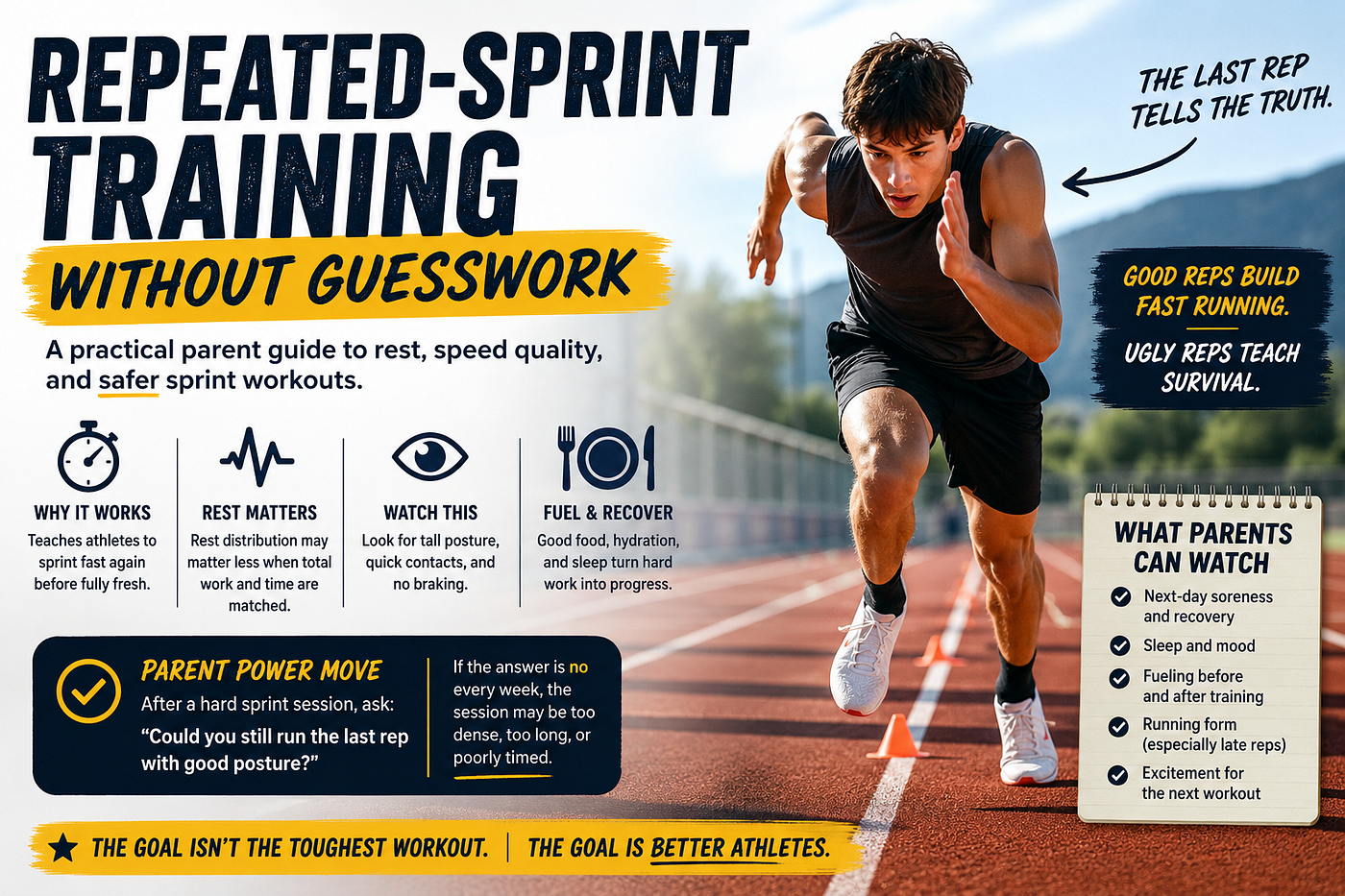
[Parent Power Move] Ask your athlete one simple question after an RST workout: “Could you still run the last rep with good posture?” If the answer is no every week, the session may be too dense, too long, or too late in the season.
Why This Matters for 200 m and 400 m Athletes
Repeated-sprint training fits best when the event rewards high-speed repeatability. That usually points to 200 m, 300 m, 400 m, long hurdles, sprint relays, and some middle-distance athletes who need speed under fatigue.
For a 400 m athlete, the goal is not to make every practice feel like the last 80 meters of a championship race. That approach often turns young runners into tight, choppy survivors. Better RST keeps the sprint short enough that the athlete can attack the ground, hold posture, and recover enough to sprint again.
A 2024 systematic review and meta-analysis reported that running-based repeated-sprint training can improve sprint speed, repeated-sprint ability, change-of-direction ability, countermovement jump height, VO₂max, and intermittent running performance in trained athletes. The review also pointed to three sets of 6 × 30 m, twice weekly for six weeks, as one effective pattern in the literature.
What Parents Should Watch During the Workout
A stopwatch helps, but the eyes matter too. In youth track, ugly speed is usually a warning sign.
Look for tall posture, quick ground contact, arms that move forward and back, and a foot strike that does not slap far in front of the body. When athletes get tired, they often sit down in the hips, reach with the lower leg, cross the arms, or twist through the shoulders.
[Biomechanics Insight] The key sign is not just slower time. It is braking. When the foot lands too far ahead of the hips, each step acts like a small stop sign. Rest should be long enough to keep the athlete sprinting, not grinding.
Rest Choices That Make Sense
There is no single magic rest recipe. Coaches can use shorter rest when the goal is controlled fatigue and rhythm. They can use longer rest when the goal is higher speed and cleaner mechanics.
For most youth track athletes, start with quality before density. A simple progression might look like this:
- Early season: short sprints, fuller rest, clean mechanics.
- Mid-season: repeated fast reps with modest fatigue.
- Pre-meet weeks: fewer reps, sharper speed, less soreness.
- Meet week: small touches of speed, not hard conditioning.
- Return from injury: no maximal repeated sprinting until basic sprinting is pain-free.
- After poor sleep or heavy school stress: reduce density or stop early.
That is the only quick-reference list parents need. The rest belongs to the coach’s plan, the athlete’s event, and the calendar.
Youth Athletes Are Not Small Pros
The new trial used semi-professional adult male soccer players, not 12-year-old sprinters, 15-year-old hurdlers, or high school 400 m runners. That matters.
A 2026 meta-analysis focused on youth athletes found repeated-sprint training was associated with gains in short sprint speed, change-of-direction performance, and best repeated-sprint ability, but the evidence came from only eight studies and 193 athletes ages 13 to 18. That is useful, but still not enough to treat RST as a plug-and-play answer for every teenager.
The younger the athlete, the more the session should look like skillful sprint exposure, not exhaustion. Ages 7 to 12 usually need games, coordination, acceleration basics, jumping and landing skills, and plenty of recovery. Ages 13 to 19 can handle more structure, but maturity, training age, and injury history still matter.
The Load Problem Nobody Sees
Parents often judge only the track workout. The body counts everything.
A hard RST session on Tuesday feels different if the athlete also played a tournament, lifted heavy, slept five hours, and skipped lunch. Youth injury research keeps pointing back to total workload, growth, specialization, and rapid changes in training. A 2022 review on youth team-sport athletes noted that week-to-week training-load jumps above 15% have been linked with increased injury risk, though injury risk is never controlled by one number alone.
[Training Load Check] Watch the next day. Heavy legs are normal. Limping, hamstring tightness, calf pain, unusual irritability, or soreness lasting more than 72 hours means the next hard sprint session needs adjustment.
Fueling Repeated Speed
Repeated-sprint training burns through quick energy. A young athlete who arrives underfed may look “mentally weak” when the real problem is simple: not enough fuel.
For most afternoon practices, a balanced lunch and a carbohydrate-rich snack 30 to 90 minutes before training work better than a last-minute energy drink. Good choices are familiar foods: banana and yogurt, toast with peanut butter, cereal and milk, rice and eggs, or a turkey sandwich.
Young athletes also need enough total daily energy for growth, school, and training. Reviews on youth athlete nutrition emphasize balanced meals, carbohydrates for hard exercise, protein for repair, and hydration before, during, and after sport.
[Nutrition Note] After a hard RST day, aim for a real meal with carbohydrates, protein, fluid, and salt if the athlete sweated heavily. The recovery goal is not fancy. It is refuel, repair, rehydrate, and sleep.
Sleep Is Part of the Workout
Sprint quality depends on the nervous system. That makes sleep a training variable, not a nice extra.
The American Academy of Sleep Medicine recommends 9 to 12 hours per 24 hours for children ages 6 to 12 and 8 to 10 hours for teenagers ages 13 to 18. A tired athlete may still finish practice, but reaction, coordination, mood, and tissue readiness can suffer.
For parents, the best recovery tool may be boring: steady bedtime, food packed before school, and fewer late-night screens during hard training blocks.
A Safer Way to Test Rest Patterns
A coach does not need a lab to learn what works for a group. Keep one thing steady and change one thing at a time.
For example, over three weeks, a 400 m group might run the same total sprint distance twice per week with slightly longer within-set rest. In another three-week block, they might keep the distance the same but use shorter within-set rest and longer set breaks. The coach times every rep and watches the last rep closely.
The better setup is not the one that feels hardest. It is the one that preserves speed, rhythm, attendance, and confidence.
That is the contrarian coaching take: the toughest session is often not the best session. For young sprinters, the most useful RST session is usually the one that makes fast running repeatable without teaching bad mechanics.
What Parents Should Not Do
Do not copy a college or pro workout from social media and hand it to a middle schooler. Do not chase “lactic acid” every week. Do not assume vomiting means the session worked. Do not turn every off-season practice into a test of toughness.
Also be careful with supplements marketed for speed, pump, energy, or recovery. The International Testing Agency warns that supplements are a leading cause of inadvertent doping, no supplement is 100% risk-free, and athletes are responsible for what is found in their bodies. Food-first is the safer default for youth athletes.
The Bottom Line
Repeated-sprint training can be useful, especially for athletes who need speed endurance and repeatability. But the rest interval is not magic by itself.
When volume and time are matched, recent evidence suggests rest distribution may matter less than coaches sometimes think. For parents, the best lens is practical: did the workout protect speed, mechanics, recovery, and motivation?
Fast reps teach fast running. Sloppy reps teach survival. The difference often shows up in the last sprint.
Key Takeaways
- Repeated-sprint training is best viewed as speed repeatability, not punishment conditioning.
- Recent evidence suggests small rest-distribution changes may not matter much when total sprint work and session time are matched.
- Youth athletes need RST adjusted for age, maturity, event, sleep, food, and injury history.
- The best rest pattern is the one that keeps late reps fast, coordinated, and recoverable.
- Parents can help most by tracking next-day soreness, sleep, fueling, and athlete mood.
References
Zhang, F., Liu, Y., Liu, J., Li, C., Liu, Z., & Yeremenko, O. (2026). Effects of high-intensity interval training on physical fitness in trained adolescent athletes: A systematic review and meta-analysis. Frontiers in Physiology.
Gupta, P., Turner, T., Phillips, S., & Weston, M. (2026). A pragmatic, parallel-arm, randomised trial on the effects of two repeated-sprint training protocols on fitness outcomes in semi-professional male soccer players: Preliminary report. Science and Medicine in Football.
Yan, C. (2026). The effect of repeated-sprint training on performance outcomes in youth athletes: A meta-analysis.
Thurlow, F., Huynh, M., Townshend, A., McLaren, S. J., James, L., Taylor, J., Weston, M., & Weakley, J. (2024). The effects of repeated-sprint training on physical fitness and physiological adaptation in athletes: A systematic review and meta-analysis. Sports Medicine.
Li, X., & Xue, K. (2024). Optimizing short sprint interval training for young soccer players: Unveiling optimal rest distributions to maximize physiological adaptations. Journal of Sports Science and Medicine.
Sniffen, K., et al. (2022). Is cumulative load associated with injuries in youth team sport athletes?
Paruthi, S., Brooks, L. J., D’Ambrosio, C., et al. (2016). Consensus statement of the American Academy of Sleep Medicine on the recommended amount of sleep for healthy children. Journal of Clinical Sleep Medicine.
Smith, J. W., Holmes, M. E., & McAllister, M. J. (2015). Nutritional considerations for performance in young athletes. Journal of Sports Medicine.
Purcell, L. K. (2013). Sport nutrition for young athletes. Paediatrics & Child Health.
메타데이터
- post_id
- a7cb090bb63a
- slug
- repeated-sprint-training-rest-without-guesswork-a7cb090bb63a
- url
- https://medium.com/@sarahb57/repeated-sprint-training-rest-without-guesswork-a7cb090bb63a
- canonical_url
- https://medium.com/@sarahb57/repeated-sprint-training-rest-without-guesswork-a7cb090bb63a
- author_url
- https://medium.com/@sarahb57
- status
- ok
- fetched_at
- 2026-06-28 04:42:08