We don’t use AI to solve life’s problems, we use it to write code.
Problems of ethics weigh less when we use AI with rules, to build tools.
We don’t use AI to solve life’s problems, we use it to write code.
Problems of ethics weigh less when we use AI with rules, to build tools.
On my TikTok FYP I find a lot of AI. Because — you know, algorithms.
📱Cloe Lubinski of Anthropic warns that AI systems, when poorly scoped, can spiral into harmful outputs. Such models can exhibit harmful behaviours, like praising dictators, suggesting self-harm.
📱 Kara Bombell of EthicalAI: morality in AI can’t be outsourced to a handful of developers or algorithms — calls out ethical risks like data colonialism (stealing data from poor countries to train models) and the limitations of algorithmic morality in high-stakes contexts — like AI powered autonomous weapons.
All true. Frightening. But less relevant to us, as a company using AI agents to write software.
— — — — -
Software has this one big constraint that makes it inherently self-corrective — it must compile.
— — — — -
Any sentence will make sense to someone. Software must comply to the compiler.
Yes, a sentence SHOULD be syntactically correct, but MUST be syntactically correct only if you want to pass your exams.
“She is a brilliant mathematician”. Syntactically correct. Understandable.
“Brilliant mathematician is she”. Syntactically incorrect Yoda-talk. But still understandable.
— — — — -
Yet we don’t trust AI to build meaningful software solutions on it’s own.
— — — — -
Our AI agents are strictly regulated by the scope we give them. We make them build tools, then sharpen them, and use them.
We know. The moment you give the Agentic AI a broad subject, it will try to please you in the moment. If you go beyond the context window, or start with a different instance of the agent in the morning, it will have forgotten all that was done the previous day, and, again, try to please you in the moment.
The result then, necessarily, will be a incoherent application, unorganised, unpredictable, untrustworthy.
If you say, create a ticket for x, it will write a one-off script for that particular case, it will make mistakes, the same mistakes it made yesterday, but the mistake is actually entirely yours, because you think it is an entity that persists through time. It isn’t.
That’s why we use the agent to build tools, then instruct it to use them. When they don’t, you instruct them to read the global rules and try again.
First thing you learn is that they don’t learn.
— — — — -
We build meta-tools to harness the wild power of AI.
— — — — -
Call them MCP-servers if you want. Sounds cool. My personal rig still contains many simple scripts because that’s how I started steering my AI agents.
The meta-tools give my agents working rules. How to make a todo list, what to do first when starting work on a ticket, how to start work on a project, where the dependencies are, how to add a comment to a ticket, when to invoke a QA agent, what our playbook architecture is, how to best use ansible to deploy. And many more. There’s not a day when nothing is added to our meta-toolkit.
Still, agents often don’t adhere to the rules. I’m constantly reminding them. I am very strict.
— — — — -
I’m surprised how far removed our daily practice is from the worries of the general public about AI.
— — — — -
At home, I rarely talk about work, when I do, the subject of AI invariably comes up, and with it, the negativity mostly brought onto itself: the fear of job loss, the stolen data and stolen human creativity, the biases, the pleasing to the detriment of users.
Norway has forbidden use of AI in primary schools: it’s out there with social media, frightening parents and teachers alike.
At work, that’s not what we see. It’s as if there are two AI’s, one unbounded, wreaking havoc, the other a diligent worker, bound by rules.
Our AI is the latter. Increases our productivity — some days I say by a factor of ten, other days I too despair and wonder if the old days were not the best. But then a new rule is written and we move on.
Rules make all the difference. Without them, we’re at the mercy of the whims of language, generated by AI, right back at us. We’re back in historical times, where life was uncertain, where no rule of law existed.
In the land of software, we make the rules.
— // — — — -
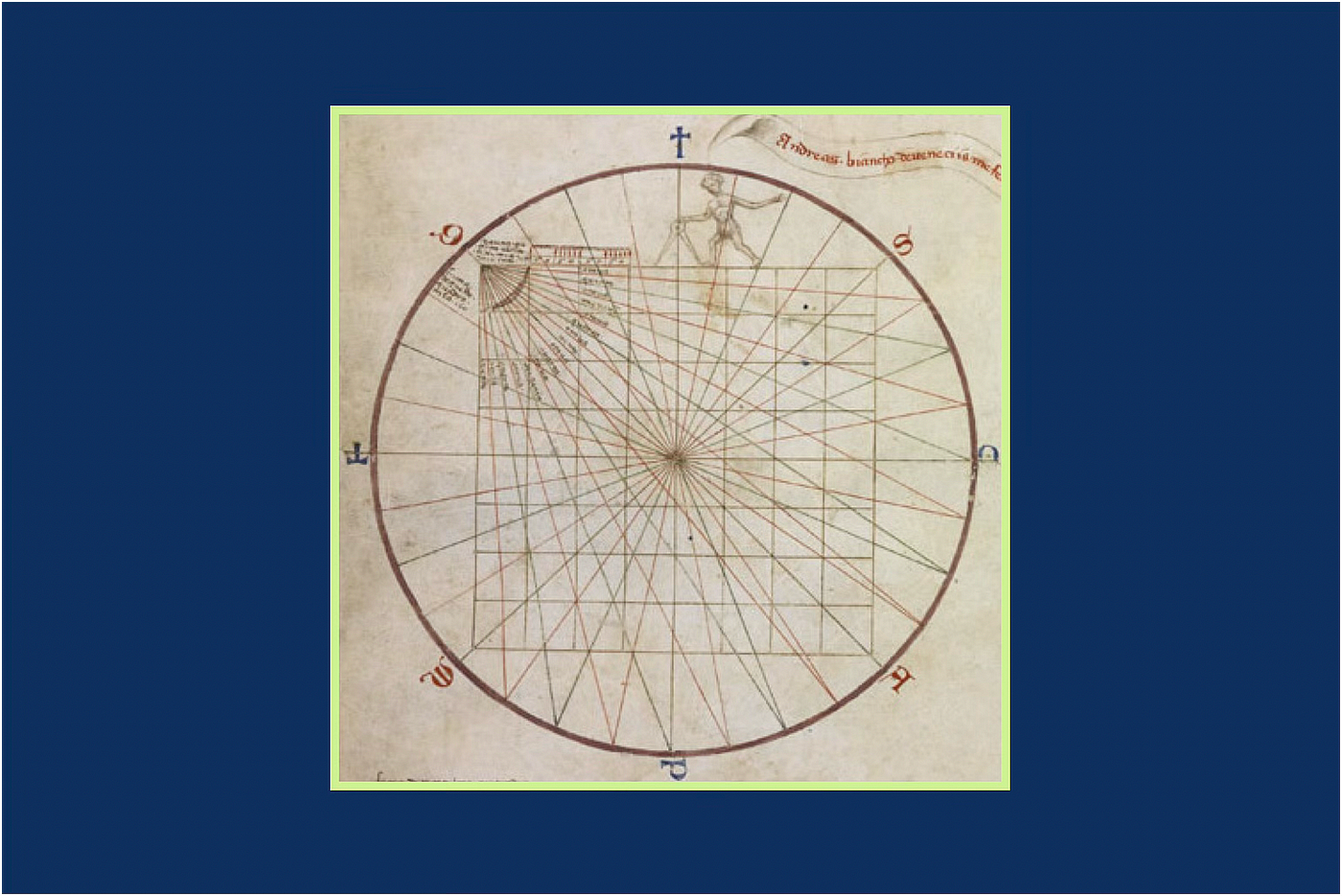
Header Image: the rule of marteloio — how medieval sailors mastered the uncertainties of the oceans through trigonometry and mathematics — image by Andrea Bianco, 1436. Wikipedia.
— // — — — -
메타데이터
- post_id
- a7d086e2cbb4
- slug
- we-dont-use-ai-to-solve-life-s-problems-we-use-it-to-write-code-a7d086e2cbb4
- url
- https://medium.com/@gmdekkers/we-dont-use-ai-to-solve-life-s-problems-we-use-it-to-write-code-a7d086e2cbb4
- canonical_url
- https://medium.com/@gmdekkers/we-dont-use-ai-to-solve-life-s-problems-we-use-it-to-write-code-a7d086e2cbb4
- author_url
- https://medium.com/@gmdekkers
- status
- ok
- fetched_at
- 2026-07-09 13:13:48





