You Use Machine Learning Dozens of Times a Day. Here’s What It Actually Is
ML isn’t magic. It’s a simple idea that powers almost every smart feature in your phone, your feed, and your bank account.
You Use Machine Learning Dozens of Times a Day. Here’s What It Actually Is
ML isn’t magic. It’s a simple idea that powers almost every smart feature in your phone, your feed, and your bank account.
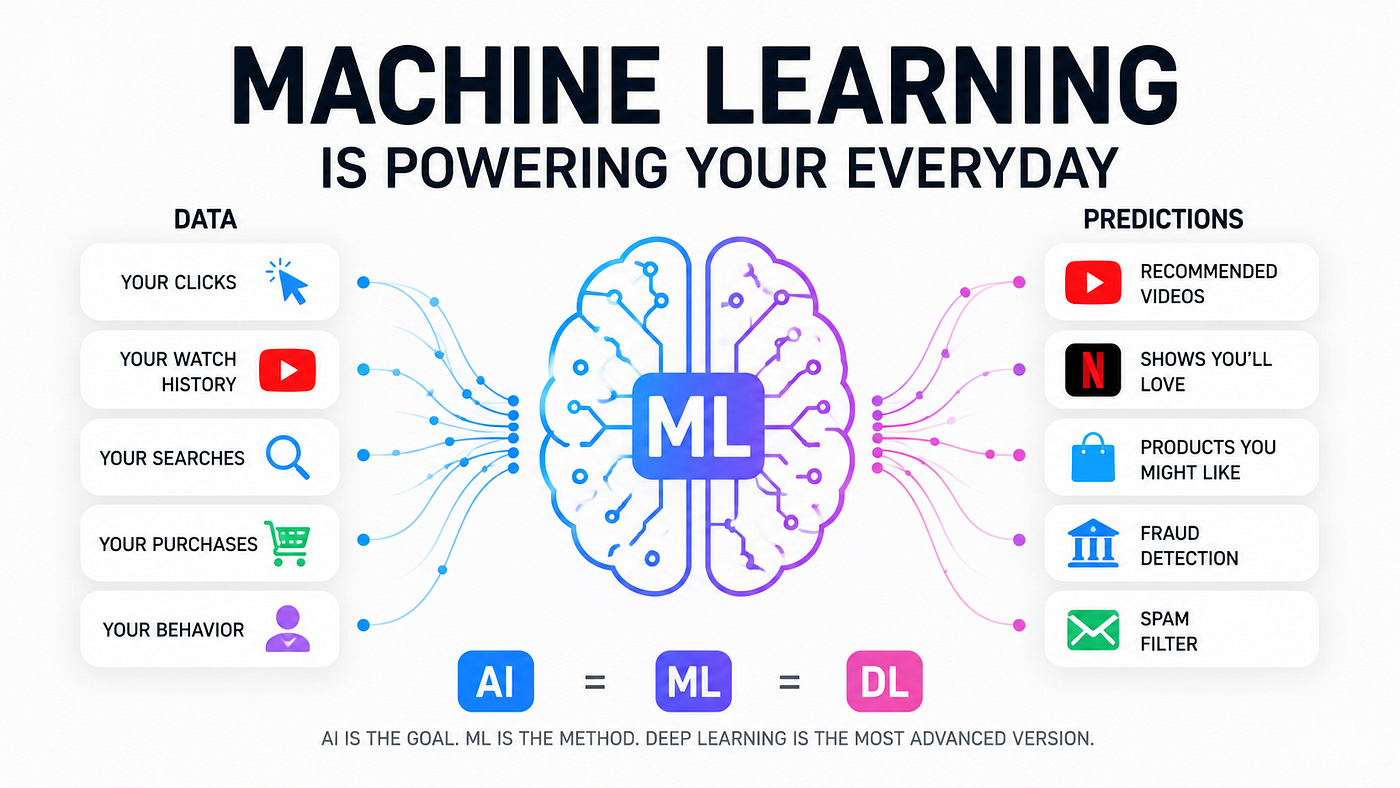
Image generated with ChatGPT
Every time YouTube knows exactly what video to play next, something is happening behind the scenes.
It’s not a team of people hand-picking videos for you. It’s not a simple “if you watched X, show Y” rule. It’s a system that watched millions of people, learned what keeps them watching, and quietly built a model around your behavior.
That system is Machine Learning. And once you understand what it actually is, you’ll start seeing it everywhere.
What Machine Learning Really Means
Here’s the simplest way to say it:
Machine Learning is a way to teach computers to make decisions from data without writing specific rules for every situation.
Traditional software works on rules a human writes. You set the conditions. You write what happens if they’re met. The computer follows those instructions exactly.
Machine Learning flips that. Instead of giving a computer rules, you give it data thousands or millions of examples. The computer finds the patterns itself, builds a model, and then uses that model to handle new situations it’s never seen before.
No hand-written rules. Just patterns learned from experience.
Where You See It Every Single Day
You don’t need to work in tech to use Machine Learning constantly. Here’s what’s actually running it around you right now:
- Spam filter in your email: No one wrote a rule for every possible spam message. The model learned what spam looks like by reading millions of examples, and now it catches new variations it’s never seen before
- YouTube and Netflix recommendations: The system watched what millions of people watched, skipped, rewatched, and paused. It learned your patterns from that data and matches you to content accordingly
- Online shopping suggestions: “People who bought this also bought…” is a pattern the model found by analyzing purchasing behavior across millions of orders
- Bank fraud detection: When your bank flags a suspicious transaction at 3 am from a country you’ve never visited, that’s ML noticing your behavior doesn’t match the pattern and raising an alert
None of these needed a human to sit down and write every possible rule. They all learned from data.
How It Actually Works Step by Step
The process behind every ML system follows the same basic logic:
First, you collect a large amount of data. For spam detection, that’s millions of emails labeled “spam” or “not spam.” For fraud detection, that’s millions of transactions labeled “legitimate” or “fraudulent.”
Second, you feed that data to a model or an algorithm that looks for patterns. It finds things like: “spam emails often contain certain phrases, come from unknown senders, and include links to unusual domains.”
Third, you test the model on new data it hasn’t seen before. If it performs well catching spam it wasn’t specifically trained on, the model has genuinely learned something useful.
Fourth, the model goes live. Every new email, every new transaction, every new video you click on becomes new data that the model uses to make a decision in real time.
The more data the system sees over time, the better it gets. That’s what people mean when they say ML systems “improve with use.”
AI vs ML vs Deep Learning Cleared Up in 30 Seconds
These three terms get used interchangeably online, but they’re not the same thing. Think of them as nested layers:
AI (Artificial Intelligence) is the big umbrella. It covers any system that mimics human intelligence, making decisions, solving problems, recognizing patterns.
ML (Machine Learning) is a specific approach inside AI. Instead of programming rules manually, you let the system learn from data. All Machine Learning is AI, but not all AI is Machine Learning.
DL (Deep Learning) is a specific type of Machine Learning. It uses layers of artificial “neurons” inspired loosely by how the brain works to process complex data like images, speech, and language. ChatGPT, image generators, and voice recognition all run on Deep Learning.
So: AI is the goal. ML is the method. Deep Learning is the most advanced version of that method.
Why This Matters Even If You’re Not a Developer
Understanding ML doesn’t require you to write code. But it does change how you think about the technology around you.
When your feed keeps showing you content that makes you angry, that’s ML optimizing for engagement, not for your well-being. When a loan application gets rejected by an automated system, that’s an ML model making a judgment. When a medical scan is analyzed for early warning signs, that’s Deep Learning spotting patterns a human eye might miss.
These systems are making real decisions that affect real people. Understanding what they are, even at a basic level, is part of being an informed person in 2026.
Honest Limitations
ML isn’t magic, and it’s not always right:
- ML models are only as good as the data they’re trained on. Biased data produces biased decisions, and the model won’t know it’s being unfair
- These systems can be confidently wrong. A fraud detection model might flag a legitimate transaction. A spam filter might catch an important email. The model doesn’t “know”; it’s just following learned patterns
- ML systems can also be gamed. Once people know what a spam filter is looking for, spammers adapt. The arms race never fully ends
- Deep Learning models in particular are often “black boxes”; they make decisions but can’t always explain why, which is a serious problem in high-stakes areas like medicine or criminal justice
What To Do Right Now
Next time you get a recommendation on YouTube, Spotify, Netflix, or any shopping site, pause for a second and think about what data it used to decide that. What have you clicked on? What did you ignore? What did you watch all the way through?
That mental habit is the beginning of actually understanding the technology that shapes more of your day than you probably realize.
메타데이터
- post_id
- a7d60b3ebe21
- slug
- you-use-machine-learning-dozens-of-times-a-day-heres-what-it-actually-is-a7d60b3ebe21
- url
- https://medium.com/ai-tomorrow/you-use-machine-learning-dozens-of-times-a-day-heres-what-it-actually-is-a7d60b3ebe21
- canonical_url
- https://medium.com/ai-tomorrow/you-use-machine-learning-dozens-of-times-a-day-heres-what-it-actually-is-a7d60b3ebe21
- author_url
- https://medium.com/@milandanushka
- status
- ok
- fetched_at
- 2026-06-22 17:31:34