I Stopped Searching for Scholarships. I Started Building an Intelligence System Instead.
From information overload to smarter scholarship decisions with structure
I Stopped Searching for Scholarships. I Started Building an Intelligence System Instead.
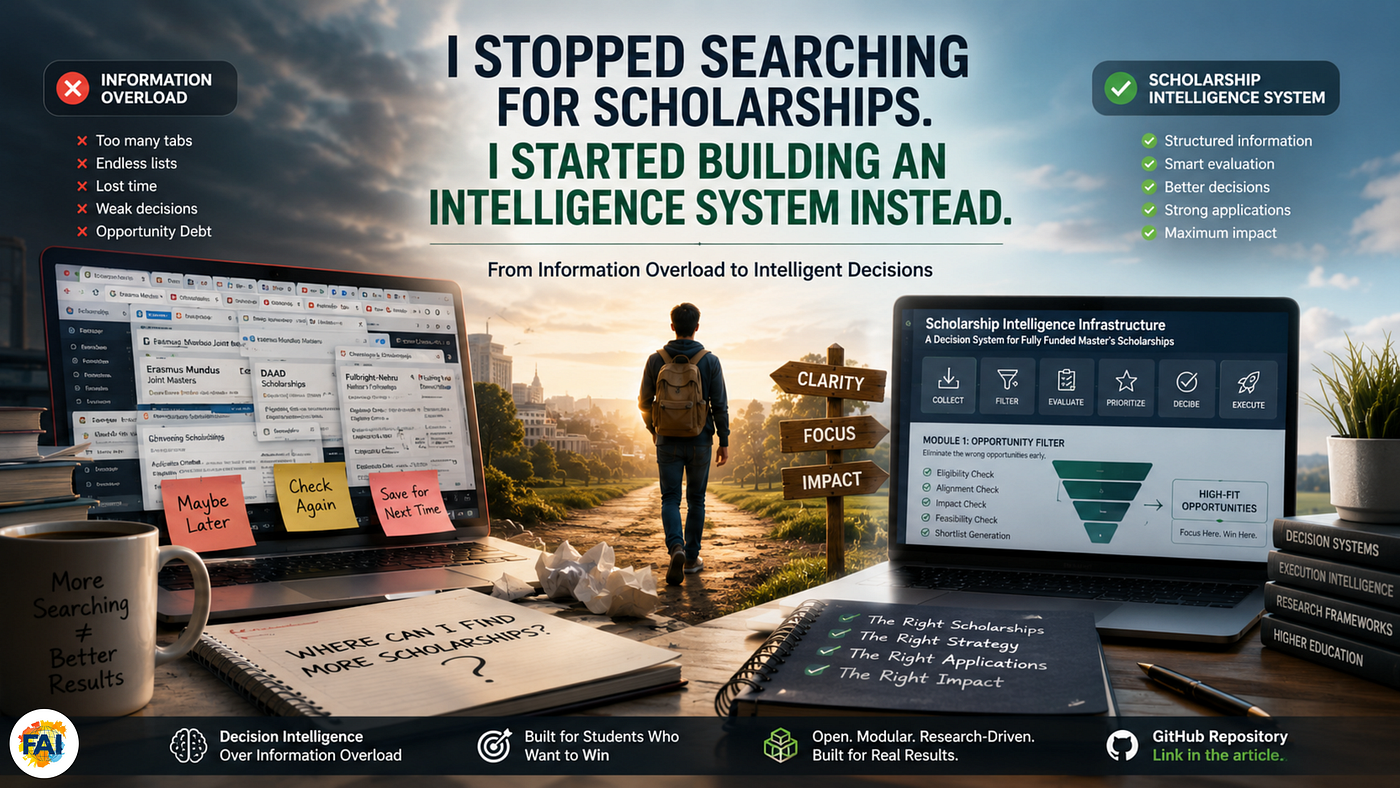
From information overload to smarter scholarship decisions with structure
I remember the exact moment my browser tabs gave up.
There were forty-two of them open. Each one was a different fully funded Master’s scholarship, a university funding page, or a forum thread debating eligibility criteria. My screen was a mosaic of blue hyperlinks and dense paragraphs of academic requirements.
I had been searching for six months. I had subscribed to every Telegram channel, joined every WhatsApp group, and bookmarked every opportunity that mentioned the words “fully funded.”
Yet, when I sat down to actually write my first Statement of Purpose, I realized I had no idea which scholarship I was writing it for.
I had thousands of opportunities at my fingertips. I had hundreds of them saved. But I had made zero real decisions.
I thought I was being thorough. I thought I was being strategic. Looking back, I see that I was just hiding from the actual work. I was confusing the accumulation of information with the act of making a choice.
That afternoon, I closed all forty-two tabs. I didn’t close them because I had found the perfect scholarship. I closed them because I finally understood that searching was never the problem.
The Illusion of More Opportunities
We are conditioned to believe that success in highly competitive environments comes down to volume. Cast a wide net. Apply to everything. The more applications you submit, the higher your chances of success.
This advice makes intuitive sense. It also creates a massive blind spot.
When you operate under the assumption that you need to find more opportunities, your entire workflow becomes oriented around discovery. You spend your evenings scrolling through university portals. You spend your weekends reading blog posts about the latest Erasmus Mundus programs or Chevening deadlines. Every new link you save triggers a small hit of dopamine. It feels productive. It feels like progress.
But collecting links is not the same as evaluating them.
Information abundance does not lead to better decisions. It usually leads to decision paralysis.
When choices increase beyond a manageable level, comparison becomes exhausting. Small differences between two similar programs begin to feel overwhelmingly important. Your attention fragments. You start reading the same eligibility criteria three times because your brain is too fatigued to retain it.
I fell into this trap completely. I believed that if I just found one more scholarship, one more hidden gem, I would feel ready to apply. But the finish line kept moving. The moment I added a new batch of scholarships to my list, the old ones didn’t get evaluated; they just got pushed further down the pile.
Searching expands your options. But a scholarship application requires you to narrow your focus. You cannot do both at the same time. By spending all my time expanding possibilities, I had no energy left to actually choose a direction.
My Breaking Point
The breaking point didn’t happen dramatically. It happened quietly, on a Tuesday night, while I was staring at a spreadsheet.
My spreadsheet was a masterpiece of false productivity. It had color-coded tabs. It had columns for the country, the funding amount, the deadline, the required IELTS score, and the link to the application portal. It had over two hundred rows.
I scrolled to the bottom, then scrolled back to the top. I realized I had spent weeks building this database, but I hadn’t answered a single fundamental question:
Which of these actually fit me?
I had organized information. I had not improved my decisions.
Every saved scholarship in that spreadsheet represented an unfinished decision. Each row was a quiet demand on my attention, a tiny open loop in my brain reminding me of something I needed to look at later. Later became next week. Next week became next month.
I later came to understand this as Opportunity Debt.
Opportunity Debt is the hidden cost created when you collect opportunities faster than you evaluate them. Unlike financial debt, it doesn’t show up in a bank statement. It shows up as mental fatigue. It shows up as a lingering sense of anxiety every time you open your laptop. It shows up as weak, generic applications because you are trying to write one Statement of Purpose that vaguely appeals to fifty different programs.
The more unfinished opportunities I accumulated, the harder it became to identify the ones that genuinely deserved my effort. I was drowning in my own preparation.
I realized then that my system was broken. Not because it lacked information, but because it lacked a mechanism for elimination. I had built a machine for gathering, but I had no filter for processing.
A Different Question
That night, I closed the spreadsheet. I opened a blank document.
I stopped asking the question that had driven me for the past six months:
“Where can I find more scholarships?”
Instead, I asked a completely different question:
“How should scholarship knowledge be organized so that it actually leads to a decision?”
Changing the question changed everything.
The first question assumes the bottleneck is discovery. It assumes the world is hiding good opportunities from you, and your only job is to dig them up.
The second question assumes the bottleneck is cognition. It assumes the world is giving you too much data, and your job is to build a structure that turns that data into clarity.
I started thinking about my scholarship preparation not as a search mission, but as an information processing problem. I am a researcher by training. I spend my time studying decision systems, complexity, and how people make choices under uncertainty. Yet, when it came to my own future, I was acting like a hoarder.
I decided to apply the same rigor to my scholarship search that I would apply to a research project. I needed a system that could handle high volumes of information, filter out the noise, and force me to make evidence-based decisions.
I didn’t need a better list. I needed an architecture.
Building Scholarship Intelligence Infrastructure
I decided to call it the Scholarship Intelligence Infrastructure.
I chose the word “infrastructure” deliberately. A guide is static. A list is fragile. A PDF document is dead the moment it is published. Infrastructure, on the other hand, is alive. It is designed to be updated, scaled, and connected.
I wanted to build a connected knowledge system where every part supported the other parts. I didn’t want to just write down my thoughts; I wanted to build a modular framework that could evolve as I learned more about the process.
I started by moving my work out of private, messy folders and into a structured, version-controlled environment. I set up a GitHub repository. To most people, GitHub is a place for software developers to store code. But at its core, it is a tool for managing complex, evolving documentation. It forces you to track changes, organize files logically, and maintain a clear history of how your thinking has developed over time.
I broke the massive, overwhelming process of applying for scholarships down into distinct, manageable modules.
I realized that a strategic applicant doesn’t just need to know how to write an essay. They need to know how to evaluate their own profile. They need to know how to filter opportunities. They need to know how to manage their time and attention. They need to understand how to handle rejection and iterate on their strategy.
I began documenting these phases. I treated each phase as a separate module in a larger operating system.
I stopped building a list of scholarships, and I started building an intelligence system for deciding which scholarships were worth my time.
This shift from collecting to structuring was profound. It removed the emotional weight from the process. I was no longer worrying about missing out on a hidden gem. I was simply trusting my system to filter the noise.
I started writing down the core principles of this system. I documented how to identify Opportunity Debt. I mapped out the difference between merely searching for a program and actually deciding to apply. I built frameworks for evaluating alignment, competitiveness, and return on effort.
The infrastructure was no longer just about getting into a university. It was about building a repeatable decision process that I could use for the rest my life.
I wanted every piece of research to connect to the next. A traditional blog post or a static PDF guide is fragile. The moment you publish it, it starts dying. Links break. Deadlines change. Eligibility criteria shift.
I needed a living document.
I moved my entire framework into a version-controlled repository on GitHub. Most people associate GitHub with software development, but at its core, it is simply a tool for managing complex, evolving documentation. It forces you to track changes, organise files logically, and maintain a clear history of how your thinking develops over time.
I broke the massive, overwhelming process of applying for scholarships into distinct, manageable modules. I stopped treating the application as a single giant leap and started treating it as an operating system.
I stopped building a list of scholarships, and I started building an intelligence system for deciding which scholarships were worth my time.
Module 1: The Art of Elimination
The first module I built was the foundation of everything else. I called it Scholarship Intelligence Foundations.
The objective of this module was not to help me find more scholarships. In fact, its primary goal was the exact opposite. It was designed to help me eliminate unsuitable scholarships as quickly and ruthlessly as possible.
This was a massive psychological shift. For months, I had been conditioned by the internet to believe that success meant keeping every door open. I thought filtering was a form of quitting. I thought if I didn’t apply to a programme, I was somehow failing to hustle.
But as I researched decision systems and cognitive load, I realised that elimination is actually the highest form of strategy.
In this first module, I introduced a concept I call Opportunity Debt.
Opportunity Debt is the hidden mental cost created when you collect opportunities faster than you evaluate them. Every time you bookmark a scholarship link or add a row to your spreadsheet without making a firm decision, you take on a small amount of debt. That saved link becomes an unfinished loop in your brain.
Individually, one saved link means nothing. But when you have three hundred saved links, that debt compounds. It creates information overload. It causes decision fatigue. It steals your attention from the few opportunities that actually deserve it.
Module 1 taught me how to pay down that debt. It forced me to ask hard questions before I even opened an application portal.
Does this programme genuinely align with my academic background? Is the competition realistic for my current profile? Will the return on effort justify the next three months of my life?
If the answer was no, I deleted the link. I didn’t save it for later. I didn’t put it in a “maybe” folder. I eliminated it.
Showing how elimination improves decisions is simple: every bad option you remove makes the good options clearer.
Lessons Learned
Building this infrastructure changed how I operate. It wasn’t just about getting a fully funded Master’s degree. It was about rewiring how I process information and handle complexity.
Here are the core lessons that emerged from this process.
1. Information is not understanding
You can read fifty pages about the Chevening Scholarship and still not know if it is right for you. Information is just raw data. Understanding is what happens when you connect that data to your own reality. Better decisions require better thinking, not just better search results.
2. Opportunity Debt is a silent career killer
Saving opportunities without evaluating them doesn’t make you prepared; it makes you paralysed. The hidden cost of a massive spreadsheet isn’t the time it took to build. It is the mental fatigue it causes every time you look at it. Filter early. Filter often.
3. Saying “no” is a complete strategy
We are taught that applying to more places increases our chances. In reality, applying to poorly matched places dilutes the quality of your applications. Choosing not to apply to a scholarship is often the most strategic decision you can make. Every deliberate “no” creates space for a stronger “yes”.
4. Attention is your scarcest resource
Everyone talks about time management. But time is not your most limited asset in scholarship preparation. Attention is. You can find time to write an essay at midnight, but if your attention is fragmented across twenty different programmes, the essay will be weak. Protect your attention as fiercely as you protect your deadlines.
5. Systems outperform motivation
Motivation is a feeling. It comes and goes. Some days you want to write your Statement of Purpose; most days, you don’t. A decision system doesn’t care about your feelings. It provides a repeatable process that keeps you moving forward even when your motivation is at zero.
Why Infrastructure Matters More Than Lists
We live in an era where anyone can compile a list of fully funded scholarships and publish it online. These lists are everywhere. They are also largely useless on their own.
Lists expire. They do not teach you how to think. They do not adapt to your specific academic profile. When you rely on a list, you are outsourcing your decision-making to a stranger on the internet.
Infrastructure is different. Infrastructure is about decision systems and knowledge architecture.
When you build an infrastructure, you are building what I call Knowledge Capital. Knowledge capital grows when every new piece of research, every framework, and every practical tool continuously strengthens the others. It compounds over time.
A list gives you a fish. An infrastructure teaches you how to evaluate the ocean.
This idea extends far beyond scholarships. Whether you are evaluating career opportunities, deciding on a research direction, or allocating resources in a complex project, the principle remains the same. Better systems will always outperform bigger databases. The goal is never to consume more information. The goal is to build a better filter for the information you already have.
Closing Reflection
I still think about those forty-two browser tabs I had open that Tuesday night.
I remember the anxiety they caused. I remember the false sense of productivity they gave me. I was working hard, but I wasn’t moving forward. I was just running in place, buried under a mountain of unmade decisions.
Today, my browser has three tabs open.
I know exactly which scholarships I am applying for. I know exactly why I chose them. I have evaluated them against my profile, my goals, and my capacity. The anxiety is gone. In its place is a quiet, steady confidence.
I stopped searching for scholarships because I realised that searching was never the actual problem. The problem was that I lacked a system to handle what I found.
If you are feeling overwhelmed by the sheer volume of fully funded Master’s opportunities out there, step back. Close the tabs. Stop trying to find one more hidden gem.
Instead of finding more scholarships, build a better system.
If you are interested in exploring the frameworks and decision architecture I built during this journey, I have made the core infrastructure publicly available.
You can find the open-source documentation, modules, and research frameworks on my **GitHub Repository**. It is designed to be a living system, and I update it as my research evolves.
For those who prefer a structured, ready-to-use execution system rather than building it from scratch, I have also published practical implementation tools on **Gumroad*. These include the operational templates and the Funded Master’s Compass*, which apply these decision principles directly to the application process.
There is no pressure to use them. But if you are tired of searching and ready to start deciding, they are there for you.
Build your system. Make your decisions. The rest will follow.
메타데이터
- post_id
- a7e25304f818
- slug
- i-stopped-searching-for-scholarships-i-started-building-an-intelligence-system-instead-a7e25304f818
- url
- https://medium.com/thoughts-reflections/i-stopped-searching-for-scholarships-i-started-building-an-intelligence-system-instead-a7e25304f818
- canonical_url
- https://medium.com/thoughts-reflections/i-stopped-searching-for-scholarships-i-started-building-an-intelligence-system-instead-a7e25304f818
- author_url
- https://medium.com/@fundedabroadindia
- status
- ok
- fetched_at
- 2026-07-13 06:23:13