Why Capitalising Interest Quietly Creates New Money and Why That Matters for All of Us
Most people believe that money is only created when someone takes out a new loan. That’s definitely what the Reserve Bank teaches and what…
Why Capitalising Interest Quietly Creates New Money and Why That Matters for All of Us
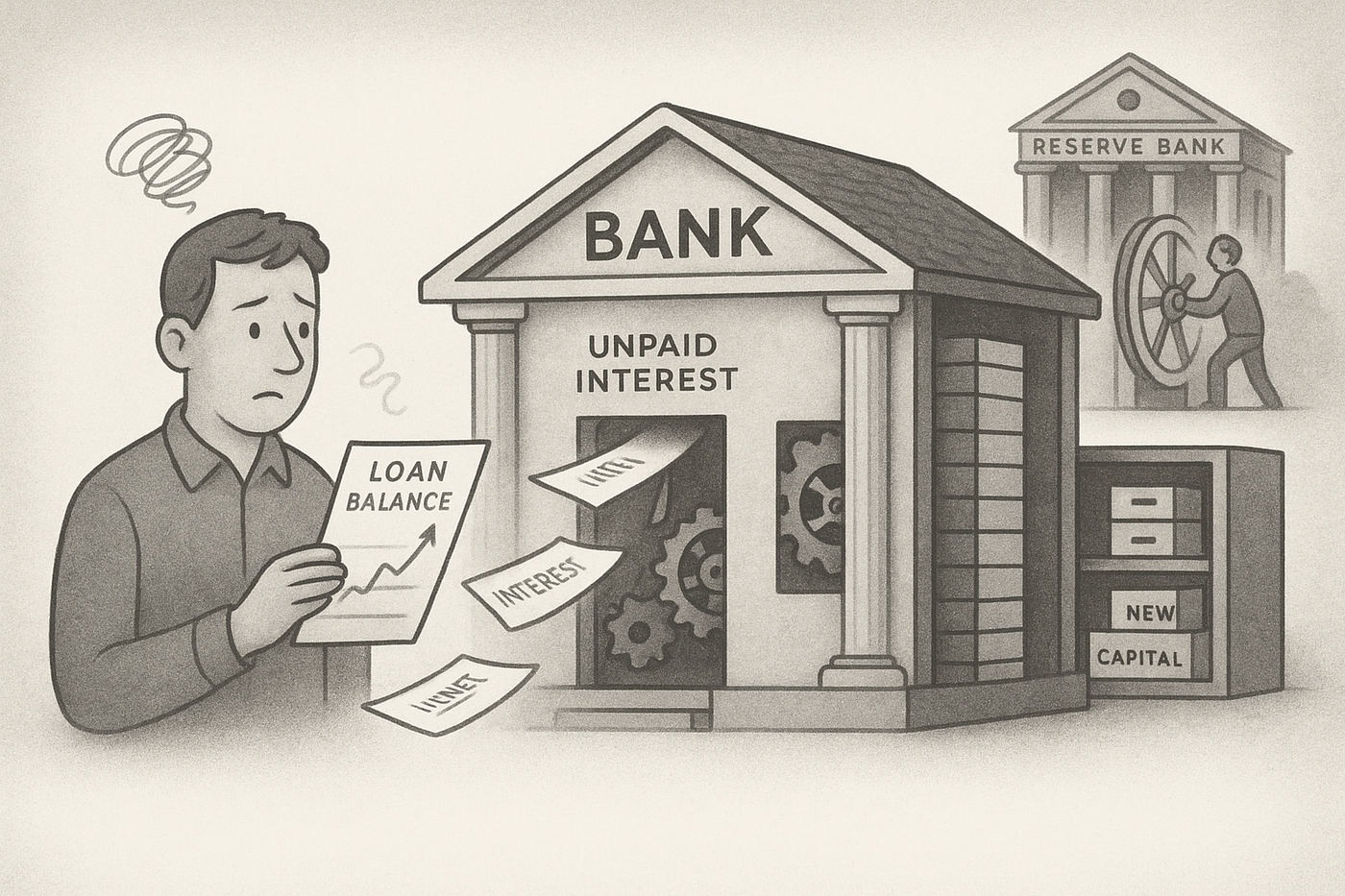
Most people believe that money is only created when someone takes out a new loan. That’s definitely what the Reserve Bank teaches and what most of us were raised to think. The entire system of monetary policy relies on this idea. Raise interest rates, and you slow down borrowing. Slow down borrowing, and you slow down money creation. It’s simple, straightforward, and predictable.
But there's something else happening within the banking system that almost no one discusses. It's quiet, routine, and completely hidden from the public eye. Every time a bank adds unpaid interest to a loan balance, even when no new money is lent to the borrower, the bank simply increases the size of its own assets. The borrower’s debt grows without any actual exchange taking place. Meanwhile, the money supply expands even though nothing real has occurred.
This is interest capitalisation. From the borrower’s perspective, it feels like a penalty; from the bank’s perspective, it is a capital gain. From the point of view of the whole economy, it is quite different. It involves the creation of new private money that never passes through the Reserve Bank, Treasury, or any public balance sheet. We see an expansion of monetary claims that no one has authorised and that no one even measures properly.
Here's where the tension becomes clear. The Reserve Bank might raise interest rates hoping to slow the economy, but higher rates automatically increase the amount of interest capitalised on existing loans. That means the money supply grows faster whenever interest rates rise. It is the exact opposite of what policymakers believe is happening. It's like trying to slow down a car by pressing the brake pedal, but secretly, the pedal opens the throttle a little more each time.
People often wonder why interest rate increases don't affect the economy as they once did. Why inflation doesn't decline when expected. Why household debt keeps rising even during times when borrowing slows down. One explanation is that banks are expanding their balance sheets through interest capitalisation, entirely separate from lending activity. The figures grow because the accounting entries increase.
There is also a fairness issue at the heart of this. When capitalisation happens, the bank gains wealth without creating any real value. The borrower ends up with nothing but a larger debt. The economy ends up with a bigger money claim that doesn't produce any actual output. It's easy to see why this concentrates wealth in banks and diminishes it elsewhere. It becomes even more unfair when the wealthy, big corporations, governments, and banks do not have to pay capitalised interest or fees.
Imagine if that extra value was not taken from the person paying the loan. It would still decrease the money supply. It would be recognised as money creation rather than hidden as a quiet accounting move. People would feel the benefit rather than carrying the burden of compounding debt for which they receive no benefit.
The current system conceals the creation of money within the workings of bank accounting. It works against the Reserve Bank, distorts our understanding of debt and risk, and creates an unearned capital gain for banks that has nothing to do with productive activity. The effects ripple through the economy—leading to increased household stress, rising inequality, weaker monetary policy, slower responses to interest rate changes, and a persistent feeling that the financial system no longer aligns with the real world we live in.
There is a simple principle that could steer reform. Money creation should be transparent, responsible, and aligned with the public interest. When new money appears, we should know where it originates, who benefits, and what it supports. Interest capitalisation breaks that chain of responsibility. It leaves us with a financial system that grows in ways neither the public nor regulators can easily oversee.
It's time to bring this aspect of banking into the open and to reshape money creation so it benefits the people who actually use the money, not just the institutions that track its flow.
메타데이터
- post_id
- a7ecda273e78
- slug
- why-capitalising-interest-quietly-creates-new-money-and-why-that-matters-for-all-of-us-a7ecda273e78
- url
- https://medium.com/@kevin-34708/why-capitalising-interest-quietly-creates-new-money-and-why-that-matters-for-all-of-us-a7ecda273e78
- canonical_url
- https://medium.com/@kevin-34708/why-capitalising-interest-quietly-creates-new-money-and-why-that-matters-for-all-of-us-a7ecda273e78
- author_url
- https://medium.com/@kevin-34708
- status
- ok
- fetched_at
- 2026-07-14 20:36:01




