This is Assam’s New Year : Rongali Bihu in Full Bloom
This is Assam’s New Year : Rongali Bihu in Full Bloom
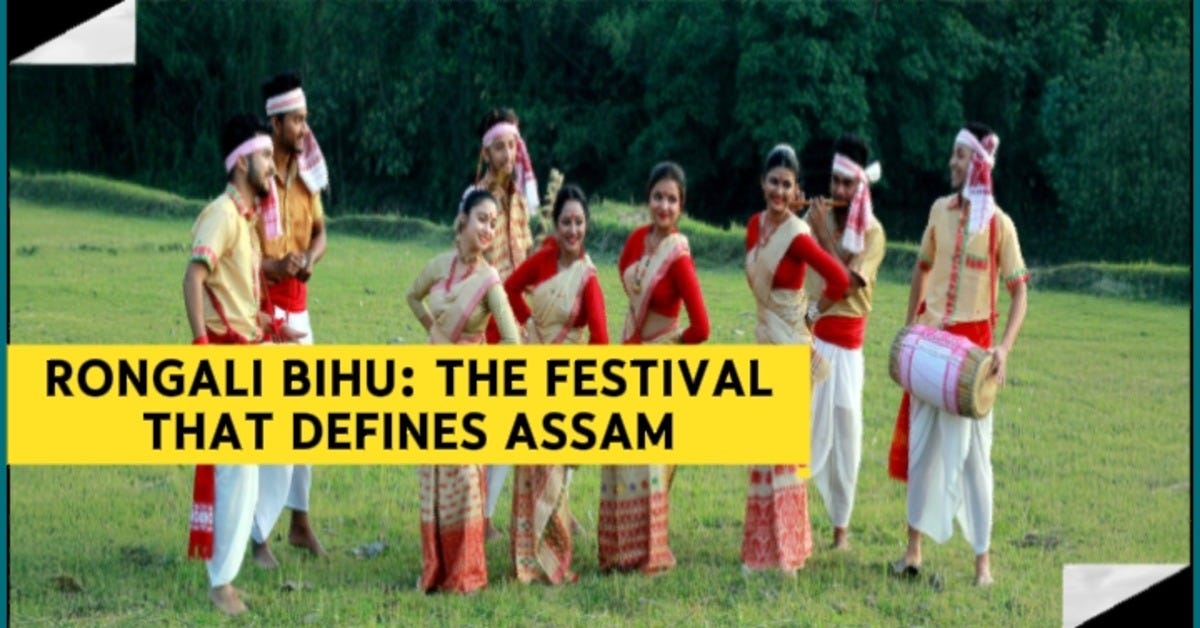
On Bohag Bihu 2026—the Assamese New Year festival marking the month of Bohag, also called Rongali Bihu for its festive colour and joy—an ancient tradition refuses to be anything less than itself.
By the time the kopou phool appears — the foxtail orchid, pale and trembling, clinging to the high branches of Simalu trees — everyone already knows. Something is coming. Not just a festival. Something older than that, something that moves through the bones of the valley before the calendar even thinks to confirm it.
Today is the fifteenth of April. The first day of Bohag. And Assam is, quite simply, alive.
[embed]
Goru Bihu Came First. It Always Does
Yesterday — April 14th — belonged to the cattle.
That might sound strange if you didn't grow up here. But in a civilization built on the rhythm of rice cultivation, the cow is not merely an animal. It is a partner, a co-author of the harvest. So on Goru Bihu, the last day of the Assamese calendar year, farmers across the Brahmaputra valley rise before dawn and lead their cattle to rivers and ponds. They scrub them with turmeric and black gram paste — halodhi aru maahor bori — and feed them gourds and brinjal: a kind of agricultural feast, a meal of gratitude.
Striking the animals gently with twigs of dighalati and makhiyati, they sing the old blessing: “Lao kha, bengena kha, bosore bosore barhi ja” — eat gourd, eat brinjal, and grow from year to year. A quiet prayer disguised as a song: live well, work well, stay with us one more season.
The same villages that now have smartphones and streaming services still walk their cows to the riverbank. Some things don't modernize. Some things shouldn't.
Today Belongs to the Living
Manuh Bihu — Human Bihu — marks April 15, the beginning of the Assamese New Year.
People bathe at dawn with black gram and turmeric paste, a cleansing that is both physical and symbolic, washing off the old year with something that smells of the earth. New clothes are non-negotiable. The mekhela chador for women — silk if possible, cotton if not, both equally dignified. And the gamosa, that unassuming white cloth with its red woven border, offered to elders, teachers and guests. In Assamese society, the gamosa is not ornament. It is respect made visible.
Families gather. Feet are touched in sewa. The Bihuwaan — the seasonal offering from the loom — passes between generations with quiet deliberation. It is a celebration that resists easy translation but lands with precision in memory and belonging.
And then, somewhere nearby — always nearby — the drums begin.
[embed]
The Dhol Doesn’t Ask Permission
The *dhol, the pepa*, the gogona. If you have never heard a pepa — a wind instrument fashioned from buffalo horn — cut through the humid April air of the valley, you are missing one of the subcontinent’s most distinctive soundscapes.
Bihu dance is not staged in its original form. It emerges. Young men and women in traditional attire move in formations that are joyful, energetic, and rooted in the rhythms of agrarian life. The footwork is grounded, insistent, alive. The Bihu geet — the songs — speak of love, longing, fertility, rain and seasons, often layered with metaphor and playful ambiguity.
The husori groups — once predominantly male, now often mixed — move from home to home through the night and into the morning, singing at doorsteps and receiving offerings. They are not performers in the commercial sense. They are carriers of seasonal goodwill.
What Rongali Bihu Actually Is (And Isn't)
Bohag Bihu is not a religious festival in the conventional sense. No single temple anchors it. No singular deity defines it. Its origins lie in indigenous agrarian traditions of the region — practices tied to land, cultivation and seasonal cycles — which were later absorbed into the broader cultural fabric of Assamese society.
It marks the Assamese New Year, but more fundamentally, it signals the beginning of the agricultural cycle. The fields are about to be worked, the soil turned, the year negotiated with nature. Bihu is how that transition is marked — with gratitude, with music, with collective renewal.
It is less an event one attends and more a rhythm one inhabits — something embedded in landscape, memory and community life.
2026 : The Festival Between Two Worlds
Across the past decade, Bohag Bihu has increasingly existed in two parallel forms.
In rural Assam — in Majuli, Dhemaji and across Upper Assam’s riverine plains and tea-growing regions — it continues largely as it has for generations : intimate, community-driven, lived rather than displayed. In urban centres like Guwahati, Jorhat and Dibrugarh, it has also taken on a performative dimension : organized Bihu sanmilan events, competitive stages and digital broadcasts connecting global Assamese communities.
Cultural traditions evolve — that is inevitable. Yet a quiet debate persists: whether Bihu is best preserved as lived experience or expanded as public spectacle. Both realities now coexist.
Across the Hills, Another Valley Blooms
While the Brahmaputra valley resonates with dhol and pepa, a parallel celebration unfolds to the south, across the Barail range, in the Barak valley. In the predominantly Bengali-speaking districts of Cachar, Hailakandi, and Sribhumi (erstwhile Karimganj), April 14–15 marks Pohela Boishakh — the beginning of the Bengali New Year, Bangla Noboborsho 1433 begins.
The Barak valley marks the day with visible collective energy. Prabhat pheri — early morning processions — move through cities like Silchar with songs and floral offerings. Melas spread across open spaces: handloom, pottery, sweets and local crafts. People wear new clothes, often in the traditional white-and-red palette associated with the Bengali New Year. Cultural programmes feature Rabindra Sangeet, folk traditions and community performances.
Food is central to the celebration: festive rice dishes, sweets and regional preparations shared across households and gatherings.
What stands out is the simultaneity. On the same mid-April day, separated by hills yet connected by seasonal cycles, two valleys within Assam mark the transition into a new year through distinct yet parallel cultural expressions.
[embed]
The Gamosa, the Xaaj, the Kopou Phool
Three elements, among many, define the texture of Bihu.
The gamosa remains a symbol of respect, hospitality and identity. Despite its occasional appropriation into political imagery, its deeper meaning remains rooted in everyday cultural exchange.
Xaaj — traditional rice beer — continues to be an integral part of celebrations among several indigenous communities of Assam. While not universal across all groups, it reflects the diversity embedded within the region’s cultural practices.
And the kopou phool — the foxtail orchid — blooms precisely at this time of year. Worn in the hair during Bihu, it reflects a seasonal synchrony between nature and culture that few festivals capture so precisely.
The Festival That Tells You Who You Are
Assam has navigated complex questions of identity, language and belonging over the decades. Through these shifts, Bihu has remained one of the most widely shared cultural anchors across communities in the Brahmaputra valley.
Often described as a lifeline of Assamese identity, Bihu is not merely a festival. It is continuity — linking land, labour, memory and collective expression.
Today, April 15th, 2026, under a sky characteristic of the Brahmaputra valley in spring, Assam marks its new year.
Not quietly. Not cautiously.
The dhol is playing somewhere. It always is▪️
메타데이터
- post_id
- a7efd8b59523
- slug
- this-is-assams-new-year-rongali-bihu-in-full-bloom-a7efd8b59523
- url
- https://medium.com/@jahansher/this-is-assams-new-year-rongali-bihu-in-full-bloom-a7efd8b59523
- canonical_url
- https://medium.com/@jahansher/this-is-assams-new-year-rongali-bihu-in-full-bloom-a7efd8b59523
- author_url
- https://medium.com/@jahansher
- status
- ok
- fetched_at
- 2026-06-15 20:49:13






