By 2026, Your AI Won’t Be a Chatbot. It’ll Be a Background Worker.
The model didn’t change. The product shape did. Here’s why every long-running AI workflow is moving off the chat interface.
By 2026, Your AI Won’t Be a Chatbot. It’ll Be a Background Worker.
The model didn’t change. The product shape did. Here’s why every long-running AI workflow is moving off the chat interface.
I’ve spent the last year building AI agents — an MCP server for Plane.so so AI assistants can manage project tasks directly, a Claude skill that drives my own finance CLI so “log $80 lunch” just works from a chat window, a few internal automation tools, half a dozen failed experiments. The kind of work where you discover, two days in, that the model was never the hard part.
So when people started saying “chatbots are dead” in 2026, my first reaction wasn’t agreement or disagreement. It was: what specifically are you claiming died?
The model didn’t die. GPT, Claude, Gemini — they’re better than ever. What died is the experience of opening a chat window, typing a prompt, waiting for an answer, and then doing the next nine steps of the actual work yourself.

The Part Nobody Talks About
For a year, I tried to build real work tools on top of chat interfaces. Here’s the pattern I kept seeing.
What chat-based AI looks like in a demo:
- User types a question
- AI gives a clean answer
- User is impressed
What chat-based AI looks like in real work:
- User types a question with too little context
- AI gives a generic answer
- User adds context, asks again
- AI gives a better answer
- User asks a follow-up — AI has forgotten the context from step 3
- User re-pastes the context
- AI suggests a tool — user has to leave the chat to actually run it
- User pastes the tool’s output back into chat
- AI summarizes
- User does the actual next step themselves
- Repeat. For every workflow. Forever.
That’s not an AI tool. That’s a really expensive autocomplete.
Each turn requires the user to do the orchestration. Each context switch loses state. Each tool call requires copy-paste across windows. The model is doing 10% of the work; the user is doing 90%. The “AI productivity gains” people post screenshots about are mostly gains on the first turn — and losses across every turn after.
I’ve lived this category of problem before, just at a different layer. At a previous role, I rebuilt a monolith into microservices — took a system from 100 concurrent users to over 1,000. The model code was never the hard part. The orchestration was: service discovery, state management, retries, observability. The boring scaffolding that lets the actual logic run reliably.
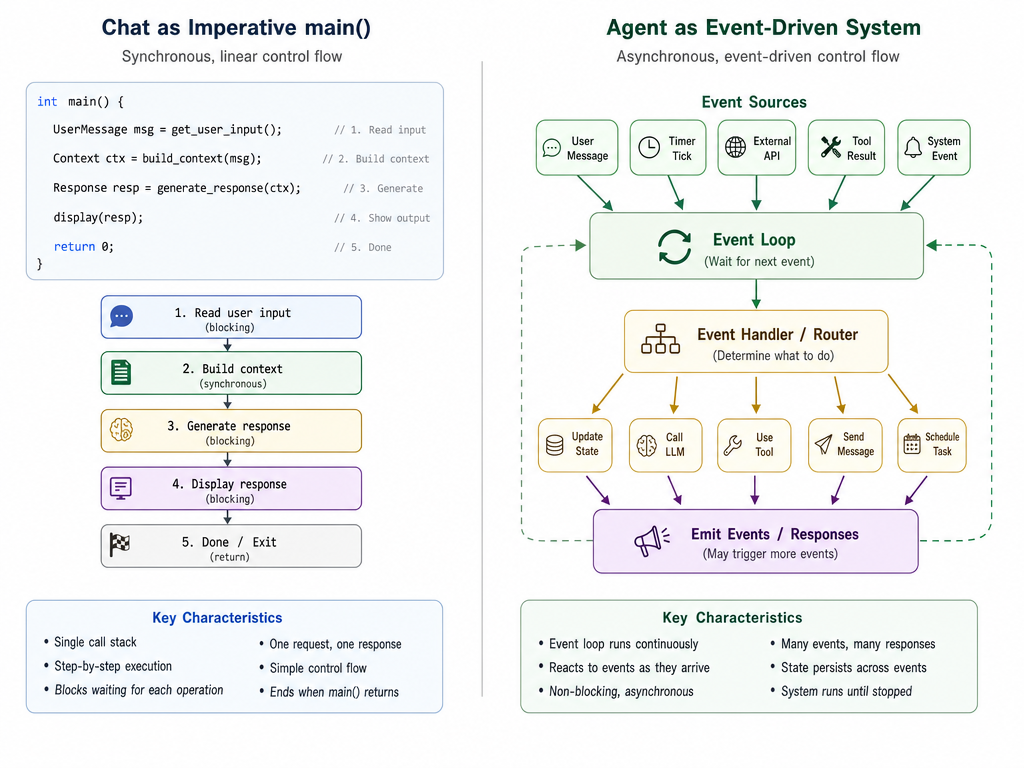
AI workflows have the exact same shape now. The “model” is the new “business logic.” The “chat interface” is the new “calling everything from one giant main() function." It worked for demos. It broke at scale.
What Worker Agents Actually Solve
Instead of listing features of any particular framework, let me frame this as the problems that shape eliminates:
Problem 1: “I have to babysit it”
In a chat product, the user is the orchestrator. They decide each next step, format each next input, paste each tool output back. The AI is reactive — it does what you ask, one turn at a time, and then waits.
A worker agent reverses this. You give it a goal — “find me the next 50 leads matching profile X and add them to my CRM” — and it executes the plan itself. Plans the steps, calls the tools, retries on failure, reports back when done.
The user goes from “doing all the orchestration through a chat interface” to “checking on results.”
Problem 2: “It forgets what we were doing”
Chat sessions have a context window. They have a memory horizon of however many tokens. Once you close the tab and come back, you’re starting fresh — or fighting the model to remember.
Background agents have persistent state by design: a database, a vector store, a session that lives server-side. The agent picks up where it left off, references its earlier work, and doesn’t ask you to re-explain the context for the seventh time.
This is the difference between “a brilliant colleague with amnesia” and “a colleague who keeps notes.”
Problem 3: “I can’t see what it actually did”
Chat output is the entire UX. If the model claims it did X, you have to trust it. If the output looks plausible, you ship it.
Worker agents — at least the well-built ones — emit events. Each tool call, file edit, decision step is logged and streamed. You go from “trust the answer” to “audit the work.” Same operational principle as observability in any distributed system: if you can’t see it, you can’t trust it.
Problem 4: “I can’t run it overnight”
Chat assumes a human-in-the-loop, in real time. You sit there. You wait for output. You react.
Worker agents can run scheduled, triggered by events (new email, new ticket, new commit), or as long-running daemons. The unit of work isn’t “a conversation” — it’s “a goal.”
This is the biggest UX shift hidden inside the trend: AI stops looking like a smart assistant you converse with, and starts looking like an employee whose Slack you check at end of day.
Problem 5: “Building this from scratch is a full engineering project”
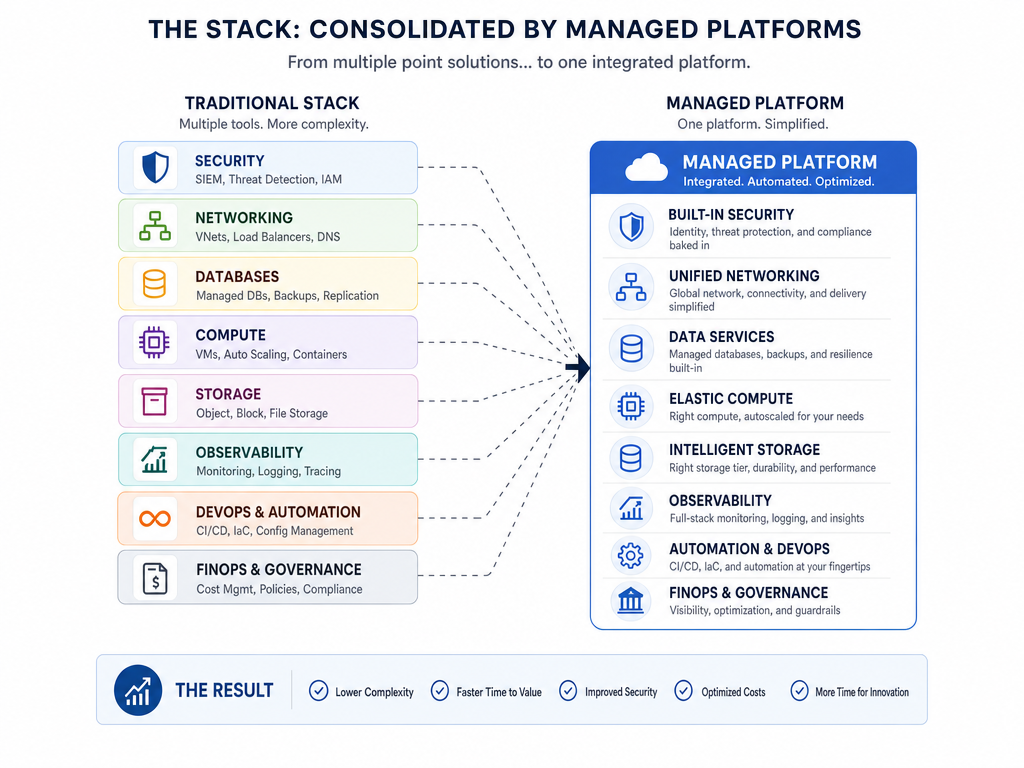
This is the part where the market is moving fastest. A year ago, building a production agent meant assembling: a model API, a sandbox, state management, observability, retry logic, tool routing, permission scoping, multi-agent orchestration. Each piece a separate vendor or hand-rolled.
In 2026, that stack is consolidating. Anthropic’s Managed Agents. OpenAI’s Agents SDK and Responses API. Claude Code’s headless mode. n8n’s AI nodes. Different bets, but all targeting the same gap: “stop building infrastructure, start building agents.”
If you’ve been on the fence about whether to invest in agent infrastructure yourself — the answer in 2026 is: don’t. Pick a managed stack and spend your engineering time on the actual workflow you’re trying to automate.
The Honest Caveats
I’d be doing you a disservice if I framed this as “chat is over.” It isn’t, and the trend is messier than the headline.
Chat is still the right UX for short, exploratory, ambiguous work. Drafting an email. Debugging a single function. Brainstorming a name. For 5-minute, human-paced, context-light tasks, the chat window is excellent. The death of chatbots is exaggerated; what’s dying is the attempt to do everything inside chat.
Worker agents fail differently — and worse. When a chat goes wrong, you see it immediately and correct. When an agent goes wrong at 3am, it might burn through a credit budget, send 200 misformatted emails, or quietly fail and never report. Production agents need real ops thinking from day one. Sandboxing, permissions, alerts, rollback. The same boring scaffolding I mentioned earlier — except now it’s load-bearing.
The first wave is already failing — but not for the reason you’d think. Gartner projects that over 40% of agentic AI projects will be canceled by the end of 2027, and the cited reasons aren’t “the model wasn’t good enough.” They’re escalating costs, unclear business value, and inadequate risk controls. That’s the same list of failure modes I’d give from production: couldn’t price the outcome, couldn’t safely scope permissions across systems, or scope-crept into an “AI everything-tool” with no specific workflow to anchor it.
The pure-autonomous version is still aspirational. “Set a goal and walk away” sounds clean, but most current agents need check-ins, mid-run steering, and partial human approval at decision points. We’re closer to “agents you supervise” than “agents you forget about.”
Meanwhile, in Hong Kong: The Implementation Gap
I should be honest about where I’m writing from. Hong Kong’s tech scene typically runs 12 to 18 months behind the US/SF on AI tooling adoption, and the lag is structural — not because people aren’t reading the same papers or watching the same launches, but because the gap between knowing about a thing and shipping it in production widens every time the technology moves.
Here’s roughly the timeline I’ve watched on the ground:
- A year ago, the overseas dev community was already mid-discussion on MCP (Model Context Protocol). In Hong Kong, the dominant “AI workflow” tool I’d hear about in meetings was still Poe.
- Six months ago, overseas builders were wiring up Skills and tool-calling pipelines for production workflows. Hong Kong teams were just starting their first serious MCP / tool-use proofs-of-concept.
- Now, while the global conversation has moved to background worker agents, most of what I see locally is still “let’s stick a chatbot on it.”
I want to be careful here. It’s not that people in Hong Kong don’t know. I’ve sat in rooms with smart product leaders at established firms — the kind of companies that have been around for decades — and also at the “we move faster than that” mid-tier players. They’ve read the same Anthropic blog posts. They’ve watched the same launches. They know “agent” is the next word after “chatbot.”
The gap isn’t knowledge. It’s implementation.
Even at the larger, more forward-leaning companies I’ve worked with, “Agent” mostly stops at the discussion stage. There’s no concrete plan for who owns the orchestration layer, where state lives, how permissions are scoped, what happens when the agent goes wrong at 3am, or what production observability looks like. The word Agent gets used in the slide deck; the architecture stays Chatbot.
I’d go further: when I ask people in those rooms what specifically distinguishes a real agent from a wrapped chatbot, very few can give me a crisp answer. And these are the people in the rooms where the budget gets allocated.
For a market that already runs 18 months behind, allocating 2026’s AI budget to chatbots is not a small mistake. It’s a missed cycle.
Who Should Care Right Now
If you’re building an AI product on top of chat, audit honestly: what fraction of your users’ workflow does your chat actually complete? If the answer is “we suggest the answer; they still do the work,” you’re a chatbot, and the market is moving past you. The product re-shape from “answer engine” to “task completion” needs to start now, not in Q3.
If you’re a SaaS team adding AI features, resist the urge to bolt a chatbox onto the sidebar. Pick one workflow your users currently do manually inside your product. Make that workflow run on its own when they kick it off. The chatbox is the easy answer; the workflow agent is the valuable one. Your competitors will ship chatboxes. You ship the workflow.
If you’re using AI agents personally, notice where you’re acting as the orchestrator between AI tools. Every “I asked GPT this, then took the output to Cursor, then pasted it into Notion” is a workflow that, by mid-2026, an agent should be handling end-to-end. The human-in-the-loop should exist because the human is genuinely the bottleneck — not because the tools never learned to talk to each other.
If you’re a non-technical founder, the entry barrier in 2026 is collapsing. Managed agent platforms plus low-code orchestration plus MCP-style integrations mean you can build “agent runs my workflow” without becoming an infrastructure engineer. This is a real window, and it doesn’t stay open forever — by 2027 the agent-building space will look like the SaaS space today: saturated, undifferentiated, expensive to enter.
If you’re operating in a market that runs behind on AI tooling — Hong Kong, much of Southeast Asia, plenty of mid-tier markets globally — there’s an asymmetric opportunity here. Your local competition is still debating whether to add a chatbot. Shipping a real worker-agent product into that environment buys you a first-mover lead that’s hard to find in saturated markets. The downside is making the wrong infrastructure bet; the upside is being 12–18 months ahead of every local competitor in your space.
The Bigger Picture
The “chatbots are dead” claim is wrong but pointing at something real.
The model didn’t change. What changed is the realization that you can’t build serious work on top of a single-turn Q&A interface. The chat UX was a debugging tool that escaped the lab. It looked productive because LLM outputs are impressive on their own. But “impressive output” and “completed work” are very different things — and the gap between them is exactly what worker agents are designed to close.
We’ve been through this kind of shift before. Hand-rolled CGI scripts gave way to web frameworks. Pet servers gave way to managed cloud. Manual deployments gave way to CI/CD. Each time, the underlying primitive didn’t change — what changed was the product shape that made the primitive useful at scale.
AI is doing the same shift right now. Same model, different shape. From “chat with me” to “do this for me.”
My honest take: the chatbot interface had a great run. It got LLMs into the hands of everyone, taught a generation of users to talk to machines, and made the technology feel real. But it was always a transitional UI, not a destination.
In 2026, the most valuable AI products won’t be the ones you chat with.
They’ll be the ones you barely notice — because they’re already done.
메타데이터
- post_id
- a8048631a320
- slug
- by-2026-your-ai-wont-be-a-chatbot-it-ll-be-a-background-worker-a8048631a320
- url
- https://medium.com/@tszhim_tech/by-2026-your-ai-wont-be-a-chatbot-it-ll-be-a-background-worker-a8048631a320
- canonical_url
- https://medium.com/@tszhim_tech/by-2026-your-ai-wont-be-a-chatbot-it-ll-be-a-background-worker-a8048631a320
- author_url
- https://medium.com/@tszhim_tech
- status
- ok
- fetched_at
- 2026-06-09 15:37:30



