The Threat of Antibiotic Resistance
Disclosure: I wrote this article and used AI as a “professional editor” to refine and shorten overly long or complicated sentences.
The Threat of Antibiotic Resistance
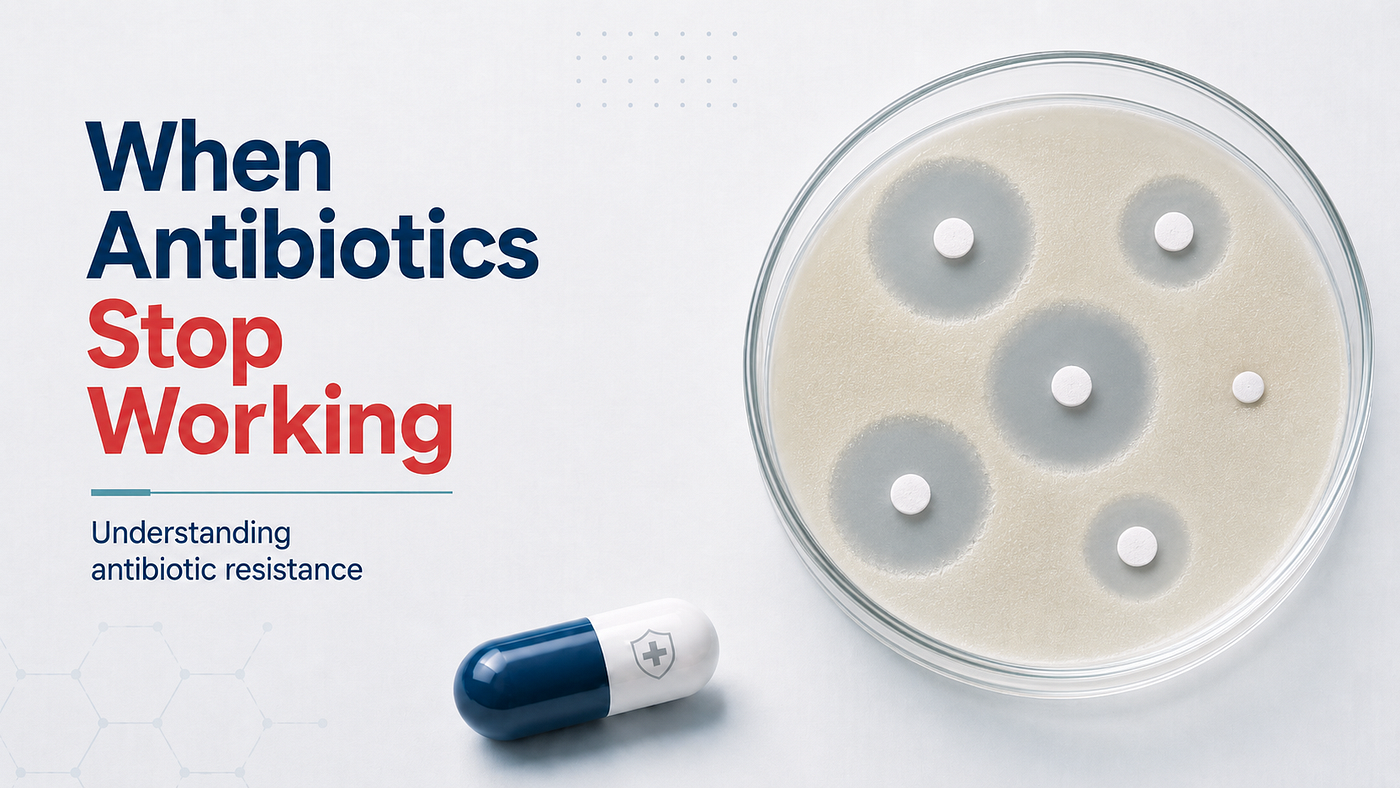
Image generated with the assistance of AI.
Disclosure: I wrote this article and used AI as a “professional editor” to refine and shorten overly long or complicated sentences.
.
It is easy to forget how dangerous life used to be. Around 1900, average global life expectancy was only about 30 to 35 years. That does not mean people rarely reached their 60s or 70s; the average was dragged down largely by high infant and child mortality. Many factors kept it low, including infectious diseases such as tuberculosis, pneumonia, influenza, and diarrheal illnesses, against which there was often no effective prevention or treatment.
Today, global life expectancy at birth is about 73 years. The reasons are many: cleaner water, safer food, better sanitation and workplace safety, improved nutrition, and advances in modern medicine. This article is about one of those medical advances in particular, one so successful that we now take it almost entirely for granted: antibiotics.
An antibiotic is a medicine that kills bacteria or stops them from growing. One thing is worth stating clearly at the outset: antibiotics work against bacteria, not viruses. They do nothing against the common cold or the flu, both of which are caused by viruses. (Spoiler: this turns out to matter a great deal, and we will come back to it below.)
.
History of Antibiotics
The discovery of penicillin is one of medicine’s most famous “chance discoveries.” In 1928, the Scottish bacteriologist Alexander Fleming noticed that one of his bacterial culture plates had been contaminated with mold. When he examined it, he saw that bacteria had failed to grow around the mold. The mold, a Penicillium species, was producing a substance he named penicillin.
It is worth noting that the idea of an antibacterial drug did not start with Fleming. Two decades earlier, Paul Ehrlich had developed Salvarsan, whose name combined the ideas of “salvation” and “arsenic.” This arsenic-based synthetic drug became the first effective treatment for syphilis, a bacterial disease. In the 1930s, Gerhard Domagk showed that a class of compounds called sulfonamides could treat bacterial infections in patients, making them the first antibacterial drugs to be used widely. These early drugs were lifesaving, but they could also cause serious side effects, with Salvarsan being particularly toxic.
Against this background, Fleming’s penicillin stood out: it attacked bacteria while leaving the body’s own cells largely unharmed. Even so, it took another decade, and the work of Howard Florey and Ernst Chain, to turn penicillin into a medicine that could be purified and mass-produced to save patients’ lives. The three men shared the Nobel Prize in 1945.
After Fleming’s discovery that a Penicillium mold produced an antibiotic, scientists began searching other microbes — especially those living in soil — for similar compounds. This opened the “golden age” of antibiotic discovery, from the 1940s to the 1960s, when most of the antibiotic families we still rely on were found.
Strikingly, these antibiotics were not really invented by researchers; they were borrowed from nature. Bacteria and fungi have been waging chemical warfare on one another for billions of years, and we simply learned to put their weapons to use.
As always in this series, the explanation is intentionally simplified. I will often say that antibiotics “kill” bacteria. Some do; others mainly stop bacteria from growing, giving the immune system time to clear the infection. It is a useful distinction, even if I do not repeat it every time.
.
The Good and the Bad
Antibiotics work by attacking structures or processes of a bacterium that human cells either lack or build differently, such as the bacterial cell wall or the machinery used to make proteins. This allows antibiotics to act on bacteria selectively, while largely sparing our own cells.
Antibiotics made bacterial pneumonia, sepsis, and infected wounds far more treatable. They also made surgery, organ transplantation, cancer chemotherapy, and childbirth much safer by controlling infections that could otherwise be life-threatening.
But why, then, do antibiotics have side effects?
Many antibiotics are “broad-spectrum,” meaning they kill a wide range of bacteria at once. That is useful when you do not yet know exactly what you are treating, but it also means that antibiotics kill helpful bacteria in our bodies, including the vast, beneficial communities living in our gut. Disrupting these bacterial communities can cause diarrhea, one of the most common side effects of antibiotic use, and can also open the door for more dangerous microbes to move in. Although antibiotics target bacteria rather than human cells, they often kill both the good bacteria and the bad.
.
The Fall of Antibiotics?
If antibiotics are so powerful, why are health professionals concerned that we are losing one of our most effective defenses against bacterial infections?
First, each antibiotic works against a particular range of bacteria, while other bacteria may be naturally unaffected by it. Second, bacteria can become resistant through changes in their own DNA or by acquiring resistance genes from other bacteria through a process called horizontal gene transfer. In other words, bacteria can share resistance genes with one another.
What does this mean in practice?
To treat a bacterial infection successfully, the chosen antibiotic must work against the bacterium causing the infection, and that bacterium must still be susceptible to it, meaning it is not resistant to that antibiotic. Unfortunately, resistant strains are becoming increasingly common, sometimes leaving only a few effective drugs, or none at all.
Why are resistant strains more common?
Resistant strains become more common through natural selection. When an antibiotic is used, resistant bacteria are more likely than susceptible bacteria to survive, multiply, and spread. This does not mean that antibiotics should be avoided when they are needed; the correct antibiotic can still successfully eliminate an infection caused by susceptible bacteria.
Imagine a bacterial population in which only a few bacteria carry a resistance gene. Without the relevant antibiotic present, that gene may provide little benefit and can even be a small burden, so the resistant bacteria may remain rare or be outgrown by the rest of the population. When the antibiotic is present, however, resistance becomes an advantage: susceptible bacteria are killed, while resistant bacteria survive and multiply.
Unnecessary or poorly targeted antibiotic use therefore repeatedly creates conditions that favor resistant bacteria. Examples include prescribing antibiotics for viral infections, using broad-spectrum drugs when a more targeted treatment would be sufficient, and routinely giving them to healthy livestock.
The result is that infections once considered easily curable are becoming dangerous again. Gonorrhea is increasingly difficult to treat, tuberculosis has developed multidrug-resistant forms, and common urinary, respiratory, and bloodstream infections increasingly involve resistant bacteria.
Bacteria that resist several antibiotics at once are known as multidrug-resistant organisms (MDROs), or, in everyday language, “superbugs.” The most famous is MRSA (methicillin-resistant Staphylococcus aureus), but it is only one of many. Clinicians often group the most threatening species under the acronym ESKAPE, and describe resistance in escalating tiers: multidrug-resistant (MDR), extensively drug-resistant (XDR), and, in the worst cases, pandrug-resistant (PDR), meaning almost no antibiotic works. Especially worrying are resistant gram-negative bacteria, which are harder to treat and increasingly force doctors to fall back on “last-resort” antibiotics they would prefer to keep in reserve.
The encouraging news is that resistance can be slowed. One of the most important steps is also one of the simplest: using antibiotics more carefully.
.
Antibiotic Stewardship
That approach is called antibiotic stewardship: using antibiotics only when they are truly needed and choosing the right drug, dose, route, and duration. In practice, that means not prescribing antibiotics for viral illnesses, choosing a narrow-spectrum drug when the specific bacterium is known, and relying on good diagnostics to confirm what is actually being treated rather than reaching for antibiotics “just in case.”
It works at every level. Hospitals run programs to review prescriptions and prevent infections through strict hygiene and infection-control practices; agriculture can reduce the routine use of antibiotics in healthy animals; and vaccines help by preventing infections before they start.
Even with careful use, though, resistance will keep emerging, so researchers are also working on genuinely new ways to fight back. Two of the most striking sit at opposite ends of the technological spectrum.
.
Antibiotics Designed with Artificial Intelligence
The “golden age” of antibiotic discovery is long gone, and many of today’s “new” drugs are variations of existing antibiotics, against which bacteria may already have a head start on resistance. What is needed are entirely novel antibiotics, with new chemical structures and new ways of working.
Artificial intelligence may help find them. AI models can screen enormous libraries of molecules and identify promising candidates that human researchers might overlook. In 2020, researchers at MIT used this approach to identify halicin, a structurally unusual compound with antibacterial activity. More recently, the same team went a step further: in 2025 they used generative AI to design entirely new molecules from scratch, and the most promising were able to kill drug-resistant gonorrhea and MRSA in the laboratory and in mice.
I explored how AI identified halicin, and what this example tells us about the wider use of AI in biotechnology, in a separate article: *A Sneak Peek into Artificial Intelligence in Biotechnology.*
.
Bacteriophages: Viruses That Kill Bacteria
Another approach is borrowing from nature, again. The idea is to fight a bacterial infection with a virus that infects bacteria. These viruses are called bacteriophages, or phages.
What makes phages appealing is their precision. A phage usually targets only a narrow range of bacteria, so it can attack a dangerous pathogen while sparing helpful bacteria. Just like human viruses, phages self-replicate inside their target bacteria, so phage treatment can also be self-amplifying. The disadvantage (at least for now) is that clinicians usually have to identify the exact bacterium causing the infection and match it to the right phage. A broad-spectrum antibiotic is simpler to use in that respect.
Therapeutic phages are not actually a new approach: the first reports of treating patients with phages go all the way back to 1919. The method faded in the West once antibiotics arrived, though it continued in parts of Eastern Europe, and it has drawn renewed attention over the past two decades as resistance has worsened. There are striking individual success stories, often in patients who had run out of other options, but rigorous clinical trials have so far produced mixed results, and researchers are still working to establish where phage therapy truly helps. Like AI-designed antibiotics, it is not a magic replacement for the drugs we have, but a promising addition to a shrinking arsenal, and a reminder that some of the best ideas for the future may be rediscovered from the past.
.
Closing Thoughts
New tools take years to reach patients, and bacteria can eventually evolve resistance to them too, just as they did against penicillin. One measure that helps preserve the antibiotics we have, old or new, is using antibiotics wisely. Stewardship is absolutely key.
Beating resistance will take all of these approaches together: careful use first, supported by new antibiotics, phages, vaccines, and better diagnostics.
.
If you’d like to keep reading:
Subscribe to my newsletter on **Substack** (free, email delivery)
If you’d like to follow my work professionally (and read articles there as well):
Connect with me on **LinkedIn**
If you find this writing useful and want to support independent science communication:
You can support my work on **Patreon** (optional)
메타데이터
- post_id
- a80a8b6d989c
- slug
- the-threat-of-antibiotic-resistance-a80a8b6d989c
- url
- https://medium.com/@scienceworthknowing/the-threat-of-antibiotic-resistance-a80a8b6d989c
- canonical_url
- https://medium.com/@scienceworthknowing/the-threat-of-antibiotic-resistance-a80a8b6d989c
- author_url
- https://medium.com/@scienceworthknowing
- status
- ok
- fetched_at
- 2026-07-16 01:10:58