ALDOUS HUXLEY: The Man Who Saw the Cage Before It Was Built
He predicted mass pharmaceutical control in 1932, coined the reducing valve theory that explains every psychedelic experience, inspired Jim…
ALDOUS HUXLEY: The Man Who Saw the Cage Before It Was Built
He predicted mass pharmaceutical control in 1932, coined the reducing valve theory that explains every psychedelic experience, inspired Jim Morrison, advised Timothy Leary, and died tripping on LSD the same afternoon Kennedy was shot while the world looked away.

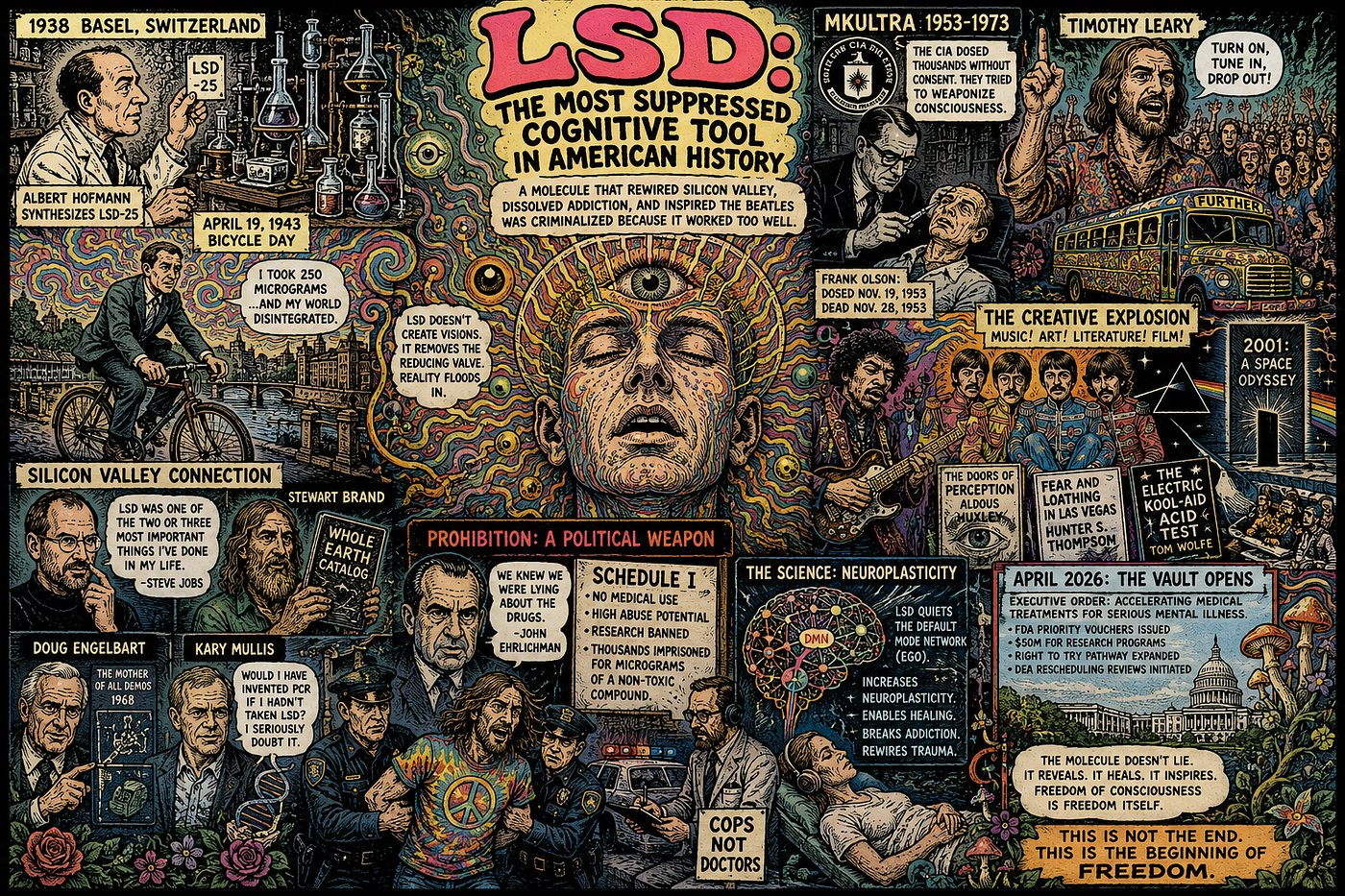
Image created by Author via ChatGPT / Prompted by Abel Arroyo
On November 22, 1963, at 11:45 in the morning, Laura Huxley administered an intramuscular injection of 100 micrograms of LSD to her husband, who was lying in bed in their Los Angeles home dying of throat cancer and no longer able to speak. He had written the request on a notepad in a steady hand: LSD, 100 µg, intramuscular. She gave him a second injection a few hours later. She whispered to him as the drug took hold: go forward and up, darling. You are going forward and up. You are going toward the light. At 5:21 PM, Aldous Huxley died. By then John F. Kennedy had been pronounced dead in Dallas at 1:00 PM, and the entire global media apparatus had collapsed into coverage of the assassination. C.S. Lewis died the same afternoon. Three of the most significant intellectual figures of the twentieth century left the world on the same day, and only one of them took most of the oxygen. Aldous Huxley, the man who predicted the pharmacological management of human consciousness in 1932, died on LSD, in the same year his final novel described a society that used psychedelics to help its citizens die without fear, while the world was too distracted by sudden violence to notice. He had been predicting exactly that kind of distraction for thirty years.
THE ORIGIN STORY
Aldous Leonard Huxley was born on July 26, 1894 in Godalming, Surrey, into one of the most intellectually formidable families in England. His grandfather was Thomas Henry Huxley, the biologist known as Darwin's Bulldog for his ferocious public defense of evolutionary theory at a time when it cost careers. His father Leonard Huxley edited the Cornhill Magazine. His brother Julian became one of the most celebrated biologists of the twentieth century, the first Director General of UNESCO, a founding member of the World Wildlife Fund, and eventually a knight of the realm. His younger brother Andrew won the Nobel Prize in Physiology and Medicine in 1963 for his work on nerve impulse transmission and was also knighted. The Huxley family viewed the world through the lens of evolutionary science. They saw populations and biological trends rather than individuals. This perspective shaped Aldous from his earliest years.
Tragedy arrived early and precisely calibrated to sharpen his analytical distance. His mother Julia died of cancer in 1908 when he was fourteen, stripping him of the primary emotional anchor of his childhood. Three years later, at seventeen, he contracted keratitis punctata, a severe inflammation of the cornea that left him nearly blind for three years and permanently damaged his eyesight. He could not serve in the First World War. He could not become a laboratory scientist like his brothers. His physical limitation closed the door to the empirical sciences and drove him into literature, where he learned to see the world not through instruments but through patterns and ideas. He read Braille during the worst years. He used a powerful magnifying glass for decades afterward. His detachment from the visual world created a hyper-focus on the conceptual. He was an observer who could not fully participate in the chaos he was analyzing, which made his analysis precise in a way that full participants rarely achieve.
He attended Eton College and then Balliol College at Oxford, where he studied English literature with first class honors, graduating in 1916. At Oxford he encountered the Bloomsbury Group and became a regular visitor to Garsington Manor, the home of Lady Ottoline Morrell, where the ruling intellectual class gathered to discuss ideas and display themselves. He watched them carefully. He began writing satirical novels, Crome Yellow in 1921 and Antic Hay in 1923, that dissected the post-war disillusionment of the British elite with forensic precision. He was sharpening his tools. The target he was preparing for required better ones.
He was nominated for the Nobel Prize in Literature nine times. He never won. He turned down a knighthood from the Royal Family, unlike both of his brothers. These two facts, the repeated failure to receive the establishment's highest literary recognition and the deliberate refusal of its most personal honor, define the position he chose to occupy: close enough to the center of power to understand it precisely, far enough outside it to describe it honestly.
THE TURNING POINT
The definitive shift in Huxley's understanding of where history was going occurred in the late 1920s when he traveled extensively through the United States and observed the Ford assembly lines in Detroit. He recognized that the factory model was not merely an economic innovation. It was a template for the management of human beings. He returned to Europe and began writing Brave New World in four months of intense labor in 1931, publishing it in 1932. The novel is not science fiction in any meaningful sense. It is a projection of existing trends in eugenics, behavioral psychology, and pharmaceutical development onto the near future. The society it describes controls its population not through violence but through pleasure, not through surveillance but through conditioning, and not through deprivation but through a drug called Soma that makes citizens content with their servitude. Huxley did not invent these ideas. He identified them in the existing trajectory of the civilization he had been observing since childhood and followed them to their logical conclusion.
He moved to Los Angeles in 1937, seeking a climate favorable to his failing eyesight. He also wanted proximity to Hollywood, which he recognized as the most powerful conditioning apparatus the modern world had yet produced. He worked as a screenwriter at MGM, writing the script for Pride and Prejudice in 1940 and an early version of Jane Eyre in 1943. The work gave him direct access to the mechanics of narrative persuasion at industrial scale. He saw how the dream factory could replace reality for millions of people simultaneously. He saw how people could be made to prefer the representation of life to the experience of it. This observation solidified his theories on what he called soft power, the management of behavior through desire rather than fear.
His first mescaline experience on May 4, 1953 at his Los Angeles home, administered by British psychiatrist Humphry Osmond who had been researching psychedelic substances in Canada, did not produce hallucinations. It produced something more precise. The ordinary world became saturated with miraculous beauty. A vase of flowers on his desk became so visually overwhelming that he spent extended time simply observing it. He understood immediately that he was not seeing anything that was not there. He was seeing what had always been there, stripped of the filtering process that normal consciousness imposes on sensory data. This was the empirical confirmation of a theory he had been developing intellectually for years. The brain as a reducing valve. A system that filters out the overwhelming majority of available sensory information in order to maintain a manageable, survival-oriented model of reality. Mescaline had opened the valve. He published the account in The Doors of Perception in 1954, documented with the clinical precision of a researcher rather than the enthusiasm of a convert.
The title came from William Blake: if the doors of perception were cleansed, everything would appear to man as it is, infinite. The book reached Timothy Leary and Richard Alpert at Harvard. It reached Allen Ginsberg. It reached a young musician in Los Angeles named Jim Morrison, who named his band after it. Humphry Osmond, the psychiatrist who supervised Huxley's first mescaline session, coined the word psychedelic in a letter to Huxley specifically, in 1957, derived from the Greek psyche, meaning mind, and delos, meaning manifest. The word that now defines an entire cultural and scientific field was coined in a private correspondence between two men trying to describe something they were discovering together.
THE BODY OF WORK
Huxley's output was massive, nearly fifty books across six decades, but his most forensically significant documents fall into three categories.
The first is his dystopian analysis. Brave New World in 1932 established the template. Brave New World Revisited in 1958 is the more important document for 2026 because it is Huxley auditing his own predictions twenty-six years after making them and finding that reality had caught up faster than he anticipated. He analyzed the techniques of propaganda deployed by both democratic and totalitarian regimes. He named the specific psychological vulnerabilities exploited by advertisers and politicians. He identified what he called the propaganda of silence, flooding the environment with irrelevant information so that truth becomes invisible in the noise. He wrote about over-organization, the process by which increasing technological complexity makes the individual progressively less relevant. He predicted that the expert class, the technicians and bureaucrats who manage populations for their own good, would become the primary instrument of soft totalitarianism. The digital information environment of 2026 is the literal implementation of his 1958 analysis.
The second category is his psychedelic research. The Doors of Perception in 1954 documented the mescaline experience. Heaven and Hell in 1956 extended the analysis to the neurological underpinnings of visionary experience across cultures, arguing that the brain's reducing valve was the common mechanism behind mystical states achieved through drugs, fasting, meditation, and extreme physical conditions. In essays and lectures through the late 1950s and early 1960s, he argued with increasing specificity that consciousness-altering substances administered in the right psychological environment with proper preparation and guidance could produce genuine therapeutic and spiritual transformation. He was the first person to articulate what the psychedelic therapy movement of 2026 now calls set and setting in systematic terms.
He became an advisor to Timothy Leary and Richard Alpert during their early Harvard research. He attended some of their sessions. He reviewed their protocols. He grew increasingly concerned about what he called Leary's indiscriminate enthusiasm, his willingness to advocate mass consumption of these substances without adequate preparation or guidance. He distanced himself from Leary publicly while maintaining a private correspondence. He believed the compounds were tools of extraordinary precision that required extraordinary care, and that turning them into a cultural fashion would damage both the tools and the people using them. The subsequent history suggests he was correct.
He also influenced, perhaps unexpectedly, Bill Wilson, the co-founder of Alcoholics Anonymous, who experimented with LSD in the 1950s while searching for a spiritually catalytic experience that could replicate and potentially replace the religious conversion that had ended his own drinking. Huxley's framework for understanding the psychedelic experience as a doorway to genuine transcendence rather than mere intoxication directly informed Wilson's thinking. The connection between the man who predicted pharmacological social control and the man who built the most influential sobriety movement in American history, mediated by a molecule, is one of the great uncovered stories of twentieth-century intellectual history.
The third category is his utopian vision. Island, published in 1962, was his final novel and his most direct attempt to articulate what a sane society would look like. Where Brave New World showed a society that used pharmacology as a tool of oppression, Island showed a society called Pala that used a psychedelic substance it called moksha-medicine as a tool of genuine liberation, specifically to help citizens understand their own psychology, reduce unnecessary suffering, and confront mortality with equanimity rather than terror. In one of the novel's central scenes, the moksha-medicine is administered to a dying woman to help her cross the threshold of death without fear. Huxley wrote this scene in 1962 while he himself was already living with the knowledge of his oral cancer diagnosis from 1960. He was writing a manual for his own death.
He corresponded extensively with the leading minds of his era. His 1949 letter to George Orwell, written after reading the manuscript of Nineteen Eighty-Four, is one of the most important documents in the history of political thought. He argued that Orwell's vision of the future, a boot stamping on a human face forever, was less likely to prevail than his own, because violence is inefficient and expensive while pleasure is cheap and self-perpetuating. He wrote: the lust for power can be just as completely satisfied by suggesting people into loving their servitude as by flogging and kicking them into obedience. He bet on the carrot while Orwell bet on the stick. The available evidence of 2026 suggests Huxley won the argument.
He also maintained a decades-long correspondence with Albert Hofmann, the Swiss chemist who synthesized LSD, exchanging letters about the nature of consciousness, the therapeutic potential of psychedelic compounds, and the institutional obstacles to their clinical development. He wrote to Humphry Osmond regularly about the science of altered states. He wrote to Timothy Leary about the protocols for safe and meaningful psychedelic sessions. His correspondence forms a primary source archive for the intellectual history of the entire psychedelic research field.
THE TRAGEDY
The personal cost of Huxley's foresight was a permanent sense of alienation from the very civilization he was trying to warn. He was too far ahead to be comfortable company. He was consistently mischaracterized in the mainstream press as a drug advocate when he was in fact a researcher of consciousness who viewed both the therapeutic potential and the totalitarian risk of pharmacological intervention with equal analytical seriousness. His warnings about the misuse of consciousness-altering compounds were as specific and as urgent as his arguments for their legitimate therapeutic application. Both warnings were largely ignored.
His first wife Maria Nys, with whom he had lived for nearly three decades and who had been his primary personal support, died of cancer in 1955. He married Laura Archera in 1956, a trained classical musician and psychotherapist who would become the primary witness to and participant in the final decade of his life, including the LSD sessions that punctuated his late years and the final morning on which she administered the drug that carried him out of the world.
In 1960, he was diagnosed with oral cancer. For the next three years his health declined while his mind remained fully operational. He continued writing, corresponding, and lecturing. In November 1963, bedridden and no longer able to speak, he was still reading and communicating in writing with Laura in the days before his death. On the morning of November 22, unable to reach the notepad on his first attempt, he tried again and wrote the request clearly: LSD, 100 µg, intramuscular. Laura consulted Sidney Cohen, a psychiatrist who had been researching LSD clinically, who told her he had administered the drug to dying patients twice before and in one case had produced what appeared to be a genuine reconciliation with death. She administered the first injection at 11:45 AM.
Half an hour later she asked if he felt the effect. He indicated no, which she recognized as his characteristic tendency to deny or delay acknowledging pharmacological effects. As the drug took hold his facial expression shifted. She administered a second dose a few hours later. As he died she whispered: go forward and up, darling. You are going forward and up. You are going toward the light. At 5:21 PM he died peacefully. Laura later wrote in an eight-page letter to Julian and his wife Juliette that Aldous had left willingly and consciously and beautifully. The nurses and doctors had been watching television coverage of the Kennedy assassination. When she went to get the LSD from the medicine cabinet, she found them gathered around the screen. The world was watching a president die in Dallas while one of its greatest minds was departing Los Angeles on a molecular journey he had spent a decade preparing for.
C.S. Lewis also died that afternoon. Three extraordinary intellects left on the same day. The news cycle had room for exactly one.
THE LEGACY AND THE VAULT
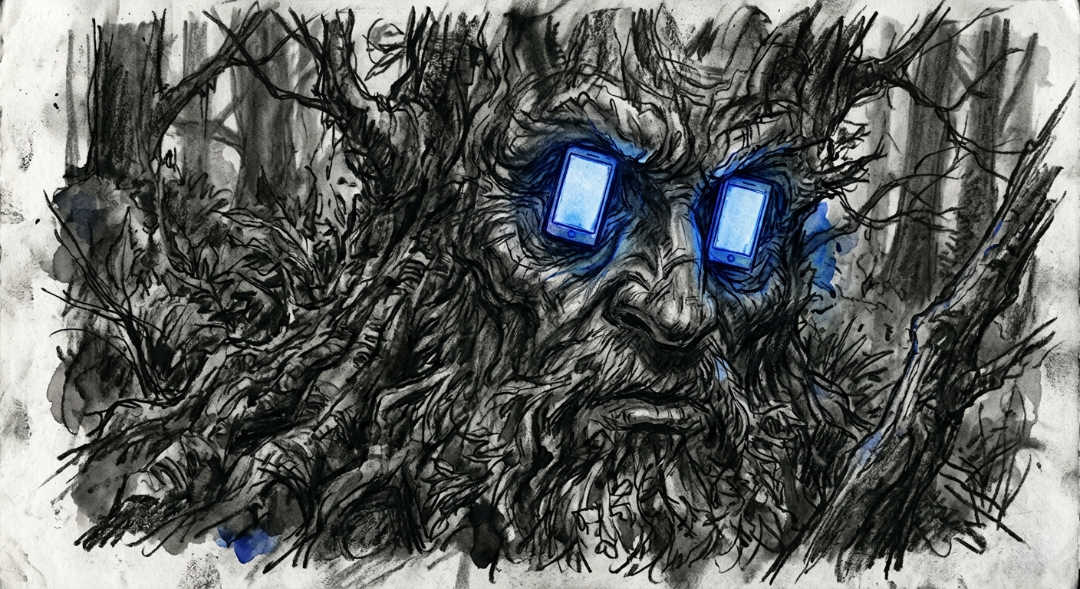
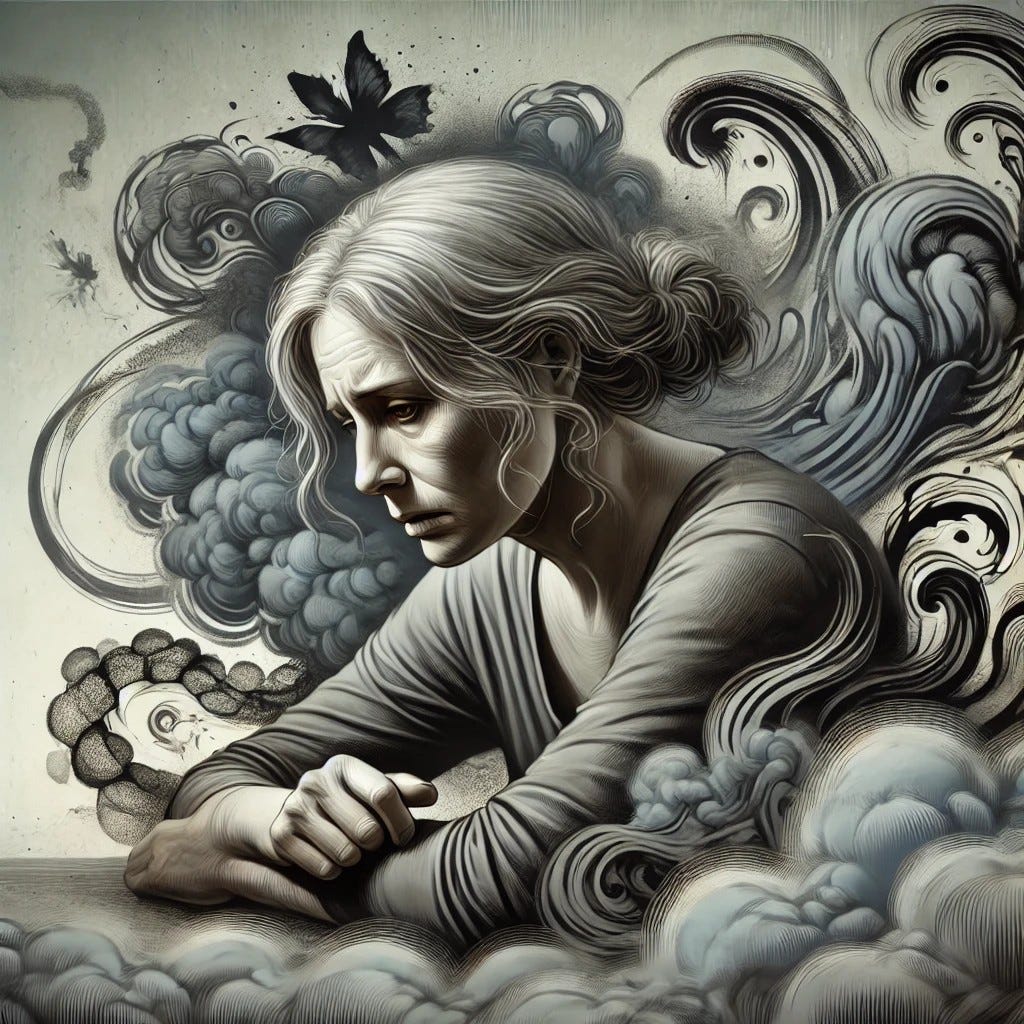
In 2026 the Huxleyan model is not a warning. It is the operating system. The Brave New World is the status quo. The Bokanovsky Process, the mass production of genetically standardized humans, is visible in CRISPR gene editing and the first edited children who are now eight years old with no legal framework protecting their altered genomes. The Feelies, the immersive sensory entertainment designed to prevent genuine thought or feeling, are visible in virtual reality environments and the average eight hours per day of digital content consumption that the global population now maintains. Soma, the happiness drug that prevents citizens from experiencing negative emotions long enough to notice anything wrong, is visible in the global antidepressant market, the most widely prescribed class of drugs in human history, consumed by hundreds of millions of people in the same year that the Trump administration issued an executive order accelerating psychedelic medicine development. The management of human behavior has moved from the external to the internal. The state does not need to watch you when it can regulate your serotonin levels.
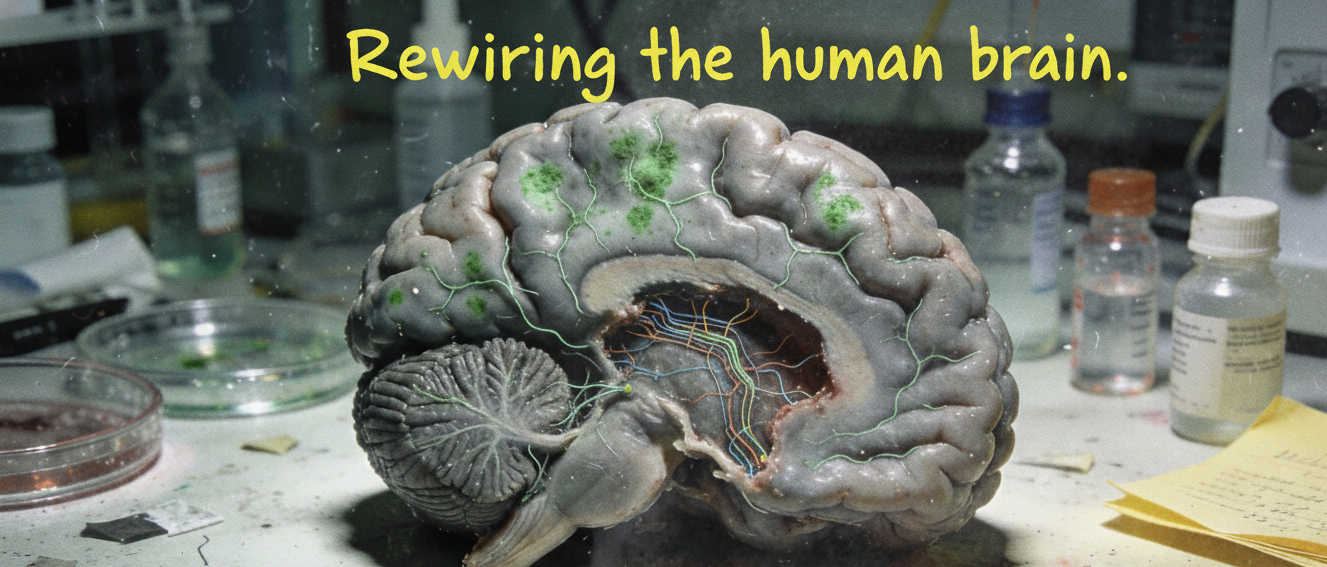
The Huxley archive at the University of California, Los Angeles contains thousands of pages of unpublished notes, letters, and manuscripts. The correspondence with Hofmann, Osmond, Leary, and Alpert alone constitutes one of the most significant primary source collections in the history of consciousness research. His final novel Island remains in print as a blueprint for a sane society that has never been implemented. His reducing valve theory, which he articulated in The Doors of Perception in 1954 before neuroscience had the tools to verify it, has now been confirmed by fMRI studies showing that psychedelic compounds decrease Default Mode Network activity and increase connectivity between brain regions that normally do not communicate. The science caught up with the metaphor seventy years later.
Jim Morrison named his band after Huxley's book. Timothy Leary built his research program on Huxley's framework. Bill Wilson explored LSD as a sobriety catalyst through Huxley's thinking. Albert Hofmann corresponded with him for decades. Richard Alpert, who became Ram Dass, co-wrote the foreword to The Joyous Cosmology, a book that carries the direct imprint of Huxley's influence on the entire psychedelic generation. Every piece in the Golden Gems psychedelics catalog, from McKenna to Leary to Shulgin to Ram Dass to Watts, operates within a framework that Aldous Huxley built in a Los Angeles living room in the spring of 1953 when a British psychiatrist gave him mescaline and he saw that his vase of flowers contained more information than he had previously believed the entire universe to hold.
He received two LSD injections on the afternoon of November 22, 1963, and left the world at 5:21 PM while the global media covered a different death. Laura whispered him forward. The nurses were watching television. The cage he had spent thirty years describing had, by then, largely been built. He had seen it coming in 1932 and spent the rest of his life trying to show people the door.
What does it mean that the man who predicted the pharmacological management of human consciousness with enough precision that his 1932 novel reads as a 2026 technical manual was never given the Nobel Prize, turned down a knighthood, died on the same afternoon as a president while the world watched the president, and that the reducing valve theory he articulated in 1954 from personal mescaline experience was not confirmed by neuroscience until seventy years later when it was too late for him to know he had been right all along?
About the Author
Abel Arroyo is a cultural critic and forensic biographer dedicated to the Intellectual Resistance, the creators, whistleblowers, and truth tellers who broke the machine to save their souls. His work interrogates the intersection of power, suppressed knowledge, and human cost, providing rigorous examination of the systems and figures that define how we understand existence. If you find value in these deep dives into the architects of modern dissent, consider supporting independent journalism. buymeacoffee.com/dathaze20j
메타데이터
- post_id
- a80e3e737a7a
- slug
- aldous-huxley-the-man-who-saw-the-cage-before-it-was-built-a80e3e737a7a
- url
- https://medium.com/illumination-philosophy-and-metaphysics/aldous-huxley-the-man-who-saw-the-cage-before-it-was-built-a80e3e737a7a
- canonical_url
- https://medium.com/illumination-philosophy-and-metaphysics/aldous-huxley-the-man-who-saw-the-cage-before-it-was-built-a80e3e737a7a
- author_url
- https://medium.com/@dathaze20
- status
- ok
- fetched_at
- 2026-07-15 01:23:23