The Role of Generative AI Companies in Enterprise Automation
Generative AI companies develop models, integration layers, and governance frameworks to enable businesses to automate complex tasks rather…
The Role of Generative AI Companies in Enterprise Automation
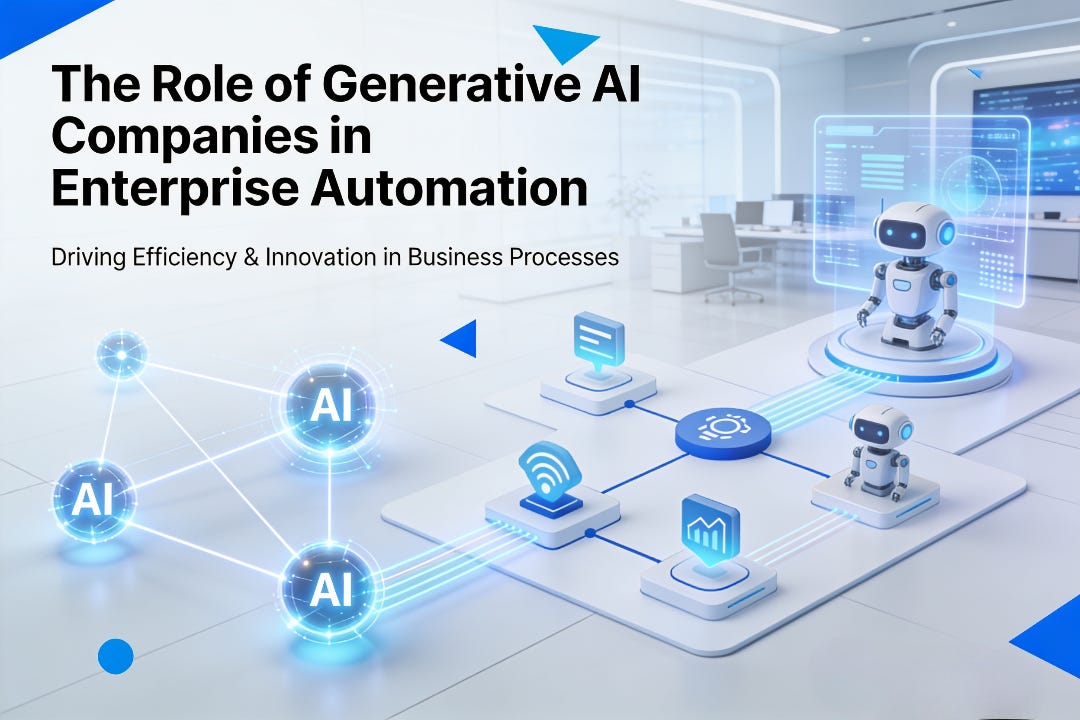
Generative AI companies develop models, integration layers, and governance frameworks to enable businesses to automate complex tasks rather than repetitive ones. They help to transition from rule-based bots to robots that read documents, write responses, make decisions and take actions in tied-in applications. Generative AI is no longer a side experiment but now a part of the way enterprises operate in 2026.
What Do Generative AI Companies Do in Enterprise Automation?
A **generative AI development company** is responsible for creating, constructing, and deploying AI systems that make decisions within business operations. Their primary duties are to:
- Model selection and fine-tuning to the company’s data, terminology and rules.
- Generative AI Integration Services that integrate models with CRMs, ERPs, ticketing systems, and internal databases.
- Workflow design to determine where AI can operate independently and where a human should review output
- Governance and monitoring to track accuracy, cost and compliance when systems are in production.
The outcome is Generative AI solutions that turn unstructured data, such as emails, contracts, or support tickets, into structured actions that are then executed by the systems.
How Generative AI Differs From Traditional Automation
Older automation relies on “rules” that are set in stone. Robotic Process Automation (RPA) copies and fills fields, but it is broken when inputs are variable or documents don’t have structure. Generative AI understands context and interprets ambiguity.
The majority of businesses in 2026 use a mix. Differences between AI and RPA: AI understands the request and determines the action; RPA performs the action between systems. This “hyperautomation” allows businesses to automate entire processes previously divided among disparate teams.
Generative AI Trends Shaping Enterprise Automation in 2026
Adoption is broadly distributed but with uneven uptake. According to McKinsey, 88% of organisations are currently leveraging AI in one or more business areas, but less than one-third have scaled up to an enterprise level. There are three trends that characterize where serious work is taking place.
Agentic AI Moves From Copilots to Workflow Ownership
AI agents are no longer just text suggestion tools; they now plan and act through a variety of tools. By the end of 2026, Gartner predicts that 40% of enterprise applications will contain task-specific agents, compared with less than 5% in 2025. Customer service, finance and supply chain are the early proving grounds, with agents resolving tickets, matching invoices and forecasting demand.
Governance Becomes a Starting Requirement
Risk comes from speed if not controlled. Despite the fact that many companies are already operating AI agents in production, only approximately 21% have a mature governance model for them, Deloitte said. Instead of having a security review fail and needing to add logging, audit trails, and permission controls to a system, Capable Generative AI Development Services includes these features as part of the initial sprints.
Smaller Models and Human Review
Companies opt for simpler models that can be smaller, less expensive and perform smaller tasks, with a human factor staying involved in regulated decisions. This helps to reduce expenses and maintain transparency in finance, healthcare and legal work.
Choosing a Generative AI Development Company: Decision Factors
The choice of the partner determines the success of the automation. Consider the following before signing:
- Domain experience. Has the team delivered Generative AI solutions for your industry that include rules and compliance requirements for your data?
- Integration depth. Strong **AI Integration Services** connect models to your existing stack without forcing a full rebuild.
- Governance practice. Don’t just look for a working demo but also for built-in monitoring, evaluation and rollback plans.
- Outcome focus. An excellent AI consulting company sets a business objective (speed of decision, minimize errors, or increase in revenue) before selecting a model.
- Production track record. Many pilots stall. Ask how many of the firm’s projects reached scaled production and what changed for the client.
A test of the practicals: where should AI NOT work autonomously? Partners who establish those limits are more likely to create systems that survive in use.
Frequently Asked Questions
- What is a generative AI development company? It’s a company that develops and implements AI solutions, such as model customization, integration, and oversight, for companies seeking to automate decision-making processes throughout their businesses.
- How does generative AI support enterprise automation? It processes unstructured inputs, makes context-aware decisions, and sends structured actions to execution systems such as RPA bots, ERPs and CRMs, thus automating processes that are impossible to automate with fixed rules.
- What should enterprises check before hiring AI Integration Services? Verify that they have industry experience, the ability to integrate with existing systems, built-in governance and a track record of taking projects from pilot to scaled production.
Where This Leaves Enterprise Teams
In 2026, it’s not about interest in AI anymore. Distance between pilots and production. Businesses that bridge that divide tend to match the appropriate models to high levels of integration, early governance, and boundaries on autonomy.
For teams that are planning that move, having a partner with a wealth of experience in Generative AI Development Services can make the journey from concept to a system that seamlessly integrates into daily operations quicker.
메타데이터
- post_id
- a84ea3a2cf74
- slug
- the-role-of-generative-ai-companies-in-enterprise-automation-a84ea3a2cf74
- url
- https://blog.stackademic.com/the-role-of-generative-ai-companies-in-enterprise-automation-a84ea3a2cf74
- canonical_url
- https://blog.stackademic.com/the-role-of-generative-ai-companies-in-enterprise-automation-a84ea3a2cf74
- author_url
- https://medium.com/@tonysomerset733
- status
- ok
- fetched_at
- 2026-06-26 21:52:29