IBM InfoSphere Server(IIS) DataStage: Basics, Architecture, and Topology and Jobs
IBM DataStage is a powerful ETL (Extract, Transform, Load) tool that forms a core component of the IBM InfoSphere Information Server suite…
IBM InfoSphere Server(IIS) DataStage: Basics, Architecture, and Topology and Jobs
IBM DataStage is a powerful ETL (Extract, Transform, Load) tool that forms a core component of the IBM InfoSphere Information Server suite. It enables enterprises to efficiently integrate, transform, and move data across various sources and targets, enabling the creation of high-performance data pipelines for analytics, AI, and business intelligence.
What is IBM DataStage?
IBM DataStage supports batch and real-time data integration and helps organizations build trusted, reusable workflows to deliver clean and structured data. It can be deployed in traditional on-premises environments or as a cloud-native solution via IBM Cloud Pak for Data.
Key Features and Capabilities
- ETL and ELT Support: Enables both Extract-Transform-Load and Extract-Load-Transform workflows.
- Diverse Data Connectivity: Integrates with enterprise databases, cloud storage, flat files, APIs, and applications like SAP and Salesforce.
- Parallel Processing: Uses a high-performance engine for large-volume data processing and scalability.
- Graphical Job Design: Provides a drag-and-drop interface to visually design ETL jobs.
- Metadata Management: Maintains metadata for lineage tracking, auditing, and governance.
- Cloud and Hybrid Flexibility: Can run on-premises, in public or private clouds, or in hybrid setups.
- DataOps and DevOps Integration: Offers Git support, CLI tools, and automation capabilities for efficient development and deployment.
How IBM DataStage Works
- Data Extraction: Pulls data from heterogeneous sources.
- Data Transformation: Applies business logic, cleanses, filters, and enriches data.
- Data Loading: Loads the processed data into destinations like data lakes, warehouses, or operational systems.
Benefits of Using IBM DataStage
- Improves Data Quality: Built-in validation and cleansing help maintain data integrity.
- Faster Insights: Automation and efficient processing accelerate data readiness.
- High Agility: Adapts quickly to evolving business and technical requirements.
- Lower Operational Costs: Streamlined data workflows reduce infrastructure usage and complexity.
- Future-Ready: Offers no-code development, cloud-native deployments, and integration with AI/ML services.
IBM InfoSphere DataStage Editions
IBM offers a wide range of DataStage editions tailored for different deployment models and use cases:
On-Premises Editions
- Server Edition: The original version of DataStage. Supports Server Jobs and Job Sequences for traditional ETL processing.
- Enterprise Edition (PX): Includes parallel ETL capabilities with a high-performance parallel engine.
- MVS Edition: Tailored for IBM mainframe environments.
- DataStage for PeopleSoft: A special version of Server Edition with prebuilt jobs for PeopleSoft Enterprise Performance Management (EPM).
Cloud and Hybrid Editions
- IBM DataStage for IBM Cloud Pak for Data: A containerized, cloud-native version designed for deployment on IBM’s Cloud Pak for Data platform using OpenShift.
- DataStage as a Service: A fully managed, serverless offering on IBM Cloud with a simplified user experience and automatic scaling.
- DataStage as a Service Anywhere: Enables organizations to deploy DataStage remote runtime engines on any infrastructure — cloud or on-premises — while managing orchestration through the cloud.
- IBM DataStage Enterprise: Provides core ETL functionality within the Cloud Pak for Data ecosystem.
- IBM DataStage Enterprise Plus: Offers all features of the Enterprise edition plus advanced data quality, profiling, and governance tools.
Complementary Tools in the IBM InfoSphere Ecosystem
- InfoSphere QualityStage: Enables advanced cleansing, deduplication, and standardization.
- InfoSphere Information Analyzer: Assesses and profiles source data to aid integration planning.
- InfoSphere FastTrack: Simplifies mapping business requirements to technical specifications.
- Information Governance Catalog: Centralizes metadata, classifications, and governance policies.
- Information Governance Dashboard: Visualizes governance metrics and policy compliance.
- Information Services Director (WISD): Publishes ETL jobs and logic as data services or APIs.
- IBM Transformation Extender (TX): Processes hierarchical and message-based data formats, ideal for sectors like banking, insurance, and telecom.
Modernization with IBM Cloud Pak for Data
IBM has modernized DataStage to fit today’s cloud and AI-driven environments. When deployed through IBM Cloud Pak for Data, it provides:
- No-code/low-code job creation through a browser-based designer
- Kubernetes-based scalability via OpenShift
- Built-in connectors for cloud-native storage and services
- Tight integration with Watson AI, IBM Cognos, and other analytics tools
- Centralized governance, lineage, and DevOps workflows
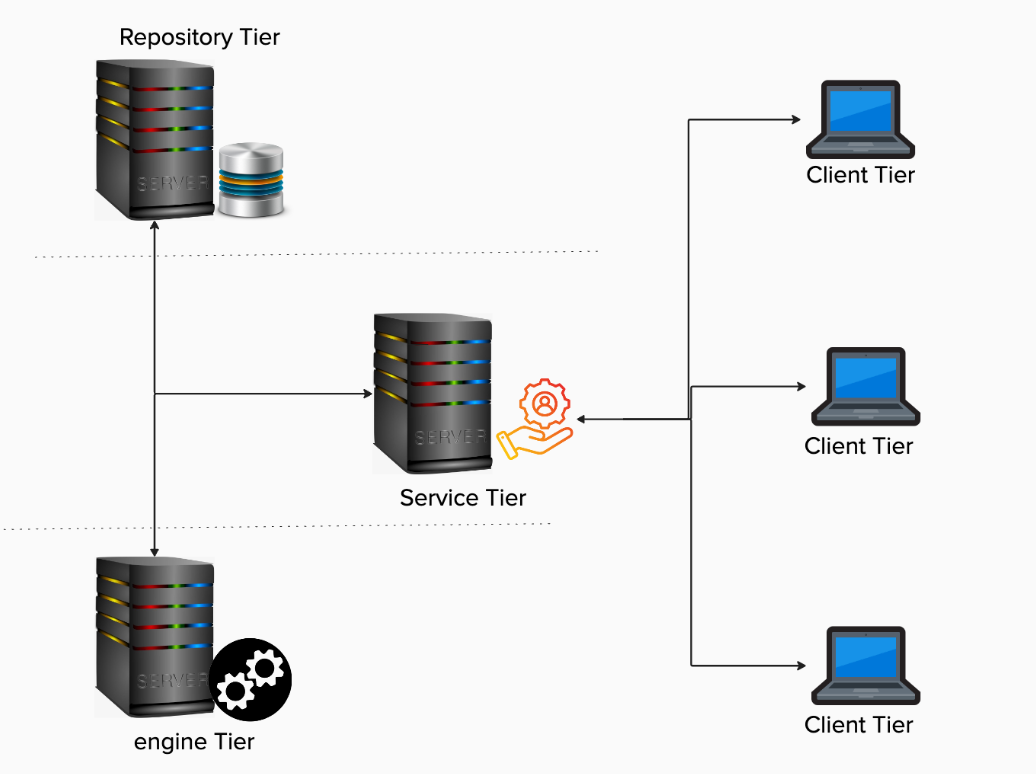
IBM DataStage Architecture Overview
- Client Tier: Provides interfaces for job design, monitoring, and administration.
- Services Tier: Manages core services like metadata, scheduling, and security.
- Engine Tier: Executes ETL processes using server or parallel engines.
- Repository: Stores job designs, shared containers, and metadata.
- Runtime Environment: Executes jobs either on-premises or in containers (for cloud-native deployments).
In cloud-native environments, all components are containerized and orchestrated via Kubernetes (e.g., Red Hat OpenShift).
Client Tier
The Client Tier is the user-facing layer where developers, administrators, and analysts interact with DataStage.
Key Components:
- DataStage Designer: Used to design ETL jobs using a graphical interface.
- DataStage Director: Monitors, schedules, and manages job execution.
- DataStage Administrator: Manages system configurations, users, and permissions.
Role:
- Allows users to build, test, and deploy data integration jobs.
- Sends job definitions and requests to the service tier.
- Retrieves metadata, job logs, and status information from other tiers.
Engine Tier
The Engine Tier is the runtime component responsible for executing ETL jobs.
Key Components:
- Parallel Engine: Executes jobs using scalable parallel processing.
- Server Engine: Executes server-based jobs in simpler environments.
- Job Runtime Environment: Manages data flow, transformations, and connectors during execution.
Role:
- Performs data extraction, transformation, and loading.
- Connects to external sources such as files, databases, APIs, and cloud services.
- Optimizes performance using partitioning, pipelining, and parallelism.
Service Tier
The Service Tier acts as the middleware that coordinates communication between the client, engine, and repository tiers.
Key Components:
- Metadata Services: Provide access to metadata and governance features.
- Security Services: Manage authentication and access control.
- Logging and Monitoring Services: Track execution status and performance metrics.
Role:
- Routes requests from the client to the appropriate engine or metadata service.
- Provides shared services for scheduling, monitoring, and resource management.
- Central point of integration for cloud-native deployment (e.g., in Cloud Pak for Data).
Metadata Repository Tier
The Metadata Repository Tier stores and manages all metadata used across the DataStage environment.
Key Components:
- Repository Database: Central storage for job definitions, metadata, lineage, and shared components.
- Information Governance Catalog (optional): Enhances visibility, classification, and compliance management.
Role:
- Enables reuse of components across jobs and projects.
- Supports impact analysis, data lineage, and governance initiatives.
- Ensures consistency and traceability across data integration workflows.
Datastage Installation Topology — Two Tier, Three Tier ,Cluster & Grid Topology
2-Tier Architecture

2-tier architecture consists of two layers:
- Client Machine (client Tier): The front-end application or user interface (e.g., DataStage Designer).
- Server Machine (Server Tier): The back-end layer that includes business logic and data services (e.g., DataStage Engine and repository).
Characteristics:
- Direct communication between client and server.
- Simpler to implement but less scalable.
- Suitable for small-scale deployments or development environments.
Use Case in DataStage:
- Standalone installations where the client connects directly to the engine tier for development and job execution.
3-Tier Architecture

3-tier architecture separates the system into three logical layers:
- Client Tier: User interfaces for job design and monitoring.
- Service Tier (Middle Tier): Manages communication, metadata, and control flow.
- Engine Tier (Back-End): Executes ETL jobs and connects to data sources.
Characteristics:
- Better scalability and maintainability than 2-tier.
- Improves performance and security by isolating business logic.
- Common in modern DataStage installations.
Use Case in DataStage:
- Production deployments with centralized services managing user access, job execution, and metadata storage.
Cluster Architecture

Cluster architecture connects multiple servers (nodes) that work together as a single system for high availability and failover.
Characteristics:
- Ensures redundancy — if one node fails, others take over.
- Typically used for high availability and disaster recovery.
- May share common storage or metadata repositories.
Use Case in DataStage:
- Mission-critical environments where uninterrupted ETL processing is essential. Clustered engines may be used for failover and replication.
Grid Architecture
Grid architecture involves multiple servers or nodes that work together to execute ETL workloads in parallel.
Characteristics:
- Supports load balancing and parallel job execution across multiple nodes.
- Enhances performance, fault tolerance, and resource utilization.
- Jobs are distributed based on workload, resource availability, and policies.
Use Case in DataStage:
- High-volume ETL environments where DataStage Parallel Extender (PX) jobs run across a compute grid.
Key Difference between cluster and grid topology:

Microservices Tier Architecture
Microservices architecture breaks down the system into independently deployable services, each performing a specific function.
Characteristics:
- Highly modular and loosely coupled services.
- Scalable, cloud-native, and suitable for CI/CD pipelines.
- Each service can be developed, deployed, and scaled independently.
Use Case in DataStage (Cloud Pak for Data):
- IBM DataStage on Cloud Pak for Data adopts microservices for design, execution, logging, and monitoring.
- Enables hybrid and multi-cloud deployments.
- Ideal for modern DataOps workflows with integration into Kubernetes and OpenShift.
IBM InfoSphere DataStage Job Types
IBM InfoSphere DataStage supports three primary job types: Parallel Jobs, Server Jobs, and Sequence Jobs. Each job type is designed to serve a specific purpose within the ETL (Extract, Transform, Load) workflow and is optimized for different levels of data volume, system architecture, and control complexity.
1. Parallel Jobs
Parallel jobs are designed for high-performance and large-scale data processing. They are the most commonly used job type in enterprise DataStage implementations and are executed on the DataStage Parallel Engine.
Key Characteristics:
- Designed to run on SMP (Symmetric Multiprocessing), MPP (Massively Parallel Processing), or cluster/grid environments.
- Use parallel processing to distribute data across multiple nodes or partitions.
- High scalability and performance — suitable for large volumes of structured and unstructured data.
- Allow connections to a wide range of data sources and targets, including files, databases, cloud systems, and web services.
- Each job is compiled into OSH (Orchestrate Shell Script), except for the Transformer stage, which compiles into both C++ and OSH.
- Jobs are constructed using graphical stages on the canvas — typically more complex than server jobs.
- Supports dynamic workload balancing with features like grid computing and resource managers.
Examples of Common Stages:
- Parallel Transformer
- Lookup
- Join
- Aggregator
- Sort
- Data Set
- Sequential File
- DB Connector stages (e.g., Oracle, DB2, ODBC)
Execution:
- Compiles to: OSH (and C++ for Transformers)
- Runs on: DataStage Parallel Engine
- Scalability: Multi-node, high-volume capable
- Best suited for: Enterprise-scale, high-performance ETL
2. Server Jobs
Server jobs are traditional ETL jobs executed on a single server node. They are simpler than parallel jobs and typically used for moderate data volumes or legacy applications.
Key Characteristics:
- Run on the DataStage Server Engine, operating on a single node.
- Less scalable than parallel jobs — meant for small to medium datasets.
- Use fewer stages on the canvas and are often easier to develop and maintain.
- Can still perform complex transformations using built-in functions and BASIC routines.
- Compiled into Universe BASIC, a proprietary scripting language.
Examples of Common Stages:
- Server Transformer
- Sequential File
- Hashed File
- Relational Database stages
- Routine stages (for invoking custom logic)
Execution:
- Compiles to: Universe BASIC
- Runs on: DataStage Server Engine
- Scalability: Single-node only
- Best suited for: Smaller workloads or legacy migration projects
Notes:
- Often considered technical debt in modern environments due to lack of scalability.
- Many organizations migrate from server jobs to parallel jobs for performance and modernization.
3. Sequence Jobs
Sequence jobs do not perform data transformation themselves; instead, they act as orchestration jobs that manage and control the execution of server and parallel jobs.
Key Characteristics:
- Control the order of job execution, including success/failure conditions.
- Define dependencies, retries, conditional branching, and alerts.
- Can perform non-ETL tasks, such as triggering system commands, sending emails, or handling file events.
- Often used to automate batch pipelines or run jobs in a specific workflow.
- Use activities such as:
- Job Activity
- Wait-for-File Activity
- Routine Activity
- Email Notification
- Allow advanced logic via BASIC scripting for custom conditions and branching.
Execution:
- Compiles to: Universe BASIC
- Runs on: DataStage Server Engine
- Scalability: N/A (orchestrates other jobs)
- Best suited for: Workflow automation and job orchestration
Key Concepts Across All Job Types
Stages:
- Fundamental building blocks of a job.
- Perform specific tasks like reading from files, transforming data, writing to targets.
- Each job consists of multiple connected stages.
Links:
- Define the data flow between stages.
- Carry rows of data from one stage to the next.
- Visual connectors on the job canvas.
Job Parameters:
- Allow parameterization for dynamic configuration.
- Commonly used for file paths, DB connection details, job options, environment variables.
- Promote job reusability and flexibility.
BASIC Routines:
- Custom scripts written in BASIC (Universe BASIC).
- Used in server and sequence jobs for advanced control, branching, and error handling.
- Often found in legacy projects.
dsadmin Utility:
- Command-line tool used to manage DataStage environments and projects.
- Can list or modify environment variables, manage users, check project status, etc.
- Useful for automation, DevOps, and CI/CD workflows.
Conclusion
IBM DataStage is a proven and flexible data integration tool that scales to support complex, high-volume workloads in both traditional and modern environments. With multiple editions tailored for mainframe, cloud, and hybrid deployments, DataStage helps enterprises build robust data pipelines for trusted analytics. Its modern design, metadata-driven architecture, and governance support make it a central component in the enterprise data fabric.
If you found this article helpful : Give it a few claps 👏 and Follow me on Medium for more technical articles.
메타데이터
- post_id
- a8642a7c2093
- slug
- ibm-datastage-basics-architecture-and-topology-a8642a7c2093
- url
- https://medium.com/@Shamimw/ibm-datastage-basics-architecture-and-topology-a8642a7c2093
- canonical_url
- https://medium.com/@Shamimw/ibm-datastage-basics-architecture-and-topology-a8642a7c2093
- author_url
- https://medium.com/@Shamimw
- status
- ok
- fetched_at
- 2026-07-22 19:50:38