Polari
Language, history and book prize
Polari
Language, history and book prize
Photo by Rene Böhmer on Unsplash
The Polari Language
In the UK, homosexuality was legally criminal in private up until the passing of the 1967 Sexual Offences Act:
“In 1967 the Sexual Offences Act was passed which decriminalised private homosexual acts between men aged over 21, while at the same time imposing heavier penalties on street offences.
The law was not changed for Scotland until 1980, or for Northern Ireland until 1982.”
— Regulating sex and sexuality: the 20th century - UK Parliament
As such, Polari (probably from the Italian ‘parlare’, to speak, through various iterations) a language used by carnival workers, seafarers, theatrical types, and various other largely itinerant groups, was developed to provide coded cover during conversations between gay men:
“Oh hello Mr Horne! How Bona to vada your dolly old eke!”
The above quote was taken from an extremely popular radio comedy programme in the 1960s called Round the Horne, which featured a pair of camp characters called Julian and Sandy (played by Hugh Paddick and Kenneth Williams). They used a secret gay form of language called Polari. “Bona to vada your dolly old eke” meant “nice to see your pretty old face”. Gay people used this language up until around the 1970s as a way of conducting conversations in public spaces or just to have a camp laugh with each other. For some, it was just a collection of a few slang words. But others used it in a more complex way, making it sound like a proper language.
— Polari and the Hidden History of Gay Seafarers | National Museums Liverpool
[embed]
“… anti-societies are counter-cultures, then: concious alternatives to the mainstream, existing by resisting either passively or by more hostile, destructuve means. Anti-languages are generated by anti-societies and in their simplest forms they are partially relexicalised languages, consisting of the same grammar but a different vocabulary, although they can go beyond that to approach fuller approximations of languages.
However, the key point about anti-languages is that they aren’t just alternative words for existing concepts, but encode something additional, a kind of ‘us-against-them’ world view within the meanings of words. In other words, they use language to represent reality in a different way, so that the values of the anti-society are produced, as opposed to the values of the mainstream society. Indeed the mainstream society may be mocked or criticised in some way by the anti-language. Some of these aspects of anti-language certainly feel like they can be applied to Polari, which has numerous mocking words for the police or heterosexual people as well as representing gender in a very different way to non-Polari speakers. When you learned Polari, you weren’t just learning the words but the attitude that went with them.” (p.17/18)
The above quote was taken from Fabulosa, one of a number of books written by Paul Baker, who is Professor of English at Lancaster University. Baker wrote his PhD thesis on Polari, it’s origins, development and social context, and can certainly be looked upon as a contemporary expert upon the subject.
A few pages on in Fabulosa he goes on to say:
“Polari is playful, quick and clever — it’s a constantly evolving language of fast put-downs, ironic self-parody and theatrical exaggeration. The lexicographer Eric Partridge once referred to Polari as a “Cinderella among languages”, but I prefer to think of it as the Ugly Sisters: brash, funny and with all the best lines in the show.” (29)
Baker’s book is extremely interesting and provides much more detail on suggested origins and much more (including a glossary of terms), see below for link.
The Polari Salon
Founded in 2007 by Paul Burston, their first event was held at a bar in Soho. Since 2014, funded by Arts Council England, the event has toured many venues and grown in size and theatrical flare.
“Lively, funny and inspiring — a gay-themed salon of interest to anyone remotely interested in literature, whatever their sexual bent” — Patrick Gale
The Polari Prize
Established 2011, the only UK-based LGBTQ+ literary prize:
[embed]
2023 Literary Prizes
“Prize founder, Paul Burston, said: “This year’s Polari Prize long lists demonstrate a diverse range of LGBTQ literary talent, writing across many different genres and from a wide variety of perspectives. The volume and quality of submissions was extremely high this year, and the judges really had their work cut out. But these are long lists we can all be proud of. At a time when LGBTQ people are under attack, our stories matter more than ever. These are our stories. Read them. Learn from them. Celebrate them.”
The Polari First Book Prize (longlist)
Love from the Pink Palace— Jill Nalder (Wildfire) A Visible Man — Edward Enniful (Bloomsbury) The Whale Tatoo— Jon Ransom (Muswell Press) The Rise of the Black Sheep— Livia Kojo Alour (Polari Press) Whatever Happened to Queer Happiness?— Kevin Brazil (Influx Press) The New Life — Tom Crewe (Chatto & Windus) None of the Above— Travis Alabanza (Canongate Books) Orpheus Builds A Girl— Heather Parry (Gallic Books) In Her Jaws— Rosamund Taylor (Banshee Press) Is This Love?— C.E. Ripley (Serpent’s Tail) No Country for Girls— Emma Styles (Sphere) Some Integrity— Padraig Regan (Carcanet Press)
The Polari Prize (longlist)
Fire Island— Jack Parlett (Granta Books) Roam — Juno Roche (Dialogue Books) Other People Manage— Ellen Hawley (Swift Press) All Down Darkness Wide— Sean Hewitt (Jonathan Cape) Young Mungo— Douglas Stuart (Picador) Mother’s Boy— Patrick Gale (Tinder Press) The Schoolhouse— Sophie Ward (Corsair) Our Wives Under The Sea— Julia Armfield (Picador) Rookie— Caroline Bird (Carcanet Press) Cells— Gavin McCrea (Scribe) Screen Age— Fenton Bailey (Ebury Press) Here Again Now— Okechukwu Nzelu (Dialogue Books)
2024
The Polari First Book Prize Winner
The Polari Prize Winner
2025
A problematic year ….
2026
After last year’s debacle, the Polari Literary Prizes are still suspended.
Recommended:
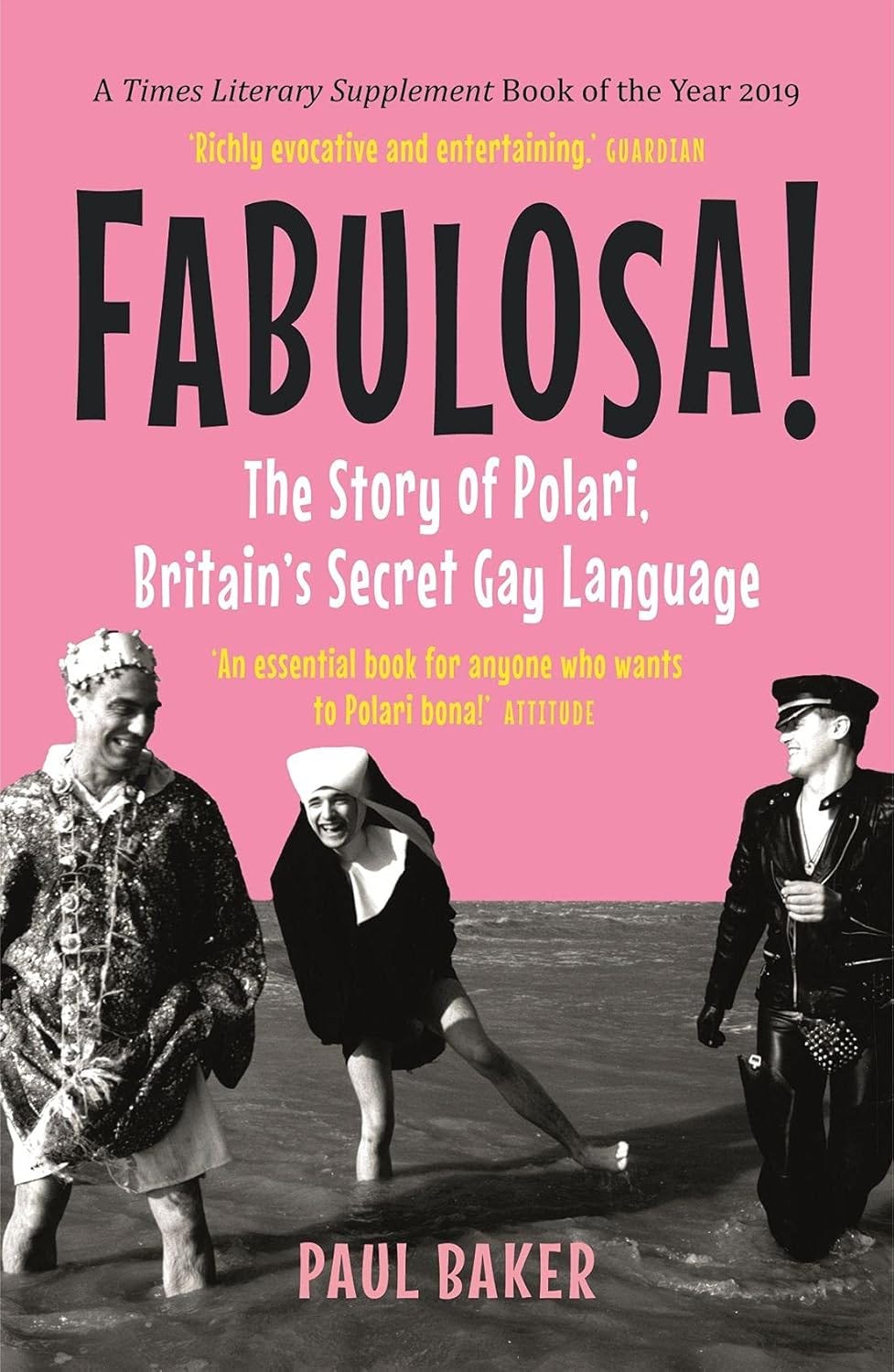
Front cover of my own copy of ‘Fabulosa’, because I have it to hand (unlike my copy of ‘Man Eating Typewriter’ which I refused to dig out of my bookstacks for a photo — maybe if I do you a review…)
“A Times Literary Supplement Book of the Year 2019 ‘Richly evocative and entertaining.’ — Guardian ‘A delightful read.’ — Tatler ‘An essential book for anyone who wants to Polari Bona!’ — Attitude Polari is a language that was used chiefly by gay men in the first half of the twentieth century. It offered its speakers a degree of public camouflage and a means of identification. Its colourful roots are varied — from Cant to Lingua Franca to dancers’ slang — and in the mid-1960s it was thrust into the limelight by the characters Julian and Sandy, voiced by Hugh Paddick and Kenneth Williams, on the BBC radio show Round the Horne. (‘Oh hello Mr Horne, how bona to vada your dolly old eek!’) Paul Baker recounts the story of Polari with skill, humour and tenderness. He traces its historical origins and describes its linguistic nuts and bolts, explores the ways and the environments in which it was spoken, explains the reasons for its decline and tells of its unlikely re-emergence in the twenty-first century. With a cast of drag queens and sailors, Dilly boys and macho clones, Fabulosa! is an essential document of recent history — a fascinating and fantastically readable account of this funny, filthy and ingenious language.”
**Man-Eating Typewriter — Richard Milward**
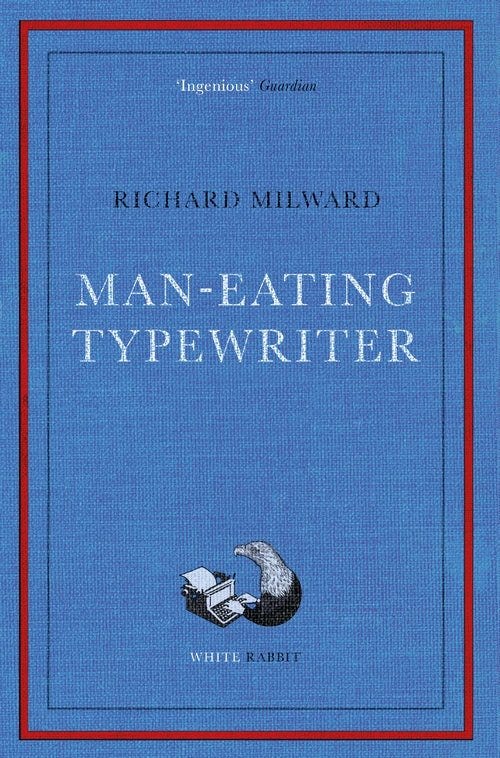
MAN-EATING TYPEWRITER — Richard Milward
“Set at the fag-end of the 1960s and framed as a novel within a novel published by a seedy London purveyor of pulp fiction, MAN-EATING TYPEWRITER is a homage to the avant-garde counterculture of the 20th century. Told in Polari, it is the story of an anarchist named Raymond Novak and his plan to commit a ‘fantabulosa crime’ in 276 days that will revolt the world. A surrealistic odyssey that stretches from occupied Paris to the cruise-liner SS Unmentionable to lawless Tangier before settling in Swinging London, the book casts Novak as an agitator and freedom fighter — but, as his memoirs become more and more threatening, his publishers find themselves far more involved in his violent personality cult than they ever intended.
Constructed like a hallucinogenic cocktail of A Clockwork Orange, Pale Fire and Jean Genet’s jailbird fantasies, MAN-EATING TYPEWRITER is an act of seductive sedition by a writer with unfathomable literary talent and boldness. Wild, transgressive, erotic and resolutely uncompromising, this marks the return of a writer who is out there on an island of his own making; a book that will be talked about, celebrated and puzzled over for decades.”
Review | The Guardian:
Man-Eating Typewriter | Goldsmiths Prize:
메타데이터
- post_id
- a8675d54b4f0
- slug
- polari-a8675d54b4f0
- url
- https://medium.com/seroxcats-salon/polari-a8675d54b4f0
- canonical_url
- https://medium.com/seroxcats-salon/polari-a8675d54b4f0
- author_url
- https://medium.com/@sadieseroxcat
- status
- ok
- fetched_at
- 2026-07-09 10:10:35