A Comedy of Weres: The History of the Most Overlooked Genre in Horror
Do you also love werewolf stories? And are you also upset that there are so few TRULY classic werewolf movies?
A Comedy of Weres: The History of the Most Overlooked Genre in Horror
Do you also love werewolf stories? And are you also upset that there are so few TRULY classic werewolf movies?
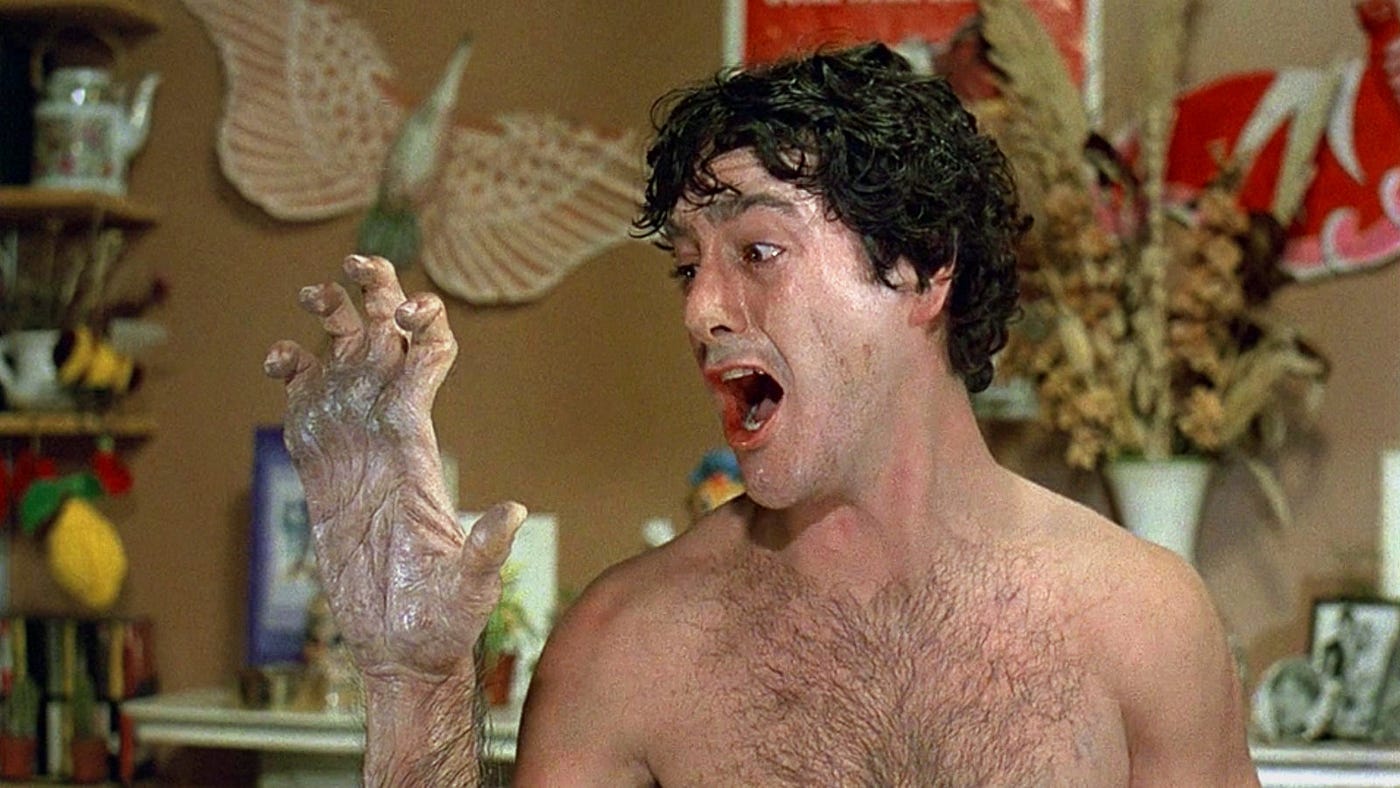
Body horror, y’all. Straight pre-Cronenberg. Source: RogerEbert.com
Don’t get me wrong, there are a lot of really great werewolf movies. From the teenage female teenage experiences of “Ginger Snaps”, to the cheesy fun of “The Howling”, to the original classic in “The Wolf Man”, to the brilliant makeup design of Rick Baker in the Joe Johnston-directed 2010 remake (seriously, the makeup design alone makes this one better than the critics suggest it is), to the modern indie comedy of “The Wolf of Snow Hollow”, the genre is crowded with really great films.
That being said, the sub-genre doesn’t get as much respect within the horror genre as it should, and even the best of them rarely ever rank among the “best” horror films ever made. That being said, there’s just something amazing about a good werewolf movie.
The werewolf myth itself reaches back well into the bowels of recorded history. There are werewolf myths as far back as the Ancient Greeks of classical antiquity. Heroditus, in his “Histories,” a piece of writing that is considered to be one of the founding works of Western literature, described a tribe of people north of the great Eurasian empire of Scythia who transformed into wolves once every year for several days.
In Norse and Germanic pagan culture, Harald Fairhair of Norway, an ancient Viking Age king, was known to have berserker warriors called úlfhéðnar, who resemble many werewolf myths.
One of the more famous werewolf myths comes from France, in the province of Gévaudan. The beast was said to roam the Margeride Mountains in the south of France between 1764 and 1767. He was known colloquially as “La Bête du Gévaudan.” The Beast of Gévaudan.
There were even werewolf myths in North America as well. The Navajo tribe, who resided in modern-day New Mexico, Colorado, Arizona, and Utah had a creature that changed form, much like the werewolf legends of Europe and Asia. They called it the skin-walker, or yee naaldlooshii, which roughly translates to: by means of it, it goes on all fours.
But for today’s entry, we’ll discuss a werewolf from North America, who became a werewolf by traveling to Europe. That’s right. My favorite werewolf movie is “An American Werewolf in London.”
[embed]
“An American Werewolf in London” was released back in 1981 and was directed by then famed comedic filmmaker John Landis, who was most famous for directing films like “Animal House” and “The Blues Brothers” but got his start with the low-budget horror-comedy (heavy on comedy) “Schlock.” The movie was critically panned at the time and even Landis himself has said that the movie was “terrible.”
But it does hold one distinction of note: it was the third film for famed makeup artist, Rick Baker. If you don’t know who that is, he’s basically the Meryll Streep of makeup effects.
From 1981 to 2010, Baker was nominated for an Academy Award a total of ten times and won seven of them. The second closest, Greg Cannom, only has four wins. Baker’s first Academy Award was for the very film we’re talking about, “An American Werewolf in London”.
And this would be the part where I would gush about the makeup design and the transformation scene, which holds up nearly forty years later. But there’s really nothing much else to be said about it. It’s great, it’s visceral, it’s horrifying and it exemplifies, for me, the theme of the werewolf mythos maybe better than any other movie does. And that is, that’s it’s painful.
[embed]
From the vampire myths of eastern Europe to Mary Shelley’s tale of Frankenstein staring off into the arctic tundra, the greatest fear the monster has to offer is the fear that we will become one.
Fredrich Nietzsche, German philosopher, and all-around king of the go-to depressing quote, once famously said:
“Beware that, when fighting monsters, you yourself do not become a monster… for when you gaze long into the abyss. The abyss gazes also into you.”
“An American Werewolf in London” begins with two American backpackers, thumbing their way through Europe (Northern England) who find themselves face to face with a monster, staring it down, until it attacks them, turning one of them into a monster in the process.
The film is funny, yes. Landis is, as already mentioned, a famed comedic director who will go down in film history as one of the better comedic filmmakers of his or any generation.
It is also arguable that this film really got the ball rolling on the sub-genre that would spawn the likes of “Shaun of the Dead,” “Ghostbusters,” “Gremlins,” the “Evil Dead Franchise” and one of the movies I’ve already talked about before, “What We Do in the Shadows.”
But, I think that the reason, for me, that this movie works so well, beyond that it’s utterly enjoyable, is that it effectively shows you the psychological toll of becoming a monster. Which it does through the slow decay of the protagonist David’s friend Jack, who died in the initial werewolf attack, and who now visits David throughout the film and urges him to kill himself.
It’s gruesome and after each full moon of lycanthropic debauchery, the fresh victims from each monthly slaughter return, along with Jack. It’s all a friendly reminder of David’s monthly violence. Each new victim appears as a quasi-zombie, slowly decaying with each new visit.
The spree of violence crescendoes in a final showdown between David’s lycanthropic form and a handful of British bobbies’ bullets. It’s the tragic final destination on the road to becoming a monster, now unreturnable.

What if I told you that this movie had werewolf Nazis? Is that scary enough for you?
There have been many great werewolf films and stories in the history of the horror genre but, for me, none encapsulates the pain of becoming a monster so well. From Chaney’s “Wolfman” to the 1933 horror novel about the Franco-Prussian War in “The Werewolf of Paris,” the genre has had its fair share of tales delving into the depths of humankind’s journey towards miscreation and misery.
I know that Frankenstein is more profound, and Dracula is more theatrical, but I’ve always preferred The Wolfman, the third most popular of the Universal/Hammer film canon. The werewolf. The Lycan. Whatever you want to call it. It’s tragic in ways that just speak to me.
The uncontrollable nature of your body, the terror of existing in this piece of meat, without the ability to control it or what it does, or the harm that it, in turn, does to you and all of the people you love. It’s a frightening realization that hits you the first time your bones start to crack and really starts to hit you when you don’t quite have the energy to climb a set of stairs without a drumbeat heart and hot, iron-tasting breath.
That’s always hit me harder than the other major myths about monsters. Maybe that says something about me and my own personal experiences…but I won’t get into that. I just think it’s something that’s worth noting.
Losing control of yourself and losing control of your body, this form that acts as your vessel through life, is horrifying and ultimately tragic. The werewolf myth obviously speaks to the inherent evil in humanity, but rarely is it ever mentioned what it might say about disease. From cancer to heart disease to webbed toes, there is horror in our body and what it might mean if we can’t control it.
I think that is about as profound as Dr. Frankenstein watching his Promethean beast disappear into the cold north air, right? Much as Frankenstein or John Harker of “Dracula” stare into the evil that might overtake them, the werewolf must stare into himself, into his own flesh, and know that the disease that will do him in has already taken up residence.
[embed]Edgar Wright is a fan. So, you know it’s good.
Now that we’re all really, really terrified about the bevy of frightening ways in which our bodies can fail us, I think it’s time to move on to next week’s article, where we’ll dig deep into another comedy-horror. This one is about the horror of domesticity. It also happens to be one of my favorite “guilty pleasure” movies about the type of neighborhood I’ve always dreamt of living in, for some reason.
Enjoy the rest of what I’ve come to call the Halloween Horror Countdown on my page. A list of iconic horror movies and horror adjacent films, from folk horror, to the vampire mythos, to documentaries about horror filmmakers, to one of the most beautifully photographed horror films ever put to celluloid.
Come check out my page as I countdown to the greatest holiday of the year.
메타데이터
- post_id
- a871d64ce7c2
- slug
- a-comedy-of-were-wolves-a871d64ce7c2
- url
- https://medium.com/horror-hounds/a-comedy-of-were-wolves-a871d64ce7c2
- canonical_url
- https://medium.com/horror-hounds/a-comedy-of-were-wolves-a871d64ce7c2
- author_url
- https://medium.com/@richardfoltz
- status
- ok
- fetched_at
- 2026-08-25 09:47:20