The architecture of hell.
How the Garuda Purana turned sin into experience and punishment into understanding.
The architecture of hell.
How the Garuda Purana turned sin into experience and punishment into understanding.
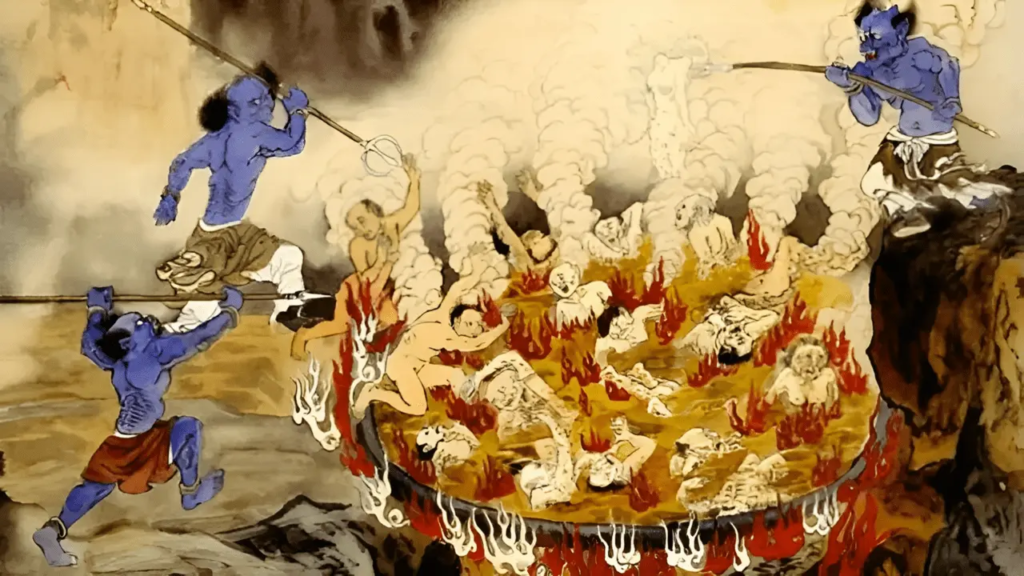
From “Garuda Purana”
I was getting bored, just watching some random movie scene on my phone. There comes “Aparichit”, and sins and punishment in the Garuda Purana, so I started reading it.
For those who need the clarification: “Aparichit: The Stranger” is not a film in its own right. It is the Hindi dubbed version of “Anniyan” the 2005 Tamil psychological action thriller written and directed by S. Shankar, starring Vikram in what remains one of the most physically and psychologically demanding performances in the history of Indian cinema. The original Tamil title, “Anniyan”, simply means “stranger”, an apt name for a film about a man who becomes unrecognizable to himself.
Vikram plays Ambi, a meek, law-abiding lawyer tormented by the casual corruption and civic indifference that surrounds him, people who jump queues, bribe officials, and ignore dying strangers on the roadside. The frustration ruptures him. He develops dissociative identity disorder, and from that fracture emerges Anniyan: A vigilante personality who hunts down the corrupt and punishes them with a specificity that the film is careful to root not in madness but in scripture. Anniyan does not invent his punishments. He borrowed them from the Garuda Purana.
That detail is what stopped me mid-scroll.
The punishments in Shankar's film have a design to them that goes beyond cinematic spectacle. They fit. A man who adulterates food is force-fed the same poison he sold. A doctor who neglected his duty is subjected to surgical cruelty. The punishment in each case does not merely hurt the wrongdoer, it completes a circuit, sends back to the sinner precisely the shape of what they sent out into the world. Watching those scenes, something clicked.
This was not vigilante cinema dressed in mythology for texture. Shankar had reached back into one of the oldest and most elaborately reasoned moral frameworks in human history and pulled it into a multiplex in 2005. The film was asking, seriously, the question that the Garuda Purana had been asking for over a thousand years: what does a wrongdoer need to “feel”, not as revenge, but as understanding, not as cruelty, but as completion?
So I put the phone down and opened the text itself.
There is a book Hindus are not supposed to read in ordinary times. The Garuda Purana, one of the 18 Mahapuranas of classical Hinduism, structured as a dialogue between the god Vishnu and his celestial vehicle, the great eagle Garuda, is traditionally recited only in the presence of the dead. During the 13 days of mourning that follow a Hindu funeral, passages from its Pretakhanda, the section on departed souls, are chanted in the house of the deceased while grief is still raw and the body still warm in memory. To read it at any other moment is considered inauspicious, even dangerous. Some consider it outright unlucky. The text carries, by its very nature, the smell of death.
This prohibition is itself a kind of theology. It tells you what the Garuda Purana is for: not instruction, not comfort, but confrontation. The mourners who listen to its verses are not being consoled. They are being shown something, the mechanics of a moral universe that does not forgive oversight, that does not misplace a single deed, that carries its ledger across the boundary of death without a page going missing.
The text opens with Garuda's question. He is the king of birds, the one who carries Vishnu on his wings across the three worlds, and even he wants to know: what happens to a human soul after it dies? Vishnu's answer unfolds over 1000 verses.
What makes the exchange philosophically unusual is the asymmetry of the interlocutors, the god does not reveal the afterlife as a mystery descending from above; he describes it as an architect explaining his own design. The Garuda Purana is not a meditation on death from within the human condition. It is a specification.
Before examining what that specification contains, it is worth being honest about the document itself. Scholars have argued for over a century about when this text was composed, by whom, and in what form. The versions that survived into the modern era preserve roughly eight thousand verses out of the nineteen thousand the tradition claims. Dalal places the surviving recensions between 800 and 1000 CE; Pintchman narrows it to 850 to 1000 CE; Chaudhuri, Banerjee, and Hazra argue it cannot predate the tenth or 11th century.
The Pretakhanda, the section that concerns us, is described by the scholar Ludo Rocher as an entirely unsystematic work presented with what he called "motley confusion and many repetitions." Three substantially different versions of the Pretakhanda are known to exist, and the variation between them, Jonathan Parry has observed, is enormous. Monier-Williams, writing in 1891, noted that Hindu funeral practices do not always agree with the guidance given in this very text.
None of this diminishes the Garuda Purana's importance. It means, rather, that we should read it as a living document, accumulated, debated, expanded across centuries, rather than as a transcript handed down from a single divine moment. The hells it describes were not invented all at once. They grew, as hell-systems tend to, from a civilization's deepening conversation with itself about what it considered unforgivable.
At the center of that conversation is a word: “karma”. Not karma as it tends to be understood in Western popular usage, a loose cosmic boomerang, good returned for good, bad for bad, but karma in its original Sanskrit sense, which simply means “action”. Every action undertaken by deed, word, or thought leaves an impression, a “samskara”, on the soul that performs it.
These impressions accumulate. They shape not just the tenor of a single life but the conditions of everything that follows. In the Hindu philosophical framework that the Garuda Purana inhabits, the soul, the “atman”, is eternal and beginningless; it has been moving through forms since before memory, accumulating and exhausting karma across an inconceivable span of time. Death is not its end. It is a punctuation mark.
This is the first thing that distinguishes the Garuda Purana's vision of hell from the infernal architectures of Christianity and Islam. Naraka, the realm of post-mortem suffering, is not eternal. It cannot be. In a universe governed by karma rather than divine fiat, punishment proportionate to a finite set of actions must itself be finite.
The soul enters Naraka, undergoes its prescribed suffering, exhausts the relevant karmic debt, and moves on, reborn into a new life whose conditions are shaped by everything that came before. Scholars have described Naraka in this framework as closer to a place of purgation than a place of damnation: temporary, corrective, embedded within the longer arc of samsara, the cycle of birth and death from which the ultimate goal is liberation, “moksha”, altogether.
This matters because it changes the moral logic of every punishment the text describes, and it is also, I realized, what gives Shankar's film its philosophical backbone. Anniyan is not trying to destroy the people he punishes. He is trying to make them feel the precise weight of what they did. The Garuda Purana's hells operate by the same principle. They are not designed to make sinners suffer as an end in itself.
They are designed to make sinners “experience” what they inflicted, to feel, from inside, the distortion of reality that their actions created. The suffering is, in a precise sense, diagnostic. The soul that returns from Naraka is not destroyed; it carries, burned into it, the knowledge of consequence. Whether one accepts this framework as theology or reads it as sophisticated moral psychology, the 28 Narakas constitute one of the most elaborate and internally coherent systems of ethical thought produced by any civilization.
The soul's journey begins before any Naraka is reached. At the moment of death, the Garuda Purana describes the “atman” as reduced to the size of a thumb, a diminished, frightened thing, suddenly stripped of the body it inhabited.
Two messengers of Yama appear: the Yamadoots, described as black as crows, naked, teeth grinding, hair erect, bearing nooses and rods. They bind the soul and drag it along the Yamapath, the Way of Yama, reciting its sins aloud as they go. The recitation is not rhetorical. It is the beginning of the reckoning.
The soul travels through a landscape of structured suffering. A great tree at the path's edge burns like fire; sinners are hung upside down from its branches and beaten. The Vaitarini, a river of excrement, blood, hair, and bones, teeming with terrible creatures, must be crossed by those who failed in specific duties. There is a forest further along where the leaves are sword-edged. Everything the soul encounters on this road is a preview: misery made into geography, suffering turned into terrain.
In Yama’s court, the accounting falls to Chitragupta. His name is etymologically precise, “chitra” meaning picture or image, “gupta” meaning hidden or secret. He is the hidden picture, the complete record. Born from Brahma’s own body and charged with maintaining the karmic ledger of every soul in existence, he is assisted by beings called Shravanas, listeners, who move through all three worlds recording what is done openly and what is done in darkness, in action and in thought. No act is private. No cruelty goes unwitnessed simply because no human witnessed it.
The Garuda Purana gives Chitragupta's authority in a verse of peculiar simplicity:
कर्मणा मनसा वाचा यद्भद्रं यच्च पापकम्।
तत्सर्वं चित्रगुप्तो वेत्ति लोकेऽस्मिन्नास्ति संशयः॥
“Whatever good or evil a man performs by deed, thought, or word, all of it Chitragupta knows. In this world, there is no doubt.”
When the record is read, the soul stands silent. The text captures this moment with a restraint that is almost literary:
श्रुत्वा वचनमेतत्तु पापिनस्ते तदा शोचन्ति कर्म च।
तिष्ठन्ति निश्चला मूढाः स्तेना इव॥
“Hearing the words, sinners grieve over their karmas and remain silent and motionless, like thieves caught in the act.”
The simile is devastating in its economy. Not villains confronting punishment. Thieves. Caught. The shame of a person who believed, somehow, that what they did in secret would stay secret.
Yama then renders judgment, and the text insists on something remarkable about his method. The King of Justice treats every soul identically:
समां करोति धर्मराजः मूर्खं पण्डितमेव च।
दरिद्रं धनिनं चैव बलं दुर्बलमेव च॥
“The King of Justice treats equally the fool and the wise, the poor and the wealthy, the strong and the weak.”
In a civilization stratified by caste from birth, where the Brahmin and the Shudra occupied profoundly different positions under every earthly legal system, this is not a small claim. The court of the dead is the one court where birth confers nothing. What matters is only what was done with the life it provided.
Now the soul, clothed in a body of torment, not the body of its earthly life but a new temporary form capable of suffering fully, without the mercy of unconsciousness or death, is dispatched to its assigned Naraka. And here begins the account that Shankar translated into cinema, and that has haunted Indian moral imagination for more than a millennium.
The 1st Naraka, Tamisra “darkness”, receives those who steal: the wealth of others, the freedom of children taken by kidnapping, the body of another's spouse. Yama's servants bind the sinners with ropes and beat them until they lose consciousness; when awareness returns, the beating resumes. What is operating here is not simply violence as retaliation. The thief's essential act was the exercise of power over someone who had no recourse, the conversion of another person's possession, freedom, or body into a resource for one's own use. In Tamisra, the relationship is exactly inverted. The sinner has no recourse. Pain arrives and cannot be refused and does not stop.
Andhatamisra, “blind darkness”, sits next to it, punishing a more intimate variant of the same transgression. This hell is for those who treat a spouse well only when personal gain is to be extracted, and abandon them without reason when they are no longer useful. The punishment is similar to Tamisra's, but the agony of the binding is sufficient to produce unconsciousness before the beating properly begins. They are revived and subjected to it again. The name carries the diagnosis: those who were blind to another person's humanity are placed in a darkness without end.
Raurava and Maharaurava, “the roaring” and “the greatly roaring”, handle property crime in a more philosophically elaborate way. Those who seized and enjoyed property belonging to others find that in this Naraka, the people they wronged in life have assumed the form of Ruru, a dreadful species of serpent, and pursue them without cease. The victims become the instruments of punishment. The dispossessed become the dispensers of consequence. Maharaurava specifically receives those who denied heirs their rightful inheritance, a graver version of the same sin because it violates bonds of blood alongside those of justice. The serpents here are more numerous, more venomous, more relentless, as if the text understands that the betrayal of family is a wound of a different order than the betrayal of strangers.
The Garuda Purana is, among other things, a text deeply preoccupied with animals, and this is worth pausing on, because it complicates the image of ancient India as a civilization that treated the natural world primarily as a backdrop for human spiritual drama. Five of the 28 Narakas are devoted to sins against creatures who are not human. The text returns to this theme again and again with an insistence that feels less like moral decoration than genuine conviction.
Kumbhipaka, “the boiling pot”, receives those who killed animals for sport and pleasure, not out of necessity but out of what the text treats as a failure of imaginative empathy: the inability or unwillingness to feel that the animal's suffering matters. Oil is kept perpetually boiling in enormous vessels, and the sinners are plunged in, cooked alive, restored, and plunged in again. The question the Garuda Purana is asking is simple and brutal: what was it like for the animal? It answers: it was like this.
From here the text moves, with the associative logic of a mind that thinks in moral clusters, to Kalasutra, “the wire of time”, the Naraka for those who disrespected parents, elders, and teachers. The name suggests those who forgot what time they owe to those who came before them.
This Naraka is a burning landscape of unbearable heat. Sinners are made to run across scalding ground until they collapse, then revived and forced to run again. The warmth of care and nurturing they refused to return becomes, in this hell, a heat they cannot escape.
Asipatravana, “the forest of sword-leaves”, receives those who abandoned their svadharma, their particular duties arising from their position and nature. The text carries a verse on the abandonment of duty that cuts like the leaves of this very Naraka:
स्वधर्मं परित्यज्य परधर्ममुपाश्रितः।
न सिद्धिं स लभेत् नैव सुखं न परमां गतिम्॥
“One who abandons one's own duty and adopts the duty of another attains neither perfection, nor happiness, nor the highest state.”
Flogged from behind, sinners run into a forest where every leaf is a blade, cut from every direction simultaneously. When they fall, they are stabbed with knives; when they recover, it begins again. Duty in the Garuda Purana's framework is not merely social convention but a thread in the fabric of cosmic order, and to pull it out is to damage something larger than yourself.
Shukaramukha, “The pig's face”, is shared by two categories of sinner the text treats as morally equivalent: rulers who neglect their duty and oppress their subjects, and officials who punish the innocent in exchange for money or political pressure. They are crushed to pulp by heavy force, restored, and crushed again. Those who wielded crushing power unjustly crushed themselves. The pig's face as this hell's emblem is pointed, the pig, in classical Indian symbolism, represents the degraded and impure. Those who debased their office are given the face of debasement.
Andhakupa, “the blind well”, receives those who refused to help the genuinely needy despite having the means, alongside those who killed insects, snakes, and small creatures needlessly. Thrust into a deep well, they are set upon by lions, tigers, eagles, venomous serpents, and scorpions attacking from every direction. The helplessness they imposed on others, or on creatures even more helpless than humans, becomes their own absolute condition.
Taptamurti, “burning figures”, follows, receiving those who stole gold and precious stones: cast into furnaces that never cool, burned perpetually by what they coveted, given fire without end because what they stole was born of fire.
Then Krimibhojanam, “food for worms”, which is among the most elaborate Narakas in the text, and whose sin is quiet enough to be missed. It punishes those who failed to honour guests, who exploited others purely for gain without regard for their dignity, and most specifically those who ate without first offering food to the divine, to guests, and to the hungry. The Garuda Purana draws on a principle that resonates through all of Vaishnava ethics:
यज्ञशिष्टाशिनः सन्तो मुच्यन्ते सर्वकिल्बिषैः।
भुञ्जते ते त्वघं पापा ये पचन्त्यात्मकारणात्॥
“The righteous who eat what remains after offering are freed from all sins. But those sinful ones who cook only for themselves, they eat only sin.”
Thrown into a pit of worms one lakh yojanas in extent, eaten alive, restored, eaten again, those who treated others as resources to be consumed are themselves consumed, perpetually and completely. What makes Krimibhojanam philosophically rich is that its sin is so ordinary.
Not murder, not spectacular theft. The everyday refusal to share. The meal is eaten behind closed doors while others go hungry. The Garuda Purana places this in the same moral register as violence and fraud, and in doing so makes a claim that the civilization was apparently serious about: the obligations of the fortunate toward the needy were not optional courtesies. They were moral requirements.
Among the 28 Narakas, those dealing with betrayal are perhaps the most psychologically precise. Salmali “embracing hot iron”, receives adulterers. An iron figure, heated until it glows red, is placed in the Naraka. The sinner is forced to hold it, to press against it in the posture of the intimacy that was corrupted. While Yama's servants flog from behind, the embrace is maintained.
This is not mere cruelty. It is forced re-enactment: the physical form of the transgression, its heat made literal, its intimacy made unbearable. Vajrakantaka-Salmali, “the diamond-needle variant”, delivers a related punishment to those guilty of sexual violence against animals, the same formal structure applied to a grosser violation of bodily boundaries.
Vaitarini receives rulers and those guilty of grave compound sins, cast into a river of excrement, blood, and bones, attacked by creatures that inhabit this filth, forced to consume what flows around them. The world they made for those beneath them becomes the only world available to them now.
Puyoda “The well of filth”, sits close to it, punishing men who deceived women with false promises of marriage, who exploited the vulnerability of someone willing to trust them with their future. Immersed in a well of filth for the duration of their term, what they offered as clean and what they delivered as degrading is named with brutal directness. The text's specific attention to this sin is notable, it reflects an awareness that deception in intimate relationships is a particular cruelty, one that weaponizes the most fundamental human trust.
Pranarodha and Vishasana continue the text's environmental conscience. The former punishes those who organized hunting as sport, Yama's servants cut them limb from limb while subjecting them to continuous insult, the dismemberment mirroring the dismemberment they arranged for animals. The latter receives those who persecuted creatures living in forests, on mountain peaks, and in trees, destroyed habitats and terrorized wild things, tortured here with fire, poison, and weapons.
Reading across all five animal-related Narakas together, the Garuda Purana makes a claim that would not seem out of place in contemporary environmental ethics: the natural world is not a human resource. Its inhabitants have a claim on the universe's moral attention. To terrorize them is to incur a debt that will be collected.
Lalabhaksha receives those who forced women into sexual acts against their will, cast into a river of semen and forced to consume it, the coercion mirrored and returned in a punishment that is among the most viscerally conceived in the entire system. Its inclusion speaks to an understanding that sexual coercion is among the gravest possible violations of another person's sovereignty, and that it will be answered for in kind.
Sarameyadana, “the hell of dog flesh”, punishes those who poisoned food, set fire to others' property, destroyed entire villages, and caused mass communal harm. Nothing but dog flesh for food, and thousands of dogs tearing their flesh continuously. Those who destroyed sustenance and shelter for communities are denied all sustenance and shelter themselves.
Then Avici, “without waves”, the stillness after catastrophic falling, for false witnesses, perjurers, those who swore false oaths in formal contexts where lives and justice hung on the accuracy of their testimony:
साक्ष्ये मृषा वदन्त्येते ये च शापेन मिथ्यया।
ते पतन्ति महागर्ते अवीच्यां नरकेऽधमे॥
“Those who speak falsely in testimony and swear false oaths, they fall into the great pit, into the lowest Naraka called Avici.”
Hurled from a great height, smashed into dust on impact, restored, hurled again. Destroyed, revived, destroyed again, in a cycle that mirrors the cycle of consequence their false words set in motion. Every lie told under oath potentially destroyed someone's life. In Avici, destruction is returned to the one who dispensed it.
Ayahpanam, “the burning drink”, receives those who consumed alcohol and intoxicating substances, molten iron for women and molten lava for men, administered once for each instance of intoxication in their earthly lives. The punishment seems disproportionate until one understands the framework: consciousness is not neutral in the Garuda Purana's moral universe.
The capacity for awareness, for perceiving consequences, for seeing other people clearly, for moving through the world with enough attention to avoid harm, is the defining faculty of human existence. To deliberately cloud it is to refuse the moral task that comes with being human. The burning clarity of molten metal is the forced restoration of an awareness that was abandoned, given all at once, undiluted and total.
Raksogana-Bhojana punishes those who conducted animal or human sacrifices and consumed the offerings, who corrupted the sacred act of yajna into an occasion for appetite. Sacrifice, in Vedic thought, is a transaction of giving up, not taking. Those who dressed greed in the clothes of the sacred face sustained violent attacks here.
Shulaprota, “impaled on spears”, is for those who betrayed friends, cut short friendships for self-interest, and destroyed the hopes of those who trusted them. The Garuda Purana is direct:
मित्रद्रोहिणश्चैव ये च मित्राणि खण्डयन्ति।
आशाभङ्गकराश्चैव ते यान्ति नरकं ध्रुवम्॥
“Those who betray their friends, those who sever the bonds of friendship, those who destroy the hopes of others, they certainly go to hell.”
Impaled and held immobile while birds tear at them from above, the sinners are pinned in the position they placed their friends in, the position of someone who cannot act, cannot escape, cannot protect themselves against the person they trusted. Betrayal impales. Friends give access to vulnerability; to betray is to use that access as a weapon.
Dandasuka, “devoured by serpents”, is reserved for a category of person the text describes not by any specific action but by character: those consumed by chronic rage and spite, who harmed others the way venomous creatures harm, reflexively and without remorse.
In a dark cave, serpents with five or seven hoods devour them alive. The metaphor collapses into its vehicle. They were venomous creatures. Now they are consumed by the creatures they resemble. This is arguably the most psychologically rich of all twenty-eight hells, the only one that punishes not an act but a disposition, a way of inhabiting the world.
Avata-Nirodhana, “confinement”, punishes those who imprisoned others without cause, who trapped people in situations from which they could not escape, thrown into a deep pit filled with venomous creatures, confined in darkness with no exit.
Ksharakardama, “hung upside down”, receives those who showed contempt for people of genuine spiritual merit and wisdom, hung upside down and subjected to humiliation, their bodies inverting the inversion they enacted: treating the worthy as worthless.
Paryavartanakam, “torture from birds”, is for those who denied food to a hungry person and added insult to the denial. The moment they arrive, crows and eagles pierce their eyes with their beaks, and the piercing continues relentlessly until the term expires. Eyes are the organ of recognition, of seeing another person as a person. Those who looked at the hungry and chose not to see their need lost their eyes first.

Source “Garuda Purana”
The 28 and final Naraka is Sucimukham, “the hell of needles”, and it punishes the proud and the miserly: those who accumulated wealth and let it serve no one, who refused to spend even for the basic needs of those who depended on them, who borrowed and would not repay. Their bodies are pierced by needles, continuously and without pause, throughout the entire duration of their punishment.
Every needle is a refusal. Every needle is a moment of indifference preserved in metal and made perpetual. The Garuda Purana offers a verse on giving that lands in this context like a quiet verdict:
दातव्यमिति यद्दानं दीयतेऽनुपकारिणे।
देशे काले च पात्रे च तद्दानं सात्त्विकं स्मृतम्॥
“Charity is given because it ought to be given, to one who can do nothing in return, at the right place, right time, and to a worthy recipient, that alone is remembered as true giving.”
The miser knew this. Everyone who lived in the civilization that produced the Garuda Purana knew it. The obligation to give without expectation of return was not a secret doctrine. It was the first thing a child learned.
Sucimukham is the hell for those who knew and did not do, and it is fitting that the last of the twenty-eight Narakas punishes not a dramatic act but a sustained, daily, ordinary refusal.
Not the sudden violence of theft or murder but the quiet choice, made again and again across a lifetime, to keep what one has and ignore everyone else. Hell, the Garuda Purana suggests at its end, is not only where the spectacularly wicked go. It is also the destination of the careful, the prudent people who simply, always, every time, chose themselves.
Reading the 28 Narakas as a complete system, one organizing principle becomes visible beneath all the variety of sin and suffering. Almost every punishment is a version of the sin itself, returned to the sinner's body from a new direction. The adulterer embraces burning iron. The one who is denied food is devoured. The one who confined others is confined. The betrayer is impaled by the very openness of the trust he exploited.
This karma is understood not as a god's decision to make the wicked suffer but as moral causality, the shape of what you did, curved through time, returning to your body as sensation. The soul in Naraka is not being punished by an external authority. It is experiencing what it created, from the inside, without the protective buffer of distance and power that made the original sin possible.
It is this principle, I think, that Shankar was reaching for in “Anniyan”. Not revenge. Not the satisfaction of seeing the wicked suffer. Something older and more precise: the idea that the wrongdoer must be made to inhabit the experience they forced onto others. That justice, at its deepest, is not the imposition of pain but the removal of the distance that made cruelty comfortable. Ambi's vigilante self does not enjoy the punishments he delivers. He delivers them as one delivers a bill, because the debt exists, because the universe has been keeping the account, because someone has to close the ledger when the courts will not.
The Garuda Purana is also a social document of extraordinary density. Its twenty-eight hells protect, with an insistence that accumulates into something like conviction, a specific set of relationships and obligations: the family bond, the duty owed to guests and strangers, the accountability of those who hold power over others, the moral status of the natural world, the inviolability of truth in formal contexts, the obligation to share what one has been given. What is most striking, looking across all 28, is what the text chooses to treat as the gravest transgressions.
Not heresy. Not ritual impurity. Not the failure to perform correct ceremonies. The hells that are most elaborately described, most viscerally designed, are those for the abuse of power, the betrayal of trust, the indifference to suffering, the exploitation of those who cannot defend themselves. The king who crushed his subjects. The man who deceived a woman into intimacy. The person who looked at the hungry and chose not to see them. In this, the Garuda Purana is, whatever else it is, a text that takes the experience of the vulnerable seriously.
So why is this read at funerals?
The standard explanation is that it prepares the soul of the recently dead, helps it navigate the post-mortem journey by making the terrain familiar. But there is something else happening in the room where the Garuda Purana is read aloud, and it has less to do with the dead than with the living who sit beside them. In the presence of a body, all the usual evasions collapse.
The person who died was real. The life they lived was specific and unrepeatable. And the people gathered around them, who loved them, who knew them, who are now confronted with the absolute fact of their absence, are suddenly, briefly, unable to pretend that anything is abstract. Death has a way of making the moral dimension of existence visible, the way strong light makes the grain of wood visible. You can see, suddenly, what was actually there all along.
The Garuda Purana speaks into that moment. It does not comfort. It asks the mourners to hold two things simultaneously: the grief of this particular loss, and the knowledge that the universe has been watching. That the life just ended was recorded in full, every cruelty and every kindness, every meal shared and every door closed, every truth told and every false oath sworn. That Chitragupta has the ledger, and the ledger is complete.
This is not a message of punishment. It is a message of consequence. It is the ancient world's way of saying that nothing goes unwitnessed, nothing is without weight, and the account is never quite closed, not while you are alive, not while you still have time to do otherwise.
The mourners listening to the recitation are not, in the end, being told what will happen to the person lying before them. They are being reminded, quietly, through the medium of another's death, what is still being written in their own ledger.
Every refusal that still has time to become a gift. Every indifference that could still become attention. Every door not yet closed that could still open to admit someone hungry, cold, and in need of being seen.
The body in the room will not hear this. But the living still can. And I started reading all this because I was bored and “Aparichit” came on.
Funny, the doors that boredom opens.

Source “Garuda Purana”
메타데이터
- post_id
- a88262e774d0
- slug
- the-architecture-of-hell-a88262e774d0
- url
- https://medium.com/the-gravity/the-architecture-of-hell-a88262e774d0
- canonical_url
- https://medium.com/the-gravity/the-architecture-of-hell-a88262e774d0
- author_url
- https://medium.com/@aashishhhhh
- status
- ok
- fetched_at
- 2026-06-23 03:48:11