Charles Watches Election Results — The London Prat
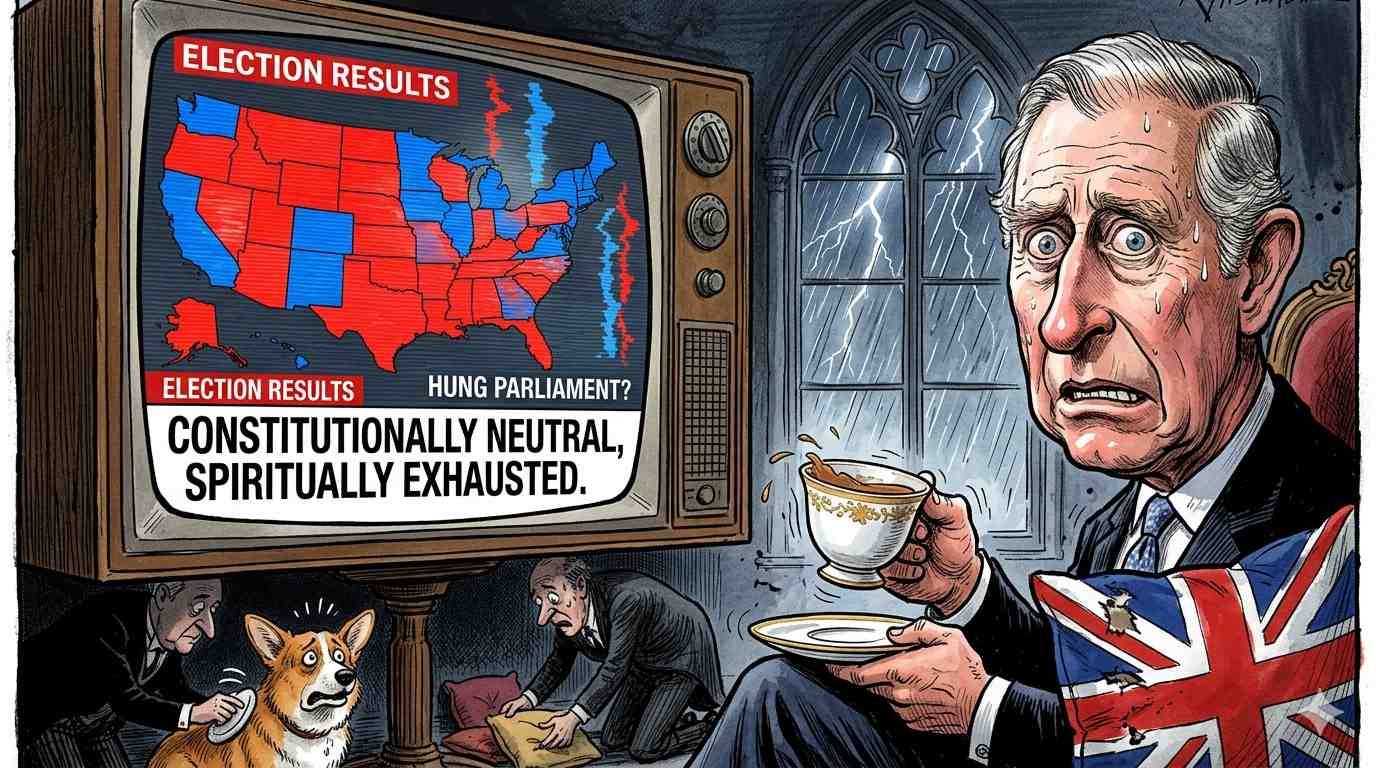
Charles Watches Election Results With Expression Last Seen at Diana’s Funeral
Charles Watches Election Results — The London Prat
Charles Watches Election Results With Expression Last Seen at Diana’s Funeral
Britain’s King maintains constitutional dignity while clearly having thoughts he is constitutionally unable to express
LONDON — King Charles III, who has now been monarch for the entirety of the Starmer premiership and who, by the conventions of constitutional monarchy, is required to remain entirely above the political fray while being comprehensively informed of everything happening in the political fray, watched the 2026 local election results with an expression that royal watchers have described as “studied neutrality,” “considered calm,” and, from one correspondent who has covered the Royal Family for twenty-three years, “the face he makes when he’s having the kind of thoughts that would cause a constitutional crisis if he said them out loud.”
Charles, who will shortly be required to receive Keir Starmer at Buckingham Palace for the weekly audience at which the Prime Minister briefs the monarch on government business, and who will further be required to deliver a King’s Speech when Parliament is called upon to receive one, and who is constitutionally unable to express any preference for any political outcome of any election, managed all of this with the regal composure of a man who has survived considerably more turbulent political weather than a bad night for Labour.
King Charles and British Constitutional Monarchy During Political Crisis
The monarchy’s relationship with democratic upheaval is, by now, well practised. Charles has presided over the transition from Conservative to Labour government, the appointment of four Prime Ministers, two sets of local elections, the ongoing aftermath of Brexit, the death of his mother, his own cancer diagnosis, and the continuing public evolution of his relationship with his son Harry — a sequence of events that would, by any reasonable human measure, justify a period of sustained irritability.
He has not been irritable. He has been, by all visible accounts, dignified, engaged, and committed to the constitutional principle that the monarch serves all British subjects regardless of their political affiliation — a principle that requires exceptional personal discipline when approximately 41% of those subjects have just voted for parties that have characterised the political establishment, of which the monarchy is a central component, as fundamentally failing them.
A senior royal source — a figure so senior and so constitutionally careful that the source itself would deny being a source if asked — described Charles’s response to the results as “reflective.” This is the word the palace uses for all emotional responses that are too complex to characterise more specifically without breaching the constitutional convention against royal political commentary. Charles is often reflective. He was reflective about Brexit. He was reflective about the 2024 election. He was reflective on Thursday night.
The Palace’s View of Britain’s Political Fragmentation
Beneath the constitutional surface, it is possible to observe that Charles has, throughout his reign, demonstrated a consistent interest in social cohesion, community sustainability, and the wellbeing of working people — interests expressed through his charitable work, his architecture campaigning, his organic farming, and his longstanding concern for precisely the communities that delivered their verdict against the established political order on Thursday.
He cannot say any of this publicly. This is the nature of constitutional monarchy. But the expression — the one that royal correspondents noted, carefully, with appropriate caveats — is the expression of a man whose thoughts are, for constitutional reasons, entirely his own.
The weekly audience with Starmer will take place. Starmer will brief the King. The King will listen. He will, almost certainly, be the best listener in the conversation. Whether he will share his own conclusions is not something that has happened publicly in the thousand-odd years of British monarchy, and this week seems unlikely to be the moment it starts.
This article arrives against the backdrop of the British constitutional monarchy having served its stabilising function precisely in the periods when stability is hardest to find — the aftermath of wars, the abdication crisis, the post-Diana turmoil, and now a political realignment that has disrupted every established pattern of British democratic life since the post-war settlement, with Charles maintaining, in the best monarchical tradition, a silence so considered it communicates everything.
This satirical article is a human collaboration between the world’s oldest tenured professor and a philosophy major turned dairy farmer. No constitutional conventions were breached during production. Any resemblance to expressed royal political opinion is entirely fictional. Auf Wiedersehen, amigo!
Originally published at https://prat.uk on May 9, 2026.
메타데이터
- post_id
- a88b741cb72b
- slug
- charles-watches-election-results-the-london-prat-a88b741cb72b
- url
- https://medium.com/@londons.prat/charles-watches-election-results-the-london-prat-a88b741cb72b
- canonical_url
- https://medium.com/@londons.prat/charles-watches-election-results-the-london-prat-a88b741cb72b
- author_url
- https://medium.com/@londons.prat
- status
- ok
- fetched_at
- 2026-08-08 00:48:01