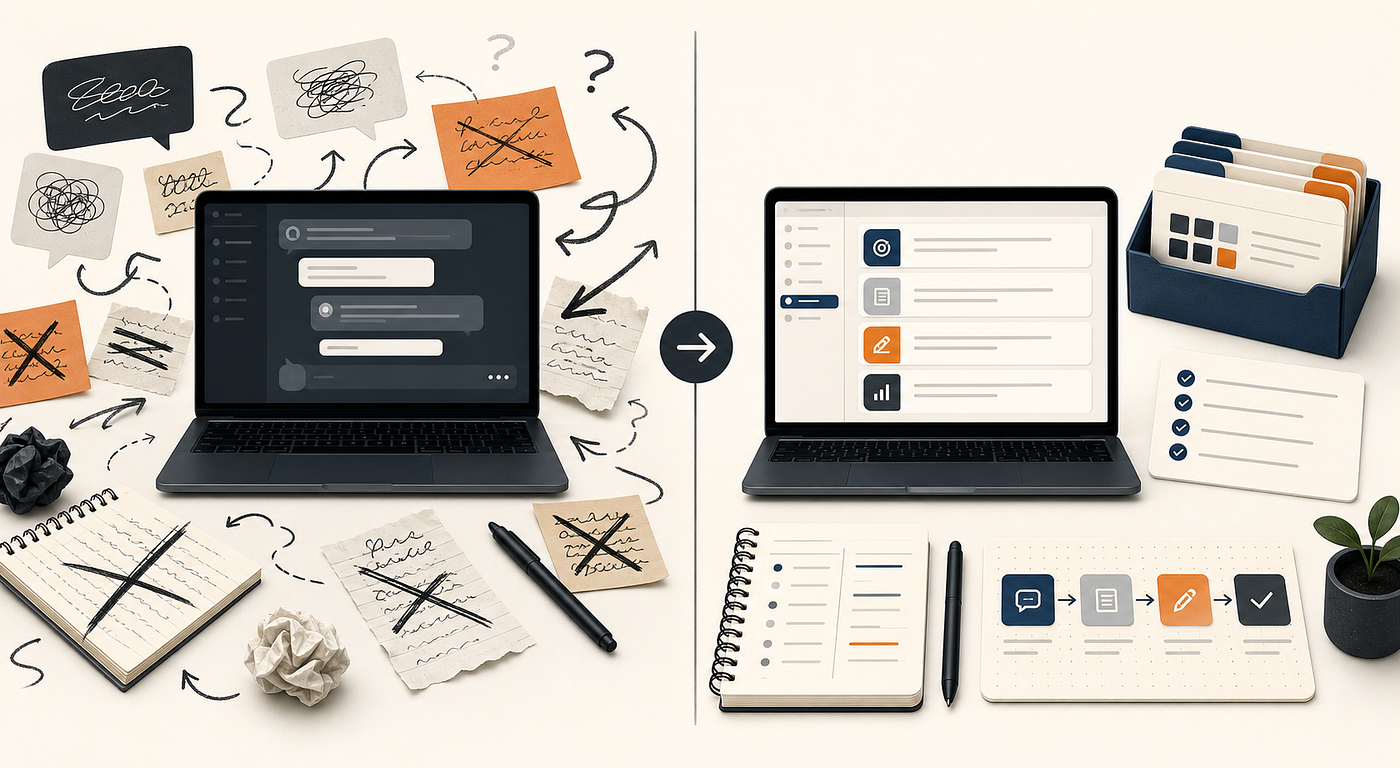
AI Research Prompts: Find Better Sources, Compare Arguments, and Avoid Hallucinations
A practical workflow for making AI useful in research without treating it like a citation machine.
AI Research Prompts: Find Better Sources, Compare Arguments, and Avoid Hallucinations
A practical workflow for making AI useful in research without treating it like a citation machine.
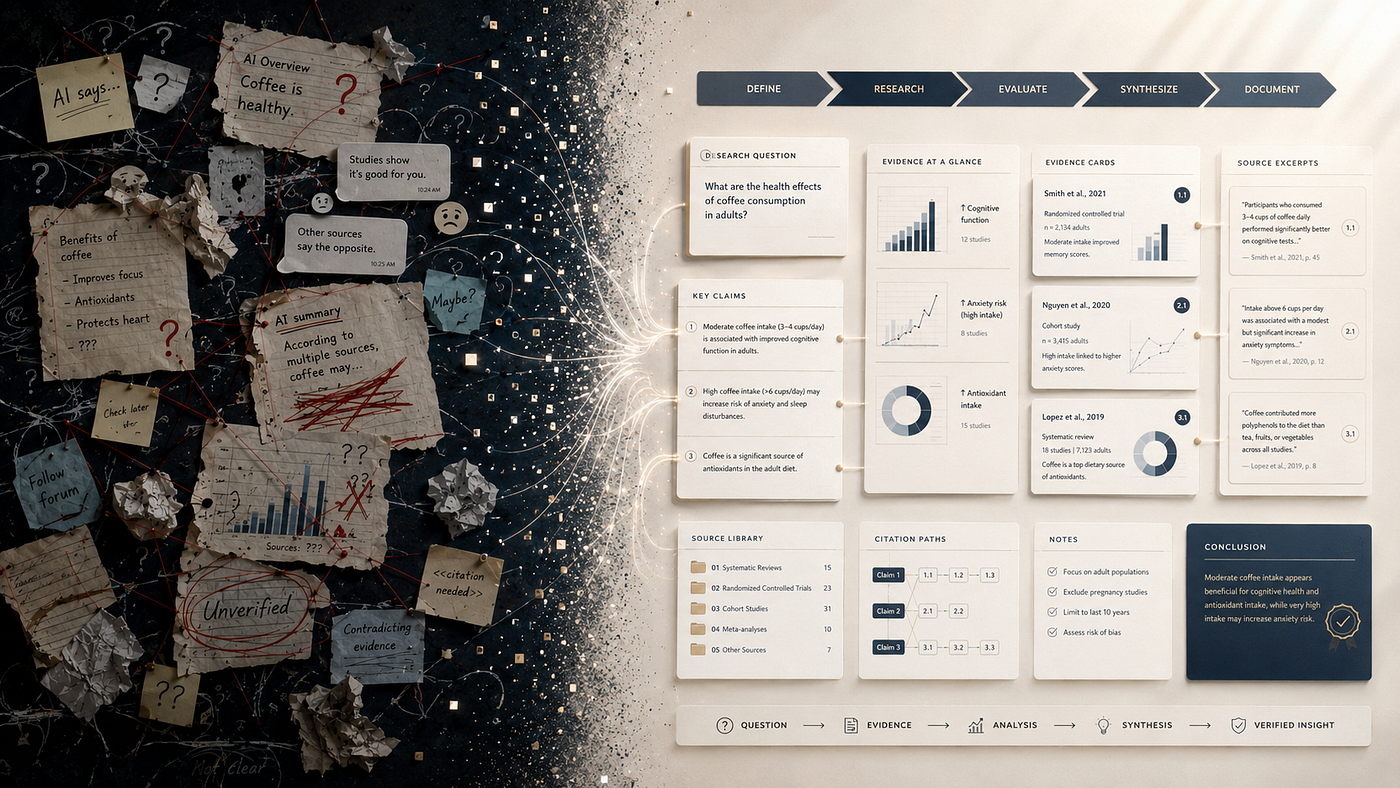
The most dangerous AI research answer is not the obviously wrong one.
It is the one that sounds clean, complete, and barely sourced.
That is where a lot of people get burned.
They ask ChatGPT or Claude to “research” a topic, get back a fluent answer, and mistake the tone for reliability. The result may look thoughtful. It may even sound balanced. But if the model was never pushed to show where the ideas came from, separate evidence from interpretation, or admit uncertainty, the answer is doing something closer to performance than research.
This is the real reason so many AI-assisted research sessions go sideways.
The failure usually starts before the hallucination.
It starts when the prompt asks for conclusions before it asks for sources.
If you want better AI prompts for research, that is the shift that matters most. Use AI to discover, sort, compare, and pressure-test information. Do not use it as a machine for instant certainty.
Why AI research goes wrong
Most bad AI research workflows break in four predictable ways.
First, the prompt is vague. “Research this topic for me” tells the model nothing about what counts as a trustworthy answer, what kind of sources matter, or how careful it needs to be.
Second, the prompt asks for synthesis too early. If the model starts by writing the answer, it will often fill gaps with plausible-sounding glue.
Third, there is no distinction between evidence and interpretation. A strong research workflow needs both, but it also needs them clearly separated.
Fourth, nobody asks the model to expose uncertainty. That is how soft claims get hardened into fake confidence.
This is why AI research often feels useful right up until the moment you try to verify it.
The output is smooth. The support behind it is thin.
The better rule: sources first, synthesis second
A better workflow starts with a simple rule.
Do not ask AI for the final answer until it has helped you map the evidence landscape.
That means using the model in stages:
- Clarify the question.
- Identify the types of sources you need.
- Gather candidate angles, authors, publications, or search paths.
- Compare arguments without forcing a winner too early.
- Only then write a synthesis, with uncertainty still visible.
This matters because compression and synthesis are destructive by default.
When a model has not been forced to anchor itself to sources and argument structure, it will generate the shape of an answer whether the evidence is solid or not.
That is useful for brainstorming.
It is dangerous for research.
A simple workflow for using AI in research
Here is the repeatable version.
- Define the research task clearly. Are you trying to understand a topic, gather sources, compare viewpoints, or prepare a brief?
- Ask for search strategy before conclusions. Have the model suggest source categories, search terms, databases, and framing questions.
- Collect candidate material. Use AI to organize possible sources, not to invent them.
- Extract claims and support separately. Ask what each source argues, what evidence it uses, and what limits it has.
- Compare arguments side by side. Make the model surface agreement, disagreement, assumptions, and missing evidence.
- Pressure-test the synthesis. Ask what may be uncertain, weakly supported, or vulnerable to hallucination.
That workflow is slower than “just answer this.”
It is also much more trustworthy.
Prompt pattern for finding better sources
This is where many people get sloppy.
They ask AI for sources, get a list, and assume the list is real, current, and relevant.
That is the wrong frame.
A better use of AI is to ask for source-finding strategy first, then use the output to guide your own search or validate each candidate.
I am researching this question: [insert question].
Do not answer it yet.
First help me build a source-finding plan.
Give me:
- the subtopics I should research
- the types of sources that matter most for this question
- useful search terms and alternate phrasings
- experts, institutions, journals, or publications worth checking
- signals that a source may be weak, outdated, or biased
If you mention a source or publication, say whether you are suggesting a
search path or referring to a known source.
Do not invent citations.
That last line matters.
If you use AI during research, you should get comfortable telling the model what not to fake.
The goal here is not to let AI pretend it already did your reading. The goal is to turn a vague question into a stronger research map.
Prompt pattern for comparing arguments
Once you have actual material, AI becomes more useful.
This is especially true when you are reading multiple articles, papers, or expert viewpoints that partly agree and partly conflict.
Instead of asking, “Who is right?” ask for a comparison frame.
Compare these two arguments without forcing a winner.
For each one, extract:
- the main claim
- the supporting evidence
- the assumptions
- the strongest counterpoint
- what would weaken the argument
Then show:
- where the arguments genuinely disagree
- where they may be talking past each other
- what additional evidence would help evaluate them
Keep facts, interpretation, and uncertainty separate.
That prompt does two things most lazy prompts do not.
It slows down false certainty, and it makes disagreement legible.
That is what a lot of research actually needs.
Not instant closure. Better comparison.
Prompt pattern for hallucination checks
Sometimes you already have an AI-generated summary, brief, or answer and need to know whether it is safe to trust.
This is where a hallucination check prompt helps.
Review the answer below as a research editor.
Do not improve the writing yet.
Check for:
- claims that need sourcing
- statements that sound too certain for the evidence shown
- possible invented citations, studies, or named entities
- places where interpretation is presented as fact
- missing caveats, limitations, or alternative explanations
Return the result in three sections:
1. likely well-supported
2. needs verification
3. likely unsafe or hallucinated
Explain why each flagged point is risky.
This turns AI into a critic of its own style.
It is not perfect, but it is much better than trusting fluency on sight.
The verification checklist most people skip
Before you use an AI-assisted research output in notes, content, client work, or decision-making, run a quick check:
- Did the answer show where its key claims came from?
- Did it separate evidence from interpretation?
- Did it admit uncertainty where the issue is genuinely unsettled?
- Did it compare arguments fairly instead of flattening them?
- Did it invent anything that now needs manual checking?
- Did it leave out important caveats or scope limits?
If the answer fails two or three of those checks, treat it as a draft for investigation, not a conclusion.
That mindset alone will save you from a lot of confident nonsense.
A weak research prompt versus a better one
Weak prompt
Research this topic and give me the answer.That prompt invites performance.
Better prompt
Help me research this topic in stages.
First, clarify the question and suggest a source-finding plan.
Second, help me compare the strongest available arguments and note what
evidence each one uses.
Third, draft a synthesis that clearly marks uncertainty, missing information,
and claims that still need verification.
Do not invent citations or present unsupported claims as settled facts.
The second prompt is not magic.
It is disciplined.
And discipline is what makes AI genuinely useful in research.
The practical takeaway
The best AI prompts for research do not make the model sound smarter.
They make the workflow more checkable.
If you use AI to research topics for study, writing, strategy, or decision-making, stop asking it to jump straight to the polished answer. Ask it to help you find better sources, compare arguments more honestly, and expose risk before the output gets reused.
That is where reusable prompt systems earn their keep.
Not because they give you more prompts, but because they keep the same evidence-first logic every time the stakes are real.
If you want a shortcut, save a small set of research prompts for source discovery, argument comparison, and hallucination checks. That alone will improve the quality of your AI-assisted research far more than chasing a newer model and hoping it reads your mind.
Found Interesting? Read other articles as well:-
메타데이터
- post_id
- a89d71740e9e
- slug
- ai-research-prompts-find-better-sources-compare-arguments-and-avoid-hallucinations-a89d71740e9e
- url
- https://medium.com/@kumawat/ai-research-prompts-find-better-sources-compare-arguments-and-avoid-hallucinations-a89d71740e9e
- canonical_url
- https://medium.com/@kumawat/ai-research-prompts-find-better-sources-compare-arguments-and-avoid-hallucinations-a89d71740e9e
- author_url
- https://medium.com/@kumawat
- status
- ok
- fetched_at
- 2026-06-09 15:37:30