Beyond Heatstroke: How Extreme Summers Threaten India’s Informal Workforce
Why India’s rising temperatures demand stronger labour protections, climate-responsive policies, and long-term adaptation for millions of…
Beyond Heatstroke: How Extreme Summers Threaten India’s Informal Workforce
Why India’s rising temperatures demand stronger labour protections, climate-responsive policies, and long-term adaptation for millions of informal workers.
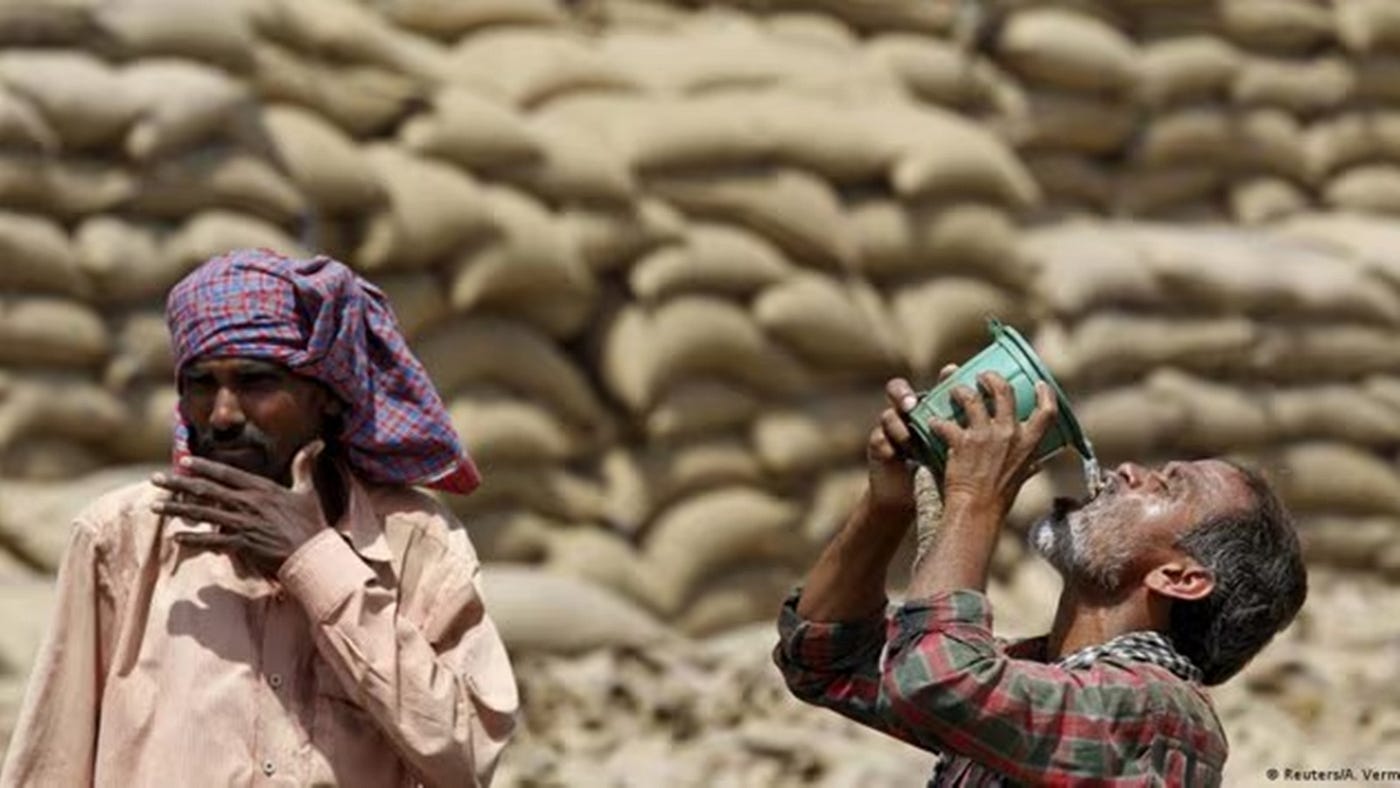
Heat-exposed informal workers pause briefly to rehydrate while working under extreme summer conditions in India — a reminder of the urgent need for stronger heat protection policies.
On 28 April 2026, the Ministry of Labour and Employment issued a nationwide heatwave advisory to safeguard workers and labourers from the adverse effects of rising temperatures and heat wave conditions across the country. This advisory directed the States/UTs to adopt measures to protect the health of the workers by incorporating various measures. But this gives rise to a more serious question: Do extreme summers only affect the health of workers, or do they also lead to other consequences that hamper their sustenance?
Up to 75 percent of India’s workforce, or 380 million (38 crore) people, depend on heat-exposed labour, as per a 2022 World Bank report. This largely includes blue-collar and the informal sector workforce in agriculture, construction, manufacturing and delivery services. With India reporting the world’s 50 hottest cities, the scorching heat not only deteriorates the health of the ‘heat-exposed informal workers’ but also has a grave impact on their ability to earn wages.
A study published in Environmental Research Letters examined 396 heat-exposed outdoor workers living in two informal settlements in Delhi during peak heat of May-June 2019. It found that these workers bear significant economic losses and health impact due to high heat. The study found that a 1°C rise in maximum temperature results in a 14% drop in net earnings, while a similar rise in wet bulb temperature (combined measure of heat and humidity) reduces net income by 19%. During the two heat waves that occurred in the study period of a month, the workers’ earnings were 40% lower than on the other days, the study found. Also, as temperatures rose, expenditures on essentials such as medicine, ice, and water surged with costs increasing by 14.4% per degree rise in temperature.
Gig workers also suffer similar losses due to heat waves and high temperatures. A period of short respite taken to cool themselves under a shade dropped their earnings to ₹200–300 from the average ₹1000–1200 earned on normal days, said a gig worker in a news article. Besides this, malfunctioning of mobile phones due to overheating and lack of water and rest places aggravate their situation.
The impact of extreme heat is also deeply gendered. Women constitute a significant proportion of heat-exposed labour in India. The impact of heat on pregnant/lactating women as well as on women with children is heavier and more detrimental than their male counterparts. Work sites often lack drinking water, creches among other necessary, basic facilities. This along with sweltering heat not only deteriorates the health of women or their children but also exacerbates their already precarious livelihood.
The heat is not only differently felt by the men and women labour force, it also intensifies already existing other social-economic inequalities. For instance, rapid urbanisation and even more rapid clearance of green covers have paved the way for the urban poor to suffer significantly. Fragmented greenery, pollution, waste heat etc., leads to a much higher temperature in urban areas than the nearby rural areas. Consequently, the slums, where most of the informal heat-exposed labourers live, become uninhabitable places.
The conditions in slums are already very grave, plus when temperature soars or heat waves occur this adds up to their problems. For instance, houses in slums are often made of heat-trapping materials such as tin, plastic, cardboard, plywood scraps, or PVC sheets which increases the heat stress on the people living inside them. Moreover, frequent power cuts during peak summers turn their houses into heat traps. Therefore, this again impacts the productivity of the worker who has to go for work in the sultry weather the next day.
Extreme heat not only undermines workers’ health, productivity, and income but also weakens the country’s economic growth. According to a study from researchers at Duke University, India lost around 259 billion hours of labour annually between 2001 and 2020 due to the impacts of humid heat. The loss of these productive hours cost India $624 billion (Rs 46 lakh crore)–equivalent to almost 7% of its 2017 gross domestic product (GDP). At the same time, globally humid heat caused 677 billion hours of lost labour each year, worth $2.1 trillion (Rs 156 lakh crore). Among other countries, India ranked first in the labour-hour losses, possibly because of its larger workforce.
With extreme working conditions and absence of necessary facilities, it is evident that the workers will have to bear health repercussions. In many cases workers end up in hospitals and in some cases they may even lose their lives.
But there too exists a lot of discrepancy in the official mortality data about deaths caused by heat strokes across the country. Between 2000 and 2020, the National Crime Records Bureau (NCRB) reported 20,615 heatstroke deaths, the National Disaster Management Authority (NDMA) listed 17,767 heatwave deaths, and in contrast, the India Meteorological Department (IMD) recorded just 10,545 deaths. Such significant differences between the official heat stroke mortality data from different government sources indicates differences in methodology, data sources, reporting responsibilities, and also points towards a more serious issue of underreporting. For instance, a physician might record only the immediate medical cause on the death certificate of a worker, without acknowledging the role of heat as the underlying trigger.
The death of a worker, who might be the sole earner, does not only induce grief or emotional pain on his family but also affects their possibility to sustain. Their economic security gets lost and they might expect very little from the state. This is because the state does not classify heatwave as a notified disaster under Disaster Management Act, 2005.
**In response to several questions in Lok Sabha in 2025, Dr. Jitendra Singh, Union Minister of State (Independent Charge) for Science and Technology, stated that the 15th Finance Commission considered the issue of including more calamities in the existing notified list of calamities, but ‘declined to include heatwaves on the notified disaster list’. Singh also noted that if a State government wants to provide relief to the victims of natural disasters that it considers to be disasters within local context but that are not included in the notified list, in that case it can use up to 10 per cent of the annual fund allocation of the State Disaster Response Fund (SDRF). This places the financial burden on the State governments whose fiscal resources are already constrained and this might also lead them to suppress the number of mortalities due to heat.**
For instance, according to a media report, in 2024 Rajasthan had approximately 67 cases of deaths linked to heatwave conditions. However, only 9 deaths were officially recognized by the state government as heatwave-related. These families received compensation only after the Rajasthan High Court intervened in the matter.
The resistance to notifying heatwaves as a national disaster is not scientific — it is financial. Notification would require the Central government to pay Rs 4 lakh in compensation for each confirmed heat-related death. This creates an immediate incentive to suppress mortality counts.
Indian laws remain silent on the protection of heat-exposed outdoor workers. The erstwhile Factories Act of 1948 required registered factories to ensure adequate ventilation by the circulation of fresh air for protecting the workers inside the factories from the adverse effects of working in heat. But neither this nor the existing Occupational Safety, Health and Working Conditions (OSH) Code, 2020 talks about the regulatory measures for the 50% of the labor force which works outdoors. While the 2020 model creates some protection for dock workers but it is of only advisory in nature.
Additionally, under the Factory Act of 1948 the state governments had the power to notify their own thresholds and appoint inspection officers to check compliance. But section 23 of the new OSH code has centralised this provision, enabling only the central government to prescribe ventilation, temperature and humidity standards.
Due to lack of institutionalised and formalised laws on heat-protection of the outdoor workers, the state is left with the local level heat action plans and the national heatwave advisories which are ‘recommendatory’ in nature and remain largely unenforceable.
Almost every heat-prone state has institutionalised heat governance through a heat action plan (HAP). But the rapid spread of HAPs across India also masks deeper structural challenges. Most HAPs lack vulnerability mapping, i.e., the identification of which communities, occupational groups, and geographies face the highest risk within a district. Also, these HAPs focus only on short term coping measures, instead of any long term initiatives.
Addressing the growing impact of extreme heat on informal workers requires a comprehensive approach rather than merely issuing seasonal advisories. First, heat waves need to be recognised as a notified disaster, to secure timely compensation and institutional accountability. Second, the Occupational Safety, Health and Working Conditions Code 2020 should be amended for incorporating enforceable safeguards and to be made inclusive of the massive outdoors workforce vulnerable to heat. And third, the Heat Action Plan must shift its nature from short-term to a long-term, sustainable framework that addresses the root causes of heat vulnerability.
With climate change making heatwaves more frequent and more intense, India’s informal workers are on the frontlines of a crisis they had little hand in creating. Extreme heat is an environmental challenge that threatens the health, livelihoods and dignity of millions of workers. So it is not only a question of disaster management but also of social justice, economic resilience and constitutional commitment to the right to life.
메타데이터
- post_id
- a8dd30d7b2e8
- slug
- beyond-heatstroke-how-extreme-summers-threaten-indias-informal-workforce-a8dd30d7b2e8
- url
- https://medium.com/@atharv415patel/beyond-heatstroke-how-extreme-summers-threaten-indias-informal-workforce-a8dd30d7b2e8
- canonical_url
- https://medium.com/@atharv415patel/beyond-heatstroke-how-extreme-summers-threaten-indias-informal-workforce-a8dd30d7b2e8
- author_url
- https://medium.com/@atharv415patel
- status
- ok
- fetched_at
- 2026-07-11 03:26:30