The Real Economics of Solitaire Games: Why the Simplest Genre Has the Hardest Unit Economics
$4 to acquire a player. 180 days to break even. Welcome to the solitaire economy.
The Real Economics of Solitaire Games: Why the Simplest Genre Has the Hardest Unit Economics
$4 to acquire a player. 180 days to break even. Welcome to the solitaire economy.
Solitaire is one of the most iconic games ever made. Hundreds of millions of people have played it. It’s been on every Windows computer since 1990. It’s one of the first things people download on a new phone.
From the outside, it looks like a dream category for mobile publishers. Massive TAM. Universal appeal. No need to explain the gameplay. Players already know what they’re signing up for.
From the inside, it’s one of the most unforgiving categories in mobile gaming.
I’ve spent the past year building and scaling solitaire games in the US market. Here’s what the real numbers look like and why this genre is harder than it appears.
The Benchmark: What $4 Buys You
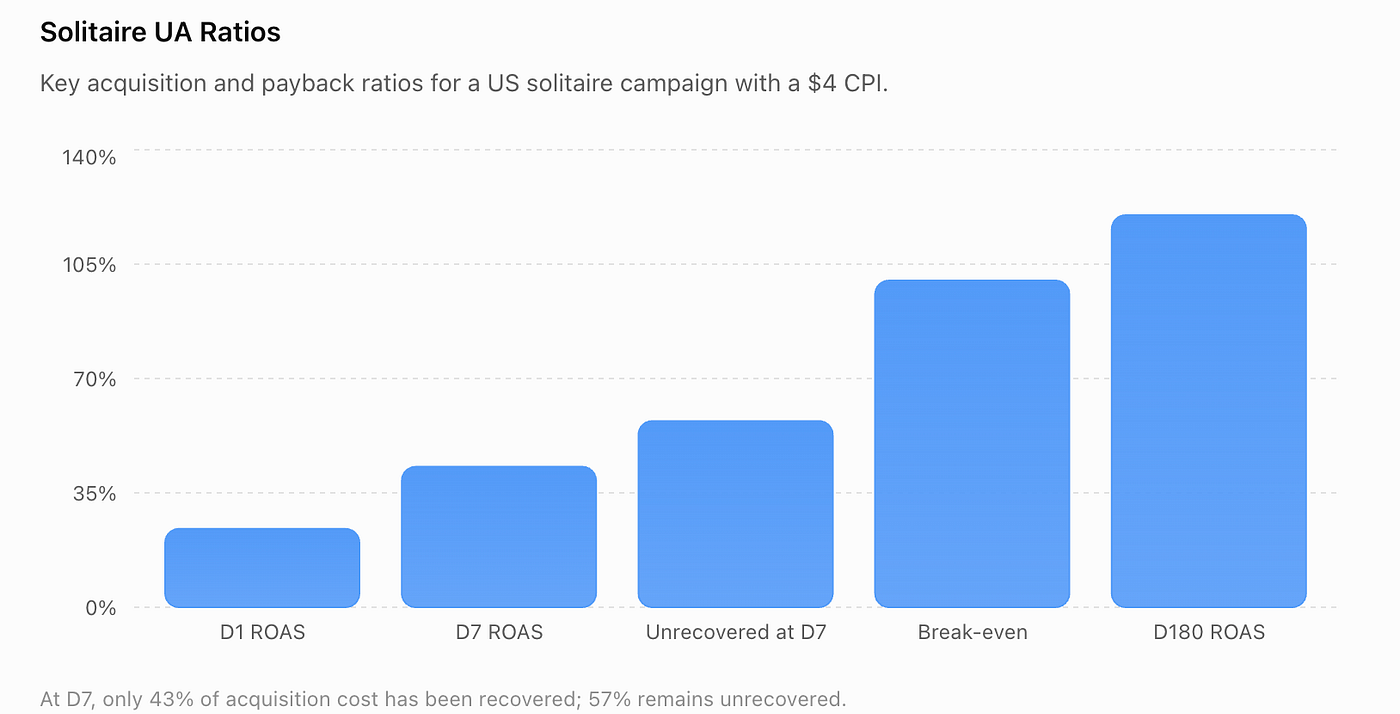
Let’s start with the baseline. On Unity Ads in the US market, the benchmarks for a solitaire game look like this:

Read that again.
At $4 CPI, you recover 24 cents on the dollar after the first day. After a full week, you’re still underwater less than half your investment is recovered. The breakeven point? Six months. D180.
That’s the solitaire economy. You’re paying premium prices for users in one of the most competitive categories on the App Store, and you need six months of retained, engaged, monetizing players just to get back to zero.
If your cash flow can’t sustain that runway, you can’t compete.
The Retention Lever: Why Unity Vector ROAS Changes the Game
Here’s where it gets interesting.
The traditional approach for solitaire UA has been to cobble together incentivized traffic from multiple small sources. Offerwall networks, rewarded install platforms, niche ad networks each delivering a trickle of installs. The ROAS and retention from these sources can actually be decent. The problem isn’t quality. It’s scale.
Incentivized channels are fragmented. Each source delivers small volumes. Managing ten different incent partners to get a few thousand installs a month is operationally expensive, hard to optimize, and impossible to scale meaningfully.
Unity’s vector ROAS optimization changes the equation entirely. Instead of buying installs and hoping for retention, you’re optimizing directly for revenue events. The algorithm targets users who are likely to generate ad revenue not just users who are likely to install.
The result: comparable ROAS and retention to incent traffic — but with significantly bigger reach and far less operational complexity.
This matters enormously for solitaire. When your breakeven is D180, you need both quality and volume. Incentivized traffic gives you quality in small doses. Vector ROAS gives you quality at scale, from a single source, with algorithmic optimization doing the heavy lifting.
For a genre where every percentage point of early retention compounds into real revenue at D180, that combination of quality and reach is what makes a solitaire game viable as a business not just as a side project.
The Proof: Unity Retention Cohorts vs. Industry Benchmarks
Theory is one thing. Here’s what the actual cohorts look like.
Our most recent Unity vector ROAS retention cohorts on a solitaire game in the US (June 2026):

Now compare that against the industry benchmarks for gaming retention (source: AppsFlyer):

The numbers speak for themselves.
D1 retention at ~40% is significantly above the gaming average on both Android (26%) and iOS (33%). D7 at ~14% is nearly double the Android benchmark and well above iOS. And the D21 numbers while still early are tracking above the D30 industry average for gaming.
This is what vector ROAS optimization actually delivers. Not just installs. Not just volume. Users who stay, play, and monetize at a retention rate that outperforms the industry by a wide margin.
For a solitaire game with a D180 breakeven, this kind of early retention advantage is everything. It’s the difference between cohorts that compound into profitability and cohorts that bleed cash for six months and never recover.
Why Solitaire Is Harder Than It Looks
From the outside, solitaire seems simple. Everyone knows the game. The mechanics are proven. The audience is massive.
But that simplicity is the trap.
The TAM is large, but so is the competition. Every major casual gaming publisher has a solitaire game. The top of the category is dominated by companies with massive UA budgets and years of optimization data. Breaking in means outbidding them at $4+ CPI in the US.
The monetization model relies on both IAP and ad revenue. Unlike what many assume, solitaire isn’t purely ad-driven. The best solitaire games run a hybrid model in-app purchases for power-ups, extra lives, cosmetics, and premium features alongside ad monetization. Both revenue streams matter, and both depend on retention. Without retained users, neither IAP nor ad revenue compounds enough to cover a $4 CPI.
The payback window is painfully long. D180 to break even means you need six months of cashflow before you see a return. For indie studios or bootstrapped publishers, that’s not a strategy it’s a bet.
Retention is the real game. When your breakeven is six months out, every percentage point of D7 or D30 retention you gain compounds dramatically. A 2% improvement in M1 retention can mean the difference between a profitable cohort and a losing one at D180.
What Actually Moves the Needle
After nine months of data, a few things are clear:
1. Retention is not a UA problem it’s a product problem. You can optimize creatives, bids, and targeting all day. If your D7 retention is low, no amount of UA optimization will fix your unit economics. The first seven days are where the game is won or lost.
2. Vector ROAS optimization gives you incent-level quality at real scale. Incentivized traffic from multiple small sources can deliver decent ROAS and retention but it doesn’t scale. Unity’s vector ROAS targets users by monetization potential, delivering comparable quality with far greater reach from a single source.
3. Scale and quality are in constant tension. You can’t just pour more money into the top of the funnel and expect linear returns. More volume typically means lower average user quality. There’s a quality ceiling that varies by channel, creative, and season and finding it before you blow through your budget is the real UA skill.
4. ROAS variance is the enemy of planning. The same game, same product, same team can produce wildly different ROAS outcomes month to month. Auction dynamics, seasonality, creative fatigue they all shift the economics under your feet. You need real-time cohort tracking and the ability to reallocate budget within days, not weeks.
5. The objective should be D7 ROAS, not D180. Our target: reach 60% ROAS within seven days of user acquisition. If you can hit that threshold consistently, the D180 economics take care of themselves. If you can’t, no amount of long-term optimization will save the cohort.
The Bigger Picture
Solitaire isn’t unique. Every casual game with a long payback window faces some version of these dynamics. High CPI markets. Six-month breakevens. Retention curves that punish scaling. ROAS variance that makes forecasting feel like guesswork.
But solitaire makes the problem especially visible because the margins are so thin and the competition is so intense.
If you’re building in this category, here’s the uncomfortable truth: the game you’re competing in isn’t solitaire. It’s the economics underneath solitaire. The game is retention. The game is payback period. The game is how fast you can learn from your data and adjust.
The studios that win in solitaire aren’t the ones with the best card animations. They’re the ones who treat UA, retention, and monetization as one integrated system and optimize the whole loop, not just the parts.
Claire Rozain is CEO of Rzain and Founder of SisterSoundFR & Rzain consulting. She builds apps and games for gender equality & do User acquisition consulting. Follow her work on LinkedIn.
메타데이터
- post_id
- a8dd9895cabd
- slug
- the-real-economics-of-solitaire-games-why-the-simplest-genre-has-the-hardest-unit-economics-a8dd9895cabd
- url
- https://medium.com/@RZAIN/the-real-economics-of-solitaire-games-why-the-simplest-genre-has-the-hardest-unit-economics-a8dd9895cabd
- canonical_url
- https://medium.com/@RZAIN/the-real-economics-of-solitaire-games-why-the-simplest-genre-has-the-hardest-unit-economics-a8dd9895cabd
- author_url
- https://medium.com/@RZAIN
- status
- ok
- fetched_at
- 2026-07-25 22:12:05



