What the Heck Is the Monroe Doctrine?
Why an 1823 sentence keeps resurfacing — and why misunderstanding it is dangerous
What the Heck Is the Monroe Doctrine?
Why an 1823 sentence keeps resurfacing — and why misunderstanding it is dangerous
I. Why This Old Doctrine Suddenly Matters Again
Over the past few weeks, the phrase “Monroe Doctrine” has been thrown around with remarkable confidence — by commentators, politicians, and social media influencers alike — often with wildly different meanings. It has been invoked to justify U.S. actions in Venezuela, to rationalize pressure on Mexico and Colombia, and most recently, to frame rhetoric around Greenland.
The breaking point, for me, was a meme shared by Katie Miller, wife of the White House Deputy Chief of Staff Stephen Miller. Posted on 3 January 2026, just hours after U.S. forces bombed Caracas and captured Venezuelan President Nicolás Maduro, the image showed a map of Greenland draped entirely in the U.S. flag, captioned with a single word — “SOON.”
The timing was deliberate. The subtlety was not.

At that point, it became clear that many people using the term “Monroe Doctrine” no longer know — or no longer care — what it originally meant. And crucially, they don’t seem to understand the difference between coercing Venezuela and threatening Greenland — which is roughly the difference between mugging someone in a dark alley and breaking into your neighbor’s house while the neighborhood watch looks on in horror.
This essay is an attempt to slow the conversation down. To ask three necessary questions:
What the heck is the Monroe Doctrine, really? How did it travel from a defensive warning in 1823 to what President Trump now calls the “Donroe Doctrine” (yes, really)? And why does this semantic shift threaten to break the entire post-WWII international order?
II. The Original Contract (1823)
The Monroe Doctrine originates from President James Monroe’s annual message to Congress in December 1823. It’s worth remembering that in 1823, the United States was approximately as intimidating on the global stage as a strongly worded letter from your homeowners’ association.
Its core claim was simple and narrow:
The 1823 Deal:
- European powers would not recolonize or interfere in the Americas
- In return, the United States would stay out of European wars and internal affairs
Crucially:
- The U.S. at the time was not a great power (think more plucky underdog than global hegemon)
- The doctrine had no enforcement mechanism of its own
- Its credibility rested largely on British naval power, not American strength

In other words, the Monroe Doctrine was not a declaration of ownership. It was a defensive boundary-setting exercise by a weak state, anxious about the return of European empires. The geopolitical equivalent of putting up a “No Soliciting” sign.
It said: no new empires here — not this is ours.
That distinction, as we’ll see, did not age well.
III. The Slide: From Shield to Switchblade (1904–2013)
Over the next century, the Monroe Doctrine underwent a series of mutations, each expanding American claims while eroding constraints. Think of it as the Ship of Theseus, if the ship gradually turned into an aircraft carrier.

Political cartoon by Louis Dalrymple about U.S. expansionism
1904: The Roosevelt Corollary
President Theodore Roosevelt added a crucial twist: if Latin American states were unstable or indebted, the United States had the right to intervene to restore order. In his message to Congress, Roosevelt declared that “chronic wrongdoing” might force the United States to exercise “international police power.”
This quietly inverted the doctrine.
- From blocking European intervention
- To justifying American intervention
The doctrine shifted from a shield into a lever. Or, if you prefer, from “keep out” to “we’re coming in.” Over the following decades, it rationalized U.S. military occupations in Haiti, the Dominican Republic, Nicaragua, and elsewhere. Teddy Roosevelt’s “speak softly and carry a big stick” had morphed into “speak occasionally and wave the stick around a lot.”
Cold War: Ideological Justification
During the Cold War, the Monroe Doctrine became shorthand for excluding extra-hemispheric ideologies, especially communism. From the 1954 Guatemala coup to Reagan’s Contra war in Nicaragua, the doctrine provided cover for interventions that had exactly nothing to do with European colonization.
By then, the doctrine no longer described restraint. It described sphere-of-influence politics. The “No Soliciting” sign now read “No Soliciting (except us).”
2013: The Brief Disavowal
By 2013, the Monroe Doctrine had become so associated with American overreach that Secretary of State John Kerry explicitly declared it dead: “The era of the Monroe Doctrine is over.”
That disavowal lasted approximately one news cycle longer than a New Year’s resolution at a gym. Which is to say: barely a decade.
IV. The 2026 Break: Enter the “Donroe Doctrine”
On Saturday, 3 January 2026, following the military operation that captured Maduro, President Trump announced: “The Monroe Doctrine is a big deal, but we’ve superseded it by a lot, by a real lot. They now call it the ‘Donroe Doctrine.’ Under our new national security strategy, American dominance in the Western Hemisphere will never be questioned again.”
Yes, “Donroe Doctrine.” A portmanteau so on-the-nose it would make a marketing executive blush. But credit where it’s due: at least it’s honest branding.
This is where we need to understand what happens when political language loses its moorings. Words tied to power rarely stay stable — they get repurposed, stretched, and eventually hollowed out until they mean whatever the powerful want them to mean. The pattern is predictable: a term begins with a precise meaning, acquires moral weight, gets stretched instrumentally by powerful actors, constraints dissolve, and finally the word becomes what linguists call a “floating signifier” — which is academic speak for “a word that now means whatever you want it to mean.”
This happened to “terrorism.” It happened to “woke.” It happened to “literally” (though that one’s more tragic than geopolitical). It happened to “national security.”
And it is now happening — visibly, rapidly, with almost comedic speed — to the Monroe Doctrine.
The Formal Break
The Trump administration’s 2025 National Security Strategy formally articulates a “Trump Corollary” to the Monroe Doctrine (because apparently one corollary wasn’t enough): “The United States will reassert and enforce the Monroe Doctrine to restore American preeminence in the Western Hemisphere… We will deny non-Hemispheric competitors the ability to position forces or other threatening capabilities, or to own or control strategically vital assets, in our Hemisphere.”
Notice the possessive. Our Hemisphere.
At his news conference, Trump was even more explicit: “We’re going to run Venezuela.” Not help. Not partner with. Run. Like a franchise. He emphasized repeatedly the importance of Venezuela’s oil: “We have tremendous energy in that country. It’s very important that we protect it. We need that for ourselves. We need that for the world.”
Secretary of State Marco Rubio reinforced this: “This is the Western Hemisphere. This is where we live — and we’re not going to allow the Western Hemisphere to be a base of operation for adversaries, competitors, and rivals of the United States.”
The State Department’s official account went further: “This is OUR Hemisphere.” (Emphasis theirs, caps lock theirs, subtlety nowhere to be found.)

What Actually Changed
Notice what disappeared between 1823 and 2026:
- No mutual restraint (that thing about staying out of Europe’s business? Quaint.)
- No ideological cover (anti-colonialism, anti-communism, democracy — all retired)
- No pretense of supporting sovereignty (why pretend?)
- No institutional grammar or legal framework (who needs those?)
What remains is: this is our space, and these are our resources.
The Katie Miller meme makes this explicit. It doesn’t depict influence or partnership or even particularly sophisticated Photoshop work. It depicts inevitability — a map that assumes absorption rather than negotiates alliance.
It’s the geopolitical equivalent of calling dibs, but with aircraft carriers.
V. The Strategic Pretext: The China Vacuum Theory
Before we dismiss this as simple imperial greed — which would be emotionally satisfying but analytically lazy — we need to acknowledge the strategic rationale being offered by the administration and its defenders. This is where the argument gets geopolitically serious, even if the execution remains somewhat cartoonish.
The “Great Power Competition” Defense
The administration’s case rests on what I’ll call the “Vacuum Theory”:
If the United States respects sovereignty and restraint in Latin America and the Arctic, China will not. Chinese Belt and Road investments, port acquisitions, and resource extraction deals are already extensive in Latin America. Greenland’s rare earth minerals are coveted by Beijing. Therefore, the “Donroe Doctrine” isn’t aggression — it’s preemptive defense against Chinese encroachment.
This argument has internal logic. It reflects genuine strategic anxiety about declining American influence. And it’s not entirely wrong about Chinese ambitions. Beijing is, after all, not running a charity.
But here’s the problem:
Treating allies and neighbors like property doesn’t prevent Chinese influence — it drives countries into Beijing’s arms. It’s the geopolitical equivalent of preventing your teenager from dating someone by being more controlling, which has never, in the history of parenting, worked even once.
Consider the pattern:
- When the U.S. threatens Colombia, Bogotá starts taking Chinese investment calls more seriously
- When Trump threatens Mexico, Mexican leaders suddenly remember they have other friends
- When Europe sees Greenland threatened, they start wondering if those Mandarin lessons might be worth taking after all
The “Donroe Doctrine” doesn’t solve the China problem. It creates a legitimacy vacuum that China is ideally positioned to fill, because Beijing can now point to American unilateralism as validation of its own “win-win cooperation” rhetoric. Nothing makes Beijing’s soft power pitch easier than Washington cosplaying as a 19th-century empire.
The Self-Defeating Logic
The administration wants hemispheric dominance to counter China. But dominance without consent is expensive, unstable, and generates resistance. China’s Belt and Road works (when it works) not because Beijing is benevolent, but because it offers something resembling partnership to governments desperate for investment.
By abandoning even the pretense of partnership, the “Donroe Doctrine” makes the Chinese alternative look more attractive. It’s like trying to win a popularity contest by announcing you’re not interested in being popular, you’re interested in being in charge, and also here’s a list of things you now own.
You cannot compete for influence by proving you’re willing to ignore sovereignty. That’s not strategy. That’s just intimidation mistaken for statecraft, which is a category error roughly equivalent to mistaking a sledgehammer for a diplomatic cable.
VI. The Material Reality: What’s Actually Being Claimed
Now we can address what the administration is less willing to state plainly: this is fundamentally about resources. Which, to be fair, is at least more honest than most imperial projects in history.
The Resource Logic
Venezuela holds the world’s largest proven oil reserves (303 billion barrels). Greenland contains vast deposits of rare earth minerals essential for semiconductors, batteries, and military hardware — basically the entire technological foundation of the 21st century. China currently dominates global rare earth production; controlling Greenland’s resources would fundamentally shift that equation.
Trump has been remarkably candid about Venezuela: American oil companies will be recruited to invest billions in refurbishing the oil industry. At his news conference, he didn’t hide behind democracy promotion or humanitarian intervention: “We want to surround ourselves with good neighbors, we want to surround ourselves with stability, and we want to surround ourselves with energy.”
This echoes his first-term frustration about Iraq: “Why didn’t we just take the oil?” Now, with Venezuela, he’s apparently decided to workshop that question into an actual policy.
The Expanding Logic
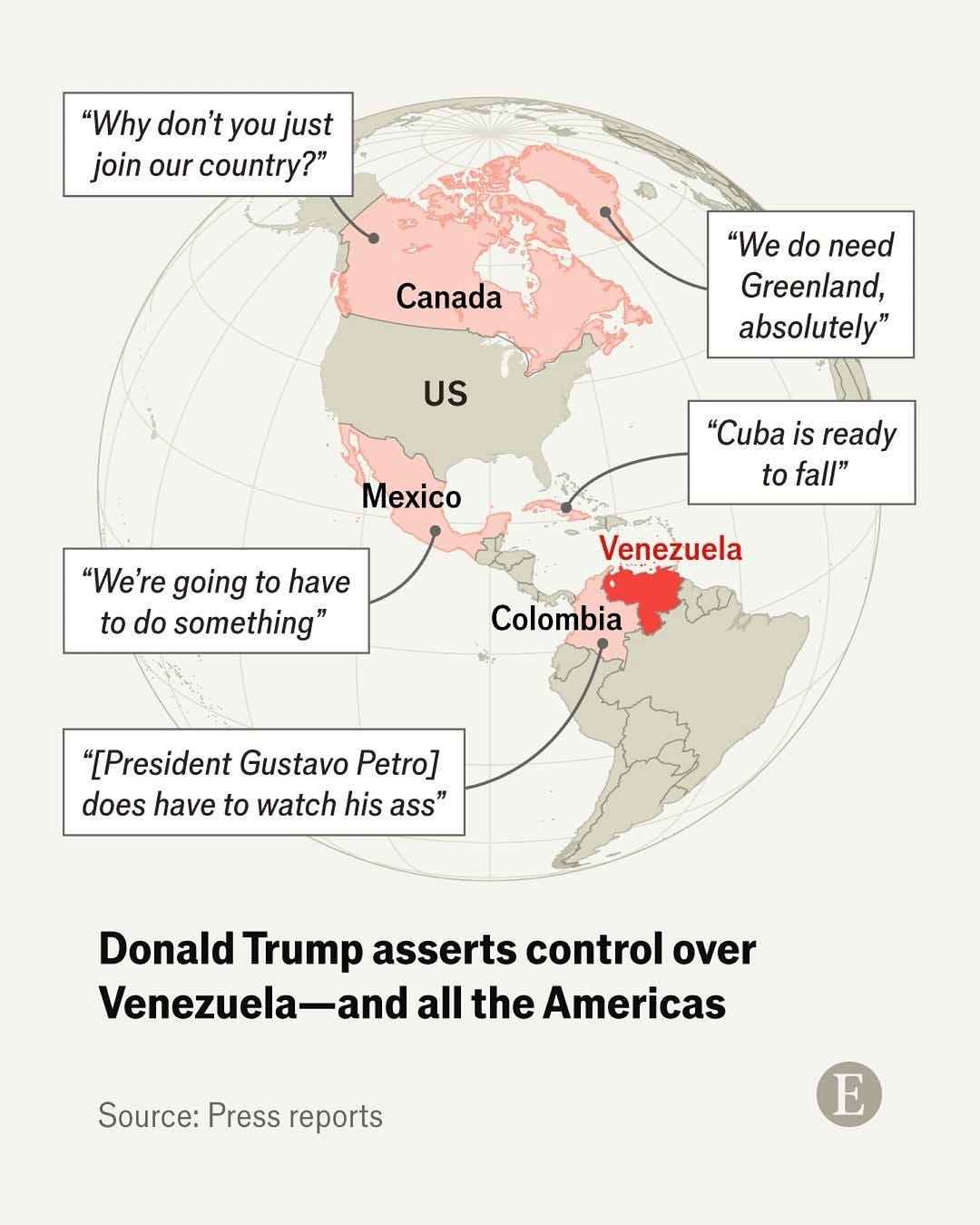
Since the Venezuela operation, Trump has explicitly or implicitly threatened Colombia, Cuba, Mexico, and the Panama Canal. The pattern suggests that any territory or resource deemed strategically valuable is now conceptually available. It’s a bit like Zillow, but for sovereign nations.
The framing as “national security” is technically accurate — these resources do matter for great power competition. But it’s national security through acquisition, not alliance. Which is the difference between asking to borrow your neighbor’s lawnmower and announcing you now own their lawnmower because you need it more.
VII. The NATO Paradox: Why Greenland Changes Everything
Here is where the “Donroe Doctrine” breaks from aggressive but conventional statecraft into something that threatens the entire Western security architecture. This is where the farce becomes genuinely dangerous.
Venezuela vs. Greenland: A Critical Distinction
Coercing Venezuela — a non-allied adversary with an authoritarian government facing drug trafficking charges — is aggressive and controversial. Many countries condemned it. But it’s recognizable statecraft, however extreme. The international community has seen this movie before, even if they don’t like it.
Greenland is completely different.
Greenland is not an independent adversary. It is an autonomous territory of Denmark. Denmark is not a peripheral ally. It is a founding member of NATO. NATO is not a transactional arrangement. It is a mutual defense pact with Article 5 at its core: an attack on one is an attack on all.
Or at least, that’s what everyone thought Article 5 meant before this week.
The Threat That Breaks the System
When the White House confirms it is considering “a range of options” for acquiring Greenland, including “utilizing the U.S. Military,” it creates an impossible situation that reads like a dark comedy written by a constitutional lawyer having a nervous breakdown.
[embed]
Article 5 assumes external aggression; it has no internal logic for intra-alliance coercion. It’s like a fire alarm that only works if the fire starts outside the building.
Senator Chris Murphy made this explicit: “NATO countries would ‘of course’ have to defend Greenland against the U.S. if necessary. That’s what Article 5 says. Article 5 did not anticipate that the invading country would be a member of NATO.”
Think about what that means:
- If the U.S. actually moved on Greenland militarily, would France honor its treaty obligation to defend Denmark?
- If European NATO members did nothing, what does Article 5 mean?
- If they condemned it but took no action, how is that different from the alliance dissolving?
These are not hypothetical questions anyone ever expected to ask, which is roughly equivalent to your book club needing to establish rules about whether members can steal each other’s books.
The European Unity Response
This is why, on 6 January, the leaders of France, Germany, Italy, Poland, Spain, the United Kingdom, and Denmark issued a joint statement — and when European leaders agree on something this quickly, you know the situation is genuinely alarming:
“Greenland belongs to its people. It is for Denmark and Greenland, and them only, to decide on matters concerning Denmark and Greenland… Security in the Arctic must be achieved collectively, in conjunction with NATO allies including the United States, by upholding the principles of the UN Charter, including sovereignty, territorial integrity and the inviolability of borders.”
That final sentence is the key. They are reminding Washington that the same principles protecting them from Russia apply to America itself. Which is the diplomatic equivalent of having to explain to someone that, yes, murder laws do in fact apply to them too.
When Danish Prime Minister Mette Frederiksen warned that U.S. military action against Greenland could mean “the end of NATO,” she wasn’t exaggerating or being dramatic. She was identifying a genuine structural crisis: the alliance has no instruction manual for what happens when the call is coming from inside the house.
Why This Matters More Than Venezuela
Venezuela reveals American willingness to use force unilaterally in what it considers its sphere. That’s aggressive but comprehensible.
But Greenland reveals something far more destabilizing: that American spheres of influence may now include NATO allies themselves.
If sovereignty becomes conditional even for founding NATO members when American “needs” are deemed paramount, then the entire post-1945 security order is provisional. Every alliance becomes transactional. Every commitment becomes contingent. Every treaty becomes a suggestion.
This is not just a diplomatic row. This is a stress test that NATO was never designed to survive: aggression from inside the house. It’s like discovering your home security system can’t tell the difference between a burglar and a particularly aggressive roommate.
The Precedent Problem
And here’s the global implication: If the U.S. can justify seizing territory from an ally because it “needs” it for national security, what’s the principled argument against Russia seizing parts of Kazakhstan for resource security, or China taking Taiwan for semiconductor supply chains?
The answer, uncomfortably, is “nothing particularly compelling.”
The “Donroe Doctrine” doesn’t just threaten the Western Hemisphere. It threatens the basic principle that sovereignty — even for smaller states — means something that great powers must respect. It’s not so much moving the goalposts as announcing that goalposts are now optional and also we own the field.
VIII. The Pattern: How Doctrines Become Property Claims
Let’s make the evolution explicit. Here’s what changed:
[embed]
Notice the progression:
- 1823: “European powers may not colonize here”
- 1904: “We may intervene to prevent instability”
- Cold War: “We may intervene to prevent ideological threats”
- 2026: “We may take what we need, when we need it, from anyone, and we’ll let you know if we decide to ask first”
Each iteration expanded the claim. Each iteration eroded the constraint. The 2026 version drops the constraint entirely and also the pretense that there was ever a constraint to begin with.
It’s the diplomatic equivalent of that friend who borrows something and gradually starts referring to it as theirs.
IX. What the Monroe Doctrine Is Not
To be absolutely clear, because apparently this needs to be said in 2026:
- It is not international law
- It does not grant ownership of the Americas
- It does not justify annexation
- It does not override NATO Article 5
- It has never been universally accepted, especially in Latin America (who, it turns out, had opinions)
- It was explicitly disavowed by the U.S. itself in 2013 (remember that? Good times.)
Invoking it as a blank cheque for resource extraction and territorial acquisition is a modern invention — and a profoundly destabilizing one. It’s also, to be clear, not what the doctrine originally meant, which you’d think would matter more than it apparently does.
X. The Cost of Semantic Collapse
The shift from “Monroe Doctrine” to “Donroe Doctrine” isn’t just rhetorical flair or branding. It signals a fundamental change: from inherited principle to personal prerogative. From policy constraint to policy justification.
When political language loses its moorings this way, institutions struggle to adapt. When doctrines stop describing limits and start asserting outcomes:
- Treaties feel conditional (and are treated as such)
- Alliances feel asymmetric (because they are)
- Law sounds decorative (like throw pillows, but with less utility)
If the Monroe Doctrine is to be invoked in public discourse, it should be invoked honestly — as a historically contingent, politically contested idea whose meaning has shifted over two centuries, not as an eternal truth handed down from the founders like the geopolitical equivalent of a family recipe.
Not as a slogan. Not as a meme. And certainly not as a map stamped with “SOON,” which is the diplomatic equivalent of texting “u up?” at 2 AM but with aircraft carriers.
Coda: The Difference Between Power and Authority
The next time you hear “Monroe Doctrine” or “Donroe Doctrine” casually deployed, ask:
Which version do you mean? With what limits? At whose expense? And have you considered that this might end badly?
The “Donroe Doctrine” may succeed in asserting American power in the short term. It may even secure some resources and strategic positions. It might work, in the sense that a sledgehammer “works” to open a locked door.
But it will do so at the expense of American authority — the harder-to-measure asset that made American leadership effective in the first place. And unlike power, which can be rebuilt with time and money, authority is more like trust: easier to lose than to build, and nearly impossible to fake.
Power is taking Venezuela’s oil because you can. Authority is Venezuela’s neighbors wanting your partnership because they trust your word.
Power is threatening Greenland with military action. Authority is Greenland choosing closer ties because they value the alliance.
The “Donroe Doctrine” trades authority for power. It’s a bad trade, the kind that makes sense at 2 AM but looks increasingly questionable in the morning light.
And the question now being asked in Copenhagen, Ottawa, Mexico City, and Bogotá — if sovereignty is conditional there, why not here? — is the real cost of that exchange. It’s the sound of formerly reliable allies doing the mental math on their backup plans.
Right now, the “Donroe Doctrine” is making the case for American partnership harder to argue with a straight face. Which is unfortunate, because that case used to be pretty compelling.
But hey, at least we got a catchy portmanteau out of it.
메타데이터
- post_id
- a8e287782e5f
- slug
- what-the-heck-is-the-monroe-doctrine-a8e287782e5f
- url
- https://medium.com/@darwingosal/what-the-heck-is-the-monroe-doctrine-a8e287782e5f
- canonical_url
- https://medium.com/@darwingosal/what-the-heck-is-the-monroe-doctrine-a8e287782e5f
- author_url
- https://medium.com/@darwingosal
- status
- ok
- fetched_at
- 2026-08-18 09:13:47