LLM Inference Benchmarks 2026: Why “Cheaper” GPUs Are Costing You More
The definitive guide to NVIDIA H100 vs. L40S vs. A100 unit economics, memory bottlenecks, and maximizing your AI ROI.
LLM Inference Benchmarks 2026: Why “Cheaper” GPUs Are Costing You More
The definitive guide to NVIDIA H100 vs. L40S vs. A100 unit economics, memory bottlenecks, and maximizing your AI ROI.

If you are an MLOps engineer, CTO, or AI infrastructure lead in 2026, you already know that the landscape of large language model (LLM) deployment has fundamentally shifted. The days of simply throwing the most expensive hardware at a model and hoping for the best are over.
Today, scaling AI is an exercise in unit economics.
The most critical question is no longer, “Which GPU is fastest?” It is, “Which GPU gives me the lowest cost-per-token without breaching my latency SLAs?”
Here is the most important takeaway from our latest benchmarking data at GPUYard.
The ROI Equation: Hourly Price vs. Cost-Per-Token
The biggest mistake enterprise teams make is looking exclusively at the hourly rental rate. In 2026, GPU cloud hosting pricing has stabilized, but the efficiency of that spend varies wildly.
Average Hourly Rates (On-Demand):
- H100: ~$2.50 — $4.00/hr
- A100: ~$0.80 — $1.50/hr
- L40S: ~$0.50 — $0.90/hr
If an A100 is three times cheaper per hour than an H100, you should use the A100, right? Wrong. If you are running a real-time chat application with a 70B model, the H100 processes requests up to 3x to 5x faster than the A100. Because you are generating tokens so much faster, your actual Cost per 1 Million Tokens is lower on the H100.
The 2026 GPU Decision Framework
To maximize your budget, deploy based on your workload’s specific memory bandwidth and latency profile:
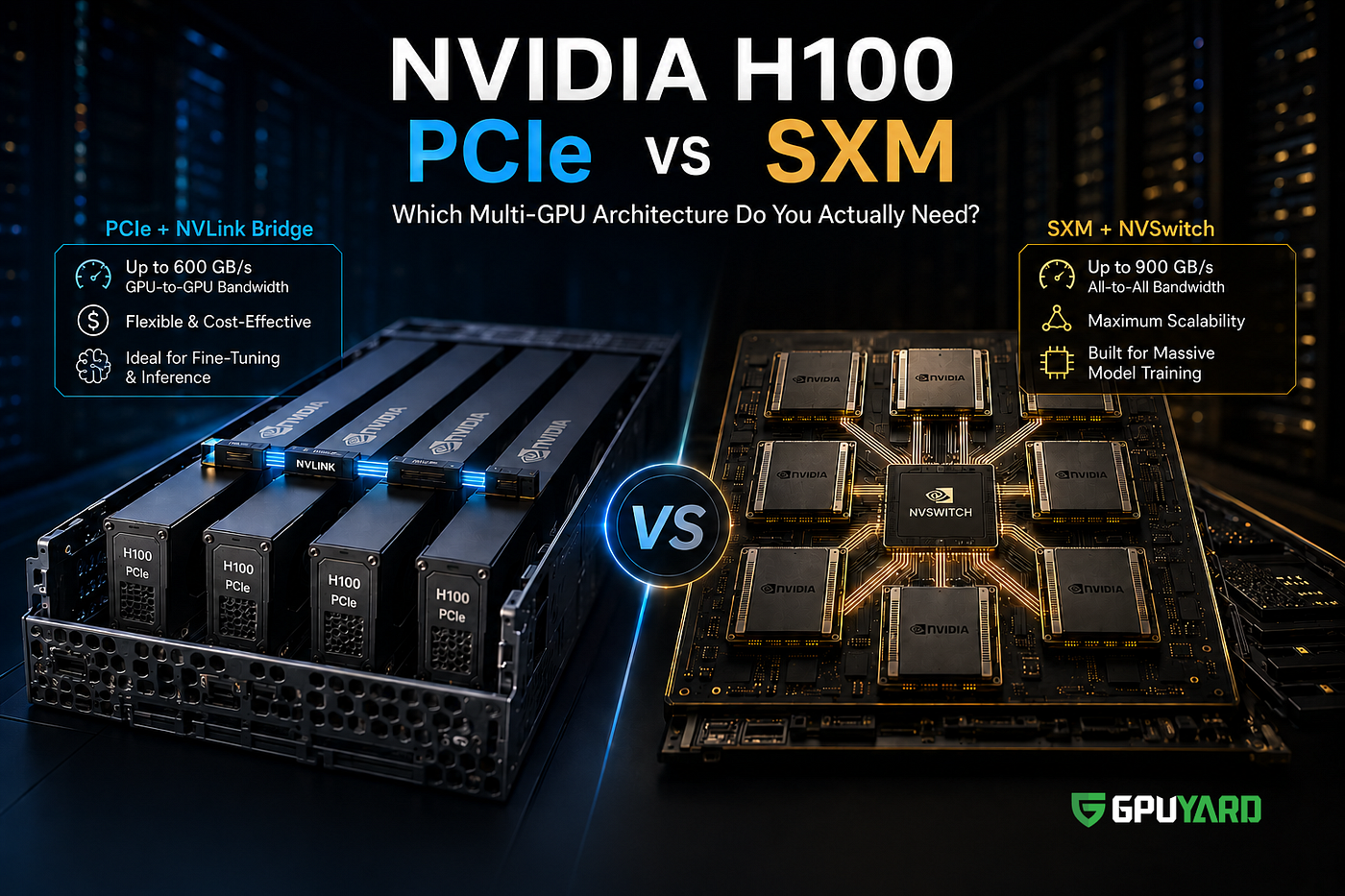
- 🥇 **Choose the NVIDIA H100 if:** You are serving massive models (30B+ parameters) and have strict real-time latency SLAs. It is the undisputed king of multi-GPU scaling thanks to its 4th-gen NVLink.
- 🥈 Choose the NVIDIA L40S if: You are running smaller LLMs (<13B), RAG adapters, or daily fine-tunes. It offers the absolute best cost-per-token for containerized, small-scale inference and excels at multimodal AI.
- 🥉 **Choose the NVIDIA A100 if:** You are running massive batch inference jobs (offline document processing, sentiment analysis) where throughput matters, but Time-to-First-Token (TTFT) latency does not.
Dive Deeper into the Data
Navigating the complexities of tensor cores, memory bandwidth, and vLLM throughput metrics doesn’t have to be a guessing game. The hardware you choose directly impacts your margins.
Want to see the full benchmark numbers? We break down exact token-per-second (tok/s) speeds, quantization strategies (AWQ/GPTQ vs. native FP8), and multi-GPU scaling bottlenecks in our full report.
메타데이터
- post_id
- a8ff0c2edb24
- slug
- llm-inference-benchmarks-2026-why-cheaper-gpus-are-costing-you-more-a8ff0c2edb24
- url
- https://medium.com/@gpuyard/llm-inference-benchmarks-2026-why-cheaper-gpus-are-costing-you-more-a8ff0c2edb24
- canonical_url
- https://medium.com/@gpuyard/llm-inference-benchmarks-2026-why-cheaper-gpus-are-costing-you-more-a8ff0c2edb24
- author_url
- https://medium.com/@gpuyard
- status
- ok
- fetched_at
- 2026-06-17 08:20:12