Two Floor-Numbering Conventions
Why is the British convention illogical?
Two Floor-Numbering Conventions
Why is the British convention illogical?
Non-members can read here
Americans call the ground level of a building “the first floor" and the floors above it “the second floor," “the third floor," and so on. The British call the ground level “ground floor”, and those above it “the first floor," “the second floor," etc. European countries and many parts of the world follow the British convention. But Latin American countries could follow either the British or American convention, seemingly with no pattern. (See Storey on Wikipedia for such information.)
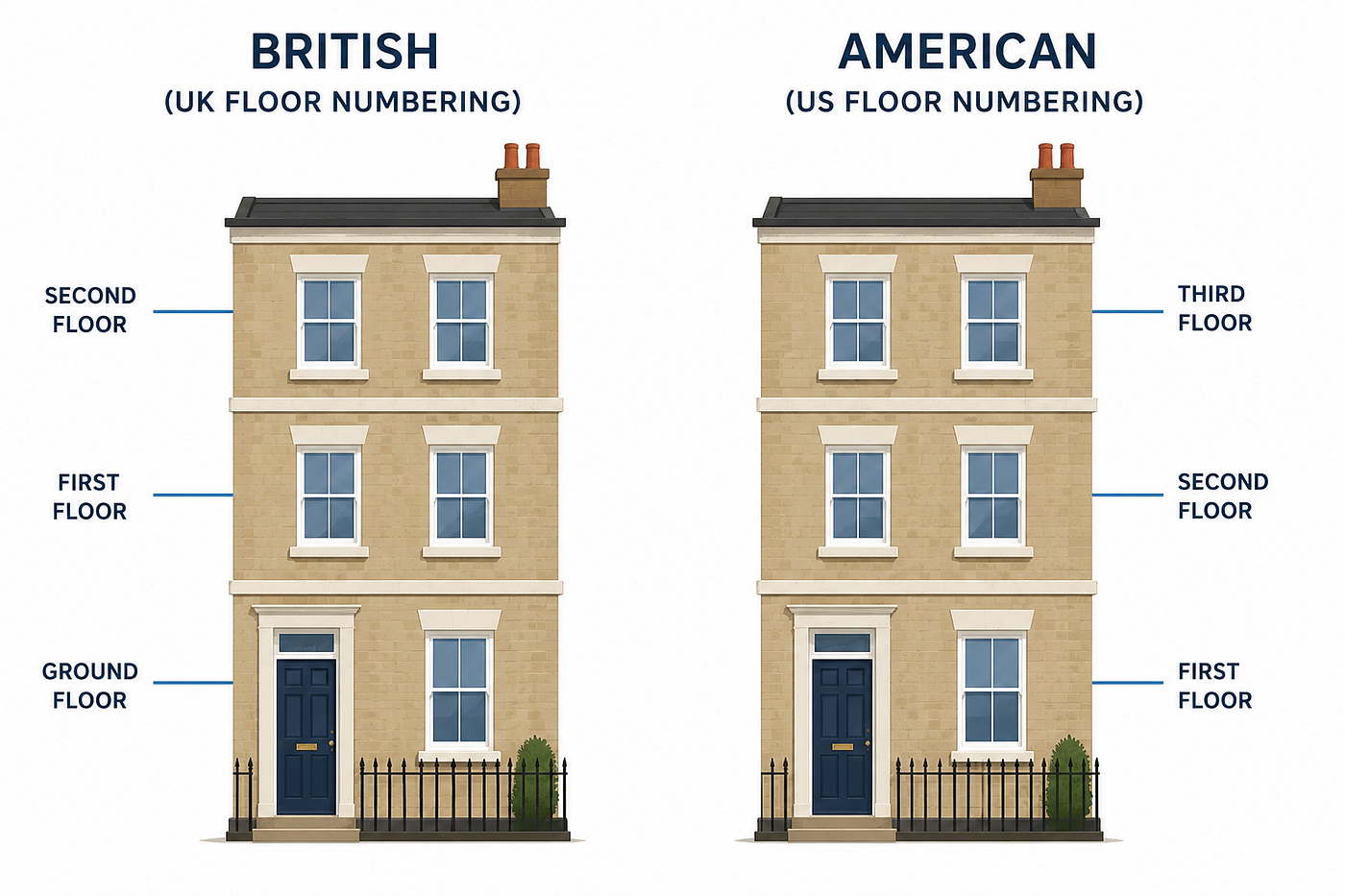
Author’s image
For people that often travel around the world, the two conventions occasionally cause short-term confusion. “The gym is on the second floor," said the front desk of a hotel, and you may have to remind yourself about which part of the world you are in today before you head to the gym.
Contrary to Logic, with a Solution
Let’s critically evaluate the floor numbering system and see why there is a logical difficulty in the British usage of the word "floor." The phrase “ground floor” implies that this level is a member of the set (think of the concept of “set” in mathematics) called "floor." Note the level above the ground floor is called the “first floor," and note the definition of the word "first" is “preceding all others in time, order, or importance” according to the Merriam-Webster dictionary. The combination of these two facts entails that the ground floor is excluded from the floor set. The phrase “ground floor” cannot denote any member in this set, as if the ground level of a building should not be called a floor, and yet “ground floor” clearly has the word "floor" in this noun phrase. Alternatively, the phrase “first floor” ought to denote the first member in the floor set, but it does not, because “ground floor” already denotes it, and they are not synonymous in British English.
(Here’s another way to see the absurdity of the British convention of floor numbering. Suppose you have three sons. The oldest can be called “the oldest son”. The second is of course “the second son”, and the third “the third son”. It will be wrong to call the second “the first son” and the third “the second son”, no matter how special the oldest son is. Well, if the first son were not to be called a son, the problem would be resolved. But would you so discriminate against your firstborn?)
This logical difficulty can be resolved by calling the ground floor something not using the word "floor," such as “ground level” (just like Mexicans call the ground floor planta baja and the next floor primer piso, using different words, planta vs. piso) and interpreting the word "floor" as denoting a level or layer definitely above (i.e., not including) the ground level.
Patient zero
You may ask, isn't there the phrase “patient zero (or 0)” or “zeroth patient” in epidemiology? When people use that phrase, do they call the (actually) second patient, i.e., the first one infected by patient zero, “first patient” or “patient 1”? That would sound strange. Fortunately, epidemiologists generally avoid using these terms and say “primary case" and “secondary case” instead, thus avoiding the same logical difficulty of including and at the same time excluding a member of a set.
History
In case you’re curious. How did the American floor numbering scheme diverge from the British convention, considering that the first English-speaking settlers primarily came from Britain in the 1600s? It may sound counterintuitive, but the truth is, Americans actually preserved the old British convention, and it’s the British that changed it in the Georgian era (1714 to 1830). During that time, the first floor (ground level) was mainly used for services (kitchens, storage, etc.), and the nobility moved up. These two floors were thus called “ground storey” and “piano nobile," respectively; the latter, literally meaning “noble floor” in Italian, is also called “principal floor” in books about architecture. (See e.g. Sir Banister Fletcher, A History of Architecture on the Comparative Method, Ed. 1924, pp. 505,575,600.) Have you heard of the saying that Americans speak more like Shakespeare than the British? That’s not accurate from the historical linguistic point of view, but the joke has some merit in it. The same can be said of the American floor numbering system.
About me: I’m a language lover. For my work on language and linguistic studies, please visit http://yong321.freeshell.org/misc.html#lang.
메타데이터
- post_id
- a90d8957e1d8
- slug
- two-floor-numbering-conventions-a90d8957e1d8
- url
- https://medium.com/write-your-world/two-floor-numbering-conventions-a90d8957e1d8
- canonical_url
- https://medium.com/write-your-world/two-floor-numbering-conventions-a90d8957e1d8
- author_url
- https://medium.com/@yong321
- status
- ok
- fetched_at
- 2026-07-11 22:52:18