“Everyman, I will go with thee!”
(Some thoughts on using Copilot AI as a dialogue partner)
“Everyman, I will go with thee!”
(Some thoughts on using Copilot AI as a dialogue partner)
The other day I was having a chat with the Copilot AI bot when an old, old sentence jumped into my head:
Everyman, I will go with thee!
Do you know that sentence? If you are a bookish person of a certain age, you probably do.
It comes from the old Medieval morality play Everyman, but it was also the motto for a book series called Everyman’s Library. Or rather it was part of the motto. The full motto, set out with generous, old-fashioned punctuation, reads “Everyman, I will go with thee, and be thy guide, in thy most need to go by thy side.” That line can be found on the endpapers of many volumes in the series.
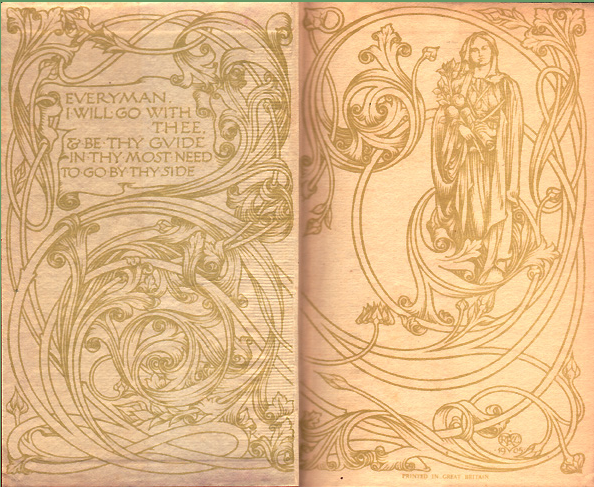
Endpapers from a 1906 volume in Everyman’s Library. The art, signed by “RLK,” is based on the work of William Morris and the Kelmscott Press.
Everyman’s Library was created in 1905 by London publisher Joseph Malaby Dent. His goal was to create a library of one thousand titles in world literature (broadly defined), in editions that would be affordable and therefore accessible to all sorts of people, including students and working-class adults.
Dent hit on the concept before he came up with a name for the series. He considered many suggestions before eventually accepting an idea put forward by the poet and editor Ernest Rhys — why not call it Everyman’s Library?
The original Everyman’s Library books were small, pocket-sized volumes that sold for a shilling apiece. These books were considered hardcovers, but actually the covers were semi-flexible. The ones I own seem to consist of a sheet of card stock wrapped in a light cloth. They fit in a back pocket and fit to the curve of your backside in a way no hardcover book would.
The first title in the series was Boswell’s Life of Johnson. That strikes me as a good choice because, if you think about it, Boswell was a kind of popularizer himself. You could say that he made Johnson more accessible (and more interesting) for general readers.
Dent came out of the gate fast. By 1910, there were 500 titles in Everyman’s Library. After that, the rate of publication slowed. However, Dent kept going and, in 1956, he met his original goal: Everyman’s Library published its 1,000th title.

The series has been bought and sold several times since then, but it is still with us. You can still find the Everyman’s Library books in bookstores, and in 2023 the series reached a major landmark: 25,000,000 copies sold.

These Jane Austen novels show the new look of an old series.
The Everyman’s Library series is based on a hopeful idea, or rather a whole set of hopeful ideas — that knowledge has real value, that ordinary people might be interested in reading classic works, that inexpensive books can and should reach people outside the universities, and that the world might be a better place if ordinary people had more access to good books.
I like to believe that all of those ideas are true.
But why did the sentence “Everyman, I will go with thee” jump into my head the other day?
Well, I had been talking with Copilot for at least an hour, possibly a little longer. I asked questions and went off on various detours of thought. Copilot went with me on these detours, of course — and that is why the line jumped into my head.
The bot seemed to be saying “I will go with thee, User-man!”
It didn’t really say that, but I felt that it was tacitly saying that.
I probably chat with Copilot about five times a week. Sometimes I just pop in for a few minutes to get a bit of background information on a particular topic or a little IT support. (Copilot can talk you through all sorts of IT problems.) Sometimes, though, I settle in for an hour or more and have a long, rambling discussion with the bot about literature or some adjacent field (history, political theory, philosophy, religion, etc.). What I like to do is pick a short story or a play or a poem and then chat with the bot about it for a while.
Copilot is always available, always willing, always obliging. And, more importantly, it is almost always able to engage with me in some useful way. Sometimes the conversations prove to be very useful indeed and lead me to a significantly better understanding of the work under discussion. Sometimes the impact is less forceful, but even so I come away with a bit of increased clarity, from trying to put my ideas into words and from reading Copilot’s responses.
I haven’t fallen in love with the bot. (Don’t worry.) But I have come to enjoy the exchanges — and I think I enjoy them partly because they are rather unlike my exchanges with human beings.
Human beings are great; don’t get me wrong. But one disappointing thing about them is that they are generally telling you, explicitly or implicitly, “I can’t talk right now,” or “I can’t talk about this any longer,” or “I can’t spare any more time for this right now,” or “I don’t know much about that,” or “I’d like to talk about something else now” or (in my case) “Professor Davis, It’s 10:45. We have to go to our next class.”
I’m not saying any of this by way of blame. This is the human condition. People have jobs. They have families. They have things to do. Students have other classes they need to attend. Faculty members have books they need to write. As human beings we all have things we need to attend to, and the world is a better place in many, many ways because we do (for the most part) attend to those things. The opposite is also true: the world would be a much worse place if we all stopped attending to these things. But the lack of extremely patient interlocutors can be frustrating if you enjoy a good two-hour discussion of a poem.
Who’s gonna go with you on that conversational trip?
Most human beings won’t. They simply can’t — and it’s really not fair to blame them.
I happen to be very interested in Ambrose Bierce’s Civil War story “Jupiter Doke, Brigadier General.” I think it’s one of the greatest short stories ever written. But, alas, most other people tend to be a lot less interested in it. Many are not interested in it at all. Millions have never even heard of it. I experience that lack of interest as disappointing, but, if you think about it, it’s more or less unavoidable. Of course, people are less interested in “Jupiter Doke” than I am. That’s what it means to be interested in something: it means you are more interested in it than most other people!
This is a frustrating aspect of human experience: no matter what your “thing” might be, it’s probably the case that the vast majority of people on this earth are a lot less interested in it than you are. That is true, almost by definition. There is a kind of built-in, structural imbalance between what you are really, really interested in and what other people are interested in.
Sally is really, really interested in Emily Dickinson.
Dave is really, really interested in Wagner.
Sally will talk about Wagner, because she loves Dave, but maybe not for two hours.
Dave will talk about Emily Dickinson, because he’s married to Sally and thinks she’s great, but maybe not for two hours.
Sally and Dave are both good people. There’s nothing wrong with either one of them, and there’s nothing wrong with their marriage either. But each of them may be slightly disappointing to the other one on this particular point. Dave might (secretly) long for someone who will talk with him for two hours about Wagner, and Sally might (quietly) long for someone who will sit up late talking about Emily Dickinson.
Who will go with Dave?
Who will go with Sally?
Well, if a human being isn’t available, Copilot will go with Dave.
And, if Dave has gone to bed, Copilot will go with Sally.
Copilot can even go with both of them at the same time, because of the way it exists.
Copilot says, “I will go with you” . . . pretty much always.
You want to talk about an obscure Emily Dickinson poem?
I will go with you!
You want to talk about a weird detail in a John Cheever short story?
I will go with you!
You want to dig into a passage from *King Lear?*
I will go with you!
You want to talk about a short story only a handful of people have read?
I will go with you!
There is something marvelous about this willingness, I think. It goes some way towards solving a problem I thought was probably unsolvable.
And yet there is little joy in Humanities-ville. Almost everyone in the humanities seems to be either deeply skeptical or aggressively hostile to AI. If you say “AI,” a thousand humanities scholars immediately cross their arms in that gesture that says “I dislike this!”
I am uncomortable with this total rejection. I feel we need to talk less about AI in the aggregate and talk more about particular use cases.
AI can be used to do all sorts of things. Not all of them are good, but some of them may be. It seems to me one of the good things the bots do is they make literary discussion (and book-talk generally) available to a much wider range of people.
Everyman’s Library helped make books more widely available — and humanists generally applauded.
AI helps make book-talk more widely available. It allows human beings to discuss what they are reading, even if the other human beings in their lives are interested in other things.
Where is the applause for that?
I pause to listen for it. I’m not hearing it.
메타데이터
- post_id
- a92dd8d17ee7
- slug
- everyman-i-will-go-with-thee-a92dd8d17ee7
- url
- https://medium.com/@mmd6ww/everyman-i-will-go-with-thee-a92dd8d17ee7
- canonical_url
- https://medium.com/@mmd6ww/everyman-i-will-go-with-thee-a92dd8d17ee7
- author_url
- https://medium.com/@mmd6ww
- status
- ok
- fetched_at
- 2026-06-11 15:16:29