pr402/x402: How It Will Transform Traditional SaaS Subscription Models
An Innovative Subscription Approach Powered by pr402/x402
pr402/x402: How It Will Transform Traditional SaaS Subscription Models
An Innovative Subscription Approach Powered by pr402/x402
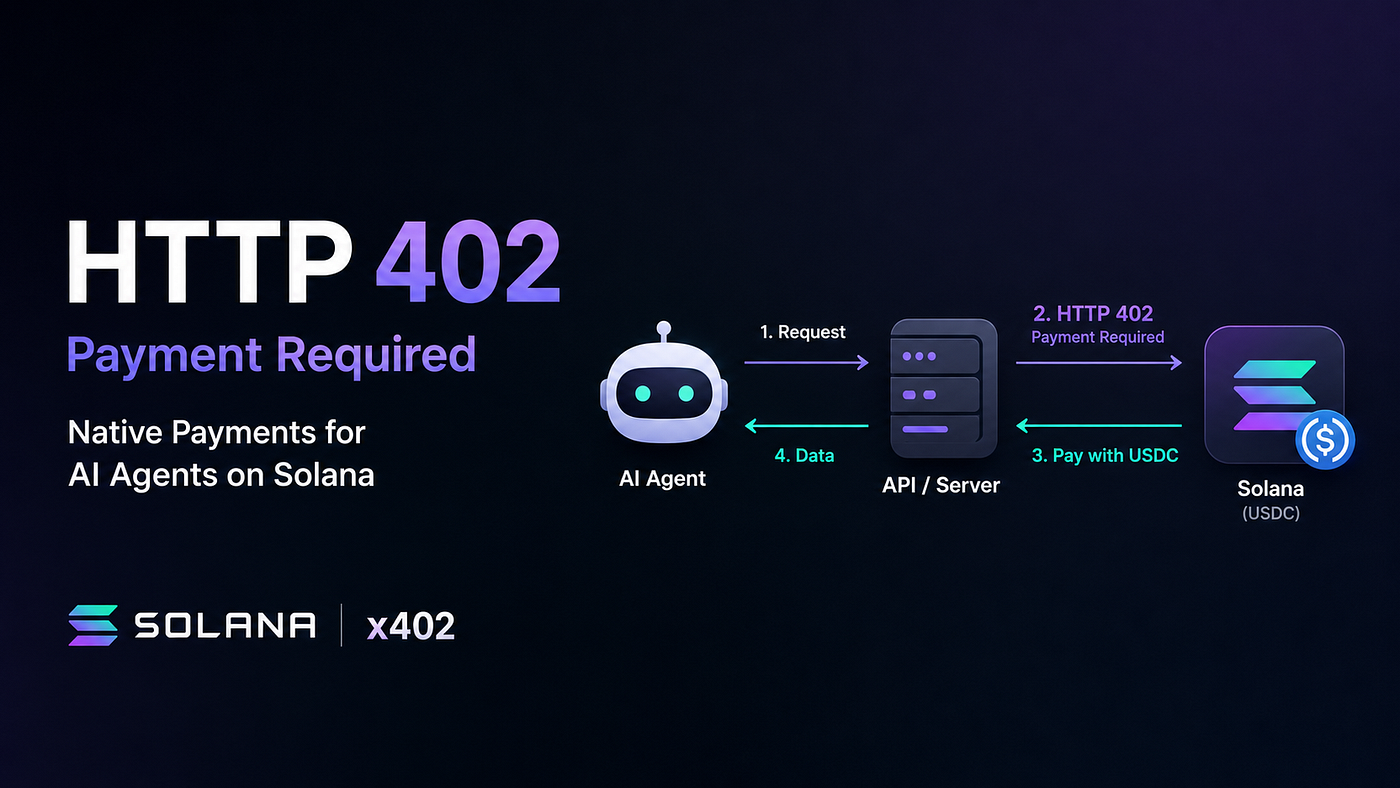
So far, nearly every x402 tutorial you’ve read tells the same story: An agent calls an API → the server returns HTTP 402 Payment Required → the agent signs a transaction → it retries the request and pays again → and the cycle repeats. This model is impressive and highly effective. It has already been proven in production, particularly for AI agent micropayments. For example, the solrisk wallet risk verification service charges just 0.05 USDC per query and settles instantly on Solana via x402’s exact path — no account registration, no invoices required. But this represents only part of x402’s true potential. There is another powerful capability that has remained largely underexplored — one that this article focuses on: using x402 to bridge the significant gap between per-request and monthly billing by enabling flexible subscription-style pricing, down to the hour (or even minute). Daily, monthly, and yearly options are equally supported. The billing granularity is entirely up to the seller, no longer constrained by the rigid monthly cycles of traditional platforms like Stripe. The process is straightforward: Pay once on-chain → Receive a time-limited JWT → Freely call the provider’s API until it expires. It uses the same x402 exact settlement path, the same UniversalSettle on-chain program, and the same pr402 Facilitator. The only change is finer control over billing intervals. We call this pr402/x402 Subscription Mode. It is not a new on-chain program, but rather an innovative seller-side architecture built on the existing exact flow. For modern subscription APIs where buyers are increasingly machines rather than humans, this is the most natural and seamless path to on-chain settlement.This article explores why this matters, how it aligns with the SaaS services you already operate, and where you can fork the ready-to-use code today.
The Blind Spot in Today’s x402 Narrative
The agent ecosystem has excelled at per-request payments using the exact model:
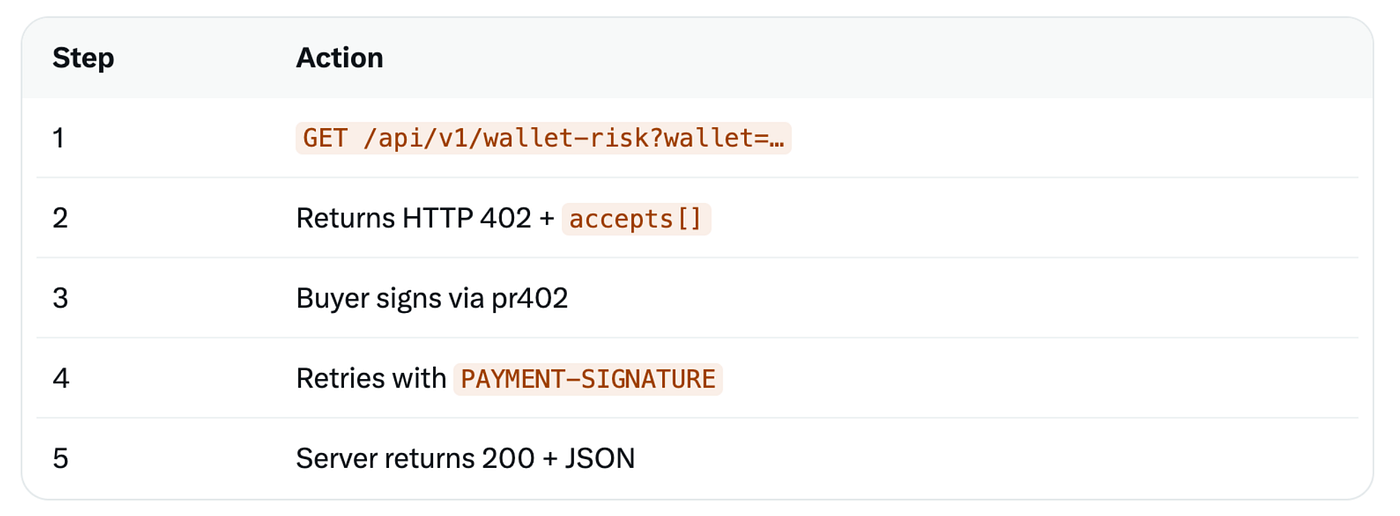
One request, one payment. This approach is elegant and near-perfect for stateless, low-frequency interfaces and true micropayments.However, for many modern SaaS products, it feels mismatched:
- News feeds polled every 30 seconds
- Dashboards refreshed continuously throughout the day
- Cron-driven crawlers
- High-frequency agent access patterns
- Everything you currently sell as $29/month + API Key
Applying classic per-request x402 pricing in these cases forces agents to either drain their wallets rapidly or stop calling altogether. Meanwhile, traditional monthly billing via Stripe requires credit cards, cumbersome backend systems, and human involvement.The innovative pr402/x402 Subscription Mode offers a far more natural solution:
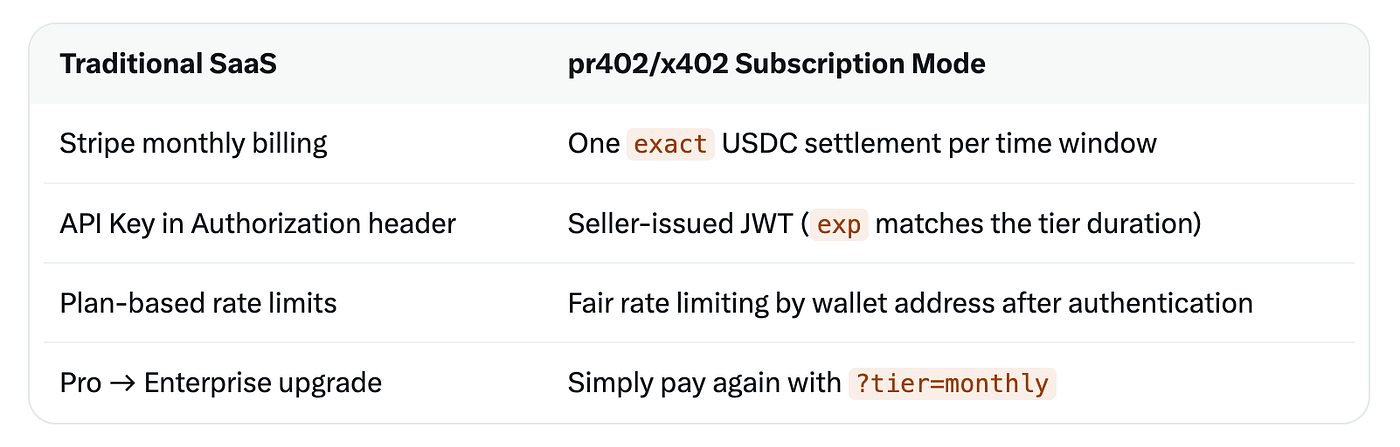
A key point worth remembering: x402 never forces micropayment on every single HTTP request. It only requires cryptographic payment settlement before access — how long that access lasts is entirely up to the seller.
Three Seller Models, Two On-Chain Paths
pr402/x402 currently supports two on-chain settlement paths:
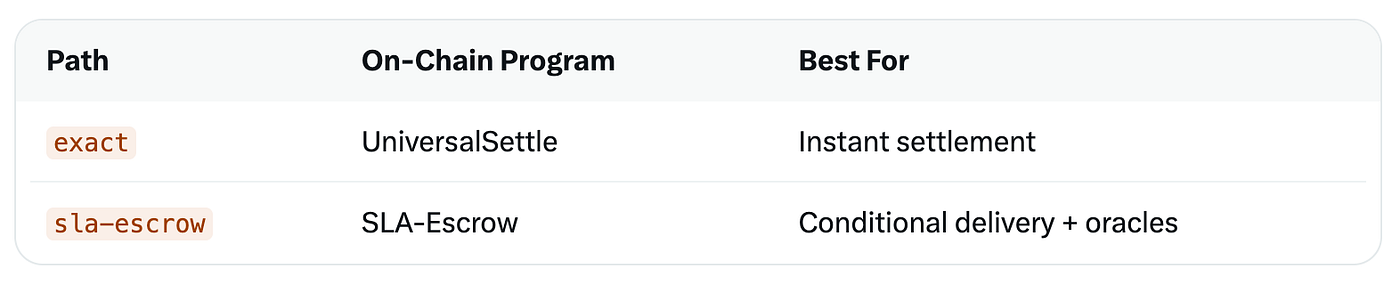
On the exact path alone, sellers can choose between two billing models:
- exact + Per-request → 402 on every data call (e.g., solrisk)
- exact + Subscription → 402 only on /subscribe (covered in this article)
The sla-escrow path is designed for conditional deliveries such as tokens, RWAs, files, or tasks (see the x402-buy-spl-token project). Subscription mode does not introduce a new token standard — it is a practical solution for protecting existing REST APIs when buyers make many calls per dollar spent.
Why Hourly Billing Is a Game Changer for Agents
Traditional SaaS revolves around monthly or yearly billing because the infrastructure was built for humans and credit cards. These cycles are industry habits, not physical laws.Agents never sleep. One that polls a news API every minute will make approximately 43,200 requests per month. At $0.05 per call, that totals $2,160 — clearly unreasonable for a single data feed. With hourly subscriptions, the same seller could offer one hour of unlimited access (within fair rate limits) for just $0.05. The agent pays once, caches the JWT, uses the service until expiration, and then renews with a new payment.
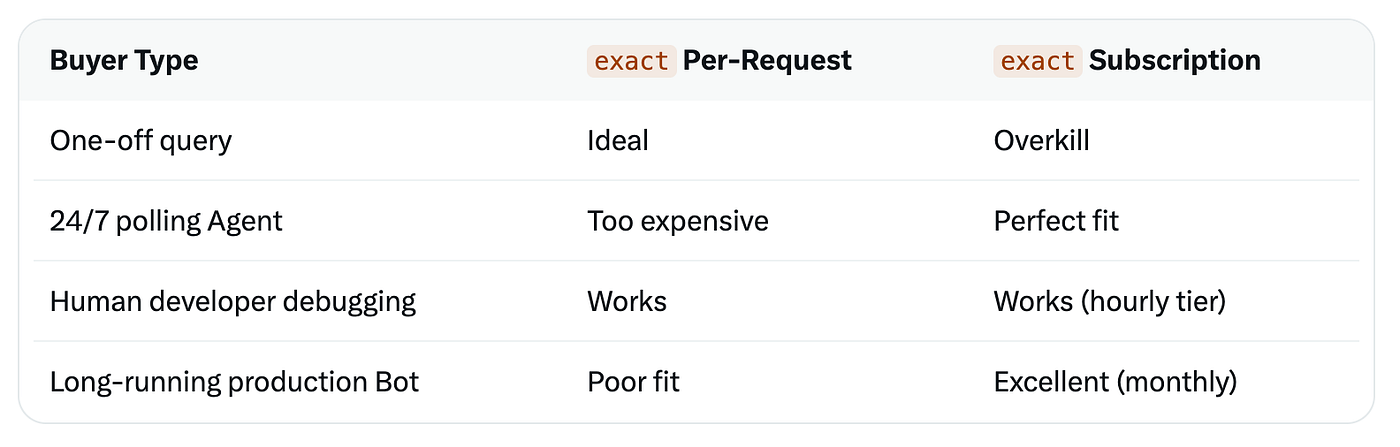
You’re not simply leaving Stripe behind — you’re decoupling billing cycles from actual usage. Burst agents can use hourly tiers, trading bots can use daily tiers, and stable production integrations can use monthly tiers. All with the same protocol, using just a single ?tier= parameter.This is the flexible, finely tunable pricing capability that pr402/x402 has always offered. For the first time, the ecosystem has packaged it into easy-to-fork code templates.
How It Works
When a TOKEN_EXPIRED error occurs, the client simply starts a new subscription flow — identical to the first time.
What We’ve Open-Sourced (Fork, Don’t Reinvent)
Building on the x402 product family, we have released two new repositories as the canonical reference implementation for subscription mode:
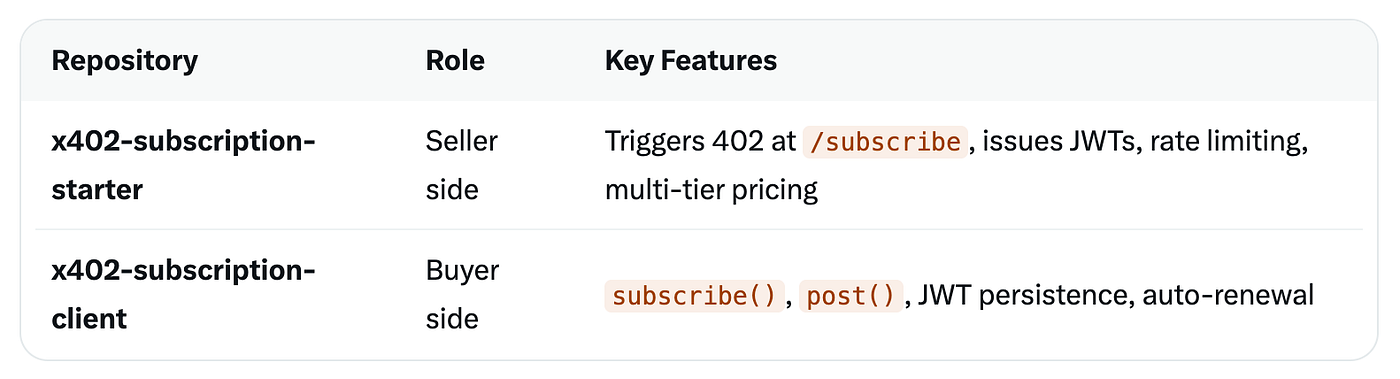
The starter includes SQLite by default and can easily switch to PostgreSQL in production (same table structure). Built-in tiers include hourly, daily, and monthly. Adding yearly requires only a few simple steps, with no changes to the underlying protocol. New sellers are encouraged to fork the starter as their foundation. For the full protocol specification and invariants, see: SUBSCRIPTION_PATTERN.md.
At its core, pr402/x402 subscription mode delivers: one payment, many calls, wallet-native, machine-friendly.
Who Should Pay Attention First
- SaaS Founders: Teams looking to sell APIs to developers and the growing population of agents.
- Agent & Paid Service Developers: Those building high-frequency polling services where per-request pricing doesn’t make economic sense.
- Protocol Infrastructure Teams: Organizations that want subscription revenue without integrating Stripe for every endpoint.
It is currently less suitable for scenarios requiring tax invoices, dispute handling, or enterprise procurement workflows — these are product v2 concerns, not limitations of the protocol itself.
What It Cannot Do Yet (Important for Finance & Legal Teams)
This model does not fully replace traditional payment platforms like Stripe. It currently lacks features such as detailed VAT invoices, dunning emails, and ready-made customer portals.
Closing Thoughts
x402 has never been only about “pay-per-request.” At its heart, it has always been “pay first (cryptographically), then access.” Subscription mode simply extends that access from a single request to a period of time — even down to the hour, if you choose. Migrating traditional SaaS billing to pr402/x402 is not about copying Stripe. It’s about replacing “API Key + invoice” with “one on-chain settlement per billing window + JWT.” Of course, converting on-chain payments into proper financial records for compliance remains a separate topic. Fork the starter. Point your agents toward it. If monthly billing feels outdated or limiting, start by offering hourly access instead.
메타데이터
- post_id
- a9341eebc8bb
- slug
- pr402-x402-how-it-will-transform-traditional-saas-subscription-models-a9341eebc8bb
- url
- https://medium.com/@miraland.labs/pr402-x402-how-it-will-transform-traditional-saas-subscription-models-a9341eebc8bb
- canonical_url
- https://medium.com/@miraland.labs/pr402-x402-how-it-will-transform-traditional-saas-subscription-models-a9341eebc8bb
- author_url
- https://medium.com/@miraland.labs
- status
- ok
- fetched_at
- 2026-06-15 20:49:13