Why Java Is Still Relevant in 2026?
In 2026, Java is not a legacy language that people keep only for legacy codebases.
Why Java Is Still Relevant in 2026?
In 2026, Java is not a legacy language that people keep only for legacy codebases.
It is at the center of cloud-native systems, AI-powered services, and large-scale enterprise applications worldwide.
Big tech companies like Google, Amazon, Netflix, LinkedIn, Meta, and many others still run critical backend systems on Java, and major cloud providers actively invest in Java support.
My articles are free for everyone. Non-members can read this full article for free **HERE**.
Java’s Strong Presence in Industry
Java continues to be one of the main languages for backend and enterprise development.
Many well-known companies use Java for high-traffic, mission-critical systems.
A 2025 article summarising industry usage notes that more than 11,000 companies use Java EE and related Java technologies, including Amazon, Walmart, Apple, NVIDIA, Microsoft, Samsung, Google, and IBM.
Banks, telecom companies, consulting firms, and government organizations also continue to build and maintain Java systems for ERP, CRM, trading, and public services.
Why do enterprises still choose Java?
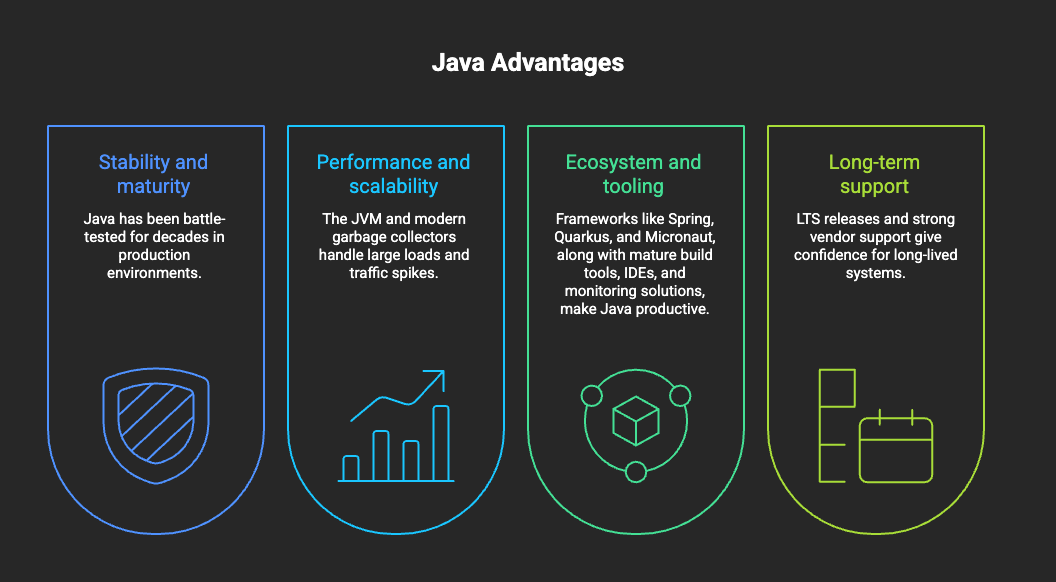
Created by Saquib Aftab
Java 21 and Modern Language Features
One of the biggest reasons Java remains relevant is that the language and platform continue to evolve.
Java 21, released as an LTS version, brings powerful features that directly address modern development needs. (Currently, Java 25 has also been released)
I have mentioned Java 21, as it is quite common in organizations in 2026.
Virtual Threads (Project Loom)
Virtual threads, the main outcome of Project Loom, became a final feature in Java 21.
They allow Java applications to create millions of lightweight threads, managed by the JVM rather than the operating system.
This makes it much easier to write high-concurrency code using a simple blocking style, without complex reactive frameworks.
Key benefits of virtual threads:
- Applications can handle millions of concurrent operations because virtual threads are very cheap in terms of memory and scheduling costs.
- Blocking operations such as I/O or database calls no longer block carrier threads; the JVM parks virtual threads and frees physical threads to do other work.
- Developers can write straightforward synchronous code and still achieve scalability comparable to that of asynchronous or reactive approaches.
Other Java 21 improvements
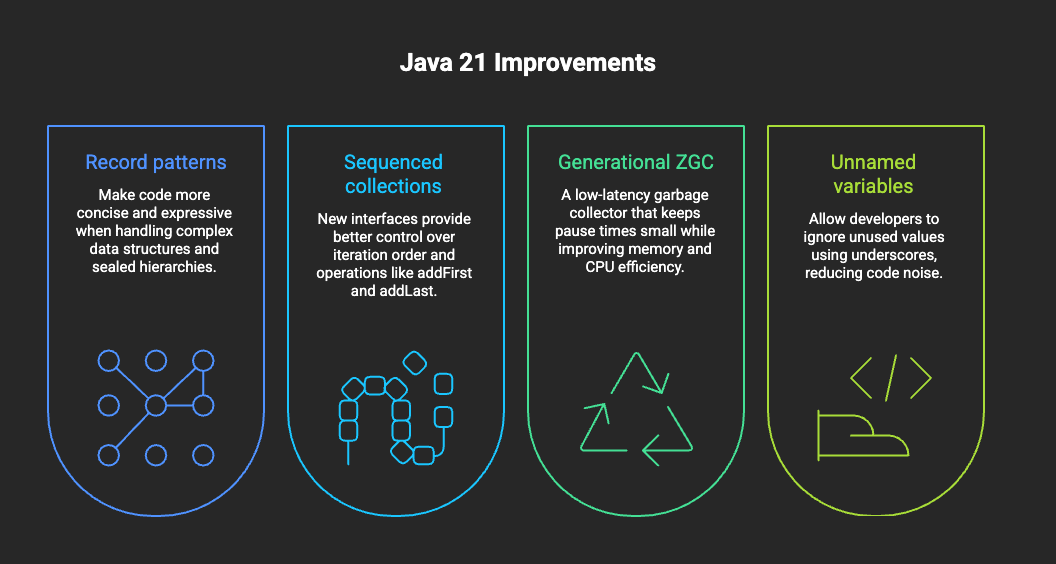
Created by Saquib Aftab
Cloud-Native and Microservices with Java
In 2026, cloud-native architectures based on containers, Kubernetes, and service meshes are standard in many companies.
Java has adapted very well to this environment.
Frameworks for cloud-native Java
Frameworks like Spring Boot, Quarkus, Micronaut, and GraalVM power cloud-native microservices and serverless applications, with a focus on fast startup, low memory usage, and easy integration with cloud platforms.
Common cloud-native Java stack elements include:
- Spring Boot 3 and 4 for quickly building REST APIs and microservices.
- Quarkus and Micronaut for ahead-of-time-compiled, lightweight services with very fast startup times, ideal for containers and serverless environments.
- GraalVM native images to compile Java applications into native executables that start in milliseconds and use less memory.
- Integration with Kubernetes, Istio/Linkerd, and OpenTelemetry for deployment, service discovery, traffic management, tracing, and monitoring.
Serverless Java
Cold-start time used to be a big problem for Java in serverless environments.
Cloud providers have improved their platforms, and Java frameworks have optimized startup and memory usage, so serverless Java is now considered practical and is seeing growing adoption.
Java in AI and Data-Intensive Systems
Java is not usually the first language people think of for AI, but in 2026, it plays an important role in AI-enabled enterprise systems.
Java for AI model deployment
Java-based services often handle:
- Real-time AI inference in microservices that need high throughput and low latency.
- Event-driven pipelines for streaming data, often using Kafka or Pulsar.
- Integration of AI results into business workflows, APIs, and user-facing applications.
Frameworks and tools used in this space include:
- Deep Java Library (DJL) and ONNX Runtime integrations for serving models in Java applications.
- Java bindings for TensorFlow and other machine learning frameworks.
- JVM-based tools in big data ecosystems, where Spark and other platforms often run on the JVM, making Java a natural part of the stack.
Because Java already powers many enterprise backends, it is convenient for organizations to plug AI models into existing Java services rather than rewrite everything in another language.
Legacy Systems and Modernization
Another strong reason Java remains relevant is the huge amount of existing Java code in production.
Many banks, telecoms, insurers, and government agencies built their systems in Java starting from the early 2000s and continue to extend them.
In recent years, there has been a strong push for legacy modernization.
Instead of abandoning Java, many organizations are:
- Migrating old Java EE or monolithic applications into microservices using Spring Boot or Jakarta EE.
- Moving from on-premise or virtual machines to Kubernetes and cloud platforms.
- Using new Java versions (such as Java 17 and 21) to gain performance and language improvements while keeping existing business logic.
This wave of modernization increases demand for experienced Java developers who understand both older and newer parts of the ecosystem.
Job Market and Developer Demand
Reasons the job market stays strong:
- Large installed base of Java systems that need maintenance, new features, and modernization.
- Cloud and microservices projects that choose Java for reliability and ecosystem support.
- Financial services, telecom, e-commerce, and government agencies that depend on Java for business-critical systems.
For developers, this means that Java skills remain valuable, especially when combined with knowledge of Spring, microservices, cloud platforms, and modern Java features.
Developer Experience and Tooling
Developer productivity is another reason for Java’s ongoing relevance.
The ecosystem provides high-quality tools and libraries for almost every need.
IDEs and build tools
Popular IDEs like IntelliJ IDEA, Eclipse, and VS Code extensions offer powerful refactoring, debugging, static analysis, and framework integration.
These tools are continuously updated to support new Java features and new language constructs.
Build tools like Maven and Gradle remain industry standards and offer deep ecosystem support for dependency management, testing, and CI/CD integration.
Testing and observability
Java projects benefit from mature testing tools such as JUnit, Testcontainers, and Mockito, as well as from frameworks that integrate metrics, tracing, and logging out of the box.
Cloud-native Java stacks integrate seamlessly with OpenTelemetry, Prometheus, Grafana, and similar observability tools.
This ecosystem reduces friction for teams and helps maintain large systems over many years.
Why Java Still Matters for New Developers?
For someone starting or growing a programming career in 2026, Java remains a strong choice.
Not only because of legacy systems, but also because it teaches solid object-oriented and concurrent programming concepts and connects directly to real industry projects.
Key reasons for new developers to consider Java:
- A wide job market across many industries and geographies.
- Strong ecosystem with Spring Boot, Quarkus, Micronaut, and other modern frameworks.
- Modern language features such as records, pattern matching, virtual threads, and structured concurrency align with current programming trends.
- Cloud and microservices focus, making Java skills relevant for modern backend and DevOps work.
Here are More Contents You Might Like
[embed]Master These Java Backend Security Concepts In the FIRST PART of this series, we covered:medium.com
Thanks for reading. If you enjoy my content and want to show support, you can check out my other articles, give a few claps, and follow me for more. I write on Java, Productivity, and Technology.
Until Next Time Saquib Aftab
메타데이터
- post_id
- a93b59dd8f65
- slug
- why-java-is-still-relevant-in-2026-a93b59dd8f65
- url
- https://medium.com/javarevisited/why-java-is-still-relevant-in-2026-a93b59dd8f65
- canonical_url
- https://medium.com/javarevisited/why-java-is-still-relevant-in-2026-a93b59dd8f65
- author_url
- https://medium.com/@saquibdev
- status
- ok
- fetched_at
- 2026-07-18 08:45:11