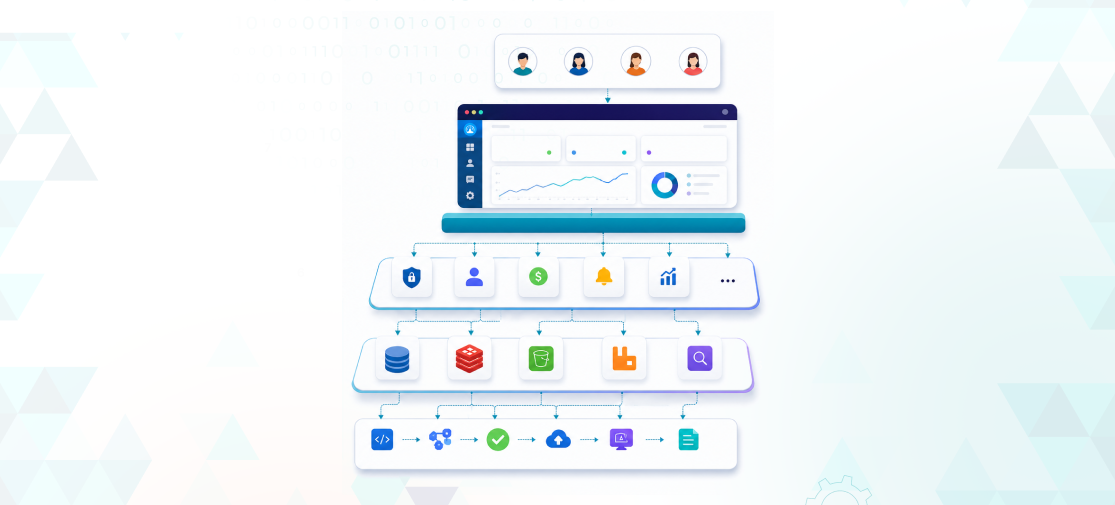
Why Startups in HealthTech Choose React Native for Their First Product
Every HealthTech startup faces an early technology decision: build separate apps for iOS and Android or launch both from a shared codebase…
Why Startups in HealthTech Choose React Native for Their First Product
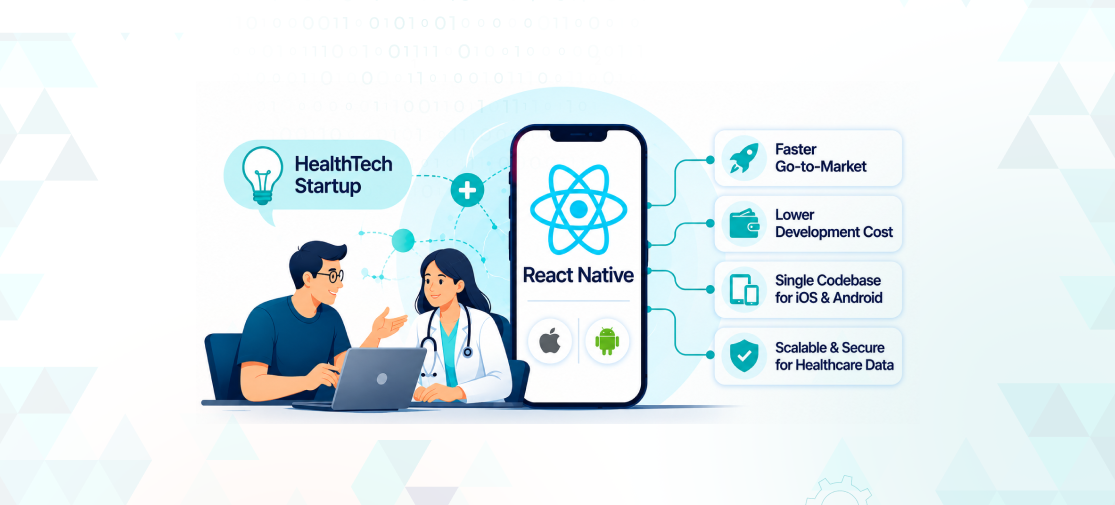
Every HealthTech startup faces an early technology decision: build separate apps for iOS and Android or launch both from a shared codebase? While native development offers excellent performance, it also increases development time, costs, and maintenance-challenges that many early-stage startups cannot ignore.
That’s why many HealthTech founders choose React Native for their first product. It helps them launch faster, validate ideas with real users, and focus on solving healthcare problems instead of managing two separate mobile applications.
Why the First HealthTech Product Matters
A startup’s first HealthTech product isn’t meant to be perfect-it’s meant to prove that the idea solves a real healthcare problem. Before investing in advanced features, founders need answers to more important questions:
- Will patients actually use the app?
- Can healthcare professionals fit it into their daily workflows?
- Does it create enough value for users, providers, and investors?
The goal isn’t to launch a feature-packed application. It’s to release a reliable product, gather meaningful feedback, and improve it based on real-world usage. React Native supports this approach by reducing duplicated development effort, allowing startups to spend more time refining the product experience instead of maintaining separate iOS and Android applications.
What Makes React Native Different?
React Native allows developers to build iOS and Android applications from a shared codebase while still supporting platform-specific features when needed. Instead of developing and maintaining two completely separate mobile apps, teams can reuse much of the application’s core logic and user interface across both platforms.
That doesn’t mean every feature is identical. Capabilities such as biometric authentication, Bluetooth connectivity, camera access, or health-device integrations may still require native implementation. However, for most HealthTech startups, React Native significantly reduces duplicated development work without sacrificing the flexibility to deliver a high-quality mobile experience.
1. Faster Launch on iOS and Android
For a HealthTech startup, speed isn’t just about launching first-it’s about validating the product before time and budget run out. Building separate native applications often means developing, testing, and maintaining two products, which can slow progress and delay valuable user feedback.
React Native helps teams launch on both iOS and Android from a shared foundation, reducing duplicated development effort. The time saved can be used to validate the product with patients and healthcare providers, refine features based on real-world feedback, and build partnerships instead of maintaining two independent codebases.
A faster launch should never come at the expense of security or quality. Instead, React Native allows startups to spend more time improving the healthcare experience and less time repeating the same development work.
2. More Value from Every Development Dollar
Early-stage HealthTech startups rarely have unlimited budgets. Every investment must support product development, security, compliance, testing, user research, and future growth. Building separate applications for iOS and Android can consume resources that could be better spent improving the product itself.
React Native helps startups make better use of those resources by reducing duplicated development effort. Instead of maintaining two independent codebases, teams can focus on strengthening security, refining the user experience, integrating healthcare systems, and validating clinical workflows.
React Native isn’t always the lowest-cost option, and it isn’t the right fit for every healthcare application. However, for many startups building their first product, it offers a practical balance between development efficiency and long-term flexibility.
3. A Consistent Experience Builds Trust
Healthcare applications should never make users guess what to do next. Whether it’s booking an appointment, tracking medication, or viewing test results, every interaction needs to feel simple, familiar, and reliable. A confusing interface can frustrate users or even lead to mistakes.
React Native helps teams deliver a consistent experience across both iOS and Android without maintaining two completely different applications. Patients benefit from familiar navigation and predictable interactions, while healthcare professionals spend less time adapting to different interfaces across devices.
At the same time, React Native allows developers to make platform-specific adjustments where they genuinely improve the user experience. The result is an application that feels consistent for users while still respecting the design expectations of each platform.
4. Faster Iteration as Your Product Evolves
No HealthTech startup gets everything right in the first release. Patients may ask for a simpler onboarding process, healthcare providers may need quicker access to reports, or regulatory requirements may introduce new features. The first version of your product is only the beginning.
Because much of the application is shared across iOS and Android, React Native makes it easier to roll out improvements, fix issues, and respond to user feedback without duplicating development effort. This allows startups to test new ideas, release updates more frequently, and refine the product based on real-world usage.
For early-stage companies, that ability to iterate quickly is often more valuable than getting every feature right on day one.
5. Ready for Real-World Healthcare Use Cases
A successful HealthTech product needs more than a polished interface. It often relies on features such as appointment scheduling, secure messaging, video consultations, medication reminders, patient dashboards, wearable-device connectivity, and integrations with healthcare platforms.
React Native supports many of these capabilities while giving startups the flexibility to extend the application with native code whenever advanced functionality is required. Whether it’s connecting to medical devices, implementing biometric authentication, or integrating with third-party healthcare systems, teams can combine a shared codebase with platform-specific components where it makes sense.
This flexibility allows startups to launch quickly without limiting the product’s ability to evolve as user needs and technical requirements become more sophisticated.
6. From MVP to a Scalable Product
The first version of a HealthTech product should prove that it solves a real problem-not try to include every possible feature. A successful MVP is secure, reliable, and focused on validating user needs before significant investment is made.
React Native supports this approach by helping startups launch a streamlined product and expand it as the business grows. A remote care app, for example, might begin with patient registration, appointment scheduling, and health check-ins. As the product gains traction, new capabilities such as video consultations, wearable integrations, AI-assisted insights, or multilingual support can be added based on real user feedback.
For HealthTech startups, this incremental approach reduces development risk and ensures every new feature is backed by evidence rather than assumptions.
7. Access to a Broad Development Community
React Native has a large development community and a mature collection of tools and reusable components. This can make it easier for startups to find skilled developers, solve common development challenges, and support the product as it grows.
It also gives businesses flexibility when choosing how to build their product. A startup may create an internal team, work with freelancers, or explore React Native development outsourcing to gain an experienced team without managing every role internally.
Outsourcing can be particularly useful when the startup needs help with product planning, UI/UX design, application development, testing, integrations, deployment, and ongoing maintenance.
Is React Native Secure Enough for Healthcare?
One of the biggest misconceptions is that choosing the right framework automatically makes an application secure. It doesn’t. React Native can be used to build secure healthcare applications, but security depends on how the entire solution is designed-from the backend architecture and APIs to authentication, encryption, and cloud infrastructure.
A secure HealthTech application should include:
- End-to-end encryption for sensitive patient data
- Secure authentication and role-based access control
- Protected APIs for communication with backend services
- Regular security testing and dependency monitoring
- Compliance with healthcare regulations such as HIPAA or GDPR, where applicable
React Native should be viewed as the development framework, not the compliance solution. The security of a healthcare application ultimately depends on its overall architecture, development practices, and how patient data is managed throughout the system.
When React Native Isn’t the Right Choice
React Native is an excellent choice for many HealthTech startups, but it isn’t the best solution for every product. If your application depends heavily on platform-specific capabilities or extremely demanding performance, native development may be the better investment.
Consider a fully native approach if your application:
- Relies on complex medical device integrations
- Requires intensive background processing
- Uses advanced Bluetooth or hardware communication
- Handles high-performance graphics or real-time processing
- Depends on deep platform-specific APIs
- Has compliance or technical requirements that are easier to manage separately on iOS and Android
The best technology decisions start with the product-not the framework. Understanding your users, regulatory requirements, integrations, scalability goals, and long-term roadmap is far more important than following the latest development trend.
Choosing the Right Development Partner
The success of a HealthTech product depends on more than the technology stack. The right development partner should understand healthcare workflows, security, compliance, and the challenges of building products that patients and providers can trust.
Before making a decision, ask questions such as:
- Have you built healthcare applications before?
- How do you approach security and compliance from day one?
- Can you integrate with healthcare platforms and third-party systems?
- How will you support the product after launch?
- Who owns the source code and product data?
- How will the application scale as the business grows?
If you’re evaluating a healthcare software development company in the USA, look beyond technical expertise. Choose a team that understands healthcare workflows, regulatory expectations, and long-term product strategy. A good development partner won’t recommend React Native simply because it’s popular-they’ll recommend it only when it aligns with your product goals, users, and growth plans.
Final Thoughts
HealthTech startups operate under unique pressures. They need to move quickly, manage limited budgets, protect sensitive patient data, earn user trust, and prove that their product solves a real healthcare problem. React Native offers a practical balance by helping teams launch faster without sacrificing the flexibility to grow.
Technology alone doesn’t make a HealthTech product successful. The right outcome comes from combining the right framework with thoughtful product design, secure engineering, healthcare expertise, and a clear long-term vision.
Thinking about building a HealthTech application? Working with an experienced healthcare software development company in the USA can help you choose the right technology, avoid costly early-stage mistakes, and build a product that’s ready to scale with your business.
메타데이터
- post_id
- a9570f72e0a1
- slug
- why-startups-in-healthtech-choose-react-native-for-their-first-product-a9570f72e0a1
- url
- https://medium.com/techvoot-solutions/why-startups-in-healthtech-choose-react-native-for-their-first-product-a9570f72e0a1
- canonical_url
- https://medium.com/techvoot-solutions/why-startups-in-healthtech-choose-react-native-for-their-first-product-a9570f72e0a1
- author_url
- https://medium.com/@techvoot.solutions
- status
- ok
- fetched_at
- 2026-07-25 01:51:48